A World by Tangled Thistle
The Lake Has Other Plans
The lake has frozen. Naturally, we are going sailing.
A bright, dry, indoor winter regatta. Immense ivory sails stand perfectly still over a cobalt lake floor, guests push tiny model sails along with hand bellows, and at a quarter to eight three of those model sails make one slow crossing that opens a warm harbor supper at every table.
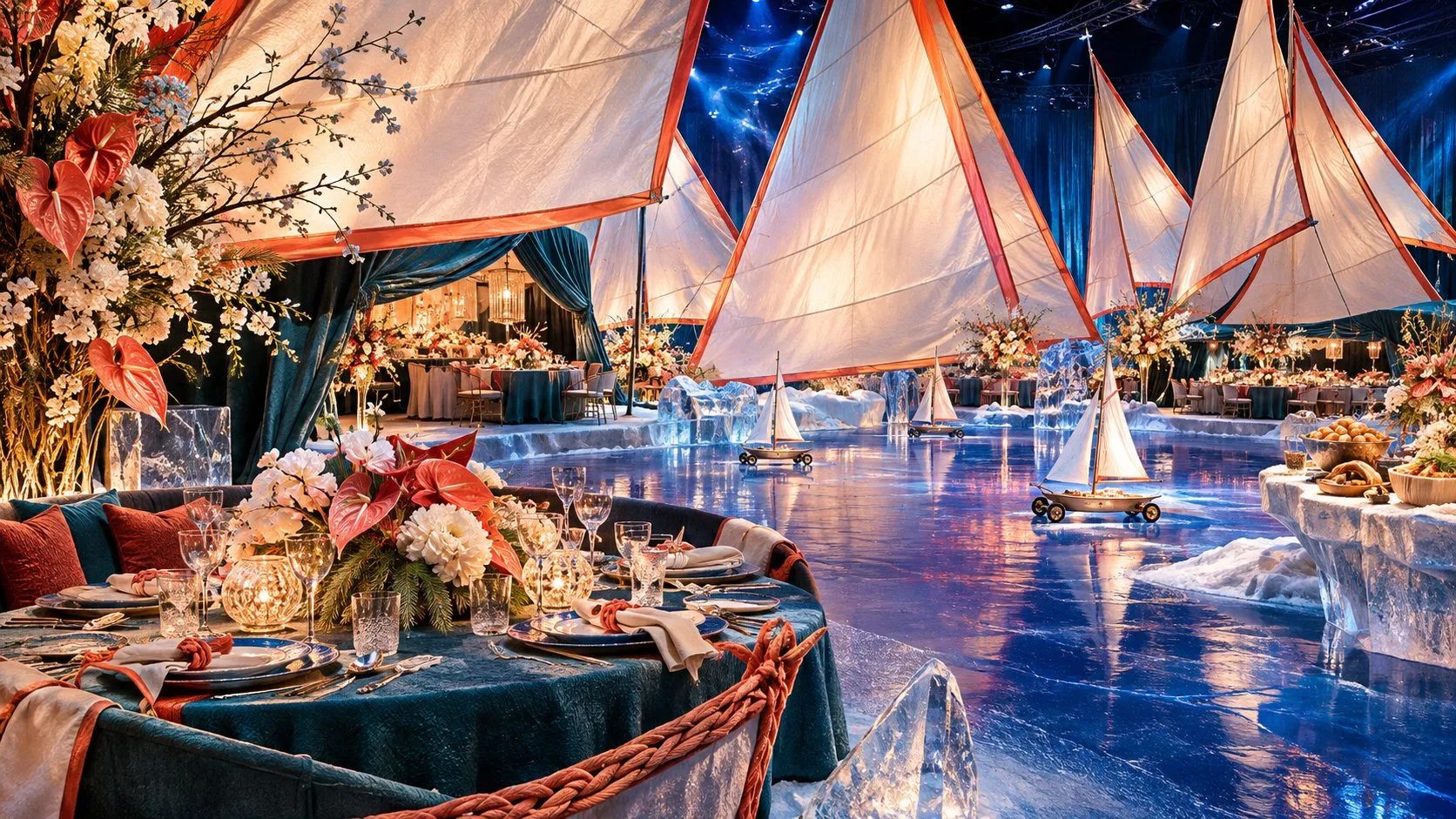
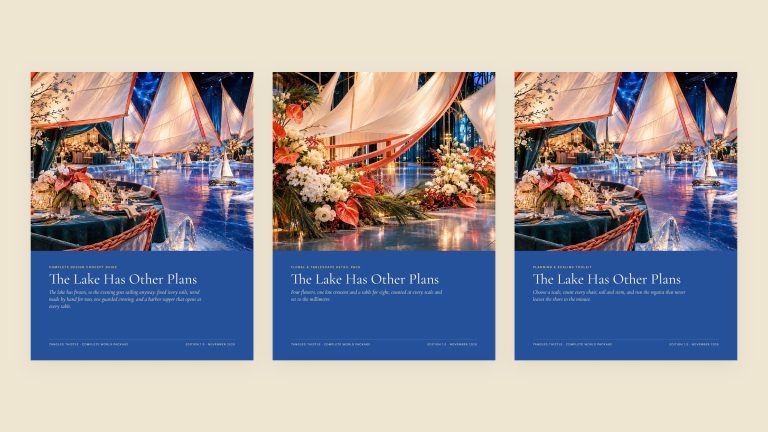
The Still Fleet over the lake floor. Concept visualization. The architectural sails are fixed and the floor is dry; the small model sails in the picture travel only inside the guarded crossing. No photograph of this World exists, and nothing here has been built.

Arrival
A summer door, opened in winter.
The first room is The Summer Door in Winter: coral door reveals cut through cobalt walls, an ivory sail soffit runs overhead, and a pale-blue matte floor does a convincing impression of a frozen lake without being one. A beige canvas bench waits in the coat niche. Somewhere ahead, a small sail shadow arrives before the fleet does.
Coats go first. Then a host says: “Welcome to The Lake Has Other Plans. Let us take your coat. Would you like Hardwater Apple, water, or a seat first? There is plenty to notice, and nothing you need to complete.” Hardwater Apple is apple, lemon, cucumber and soda, with no alcohol in it, and it comes with a warm leek and potato cup. A backed seat is free from the first minute.
The idea
A winter obstacle can become an invitation to invent another kind of movement.
A lake that usually hosts summer boats has kept its sails through winter. The ice has canceled the expected kind of sailing, so the party invents another: wind you can make with your hands, at the scale of a tabletop, while the enormous sails in the room hold perfectly still. The inspiration is hard-water sailing, sails traveling across a frozen lake. Nothing here is real ice, real sailing, a skating show or a race.
The personality is contrary, sociable and bright. Contrary, because a frozen surface starts the story. Sociable, because two people share every wind experiment. Bright, because clean blue, ivory and coral keep it well away from a dark yacht club. There are no anchors, crests, flags, ropes across the routes or scores anywhere in it.

The Still Fleet
The sails are enormous. They are not going anywhere.
The first long view ends at The Still Fleet: fixed triangular sail planes, each 3000 mm across the base and 4200 mm high, in ivory translucent sailcloth over scenic frames, canted 12 degrees and finished front and back with 40 mm coral battens. There are three in the smallest version, five in the standard one and ten, in two fleets, in the largest. They are in full view from arrival. Nothing is saved for a reveal.
The wind happens next door, in The Wind Parlor, at a much more manageable size. Each Wind Chamber is a table 2200 mm long under a clear cover 250 mm high, with two hand bellows outside it and three wheeled model sails, 120 mm tall, inside. Two guests work the bellows together and try to bring two sails alongside. That is the whole game, and nobody wins it.

Supper
Every table is a sheltered harbor.
Supper is served in The Coves, the heart of the evening. Oval tables for eight, 2800 by 1300 mm with ivory tops and a coral batten edge, sit under alternating sail planes, each tucked into a deep-teal wall cove with its own cream lamp. The chairs are deep teal with one diagonal ivory panel. Every cove can see the crossing model.
The food is named for what it is. Fennel, apple and lemon slaw comes first. Then white-fish chowder with potato, leek and corn, or white-bean chowder with potato, leek and corn, each a complete main, with a warm seeded roll and herb oil. Dessert is baked apple with oat and cranberry crumble, or apples with vanilla oat cream and crisp oat crumble. For adults who want one, Coral Tack is gin, grapefruit, dry vermouth and dilution water, and it is never required. Developed recipes, not kitchen-tested.
The turn of the evening
“The lake has found a way across.”
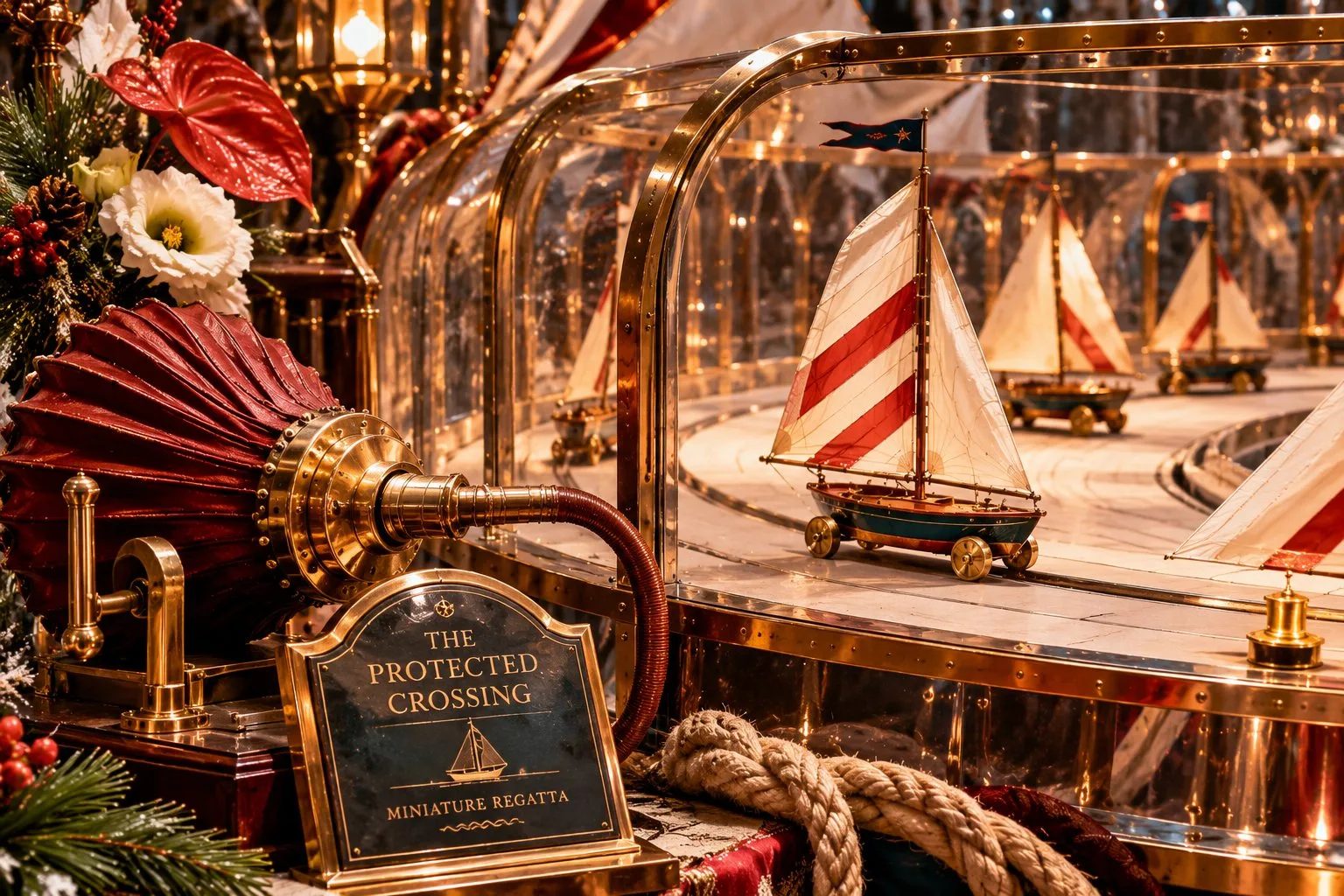
At 7:45, with dessert on the tables, a host says that one sentence. On the Shared Crossing, an enclosed dry lake model 4800 mm long with its deck at 900 mm, three model sails 250 mm tall travel slowly from one end to the other on a concealed belt that staff operate. Clear guards enclose the whole journey. It takes sixty seconds, it happens once, and it never replays.
As the sails arrive, an original acoustic phrase begins and harbor service opens at every table, including the quiet room: late crisp potatoes with dill dip and the Lee-Side Cup, warm pear, ginger and rooibos with no caffeine. Nobody powers the crossing or has to watch it. In the smallest version the model sails are already arrived and a host tells the story, and the food and music keep their moment either way.
Warm Harbor
The model stays arrived.
After the crossing the evening loosens rather than ending. The Wind Chambers stay open for anyone who still wants a go, the arrived model sails rest together at the harbor end, and the last room, Warm Harbor, becomes a place of its own: ivory walls opening into teal niches, a broad sail ceiling, a beige floor and a coral service counter with real late food on it.
Coats come back from 9:00, before anything else is put in your hands. Then a lemon oat biscuit for the road and a cloth napkin with one contrasting corner, yours to keep. The evening closes at 9:30, with no final gathering to sit through.
The evening
Three and a half hours, from the summer door to the last cup.
The times are the design’s nominal clock, starting at 6:00. A seat with a view is a complete way to attend every part of it.
- The Summer Door in WinterDoors at 6:00. Coats first, then Hardwater Apple or water, the leek and potato cup and a seat whenever you want one.
- The Wind ParlorPaired bellows at the Wind Chambers, with spectator chairs and drink ledges for anyone who would rather watch.
- The CovesSlaw at about 6:40, the chowder main at about 7:10 and dessert at about 7:35, at oval tables of eight.
- The crossingAt 7:45, one sentence and sixty seconds of three model sails crossing behind clear guards.
- Harbor serviceFrom about 7:47, late crisp potatoes with dill dip and the Lee-Side Cup at every table and in the quiet room.
- Warm HarborCoats from 9:00, a lemon oat biscuit and a napkin to take home, and a close at 9:30.

Design details
One diagonal, drawn at three sizes.
The ornament is a single diagonal batten crossing a panel once, at three scales: 400 mm on the architecture, 40 mm on the furniture and 4 mm on a menu edge. It is construction, not a logo, and every ornament gets a plain surface beside it so its depth reads. The textiles are ivory sailcloth, teal wool, beige canvas and pale-blue linen, bound in coral with finished double hems, and the back of every sail is finished as carefully as the front.
Twelve colors carry it, led by lake cobalt, ivory sail, coral batten and deep teal, with ice mist, canvas beige, nickel, lemon line, black water, soft pink, pine and white in smaller amounts. Lemon is a small directional mark, never a finish line.
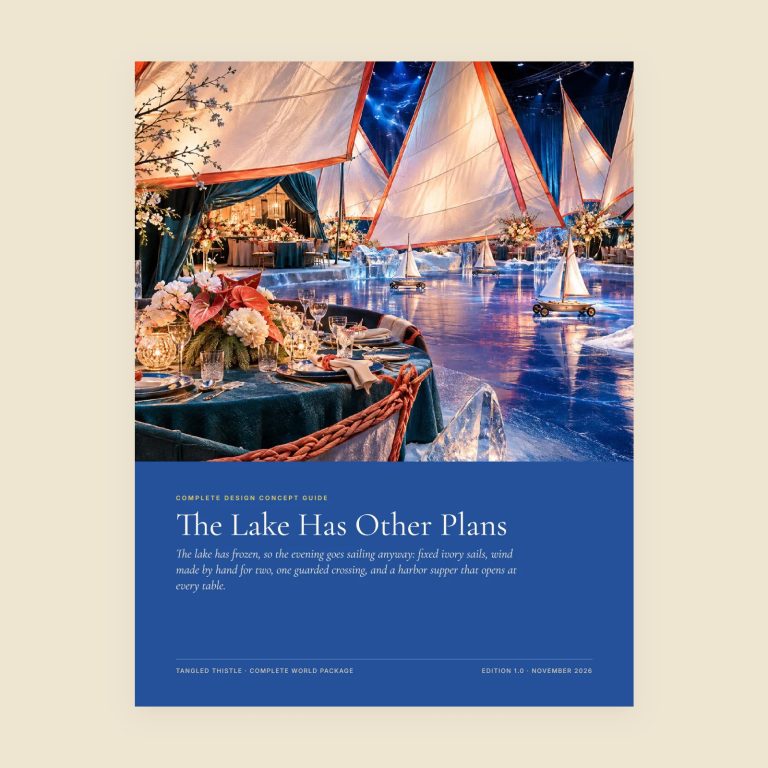
The flowers are coral anthurium, cream lisianthus, white dianthus and eastern white pine, sixteen stems to a low crescent, one to a table and no more than 300 mm high. The pine goes in first, as the dry line that refuses to apologize for being practical, and the needles and the water stay well away from the Wind Chambers.
Six rooms
Each one can be enjoyed from a chair.
- The Summer Door in WinterArrival: coral door reveals, cobalt walls, an ivory sail soffit, a pale-blue matte floor and a canvas bench in the coat niche.
- The Wind ParlorThe Wind Chambers between teal acoustic walls, on a cobalt floor bordered in coral, with spectator chairs and separate drink ledges all round.
- The CovesOval tables for eight under alternating sail planes, each in a deep-teal cove with coral ceiling battens and a cream lamp.
- A Different WindIvory walls with coral niches of dry cloth and wood samples, ceiling ribs set at three sail angles, and a host who will compare three cloth stiffnesses on a dry tray.
- The Lee SideDeep-teal wool around armchairs under a low ivory canopy, with lower sound and a static horizon panel. It opens with the doors, stays staffed, and is served every course at the same time as the main room.
- Warm HarborThe coral service counter where the model sails come to rest, teal niches, a broad sail ceiling and a clear route to coats and the door.

Worth noticing
The model’s destination is a table, not a flag.
Six small details are there for anyone who looks. The coral battens carry on around the back of the sails. A coat sleeve is cut like a sail corner. The crossing model ends at a table. Three fixed sails repeat in a quiet panel. An invented summer mark is crossed by a winter line. And the napkin you take home has one contrasting corner.
None of them is a puzzle. Nothing is stamped, collected or scored, and no host will ask whether you found them. One of the bellows may bring the sails closer than expected. The host never confirms or denies it.
How the World works
A decline is treated as perfect form, the way a good sail knows when to hold.
Five activities are offered, each once, with one question: “Would you like to try, watch, or have me show you?” Two sails alongside, changing a sail’s angle and choosing a sheltered or open cove happen at the Wind Chambers; feeling three cloth stiffnesses happens in A Different Wind; a voluntary toast to finding another way happens in Warm Harbor. No guest has to stand, touch a surface, drink alcohol, tell a story or pose for a photograph to receive the whole evening, and no name or choice is written down.
Dress is an invitation to a palette. “Choose the comfortable version of the idea. A familiar outfit with one beautiful color is enough; no costume or new purchase is expected.” No sailing equipment is expected either. The World keeps its crossing whether or not anyone touches a bellows.
Fit and adaptations
Three sizes, three days, or one table at home.
- Three sizesDrawn complete at 24, 64 and 144 guests, at 3, 8 and 18 oval tables of eight, with 4, 10 and 22 extra seats in The Lee Side. The sizes are alternatives and are never added together. The smallest keeps its model sails already arrived; the largest has two crossings on one shared cue.
- Three daysA program of five occasions: a welcome supper in The Wind Parlor on the first day; a daylight lunch in the Coves, the principal crossing supper and its late harbor service on the second; and a farewell breakfast on the third. The crossing happens once, and the model stays arrived.
- A home tableThe culinary kit has a Host’s Table menu for six to eight people, two capable hosts and a domestic oven. It is the supper, and it does not pretend to be the rooms.
- The seasonIt sits in the winter collection but it is not a Christmas World. It suits any cold-month evening, a lakeside hotel or lodge looking for a winter weekend, or a party that enjoys making the best of a frozen plan.
Start here, free
The Field Guide costs nothing and asks for nothing.
A free PDF preview of the World: the premise, the rooms, the evening and a look inside the packages. No email and no account.
What is included
Four books, the evening’s paper and a culinary kit.
The Complete World Package holds all six, with a Start Here guide that says which file to open first. Each part is also sold on its own, and each product page lists its files.
- Complete Design Concept GuideThe whole World as a design: the idea and its personality, the six rooms in route order, the Still Fleet, the Wind Chambers and the Shared Crossing, the evening minute by minute with the crossing and its fallback, five optional activities and six discoveries, the twelve colors, the menu as a guest meets it, dress, the three sizes and the three days. A designed PDF with editable SVG concept drawings.
- Floral & Tablescape Detail PackThe low crescent and its sixteen stems, the arrival, quiet-room and harbor arrangements, purchasing at 24, 64 and 144 guests and across three days, the oval table for eight laid and followed course by course, care and substitutions. A designed PDF with editable SVG drawings.
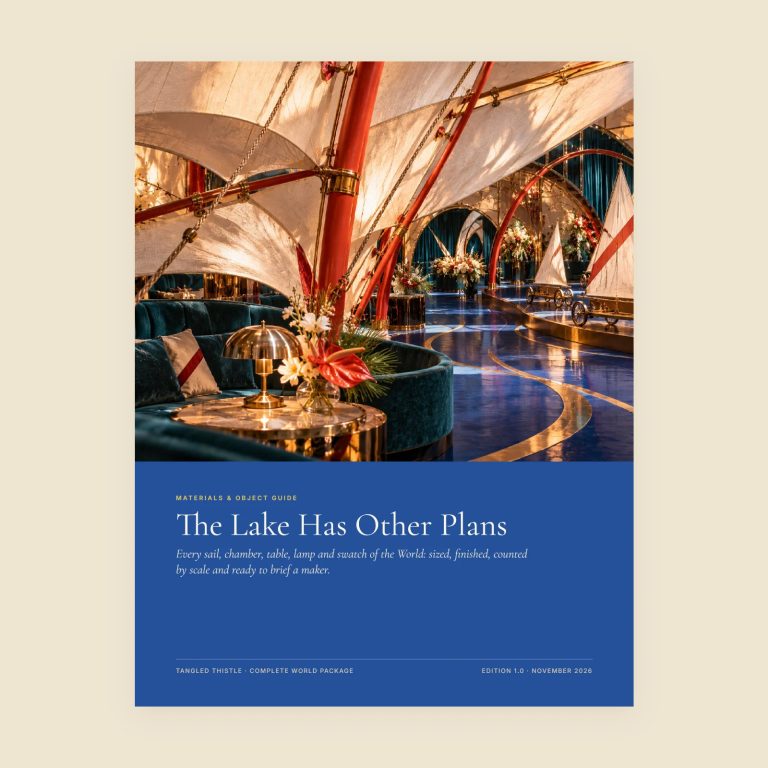
- Materials & Object GuideThe twelve colors as finishes, the four textiles and their hems, the 400, 40 and 4 mm batten grammar, the three signature objects in depth, the tables, chairs, lamps and service furniture, care and replacement. A designed PDF with editable SVG drawings. Concept design, not for construction.
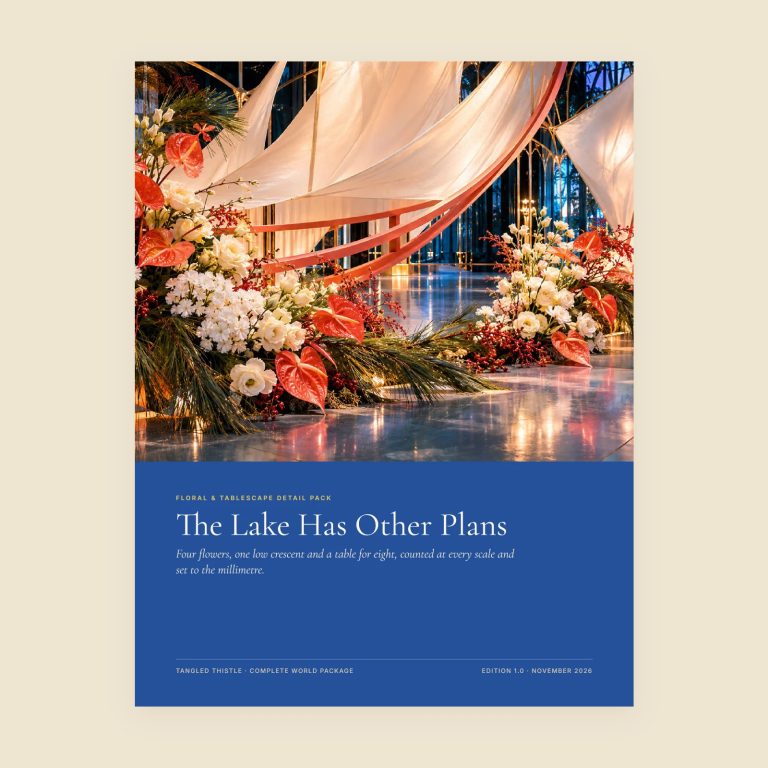
- Planning & Scaling ToolkitWhich size to run, who runs it, every cue of the evening, the sixty-second crossing and its stop rule, the pass, the five occasions, setup and strike, and a budget framework you fill in with your own quotes. A designed PDF, a live-formula Excel workbook in worked and blank versions, editable Word templates and editable SVG planning diagrams.
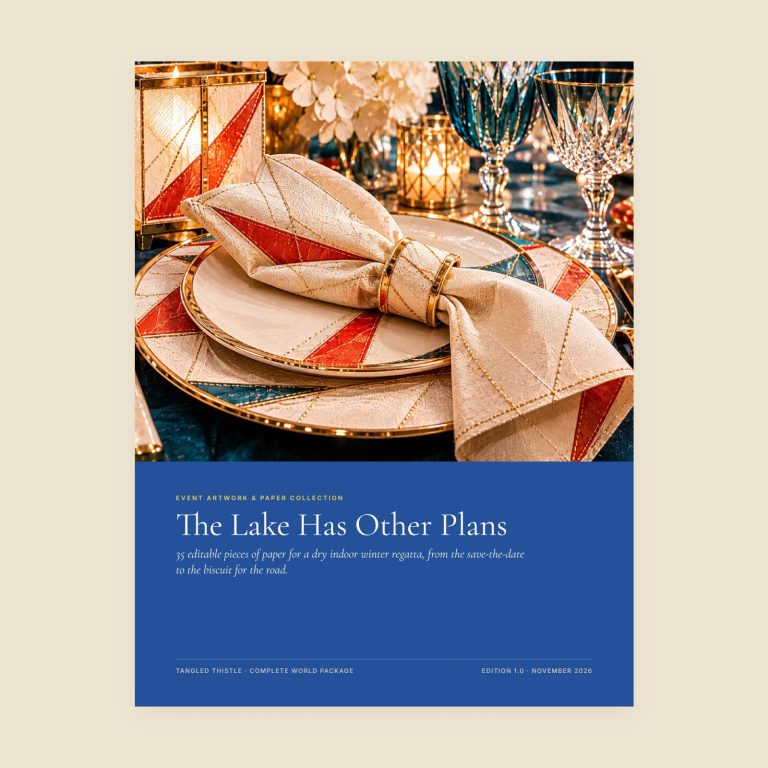
- Event Artwork & Paper CollectionThe paper a guest or host holds through the evening, from the invitation to the guest guide, the literal harbor supper menu with a large-print version, coat claims and the comfort route, in the World’s palette and its single diagonal. Print-ready PDFs with bleed and crop marks and editable SVG masters, with a typography and paper guide and a file index.
- Chowder Before the CrossingThe culinary kit from Salty World Table. Included in the Complete World Package, and sold on its own at Salt Notes. Developed recipes, not kitchen-tested.
The packages
The World, whole or in parts
The Complete World Package holds everything. Each part is also sold on its own.
Materials & Object Guide
The Lake Has Other Plans — Materials & Object Guide
What the World is made of: ivory sailcloth, teal wool, beige canvas and pale-blue linen bound in coral; the single diagonal batten at 400, 40 and 4 mm;…
$12.00
Planning & Scaling Toolkit
The Lake Has Other Plans — Planning & Scaling Toolkit
The working side of the World: the planning book, a live Excel workbook in worked and blank versions, editable Word templates and SVG planning diagrams, for 24, 64…
$24.00
Event Artwork & Paper Collection
The Lake Has Other Plans — Event Artwork & Paper Collection
The World’s printed pieces, ready for a print shop or a home printer: invitation and reply card, folded guest guide, the harbor supper menu and a large-print menu,…
$14.00
Complete Collection
The Lake Has Other Plans — Complete World Package
Everything for the World in one purchase: the Complete Design Concept Guide, the Floral & Tablescape Detail Pack, the Materials & Object Guide, the Planning & Scaling Toolkit,…
$49.00
Complete Design Concept Guide
The Lake Has Other Plans — Complete Design Concept Guide
The whole World as a design: the idea and its personality, six rooms, the Still Fleet, the Wind Chambers and the Shared Crossing, the evening minute by minute,…
$29.00
Floral & Tablescape Detail Pack
The Lake Has Other Plans — Floral & Tablescape Detail Pack
The flowers and the table, measured: one low crescent of sixteen stems per oval table of eight, the arrival, quiet-room and harbor arrangements, the place setting and its…
$14.00

One evening, three ways in
The rooms, the supper and the property version.
Tangled Thistle designs the World. Salty World Table at Salt Notes writes the menu. A hotel, restaurant or venue can ask for a version made for its own rooms.
- Tangled Thistle: the WorldFour books and the evening’s paper. The Complete World Package adds the culinary kit.
- Salt Notes: Chowder Before the CrossingThe culinary kit, included in the Complete World Package or sold on its own. Developed recipes, not kitchen-tested.
- Hospitality inquiry: for hotels, restaurants and venuesHotels, restaurants and venues: ask about a hospitality edition at tangledthistle.blog/contact/. It starts with a conversation, and there is no listed fee. A consumer download grants no rights to operate the World at a venue.
Purchase and licensing
Digital files, delivered at checkout.
- Instant downloadYour files download straight after checkout, and your order email carries the same links. No account needed.
- What you getDesigned PDFs in US Letter, an Excel workbook, editable Word templates, editable SVG drawings with each book, and print-ready paper PDFs with bleed. Each product page lists every file.
- Yours to keepFind your purchase brings your downloads back whenever you need them.
- For your own occasionsPrint it, adapt it and share printed pages with the people helping you. Please don’t repost or resell the files. The Terms of Sale have the details.
Questions
Asked before anyone takes your coat.
Is there real ice, or real sailing?
Neither. It is a dry indoor winter regatta. The floor is a matte cobalt surface, the big sails are fixed scenery, and the only things that move are small model sails: inside the clear Wind Chambers, pushed by hand bellows, and on the guarded crossing model, moved by staff. There is no skating, no boat ride and no wind blowing at guests.
Is it a race?
No. Two guests share each Wind Chamber and try to bring two sails alongside, not past each other. There are no scores, winners, medals or podiums, and the crossing is the same three model sails arriving together.
Do I have to take part to be fed?
No. Every activity is offered once and a no is good manners. Your meal, drinks and farewell are yours whether you explore, watch or stay seated, and The Lee Side is served every course at the same time as the main room.
Is it a Christmas party?
No. It sits in the winter collection, but it is a winter regatta rather than a Christmas World. There are no trees, ornaments or seasonal characters in it, so it suits any evening from the first frost to the thaw.
Is alcohol part of it?
Only if you want it. Hardwater Apple and the Lee-Side Cup have no alcohol in them, and Coral Tack is an optional adult drink that is never required. The culinary kit adds a zero-proof grapefruit counterpart to Coral Tack, served in the same glass.
Do I need a room for 144 people?
No. The World is drawn at 24, 64 and 144 guests so you can pick the size that fits, and the planning workbook does the arithmetic for numbers in between. The smallest version is a supper at home for six to eight from the culinary kit.
Can I use it for a restaurant, hotel or venue?
These packages are for your own occasions as described in the Terms of Sale. They don’t grant rights to run the World as a commercial venue experience. Hotels, restaurants and venues: ask about a hospitality edition at tangledthistle.blog/contact/.
Has any of this been built or cooked?
No. It is concept design and planning documentation, and the images are concept visualizations. Developed recipes, not kitchen-tested. Your venue, your engineer, your caterer and your local rules have the final word on anything structural, mechanical, electrical or edible, including the crossing mechanism.
Is it available in other languages?
For now the World is in English. Any other language edition will appear here only once it is complete.
The invitation
The lake has frozen. Naturally, we are going sailing.
Inspired by hard-water sailing. This is an original dry indoor regatta; it makes no claim of natural ice, lake access or real sailing, and every image on this page is a concept visualization.