Tangled Thistle
Interactive Events
Interactive event design as part of the creative world: play, making, discovery, tasting, contribution, movement and low-pressure participation that guests can enjoy without assigned fun.

Participation as design material
Give guests something irresistible to notice, try, alter or ignore.
Play, making, tasting, discovery and contribution can be part of the world itself—not an activity bolted onto the evening. Start with the social feeling and the surprise; capacity, reset and staffing come later to keep it enjoyable.
Participation without compulsory joy
Guests do not participate in an idea. They participate in a room with a clock, a crowd, shoes that may already hurt and a limited willingness to be organized. This is the part of an occasion that guests can play, make, taste, discover, alter, follow or politely ignore.
The useful question is not, What activity should we add? It is what kind of participation would make this particular gathering better? Sometimes that is a game. Sometimes it is a small making station, a clue that rewards curiosity, a food moment, a room that changes as guests move through it, or simply something interesting enough to watch without being recruited into it.
What do you actually want guests to do?
Start there. Different forms of participation ask different things from people, space, staffing and time. Choose the social job first; the prop comes later.

Play something real
A game already has rules, pace and a reason to gather. The design job is to give it enough surface area, teach it without humiliation, protect drinks and conversation, and let people enter at the right level.
Make, try or alter something
A station works when it is legible from three steps away, fast enough to avoid a queue, staffed when it needs expertise, and optional enough that declining does not make anyone feel like the boring guest.

Wander, notice and discover
Not every interaction needs instructions. A room can reveal itself in stages, reward movement, hide one excellent detail until later, or let a visual installation become something guests discover rather than a backdrop they are told to admire.

Give people something to drift toward
Lawn games, tabletop play and other low-pressure activities are useful because they create a reason to move or linger without demanding that the whole room stop and perform enthusiasm at once.
Six kinds of participation worth designing on purpose
Play
Games, contests and structured challenges. Best when the rules are learnable, the equipment has a home and spectators can still enjoy the room.
Make
Flowers, food, paper, objects or another small artifact. Best when the task is brief, the output is actually desirable and nobody needs a craft lecture in formalwear.
Discover
Clues, reveals, hunts, changing rooms and visual sequences. Best when curiosity is rewarded without making comprehension mandatory.
Taste
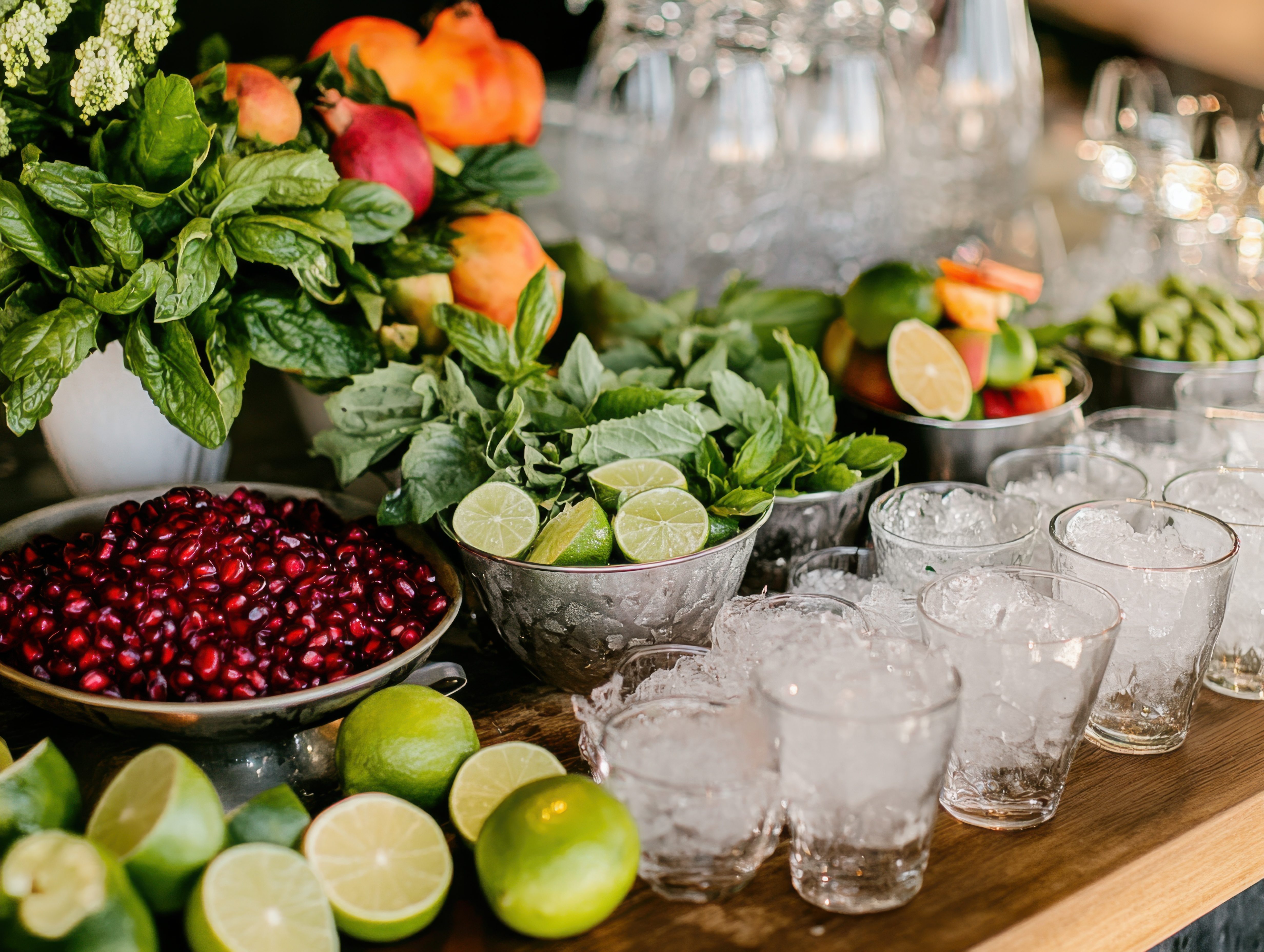
A service moment, comparison, small assembly or culinary intervention can be participatory without turning dinner into a workshop.
Contribute
Messages, choices, votes, shared objects and collaborative pieces. Give people a real reason to add something; do not create an obligation-shaped guest book with better signage.
Observe
Watching counts. A strong interactive design includes the guest who wants to see what is happening, laugh with someone else and never once hold the marker.
The room is part of the activity
Interactive ideas become bad very quickly when the floor plan is treated as an empty diagram. Every participatory beat needs a route, a capacity, a place to pause, a way to rejoin the party and a plan for the person who does not participate.
Queues are design information
If twelve people can arrive and only two can participate, you have designed a line. That may be acceptable for something extraordinary and very brief. Otherwise reduce the task, multiply the station, open it for longer, or choose a format with more simultaneous capacity.
The opt-out needs dignity
A guest should be able to watch, sit nearby, get a drink, join later or never join at all without being singled out. Accessibility, sensory load, mobility, language and social pressure are part of the creative brief, not an apology after it.
Three things kill an interactive idea
It becomes homework
Too many rules, a long briefing, a required costume, an app download or a sequence guests have to remember can turn delight into administration. The mechanism should be easier to understand than the reward is to enjoy.
It competes with the actual party
The bar, meal, dance floor, conversation and activity cannot all demand the same people at the same time. Participation works better as a pulse in the evening than as a second event stacked on top of the first.
Nobody owns reset
Markers disappear. Tiles migrate. Materials run out. Surfaces become wet. Someone has to replenish, wipe, explain, reset or retire the experience before it turns into evidence that something fun happened an hour ago.
Choose by guest behavior, not trend
- Guests do not know one another well: choose something parallel and low-stakes that creates conversation without requiring teams immediately.
- The group spans generations or mobility levels: build seated, standing and observing versions into the same experience.
- Dinner is the main event: use one short interactive pulse before, between or after courses rather than filling every transition.
- The venue is tight: favor tabletop, roaming or visual discovery over another fixed station.
- The event already has heavy production: one exceptionally good participatory moment will usually outperform five small activations competing for staff and attention.
For the deeper framework, use Interactive Guest Experiences Without Forced Fun. It covers choice, capacity, lines, staffing and guest consent in more detail.
When interaction becomes the whole world
Some occasions do not merely contain an activity; participation is part of the premise. A culinary takeover changes service. A mystery changes what guests notice. A game night changes the furniture. A brand activation changes dwell time and movement. That is where Interactive Events meets Design Atelier: the participation has to be developed alongside atmosphere, sequence, material, scale and production rather than added at the end.
For commercial or branded gatherings, read A Brand Activation Still Has to Be a Good Party. For the full occasion structure, start with The First Five Decisions. When you are ready to turn the thinking into a working plan, open Atmosphere OS.
You must be logged in to post a comment.