Production & Hosting
The Buffet Is Not Slow. Its First Six Feet Are.
Most buffet lines do not fail evenly. One slow action near the beginning can turn the entire meal into a queue. Time the friction, not the table.
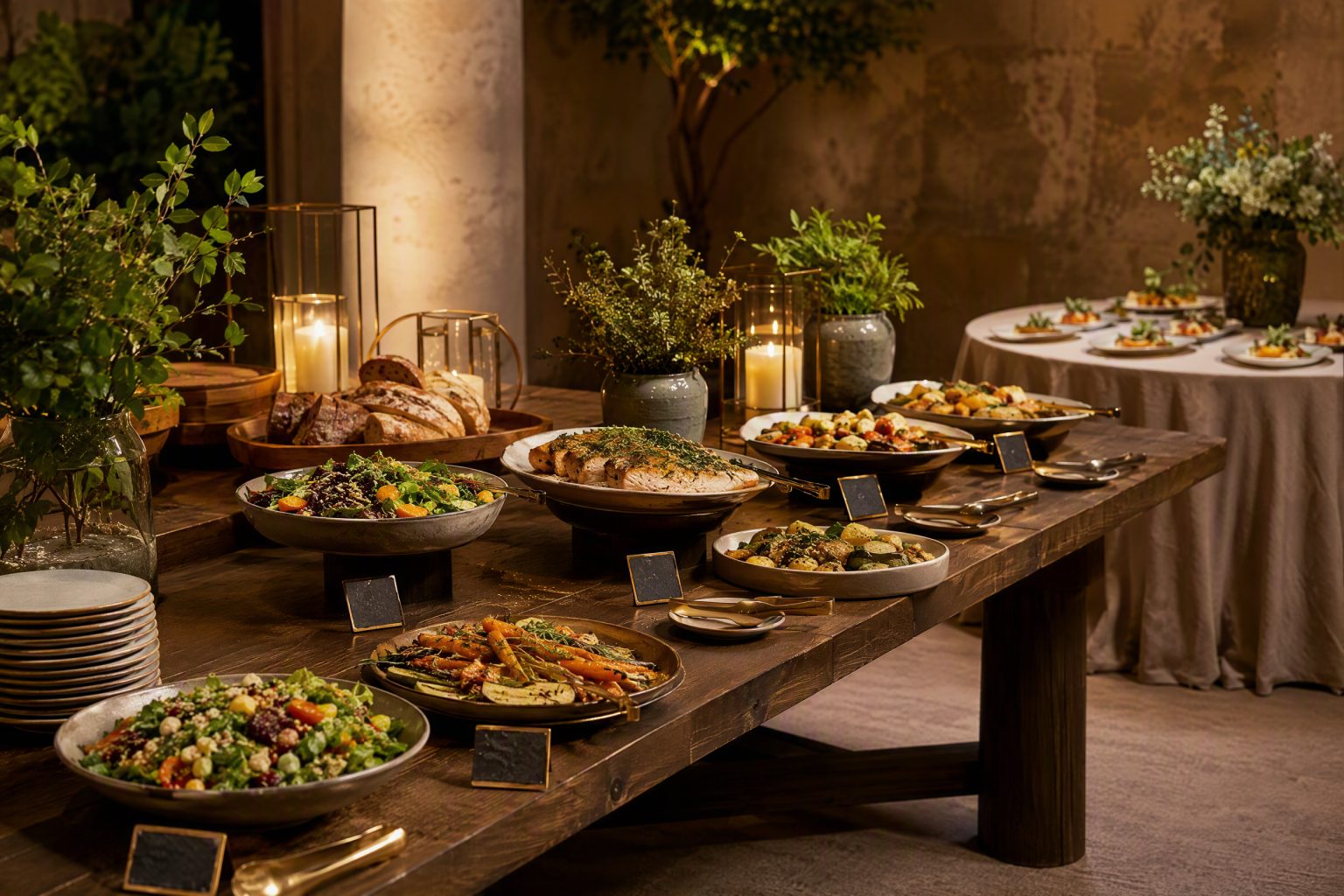
The buffet is not slow.
The spoon at the chicken is slow.
Or the carving station is slow. Or everyone is trying to read the dietary labels while holding an empty plate. Or the dressing lives directly after the greens and each person is conducting a small vinaigrette negotiation while eighty people wait behind them.
A buffet can be twenty feet long and still be defeated by its first six feet.
Queues grow at the slowest repeated action
The line does not care how quickly guests move past the bread if every person has to stop for the same staffed carving station. It does not care that dessert is self-service if plate pickup is happening through one narrow opening.
I get suspicious when the first proposed fix is “make the buffet longer.” Length is not the interesting number. I want to know which action nearly everybody has to perform and which one makes them stop long enough for the line to start breeding behind them.
That is usually where the queue begins to tell the truth.
The first six feet carry too many decisions
Buffets often place every orientation task at the beginning because it feels logical. Plates. Napkins. Menu labels. Dietary information. Salad. Dressing. Bread. Perhaps a server explaining what is happening.
Now the guest has to read, decide, reach, serve, hold and move before the line has developed any rhythm.
Move low-risk decisions downstream when you can. Condiments do not need to hold the entrée hostage. Water does not always need to be collected at the same point as dinner. A dietary question that requires a conversation may need a clear staff resource beside the line rather than inside the narrowest part of it.
Duplicate the bottleneck, not everything
If one item is responsible for most of the delay, adding an entirely second buffet may be an expensive way to avoid solving one problem.
Sometimes the answer is a second serving point for the bottleneck item. Sometimes it is pre-portioning. Sometimes it is moving a staffed action to a separate station. Sometimes it is changing the menu because the beautiful idea requires one person to assemble every plate component while the rest of the buffet sits idle.
The right solution belongs to the caterer, menu and venue. The design principle is to spend capacity where the repeated delay actually lives.
Dietary clarity should not require public negotiation
Guests should be able to understand what they can eat without becoming the reason the line stops.
Clear labels help. Staff who know the menu help. A defined way to answer ingredient and allergen questions helps. For medically consequential allergies, the catering team should handle the information and service process according to its own safety procedures rather than an event host improvising assurances.
The buffet should make the ordinary choice easy and the important question possible.
Replenishment needs a different route
A buffet is not only a guest line. It is also a service system trying to refill itself while guests are using it.
If staff have to push through the queue carrying hot pans, stacks of plates or trays, the layout is making two directions compete for the same lane.
Ask where replacement food enters, where empties leave, where hot equipment is handled and whether the service route crosses the point where guests naturally cluster.
A table that looks accessible from the front may be impossible to replenish once the room fills.
Two-sided service is useful only when the menu can support it.
Allowing access from both sides can increase capacity, but only if the layout, utensils, food protection, staff plan and venue conditions make it practical. It can just as easily create opposing traffic or duplicate confusion.
Do not use a layout trick because it sounds efficient. Use it because you walked the actual flow and it reduces a specific bottleneck.
Release waves are not automatically elegant.
Sending tables to the buffet in groups can prevent one enormous surge. It can also produce a room full of people watching other people eat if the release is slow or arbitrary.
If waves are necessary, keep them moving and make the waiting chapter feel intentional. Better still, reduce the line’s processing time so release control does not have to carry the entire operation.
The queue is part of dinner
“Buffet” does not mean the logistics disappear because the guests are holding the serving spoon. When it works, nobody really notices the mechanics; people choose, move and get back to the table while dinner is still dinner. When it does not, the opening course is a line. I would fix the spoon, the carving station or the decision bottleneck before decorating another six feet of table.
Related reading: “Buffet Is Cheaper” Is an Incomplete Sentence · How Many Event Staff Do You Actually Need? · The Event Needs Somewhere to Put the Empty Glasses
Atmosphere OS · Arc Studio
Every event has a turn. Most plans do not know where theirs is.
Arc Studio places the peak, then arranges load-in, service and the close around it and hands you the run sheet. It is a planning document rather than a venue-compliance one, and it draws that line for you.
Free to use, local-first in your browser, and there is no account until you ask for one.
The column
The Numbers
Quantities, rates, throughput and the arithmetic underneath a plan. Every figure carries its provenance: measured, assumed, vendor-reported or drawn from a published standard. Run these live in The Reckoner.
Field notes and corrections
When a number here turns out to be wrong, you hear about it.
Three things arrive and nothing else. The new field note — bar rates, cover widths, service clearances, the arithmetic worked through on one real evening. A line when a new World or Mini Occasion opens, because a night only goes up once it can actually be thrown. And a correction whenever a rule in the published rulebook changes, or a number the tools rely on turns out to have been wrong. There is no weekly slot, because there is nothing weekly to put in it.
One email per field note or opening, plus corrections when a published figure moves. Unsubscribe from any of them.
Continue through the system
Pretty is still not a plan.
A party gets planned in roughly this order. Pick the chapter where your next problem lives.
What you have to decide next
One decision constrains the next. This is the order they actually happen in.
More in this chapter

See the complete five-chapter Event Design Intelligence map →