Space & Venue Reality
The Serpentine Table Is Eleven Percent Longer Than the Spec Sheet Says
Rental sheets print the straight-line dimension, because that is the number a truck and a storage rack care about. Guests sit along the curve, which is 11.1 per cent longer at every radius without exception. Here is the arithmetic, and the place setting it costs you.
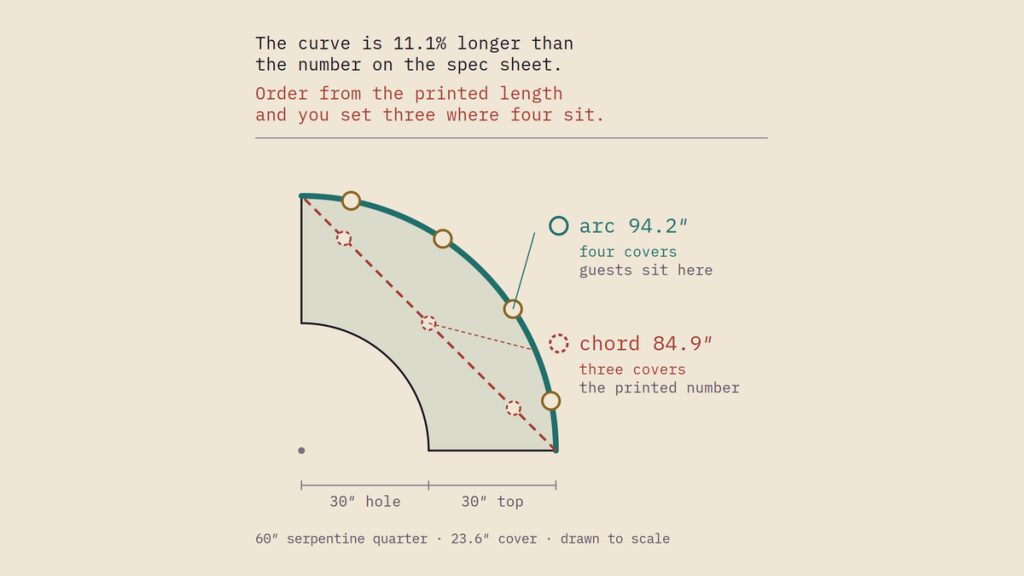
A rental company sends a line that reads 60″ serpentine · overall length 84″. You put 84 inches into the floor plan, divide by a cover, and order three place settings for that segment. Four people are going to sit there.
Both numbers are correct. They are measuring different edges of the same piece of furniture, and only one of those edges has chairs against it.
The printed number is the chord. The seating edge is the arc.
A serpentine segment is a quarter of a ring. It has two ends. The straight line between those ends is the chord, and the chord is the bounding dimension — the number that decides whether the piece fits across a truck bed and onto a storage rack. A spec sheet has an operational reason to publish that number and no particular reason to publish any other.
The curve joining the same two ends is longer, because a curve between two points always is. Chairs go on the curve.
You can tell which one you were sent in a single check. Multiply the outer radius by 1.414. If the printed length lands on or near that figure, you were given the chord.
The ratio does not change with the size
For a quarter segment of outer radius R, the chord is R√2 and the outer arc is πR⁄2. Divide the second by the first and R cancels out. What is left is π⁄2√2, which is 1.1107, and it is 1.1107 for a 36-inch unit and a 72-inch unit and every unit in between.
So the eleven per cent is not a tolerance or an estimate. It is a constant, and it is the reason a curved run keeps coming up one setting short when it was ordered off the page.
| Outer radius | Chord (printed) | Outer arc (seated) | Covers off the chord | Covers off the arc |
|---|---|---|---|---|
| 36″ | 50.9″ | 56.5″ | 2 | 2 |
| 42″ | 59.4″ | 66.0″ | 2 | 2 |
| 48″ | 67.9″ | 75.4″ | 2 | 3 |
| 54″ | 76.4″ | 84.8″ | 3 | 3 |
| 60″ | 84.9″ | 94.2″ | 3 | 4 |
| 72″ | 101.8″ | 113.1″ | 4 | 4 |
Two sizes out of six. That is why this is hard to notice from one event — and why, at 60 inches, which is the size most often specified, it is happening every time.
Everything here is built on 23.6 inches
A 60-inch round is conventionally set for eight. Its circumference is 188.5 inches. Divide by eight and each guest gets 23.56 inches of table edge. That figure is not a rounding artefact; it is the cover width the rental trade has settled on, and it is doing quiet work in every seat count you have ever been quoted.
Run the same division on the serpentine and the same number falls out twice more:
- the outer arc of a 60″ quarter, 94.2″, set for four — 23.56″ each
- the inner arc of the same unit, 47.1″, set for two — 23.56″ each
- a 60″ round, 188.5″, set for eight — 23.56″ each
Three shapes, one figure. A serpentine is not a different comfort standard; it is the same cover wrapped around a different radius. Which means every seat count you are given can be checked with one division, against a number you can derive yourself from a table you already know.
Three on the inside of the curve does not exist
The inner arc of a 60-inch quarter is 47.1 inches. Set for two, that is 23.6 inches each, which is the standard cover and perfectly fine. Set for three, it is 15.7 inches each.
Fifteen and a half inches is narrower than a dinner plate with flatware on either side of it. So when a sheet says a 60-inch unit seats seven, it is seating four on the outside and three on the inside, and the three is the half of that claim that does not survive a place setting being put down on it.
What four of them cost, as floor
Four quarters close into a ring: a circle ten feet across with a five-foot hole in the middle of it.
- outer circumference 377″ — sixteen covers
- inner circumference 188.5″ — eight covers, none of them servable from anywhere
- tabletop: 58.9 sq ft
- the hole: 19.6 sq ft, reachable by nobody
- the circle it all sits inside: 78.5 sq ft, before a single chair
Two 60-inch rounds seat the same sixteen people on 39.3 square feet of tabletop. The serpentine ring’s circle is 78.5. That is exactly twice, and the “exactly” is not a coincidence — it falls out of the same two radii, and it comes to 2.00 every time you set it up this way.
That is the space penalty expressed as a footprint instead of a feeling. The ring is not expensive because it curves. It is expensive because a five-foot circle in the middle of your room is holding nothing and seating no one, and you are paying rent on it.
Three questions, in writing, before the order
- Is the length on this sheet measured straight across the ends, or along the outer curve? If it comes out near the outer radius times 1.414, it is straight across, and it is not your seating length.
- What are the inner and outer radii? Every other figure on this page is derivable from those two, and those two are what most sheets leave off.
- Does your seat count put anyone on the inside of the curve? Ask for the inside and outside counts separately. A single combined number hides the seats that cannot be served.
None of this is an argument against the shape. A curved run does something to a room that a grid of rounds cannot, and there are evenings that are worth the floor. But it should be bought with the right number in hand, and the right number is on the curve. Once the dimensions are settled, the harder question is what the curve does to service — which is a separate problem, and the one that actually goes wrong on the night.
Every figure above is arithmetic rather than a citation, which means it is meant to be checked. The only inputs are two radii and a cover width. If your supplier’s radii differ from the ones here, substitute them — the 1.1107 does not move.
Space Lab
Unknown is a useful answer.
A room record can hold measured, published, supplied, estimated and unknown facts without pretending they are equivalent. The unknowns become the questions worth carrying to the site visit.
It shows planning estimates as estimates and keeps legal occupancy, venue approval and other authority decisions outside the calculator.
Field notes and corrections
When a number here turns out to be wrong, you hear about it.
Two things arrive and nothing else. The new field note — bar rates, cover widths, service clearances, the arithmetic worked through on one real evening. And a correction whenever a rule in the published rulebook changes, or a number the tools rely on turns out to have been wrong. There is no weekly slot, because there is nothing weekly to put in it.
One email per field note, plus corrections when a published figure moves. Unsubscribe from any of them.
Continue through the system
Pretty is still not a plan.
This field note belongs to a larger event-design system. Follow the chapter that explains the next pressure point instead of falling back into an undifferentiated archive.
What you have to decide next
One decision constrains the next. This is the order they actually happen in.
More in this chapter

See the complete five-chapter Event Design Intelligence map →