Guest Experience
Late Guests Need a Reentry Point
A late guest should not have to enter through the middle of a ceremony, interrupt dinner, or wander the venue looking for the event. Design the reentry before somebody misses the first chapter.
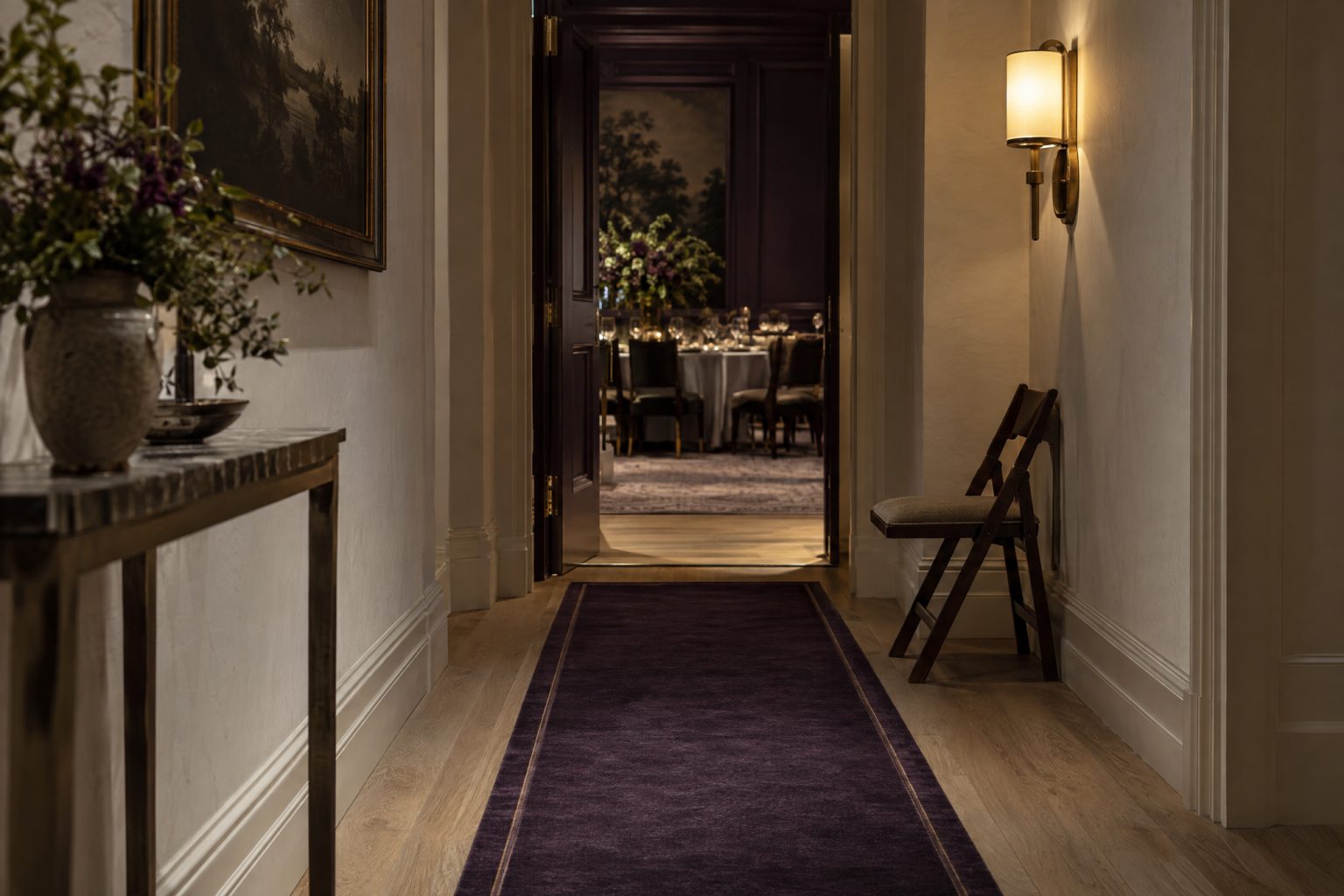
Every event timeline quietly assumes one impossible thing.
Everyone arrives when the timeline says they will.
Traffic exists. Flights are late. Babysitters run behind. Parking takes longer than expected. Somebody reads 6:30 as the time to leave the house rather than the time the ceremony begins.
None of this means the entire event should wait.
It does mean the late guest needs somewhere to reenter the story.
The front door may stop being the front door
An entrance that works beautifully during arrival can become disruptive once the event has moved on.
If the main door opens beside the ceremony aisle, behind a speaker or directly into the dining room, a late arrival can accidentally become an announcement.
Look for a secondary receiving route or holding point where the venue allows it.
A lobby, side corridor, lounge, vestibule or covered outdoor edge will do. Somewhere the guest can pause without walking directly into the most sensitive moment.
The plan does not need to punish lateness.
It needs to protect the event already in progress.
One person should know the late-arrival plan
If the door opens during a ceremony, who receives the guest?
Not the host.
Not the person giving the speech.
Not a bridesmaid making frantic eye contact from the second row.
Assign the job to someone appropriate for the event: venue staff, coordinator, usher, host representative or another designated person.
The job is simple: greet the guest, orient them, and decide whether the guest can enter immediately or should wait for the next transition. Then help them join without making them feel publicly late.
Dignity matters in both directions.
Build a pause point into formal moments
Some event chapters are harder to interrupt than others.
Vows, memorial remarks, a live performance, a quiet reading and the first two minutes of a speech all fall apart a little when a door swings open.
If a guest arrives during one of those moments, the receiving person needs a reasonable place to hold them briefly. Nobody is being exiled. It is the same courtesy as waiting outside a theater for the right moment to slip in.
Give the guest a chair if the wait may be more than a minute. Keep them out of weather. Tell them what is happening and when they can enter.
A silent mystery hallway is not hospitality.
Dinner creates a different problem
A guest arriving after the meal has started still needs a seat, food information and a way to join the table without stopping service.
Make sure the seating plan can identify their place even if nearby guests have shifted.
Tell the service lead when a late guest arrives so the kitchen knows whether and how their course can be handled. If the guest has dietary needs, that information should travel with the person, not remain attached only to a seat number.
Do not promise that every course can be recreated on demand.
Do make sure someone competent knows the guest has arrived.
Do not make the late guest cross the stage
Walk the actual route from likely entry point to the guest’s destination.
Does it cross the dance floor during a first dance? Pass directly in front of the head table during a speech? Require opening a door behind the officiant? Cut through the buffet line?
If so, find the least disruptive path.
Sometimes a guest should wait thirty seconds for applause. Sometimes they can enter along the room perimeter. Sometimes the venue has a service corridor or alternate door that is appropriate to use with staff guidance.
The shortest route is not always the best route.
Phones should not become the arrival desk
Late guests often text the host.
Where do I go? Which door? Are you already inside?
If the host is in the middle of the event, that communication has nowhere useful to land.
For events where late arrivals are plausible, give guests a contact who can actually respond or provide clear arrival instructions in advance. That might be a coordinator number, venue desk or designated contact depending on the event.
Do not publish private phone numbers more broadly than necessary.
Just make sure the person receiving questions is not the person currently giving the toast.
The late guest still needs the missing information
If everyone else received a program, transportation note, table assignment, coat direction or other instruction during the arrival window, the late guest still needs it.
Keep a small reserve at the receiving point or make sure the greeter can supply the information verbally.
Do not make the guest reconstruct the first forty minutes by interrogating the nearest table.
Reentry should restore context quickly.
Do not let lateness become public discipline
There is no need for a joke from the microphone, dramatic pointing at the empty chair that finally filled, or a room performing its shushing.
Maybe the guest made a poor timing choice. Maybe their day went sideways. Either way, the event gains nothing by making their entrance a punishment ritual.
Receive them. Place them. Continue.
The party has better things to do.
Arrive late on purpose
Before the event, imagine arriving fifteen minutes after the formal start.
Which door do you use? Who sees you? Where do you wait? When can you enter? How do you find your seat? Who tells service you are there? What information did you miss?
Fix the first answer that depends on luck.
A timeline can have a beginning without becoming a locked gate.
The event should keep moving.
The late guest should still be able to join it.
Related reading: The Guest Experience Starts in the Parking Lot · The Banquet Captain Is Running the Room’s Clock · Open Seating Is Relaxed Until Everybody Needs a Chair
Atmosphere OS · Arc Studio
Give the evening a shape it can hold.
Arc Studio builds the energy curve, marks the turn, and produces the run sheet and production brief from it. The timings come out of published rules, and the rulebook is explicit about which parts are judgment rather than arithmetic.
Free to use, local-first in your browser, and there is no account until you ask for one.
Field notes and corrections
When a number here turns out to be wrong, you hear about it.
Three things arrive and nothing else. The new field note — bar rates, cover widths, service clearances, the arithmetic worked through on one real evening. A line when a new World or Mini Occasion opens, because a night only goes up once it can actually be thrown. And a correction whenever a rule in the published rulebook changes, or a number the tools rely on turns out to have been wrong. There is no weekly slot, because there is nothing weekly to put in it.
One email per field note or opening, plus corrections when a published figure moves. Unsubscribe from any of them.
Continue through the system
Pretty is still not a plan.
A party gets planned in roughly this order. Pick the chapter where your next problem lives.
What you have to decide next
One decision constrains the next. This is the order they actually happen in.
More in this chapter
See the complete five-chapter Event Design Intelligence map →