Occasion Formats
Live Game Show Night: How to Make the Room Play Instead of Watch
Plan an interactive trivia or game-show event for 20 to 400 guests, with scalable team formats, AV, staffing, budgets, timelines, accessibility, and guest-flow decisions that keep the whole room involved.
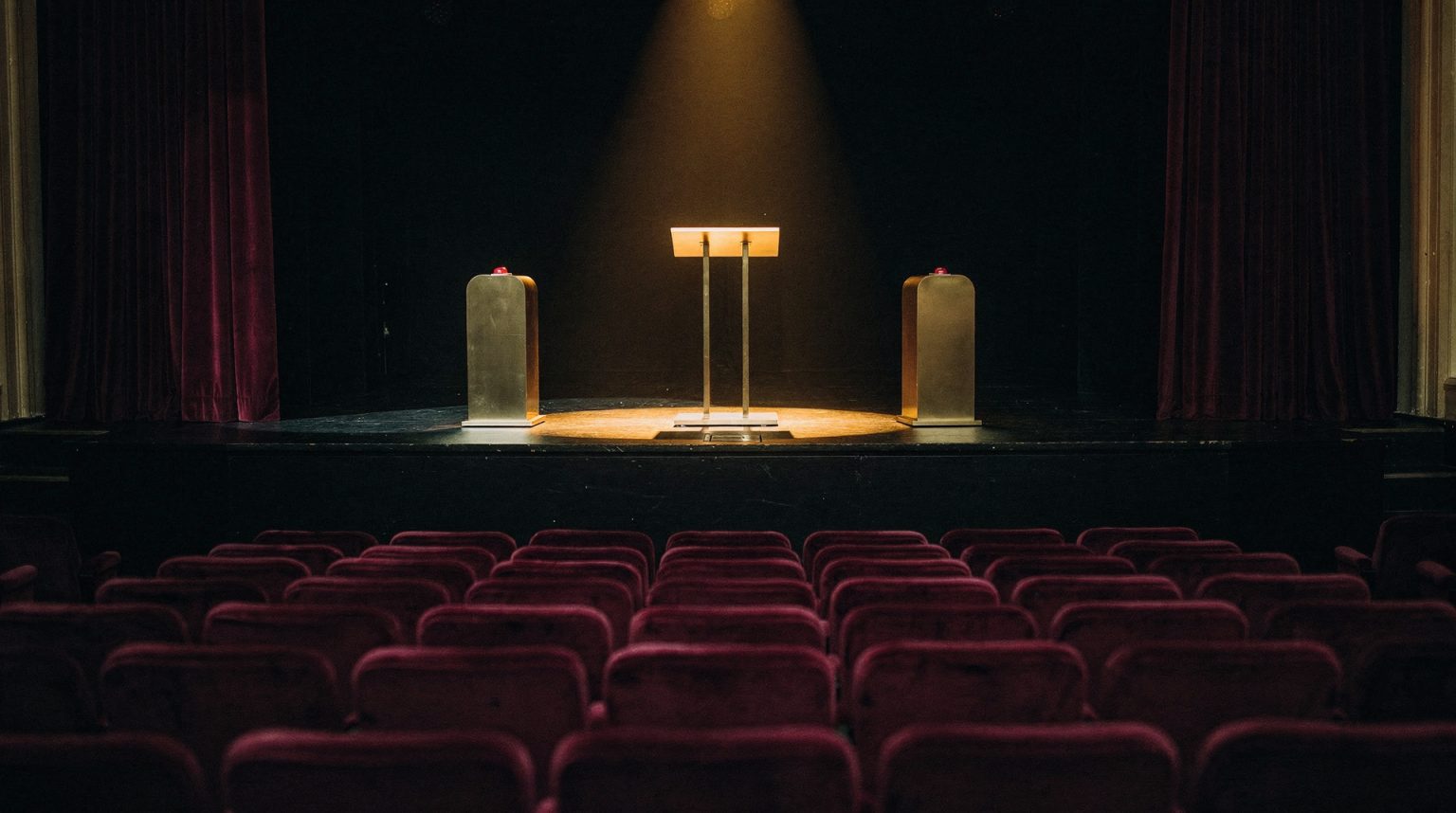
Generated image Made with flux-2-pro via ElevenLabs to show what this article describes. Nothing in it was photographed at an event.
Interactive Events · Play
A live game show is one of the cleanest answers to the 400-person participation problem because the activity scales through teams rather than through equipment for every individual. It can be serious enough for a conference, ridiculous enough for a holiday party, short enough to rescue the after-dinner energy collapse, and structured enough that quieter guests can contribute without being dragged onto a stage.
The trap is buying buzzers and calling the room interactive. Eight contestants playing while 392 people watch is a show. Perfectly respectable. It just is not the thing we are designing here.
Current event data is useful because it points toward structured participation rather than forced socializing. Eventbrite reported U.S. music-bingo attendance up 149% in its 2026 trend work, and its broader Social Study found strong interest in experiences where the activity gives people a reason to be together before anyone is asked to perform togetherness. That is exactly where a large-group game show earns its place.
Design the team before you design the questions
At large scale, the scoring unit should usually be the table or team. Everyone answers most questions through response cards, tablets, QR forms, keypads, or a team captain. Stage rounds become punctuation: one representative, one volunteer, one rotating role. They are not a permanent class of interesting people performing for everybody else.
The trap is buying buzzers and calling the room interactive. Eight contestants playing while 392 people watch is a show.
I would use three types of rounds: broad-access knowledge, sensory or visual rounds, and collaborative problem-solving. The first rewards recall. The second gives non-trivia obsessives another way in. The third stops the loudest person at the table from becoming the entire team.
Capacity: the team architecture changes with the room
| Guests | Team architecture | Screens | Host model | Recommended format |
|---|---|---|---|---|
| 20–40 | 4–6 teams | 1 | 1 host | Intimate pub/game-show hybrid |
| 50–100 | 8–14 teams | 1–2 | Host + scorekeeper | Full-room tournament |
| 100–250 | 12–25 teams | 2–4 | Host + producer + runners | Section/table competition |
| 250–400 | 25–40 teams | 3–6 | Host + producer + score/data crew | Ballroom-scale tournament |
At 400, keep teams roughly table-sized. Do not create two teams of 200 and ask each side to reach consensus unless you have developed a previously unknown interest in shouting.
Team size, screen count and host model all resolve once the headcount is fixed, which is a good argument for fixing it first.
Work four hundred through the team architecture (opens in a new tab)
Game-show flow
The room has to carry the game
Sightlines are not an AV footnote. If a guest cannot read the question, they are not participating. At 100 people, one good projection surface may be enough. At 300 or 400, I want repeated screens, a tested font size, clean contrast, and a host who is not standing directly in front of the only thing anyone needs to see. Those sightline and screen counts sit in the rulebook with the rest of the room maths.
The same applies to sound. A clever audio round is useless if the room has a six-second echo. Test the real ballroom, not the AV supplier’s optimism.
If responses are web-based, venue Wi-Fi needs a realistic load test. Build a non-phone route anyway. Technology is allowed to make the experience smoother. It does not get to become an admission requirement.
What to put in the run of show
| Clock | Action |
|---|---|
| 0:00–0:20 | Arrival, cocktails, team identification visible on tables |
| 0:20–0:28 | Host welcome, rules, test question |
| 0:28–0:43 | Round A |
| 0:43–0:58 | Round B |
| 0:58–1:08 | Break / service reset |
| 1:08–1:25 | Visual or audio round |
| 1:25–1:40 | Live team challenge |
| 1:40–1:48 | Final wager |
| 1:48–2:00 | Reveal, awards, transition |
If this sits inside dinner, build the game around service instead of making service fight for access to the tables. No server should be trying to place a hot entrée while six people are leaning across the place settings to argue about a movie soundtrack. Atmosphere OS puts the game and the service into one running order so they stop competing for the table.
Staffing and AV
| Production level | Planning allowance | Core staff | AV |
|---|---|---|---|
| Lean | $1,000–$3,000 | Host, scorekeeper/producer | PA, 1–2 displays, laptop |
| Professional | $3,500–$8,000 | Host, producer, AV tech, 1–2 runners | Multi-screen feed, wireless mics, response system |
| Ballroom scale | $8,000–$18,000 | Host, show caller, data operator, AV team, floor staff | Stage lighting, confidence monitor, 3–6 displays/projection, redundant playback |
Those are planning allowances, not universal industry averages. The spend changes depending on whether you are buying a clever host with a microphone or a produced show with scoring, lighting, multiple screens, branded content, and enough people backstage to keep a 400-person room from discovering that the spreadsheet has stopped updating. Crew maths of that kind lives in the event production archive.
Accessibility is easier here than in many interactive formats—if you design it in
Keep all critical questions visible as text, not audio-only. Use captions for video. Provide seating. Make stage participation optional and accessible. Avoid rounds that depend entirely on hearing acuity, color distinction, speed, or one narrow kind of knowledge. A team format is useful because contribution can vary by round.
Technology is allowed to make the experience smoother. It does not get to become an admission requirement.
Also preserve the dignity of opting out. Watching counts. A guest can enjoy the room, laugh with the table, and never once touch a buzzer.
How the game show turns the room back into spectators
- The host explains too much. If the rules take twelve minutes, the game needs editing.
- One answer system owns the whole night. Have a manual scoring fallback.
- The room cannot see. Add screens before you add decorative set pieces.
- The questions are too internal. A company event can include brand or culture content without becoming employee communications wearing a party hat.
- The same people answer everything. Design rounds that reward different kinds of attention.
- The finale drags. Pre-write tie breakers and make the reveal decisive.
How I would measure whether it worked
Track the percentage of teams submitting every round, response failures, voluntary stage participation, score spread, and where participation collapses. For a corporate event, add the objective that actually matters—knowledge retention, cross-department mixing, brand-message recall—but keep it secondary to the fact that people are at an event, not completing mandatory training in better lighting.
The best signal is distribution. Did most tables have multiple people contributing, or did the event create 30 captains and 370 spectators?
Where this belongs in the larger event
Use the Interactive Events framework first, then pressure-test sightlines, seating, service, and opt-outs through the Guest Journey Pressure Test. If the game needs to share the room with dinner, dancing, or another activation, the floor-plan and circulation guide matters more than another round of questions.
Sources: Eventbrite 2026 Social Study and soft-socializing trend reporting; current large-group game-show provider pricing and format pages; U.S. Access Board accessibility guidance where applicable.
Continue through the system
Pretty is still not a plan.
This field note belongs to a larger event-design system. Follow the chapter that explains the next pressure point instead of falling back into an undifferentiated archive.
What you have to decide next
One decision constrains the next. This is the order they actually happen in.
- Atmosphere What should the room feel like? Ask It Twice: Why the Same Evening Comes Back With Five Different Answers
- Venue Will this room hold it? When Prismm Goes Dark: The Deadline Is September, Not December
- Vendors Who owns each handoff? The Generator Was Late. The Washrooms Were Waiting.
- Contingency What happens if the weather turns? The Storm Wasn’t the First Failure
More in this chapter


See the complete five-chapter Event Design Intelligence map →