Occasions & Formats
Children Need Something to Discover Before They Need Something to Do
A child-friendly event does not need to become an activity center. Build discovery into the environment first, then add one or two things worth doing on purpose.
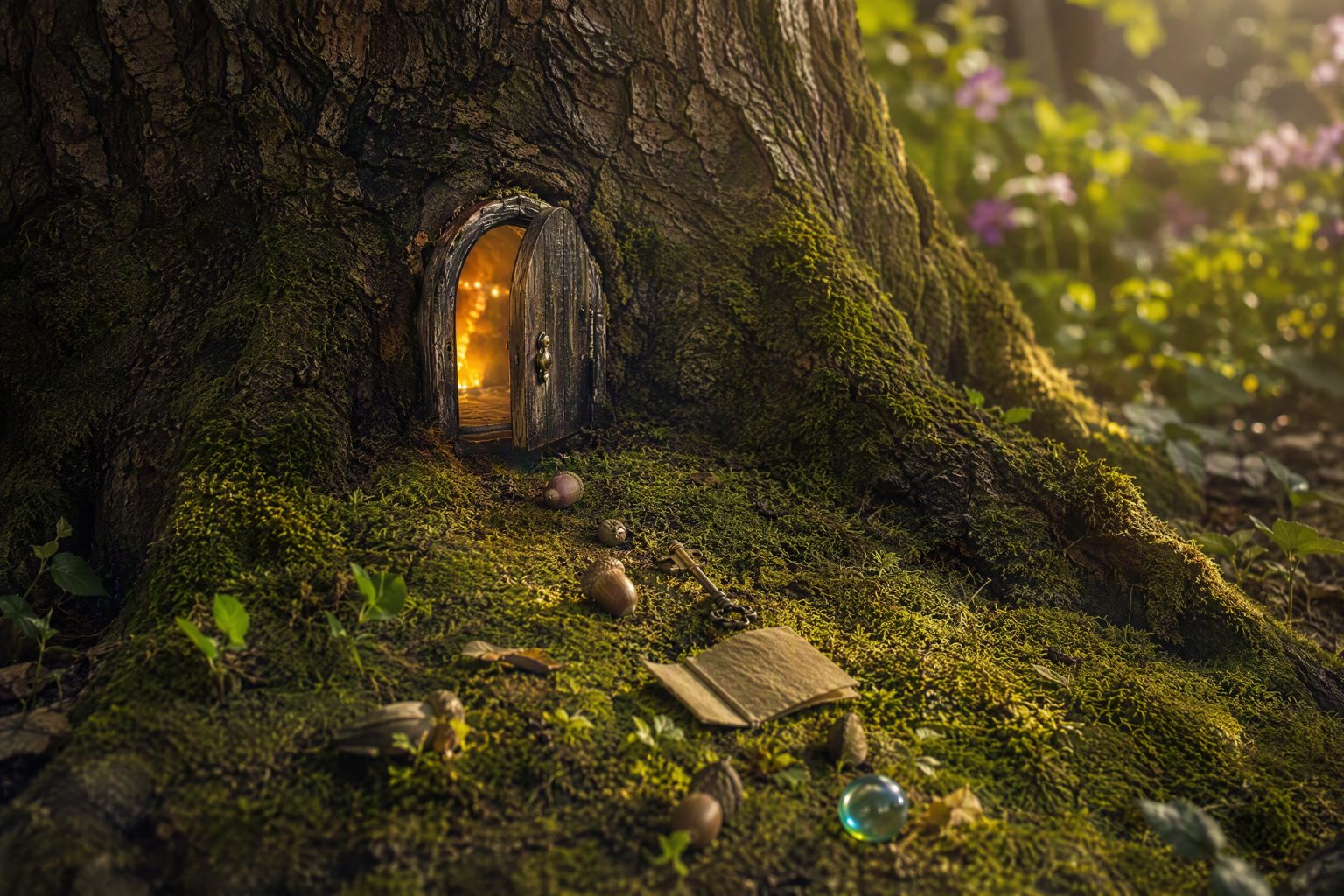
Children at events are often given one of two design roles.
Either they are treated as tiny adults who will sit beautifully through three hours of dinner because the place card has their name on it, or they are assigned to a children’s table containing enough crafts to open a small educational franchise.
There is a middle.
Children do not need an event to become a play center before they can belong in it. They need something to notice, somewhere to move without being in the way, and a few moments that feel like they were considered on purpose.
Discovery does more work than constant activity.
Put one good thing at child height
Adult eye level and child eye level are not the same view.
That changes what the room reveals.
A beautiful overhead installation may be spectacular to the adult entering the room and almost irrelevant to a child whose view is chair backs, table edges and other people’s elbows.
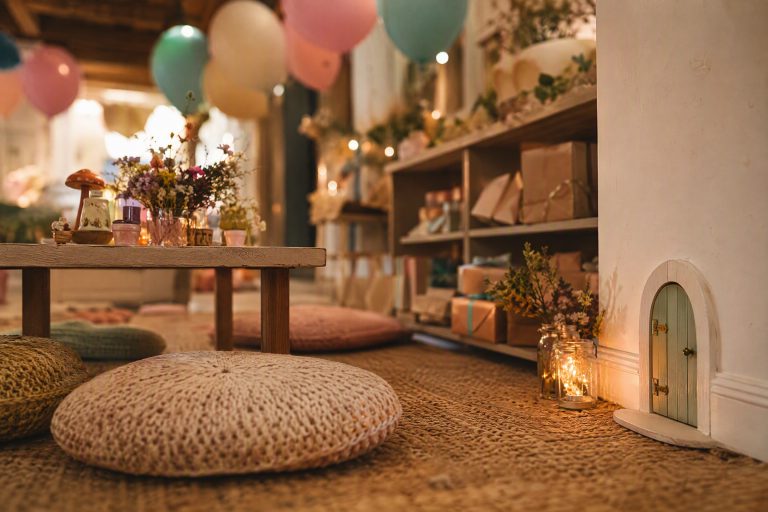
Give the lower part of the event some life. A row of small objects to notice. A hidden animal motif repeated through stationery and decor. A tiny garden detail. A low floral moment where it is safe and appropriate. A place card with something tactile. A small illustrated map.
Nobody is scattering toys around the venue. Scale just changes what a room offers a person who is three and a half feet tall.
Discovery works better when it does not require an announcement
If every child-facing idea begins with an adult explaining rules, handing out supplies and reminding everyone to finish, the activity has already acquired staffing.
A discovery element can simply exist.
Maybe there are five small creatures hidden in the tablescape. Maybe each table has a different botanical detail. Maybe the event’s theme includes objects that become more specific the closer a child looks. Maybe the escort display gives children a visual clue that adults barely notice.
Skip the competition unless the event genuinely wants one. Looking closely should be its own reward.
That kind of participation is especially useful because a shy child can do it quietly, siblings can compare notes, and an adult can join without becoming a camp counselor.
One anchor activity is usually enough
If the event has a long meal or several adult-centered stretches, one real activity can be valuable.
Choose something with a beginning that is obvious and an ending that does not require perfect completion.
Drawing works. So does building something small, decorating a single object, or adding to a collaborative piece that grows over the course of the event.
Keep the materials good enough to feel intentional. Do not give children the visual equivalent of the junk drawer because the adult tables have linen.
And think about what happens to the output. If twenty glitter-covered objects are going home in formalwear, that is part of the design whether anybody put it on the mood board or not.
Do not place the children where adults cannot see them
There is a strange tendency to solve child inclusion by moving children somewhere else.
Another room. A distant table. A corner behind the floral wall. Somewhere the event photography will not notice.
Sometimes a dedicated child-care space is entirely appropriate and professionally managed. That is a different decision.
For ordinary family participation, children should still feel connected to the gathering and the adults responsible for them should be able to maintain reasonable sightlines without abandoning dinner every four minutes.
A separate children’s table can work for some ages and groups. It can also become a small island of people who need more support than the seating plan acknowledged.
Use the guest list, not a generic age rule.
Give overstimulation somewhere to go
Children are not the only guests who can get tired of noise, light, crowds and performance, but they are often the first to make the review public.
If the event is loud, long or highly stimulating, identify a quieter edge.
It does not need to be a themed calm-down room. A lounge slightly away from speakers, a shaded outdoor edge, a side room with ordinary seating, or a spot where a parent can step away for ten minutes can be enough.
Do not fill the retreat with another activity just because the space exists.
Sometimes the useful feature is that nothing is happening there.
Food should not become the entertainment problem
A child-friendly menu does not require a completely separate cuisine built from beige objects.
It does require enough recognizable food that a child can eat without the entire table negotiating each bite.
Think about timing, portions and access. If adults are eating several courses over a long period, children may need food earlier. If the menu includes adventurous or highly specific dishes, one straightforward option can protect the evening without flattening the whole meal.
The same principle applies to drinks. Make water easy. Make cups manageable. Do not place the only child-accessible beverage on the far side of the bar queue.
Keep the interaction optional
Some children love being brought into the center of an event. Some absolutely do not.
Do not make the quiet child perform cuteness for the room.
Participation can be watching. It can be carrying one flower. It can be finding the hidden detail and telling one parent instead of the entire table. It can be doing the activity for three minutes and leaving.
Choice preserves dignity at every age.
Look at the room from knee height
Before the event, walk the family areas and literally lower yourself to roughly a child’s viewpoint.
What can be seen? What can be reached? What is fragile? What is hot? Where is the nearest adult? Is the route to the restroom obvious? Is the activity surface at a usable height? Is there anywhere quiet?
You will notice things the standing adult plan missed.
A family event does not need more children’s programming simply because children are present.
It needs the room to admit they are there.
Give them something worth discovering.
Then let them decide what to do with it.
Related reading: The Guest Experience Starts in the Parking Lot · Staff as Atmosphere · Open Seating Is Relaxed Until Everybody Needs a Chair
Atmosphere OS · Moodboard-to-Plan
Somebody has to translate the mood into a purchase order.
Moodboard-to-Plan does that translation and writes it in language a vendor can quote against. It plans, it does not assess safety or venue compliance, and it draws that line itself.
The rulebook is public. Every formula it runs on is written down where you can disagree with it.
If this is your mood
More playful

Field notes and corrections
When a number here turns out to be wrong, you hear about it.
Three things arrive and nothing else. The new field note — bar rates, cover widths, service clearances, the arithmetic worked through on one real evening. A line when a World opens, because a night only goes up once it can actually be thrown. And a correction whenever a rule in the published rulebook changes, or a number the tools rely on turns out to have been wrong. There is no weekly slot, because there is nothing weekly to put in it.
One email per field note or opening, plus corrections when a published figure moves. Unsubscribe from any of them.
Continue through the system
Pretty is still not a plan.
A party gets planned in roughly this order. Pick the chapter where your next problem lives.
What you have to decide next
One decision constrains the next. This is the order they actually happen in.
- Atmosphere What should the room feel like? The Serpentine Table Is Eleven Percent Longer Than the Spec Sheet Says
- Venue Will this room hold it? A Tiny Balcony Is Still an Outdoor Room. Give It One Job.
- Production How does it get built and run? The Event Needs a Failure Mode That Still Looks Intentional
- Vendors Who owns each handoff?
More in this chapter

See the complete five-chapter Event Design Intelligence map →