Occasions & Formats
Holiday Party for Seventy: Seventy Coats and One Bartender
At seventy guests, holiday warmth needs real infrastructure. Plan coat volume, bar capacity, food replenishment, seating, music, inclusive seasonal cues and departure before the room becomes one festive queue.
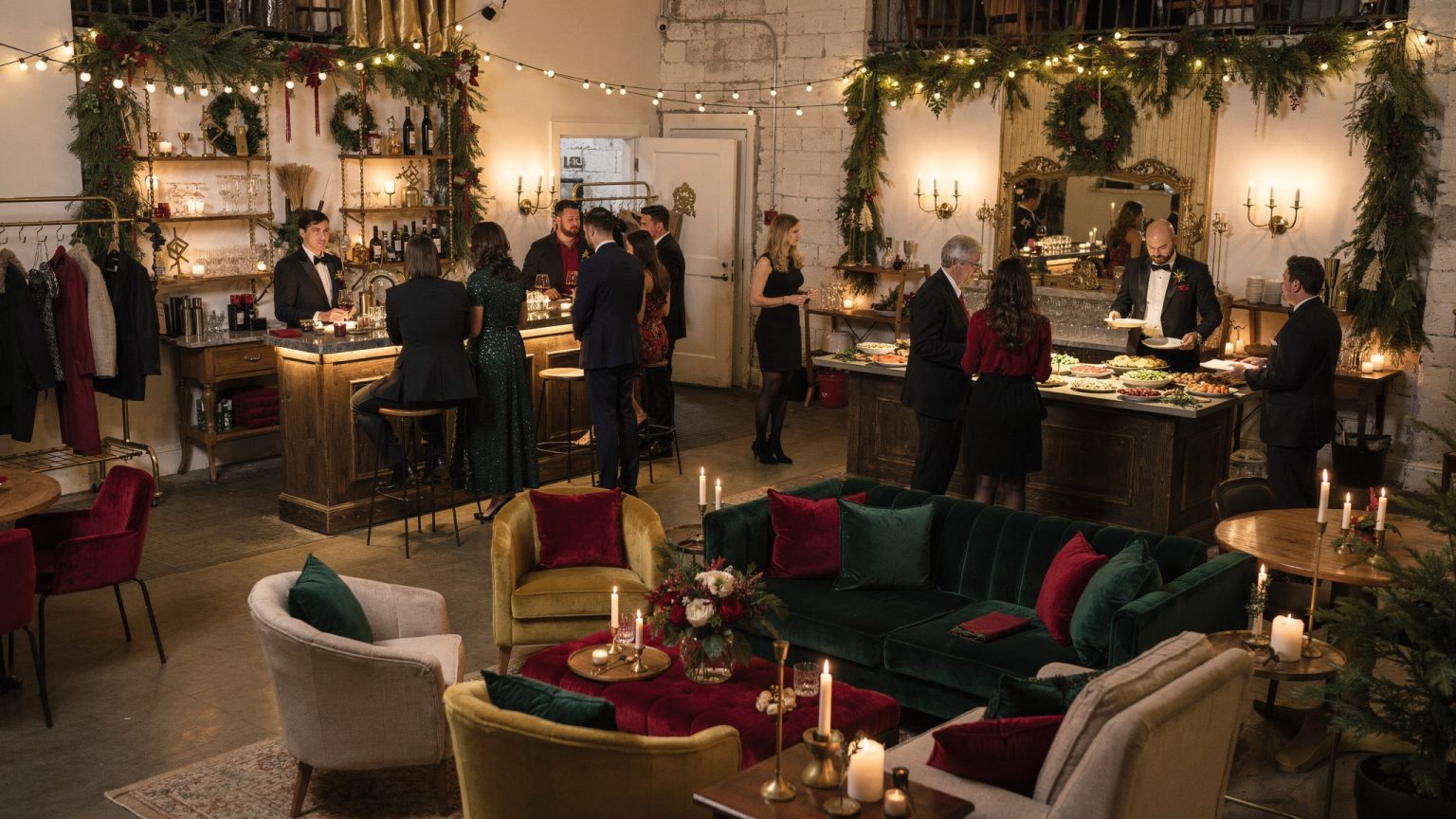
Forty-one people have arrived in the last twenty minutes, all of them wearing coats, and the bed in the spare room has become a hill.
Downstairs there is one bartender, a queue that has reached the tree, and nowhere to sit because the only seating that was not decorative went half an hour ago. Seventy people can make a room feel wonderfully alive. They also do all of this first: seventy coats, seventy first drinks inside half an hour, and most of them standing in the same doorway.
Holiday atmosphere is easy to photograph. Holiday throughput is what determines whether the party actually feels warm.
Choose the holiday language before decorating every surface
A December or winter party does not need to represent every tradition through one crowded decor package. Decide what the event is actually marking: a family holiday, an office year-end gathering, a neighborhood party, a seasonal celebration, or a specific cultural or religious observance.
Be precise where the occasion is specific and broad where the guest list is broad. Winter light, greenery, reflective materials, food, music and warmth can create a seasonal room without assuming every guest shares the same holiday symbols.
The atmosphere should feel intentional, not diplomatically overdecorated.
Coats are the first service problem
At seventy guests in cold weather, coats, scarves, umbrellas and bags consume real volume.
A bedroom pile is no longer a charming solution. Use a staffed or well-organized coat area with enough hanging space, a reliable way to hand things back and a route that does not block arrival. If the venue has coat check, ask how it handles the compressed departure peak rather than only whether it exists.
The coat-check problem is mostly a storage and queue problem wearing wool.
The first drink is the first capacity test
One bar can absolutely serve seventy people if the menu, staffing and layout support it. One bartender making individually shaken cocktails for a simultaneous arrival cannot. The throughput numbers I plan against are published, so you can argue with them before the night rather than during it.
Design for the first thirty minutes. Pre-batch where appropriate. Offer beer, wine and genuinely desirable zero-proof options. Put water somewhere guests can reach without joining the alcohol line. Give bartenders room for ice, glassware, waste and replenishment.
The second station that is not a second bar
If the event has several rooms, a secondary wine or zero-proof station can distribute pressure without pretending to be a second full bar. It needs no staff and no cocktail list. It needs to exist somewhere other than where the queue already is.
A bar line changes the room around it, so place the service point where a queue can exist without swallowing circulation. If you would rather not do that arithmetic twice, Atmosphere OS holds the arrival curve and the bar count in the same plan.
Seventy first drinks inside half an hour is the number the bar has to survive, and it reads very differently written down than it does in the head.
Test one bar against seventy (opens in a new tab)
Feed people enough to call it a party during dinner hours
Holiday parties are especially vulnerable to the tiny-food problem because passed bites look polished and substantial food looks suspiciously like feeding people.
If the event spans a meal period, guests need a real meal quantity whether it arrives plated, buffet-style, in stations or as a heavy cocktail menu. Protect hot holding, replenishment and dietary access.
Two-sided service, repeated stations or a staggered release will each solve a narrow buffet; seventy people funneled past one edge of a table will not. And if the only vegetarian option is a garnish stationed beside the carving board, the vegetarians have noticed, at every party, every year, since roughly 1998.
Give the room more than standing and dining
A seventy-person holiday party usually needs at least three social modes: active standing conversation, real seated conversation and somewhere lower-pressure to rest.
Use supportive chairs as well as lounge furniture. Keep some seating away from speakers. If the party includes older family members, people with disabilities, pregnant guests or anyone who simply does not enjoy standing for three hours, seating is hospitality rather than atmosphere loss.
The room should not imply that sitting means you have opted out of the party. Everything filed under guest journey starts from that same question: where does a person go next.
Let decorations survive an occupied room
At seventy guests, guests are the visual field.
Use fewer, larger seasonal gestures where they have consequence: entry, ceiling, mantel, bar, one tree or installation, table surfaces that still leave room for food and glasses. Keep decor out of service paths and away from heat or flame risks.
Low-level clutter disappears once people arrive. It still creates cleanup and blocked surfaces.
Atmosphere has work to do. Give seasonal material a job beyond proving the month.
Music needs an energy plan
Holiday music can become exhausting when the same narrow playlist is asked to carry three hours.
Start with arrival energy, broaden into social music and let the room become more energetic if dancing or late-night conversation develops. If a live musician or DJ is used, place sound so conversation remains possible somewhere.
The party does not need every song to confirm that a holiday is occurring.
Decide whether gifts belong to the event
Gift exchange, charitable collection, host gifts and employee gifts are different animals.
If there is a group exchange, keep the rules short enough to understand without a meeting. If gifts are optional, make that genuinely visible. If donations or collections are involved, explain what is accepted and where it goes.
Do not create an accidental status display by having expensive gifts opened publicly unless that is specifically the social tradition the group wants.
Keep workplace power in mind if this is a company party
A workplace holiday party remains connected to work even when it has excellent lighting.
Do not make alcohol, dancing or after-hours endurance the price of belonging. Make the formal portion short. Give people a socially easy exit. Avoid games or awards that depend on embarrassment. If partners are invited, make the evening intelligible to someone who does not know the internal jokes.
The broader company-dinner logic is in Company Dinner for Sixty; the holiday layer adds compressed arrivals, seasonal expectations and often more movement.
Staff the peaks instead of the average
Seventy guests may require only a modest team, but jobs will overlap at predictable moments.
Arrival needs coats and first drinks. Food release needs replenishment and clearing. A program needs someone to cue it. Departure needs coat retrieval and transport awareness. Map those peaks and make sure the same person has not been assigned to three of them.
Staffing should follow the moving parts, not an impressive-looking headcount formula.
Winter weather is part of arrival and departure
Snow, rain, ice and darkness affect parking, rideshare, stairs and walking routes before they affect the decor.
Keep entrances lit. Address slippery surfaces. Tell guests if footwear or outdoor walking matters. If shuttles or remote parking are involved, give one person responsibility for updates.
A warm room cannot undo a twenty-minute search for the entrance in sleet.
Design the last half hour before it arrives
Seventy people do not leave elegantly if coats, gifts and rideshare pickup all occupy the same eight feet of hallway.
Keep the exit route clear. Stagger transportation where practical. Move take-home items away from coat retrieval. Let music and lighting taper slightly without making the remaining guests feel evicted before the stated end.
If the party has a hard venue deadline, build the final shared moment early enough that guests can leave without missing the only meaningful thing.
Holiday warmth is operational
The best seventy-person holiday party is abundant rather than crowded, lively without anybody being conscripted into it, and seasonal without turning into a retail display. Some of that comes from the visible things, which are light, food, music and material. Rather more of it comes from the invisible ones: enough coat storage, enough bar capacity, enough chairs, enough water, enough room to move and enough clarity about how to get home.
One bar may be exactly the right plan. It just has to be a plan.
Field notes and corrections
When a number here turns out to be wrong, you hear about it.
Three things arrive and nothing else. The new field note — bar rates, cover widths, service clearances, the arithmetic worked through on one real evening. A line when a new World or Mini Occasion opens, because a night only goes up once it can actually be thrown. And a correction whenever a rule in the published rulebook changes, or a number the tools rely on turns out to have been wrong. There is no weekly slot, because there is nothing weekly to put in it.
One email per field note or opening, plus corrections when a published figure moves. Unsubscribe from any of them.
Continue through the system
Pretty is still not a plan.
A party gets planned in roughly this order. Pick the chapter where your next problem lives.
What you have to decide next
One decision constrains the next. This is the order they actually happen in.
More in this chapter


See the complete five-chapter Event Design Intelligence map →