Production & Hosting
A Staffing Recipe for the Event That Has Too Many Moving Parts
An understaffed event is obvious. A badly assigned one is worse: a room full of people, and candles unlit because everyone assumed someone else had them.
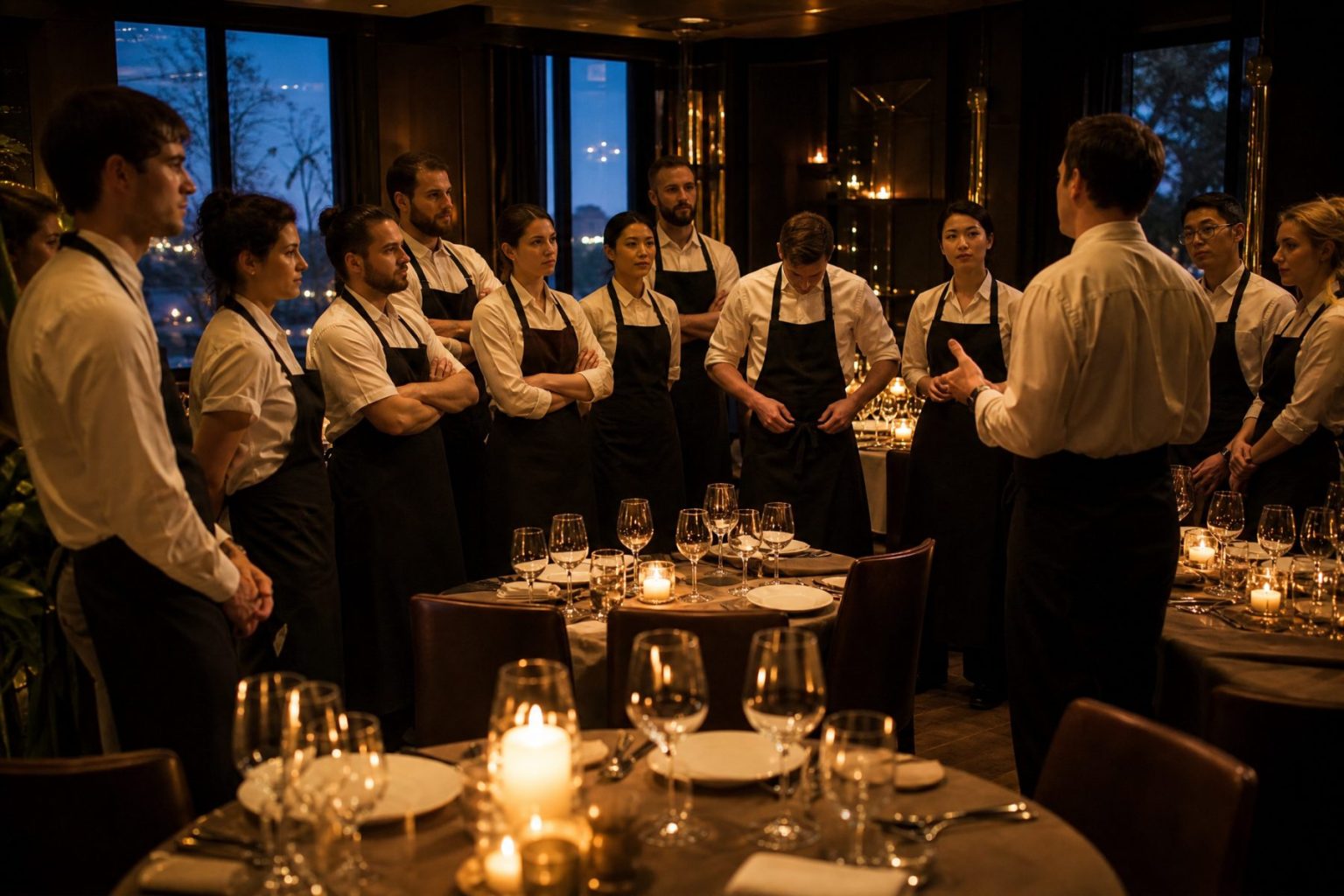
An understaffed event is obvious.
A poorly assigned event is worse: there are plenty of people, yet the candles remain unlit because everyone assumed “someone” had them. Five staff members greet the same arrival while nobody opens the accessible entrance. The room is full of labor and short on ownership.
Staffing succeeds when every consequential outcome has one owner, one deadline, one backup, and enough time and equipment to complete the work.
Build roles from the event sequence
Read the timeline and guest journey from load-in through final departure.
Identify the moments requiring active labor:
- vendor access and receiving;
- setup, inspection, and guest-ready reset;
- parking, shuttle, arrival, check-in, coats, and welcome;
- ceremony seating, cues, and transitions;
- bar opening, food service, and dietary coordination;
- room turns and furniture movement;
- speeches, entertainment, and technical support;
- restrooms, quiet spaces, family support, and accessibility assistance;
- transportation, coat retrieval, lost property, and departure;
- strike, inventory, cleaning, and venue handback.
Do not staff only the visible program. Many failures occur in the transitions before and after it.
Assign outcomes, not vague availability
“Be available near the ceremony” creates decorative staff.
“Own ceremony seating from 4:30 until the final guest is seated; keep the center aisle clear, support reserved and accessible seating, communicate holds to the coordinator, and hand the space to the ceremony lead at 5:00” creates a role.
Each assignment should state:
- the outcome;
- location and time window;
- tasks included and excluded;
- information, keys, equipment, and access needed;
- decision authority;
- who takes over next;
- the backup.
One person may own several compatible outcomes. Several people should not vaguely own the same critical one.
Staff the peak, not the average
The event may feel quiet for forty minutes and require concentrated labor for the next ten.
Model arrival, bar opening, room turns, meal service, coat retrieval, transportation, and strike as peak periods. Add targeted staffing, staggered shifts, cross-trained support, or temporary labor where appropriate.
Reducing the average headcount while preserving a complex peak merely concentrates the failure.
Separate guest-facing and production roles
The person calming a parent should not also be checking rental counts at the loading dock.
Guest-facing roles need attention, discretion, communication, knowledge of the experience, and the ability to remain physically present. Production roles may involve inventory, vehicles, tools, vendors, equipment, waste, and backstage movement.
Crossing between those worlds can be useful when planned. It becomes damaging when a guest-facing staff member repeatedly disappears because operational work was never assigned.
Reducing the average headcount while preserving a complex peak merely concentrates the failure.
Create zone leadership without creating kingdoms
Large or multi-space events benefit from named leads for arrival, ceremony, hospitality, dining, production, transportation, or other major zones.
Each lead should understand their boundary, communication path, shared resources, and the moment control transfers. They should not independently rewrite the event because another zone has not yet answered the radio.
One central event lead retains cross-zone authority. Zone leads solve within scope and escalate what affects safety, cost, schedule, guest access, or another team.
Write the escalation ladder
Staff should know what they can resolve immediately and what requires approval.
For example:
- Resolve directly: replace a missing water glass, guide a guest, move a harmless obstruction, restock an approved item.
- Notify the zone lead: developing queue, missing staff member, delayed vendor, repeated guest complaint, low inventory.
- Escalate to event lead: timeline change, room closure, major service failure, expenditure, family conflict affecting program, media issue.
- Follow emergency and venue procedures: medical, fire, security, structural, weather, evacuation, or other consequential condition.
The exact ladder belongs to the event, venue, employer, and qualified professionals. Staff should never be asked to improvise beyond training or authority.
Brief with maps, clocks, and names
A useful staff brief includes:
- current timeline and version;
- site map with guest and service routes;
- zone boundaries and posts;
- key contacts and radio channels;
- guest-facing language for common questions;
- accessibility and support arrangements relevant to the role;
- weather and contingency decisions;
- meal, break, restroom, and relief plan;
- emergency and venue procedures;
- what information remains private.
Walk the site when possible. A map does not reveal which door sticks or where the sound disappears.
Use radios for information rather than theater
Not every staff member needs a radio. Everyone who does needs a channel plan and communication rules.
Use concise identifiers, locations, facts, and requested actions. Keep private guest information off open channels. Confirm receipt when necessary and close the loop when the task is complete.
Twelve people saying “copy” does not mean the candles are lit.
Build relief into the assignment
Schedule meals, water, restrooms, temperature breaks, medication needs, and relief before fatigue begins making decisions.
Long static posts, exterior weather, late strike, heavy work, and constant guest contact require rotation. Identify who covers each role and what information transfers during the break.
A person should not have to abandon a post or avoid drinking water because the staffing plan assumes bodies are decorative infrastructure.
Staff accessibility as an integrated service
Every relevant team member should know the accessible routes, seating, restrooms, transportation, quiet spaces, and agreed support.
Assign specific staff where lifts, elevators, alternate entrances, reserved seating, captioning, interpreting, mobility assistance, or other arrangements require coordination.
Offer help without grabbing, moving equipment, or making assumptions. Follow the guest’s direction and the event’s established procedures.
A person should not have to abandon a post or avoid drinking water because the staffing plan assumes bodies are decorative infrastructure.
Protect the hosts and wedding party from becoming staff
Do not fill labor gaps with people in ceremonial, family, or guest roles unless they have explicitly accepted a specific, appropriate task.
Critical setup, childcare, transportation, vendor coordination, safety, and strike work belong to qualified or assigned personnel.
Friendship is not a contingency shift. Formalwear is not high-visibility work clothing.
Track live completion
For critical setup and transition tasks, use a simple method that shows ownership and completion.
It may be a printed checklist, shared document, zone board, or coordinator log. The tool should identify the task, owner, deadline, status, and exception without requiring everyone to update a complicated interface while carrying chairs.
“I thought you had it” should not become the event’s unofficial status field.
Hand the last loose ends to a named person
At the end of a shift or event phase, transfer keys, radios, guest information, open issues, lost property, inventory, payments, and venue responsibility to a named person.
Do not let the staff dissolve gradually while unresolved work remains attached to whoever notices it last.
Complexity must be staffed or removed
A small team can deliver an excellent event when the format matches its capacity.
Reduce guest interactions, room changes, menu complexity, custom handling, or program layers before assigning incompatible jobs to the same people.
The successful event does not merely have enough staff. It has clear ownership, relief, authority, and a plan for the moments when everything happens at once.
Part of Resources.
Atmosphere OS · Arc Studio
Write the order of the night before you book the band.
Arc Studio turns an intended feeling into a sequence with times against it and a production brief a crew can read on the day. Costs come back as bands and seasonal notes as filters, never as guarantees.
The rulebook is public. Every formula it runs on is written down where you can disagree with it.
Field notes and corrections
When a number here turns out to be wrong, you hear about it.
Three things arrive and nothing else. The new field note — bar rates, cover widths, service clearances, the arithmetic worked through on one real evening. A line when a World opens, because a night only goes up once it can actually be thrown. And a correction whenever a rule in the published rulebook changes, or a number the tools rely on turns out to have been wrong. There is no weekly slot, because there is nothing weekly to put in it.
One email per field note or opening, plus corrections when a published figure moves. Unsubscribe from any of them.
Continue through the system
Pretty is still not a plan.
A party gets planned in roughly this order. Pick the chapter where your next problem lives.
What you have to decide next
One decision constrains the next. This is the order they actually happen in.
More in this chapter

See the complete five-chapter Event Design Intelligence map →