

Description
Nobody overspent on purpose. The quote was right, the deposit was right, and the service charge was on page three.
It is not usually a spending problem
It is a counting problem. The number you planned lives in a spreadsheet, the number you agreed to lives in a contract, and the number you will actually pay arrives one invoice at a time. Each is correct where it sits. The total nobody adds up until the last invoice lands is the one that decides whether the event came in on budget.
What this is
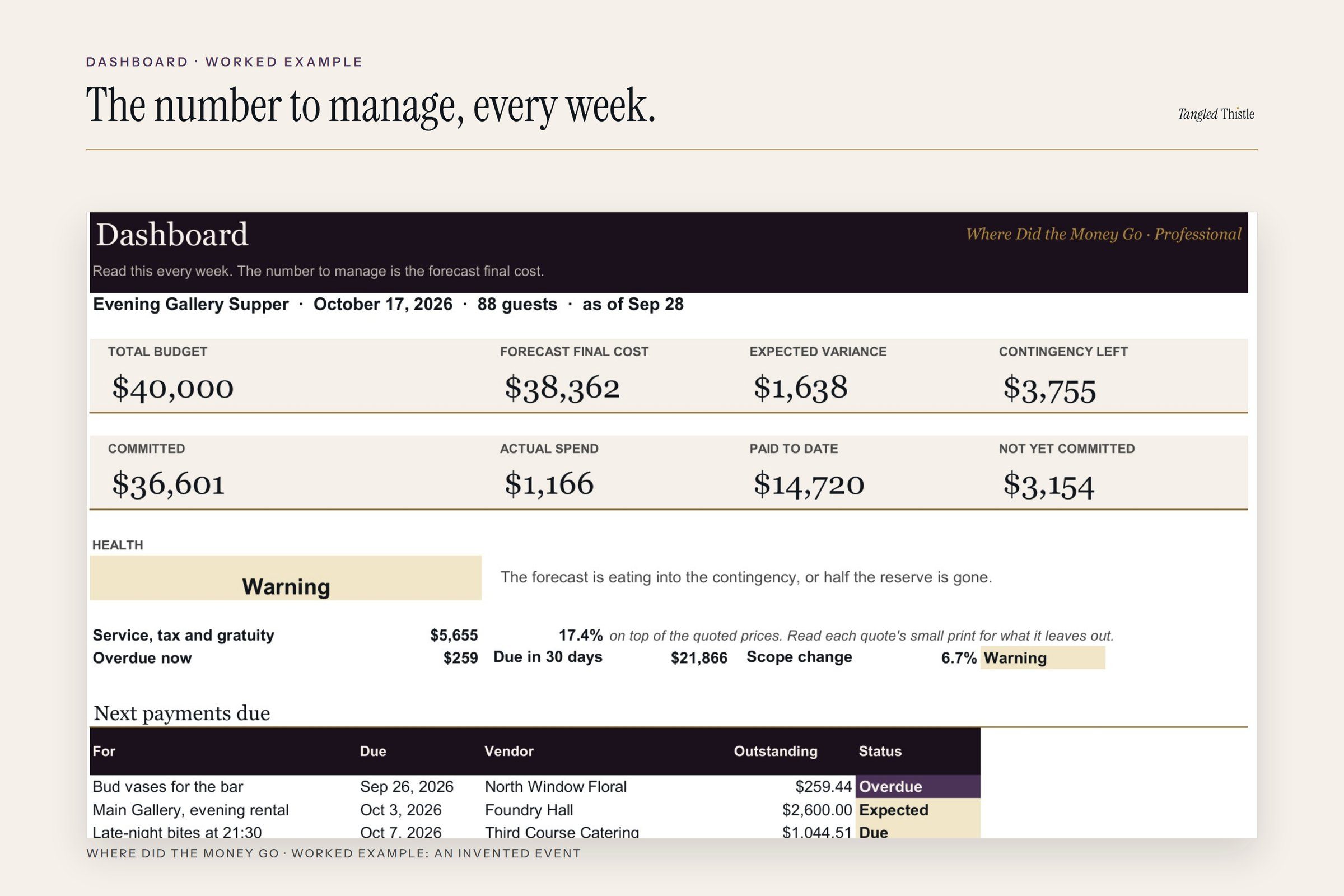
One workbook for the money side of one event. Every line carries the estimate with its service charge, tax and gratuity, the price you committed to, and the actual cost. The workbook adds them into one forecast: what the event will cost if nothing else changes. The dashboard reads it for you every time you open it: on budget, using the reserve, or over.
In every edition
- The true cost on every line. Quantity, unit price, service charge, tax (on the service charge too, if your caterer charges it that way) and gratuity. Type =Guests as the quantity and a per-head line follows the count.
- A forecast, not a sum. The actual cost where you know it, the commitment where you have one, your estimate everywhere else. A canceled line counts as nothing.
- Nothing counted twice. Payments are recorded against a line, not added to it, so the balance and the next payment date sit on the same row as the cost.
- A reserve that stays a reserve. The contingency comes off the top. Emergency purchases are logged with their cause, apart from the plan, so you can see what the reserve was spent on.
- What is due next. The next payments, soonest first, and what is already overdue, counted from today or from a date you fix for a report.
- A check on every line. It flags a possible duplicate, or a line whose plan has grown past what was committed.
Professional and up
- Invoices on their cost lines. Deposits, progress payments and finals against the line they pay for, with a twelve-month payment calendar and overdue tracking.
- Vendors, scored. Contract value, invoiced, paid, balance, deposits, insurance on file and a 100-point scorecard on six criteria you weight.
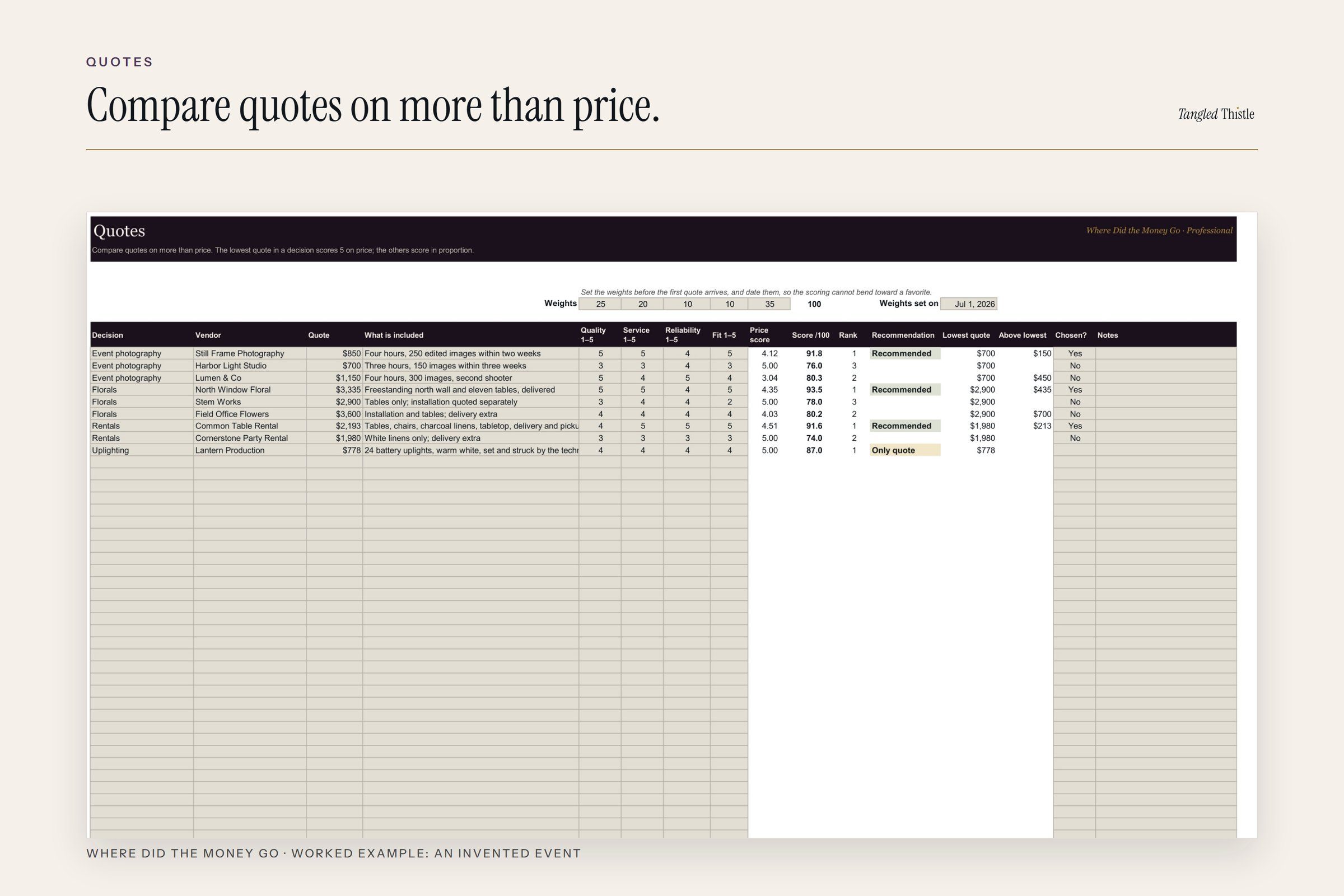
- Quotes compared on more than price. Price, quality, service, reliability and fit, weighted, with the weights set and dated before the first quote arrives.
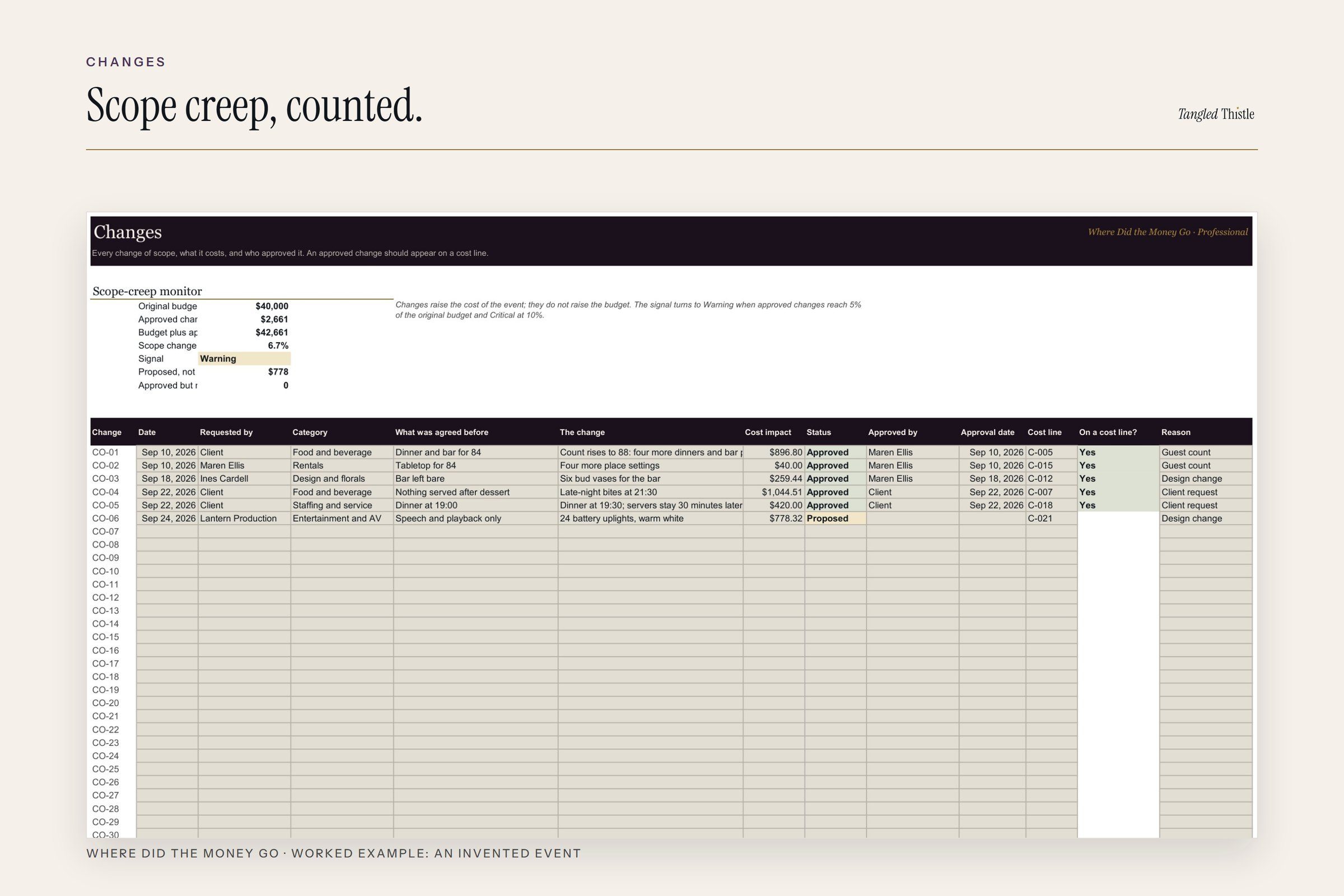
- Scope creep, counted. Every change order with its cost and who approved it. Warning at 5% of the original budget, Critical at 10%, and a flag for any approved change not yet on a cost line.
- Benchmarks with their sources. Your split against published ranges for corporate events, weddings and private celebrations. Every figure names its source, and a category with no published figure says so.
- Purchase scoring. Need, impact and risk give a priority and a recommendation: purchase now, delay, source an alternative or reject.
- Risks against the reserve. A risk register with a suggested response for each kind of risk, and a check on whether what is left in the reserve could absorb the risks you have named.
- A closeout report for after the event: how the budget ended, what changed and what to do differently.
The four editions
- Essential Edition: The money side of one event: true cost on every line, what you committed to and what it really cost, one forecast, the reserve, and what is due next.
- Professional Edition: Everything in Essential, with invoices and a payment calendar, vendor scorecards, weighted quotes, change orders, sourced benchmarks, purchase scoring, risks and a closeout report.
- Executive Edition: Everything in Professional, with dashboard charts, cash flow, ROI, a savings analyzer, an inventory register and fourteen KPIs.
- House Edition: The Executive workbook with four field guides: the Cost Reduction Playbook, Vendor Negotiation Scripts, Emergency Response Guides and the AI Procurement Advisor.
The worked example
Every edition comes as a blank workbook and as a worked example: Evening Gallery Supper, an invented dinner for 88 on October 17, the same event the other Workroom instruments use. It is frozen at September 28, nineteen days out. The forecast has passed the allocated budget and is using the reserve, approved changes (four more guests, late-night food, a later dinner) have reached 6.7% of the budget, and one florist invoice is two days overdue. Change anything in it and watch where it lands.
Who it is for
Planners, producers, in-house event teams and venue coordinators who carry the budget for an event, and hosts spending real money on one. It assumes you have quotes and contracts to enter; it does not write them for you.
It is not bookkeeping, and nothing in it is accounting, tax or legal advice. It plans one event per workbook, not a year of them.
Files, formats and license
An Excel workbook (.xlsx) of fifteen sheets, as a blank and as the worked example. Tested in desktop Excel (Microsoft 365) and in Google Sheets; written for Excel 2019 or later. Formulas are protected against a slip of the keyboard, without a password, and every sheet prints on US Letter. Room for 250 cost lines, 200 invoices, 60 vendors, 60 quotes, 80 change orders and 50 risks. A four-page quick start (PDF) comes with it.
License: single practitioner or single studio. Use it on every event you plan, for as many clients as you like, and share the reports it prints. Do not resell or redistribute the workbook.
My public Originality and inspiration standard applies to every World, product and supplied asset.
The free reading underneath it
This workbook was built from the Tangled Thistle writing that stays free and complete: Event Budget Math That Survives the Quotes, The Budget Line Items Guests Never See but Always Feel and Budget Cuts That Keep Atmosphere and Drop the Dead Weight. The articles make the argument. This is the instrument.