Design Atelier
Nothing Cold but the Ice
The food and drink design for The Ice Was the Luxury, built on the rule that the block is the only cold thing in the room and everything else arrives hot.
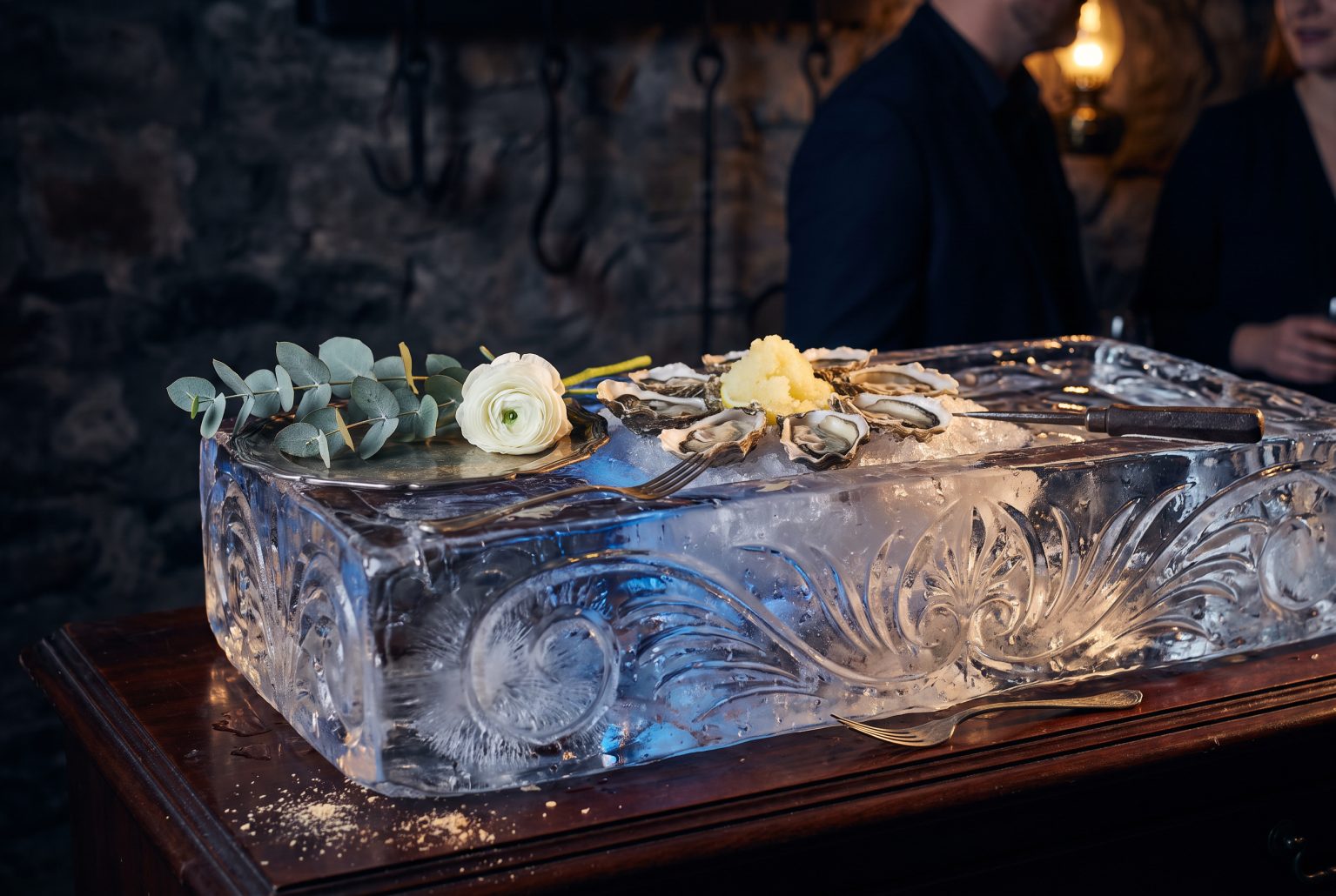
What this evening is hungry for
Heat. That is the answer and it takes people by surprise, because the room is built around ice and the obvious menu is a cold one. The obvious menu is wrong. A guest standing in a stone room at twelve degrees, holding a chilled glass, eating something cold, is not having a luxurious evening; they are having a slightly miserable one and they will leave early. Cold rooms make people hungry for hot food faster than warm rooms do, and they make them hungry earlier.
So the design rule for the whole night is simple and it inverts the theme on purpose: the ice is the only cold thing, and everything else arrives hot. One short cold course, deliberately positioned early, and then a rising temperature curve for the rest of the evening — broth, roast, buttered things, and a hot cup at the end when the block is finished. The ice keeps its status precisely because it has no competition. Put six chilled dishes on the table and the ice becomes the garnish on a cold buffet.
The second thing the room implies is weight. The visual vocabulary is mass: a hundred-kilo block, a sawdust crate, a mahogany chest, a steel tray. Food that is light, aerated and tweezered dies in this room. It looks like nothing at the scale of the objects around it and it reads as apologetic. Everything on the table should have heft — a whole fish in a broken salt crust, a copper pan of potatoes, a heavy jug.
The third is pace. A plate loses heat faster on a cold table in a cold room, so the distance from pass to guest matters more here than anywhere else in this collection. Fifty metres of stone corridor means food at forty degrees for people who are already cold, and no styling recovers from that.
The shape of the night
Arrival is standing, in the coldest part of the room, and it is short — twenty-five minutes, not an hour. Guests come in, they see the block, they get something warm in one hand and something cold in the other, and then they sit down. A long standing reception in a cellar is the single most common way to lose this evening: by the time people sit, they are cold, and cold guests do not warm up again for an hour.
Then a seated dinner of four moves rather than five: the cold course, the broth, the main with its two sides, the dessert. There is no cheese course and no separate salad. Cheese at cellar temperature in a cellar is one texture too many after a cold first course, and a leaf salad in a twelve-degree room is a plate of cold wet leaves, which is what it always was but here you cannot hide it.
The hours. Doors at eight, seated by half past. Cold course at a quarter to nine, while the block is still square. Broth at half past nine, which is the pivot of the night. Main at ten. Dessert at eleven, by which point the ice looks used rather than installed. Hot cups from midnight, late food at one, standing.
The welcome drink and the arrival food
Within ninety seconds of the door, two things. A glass of Ice House Punch, poured cold and served with no ice in it at all — this is the design decision that sets up the whole evening. The punch is chilled by being held in a stone or steel vessel packed into the sawdust crate beside the block, exactly as a nineteenth-century household chilled its wine, and it goes into the glass at four or five degrees without a cube. Guests notice within a mouthful that their drink is cold and there is nothing in it. That is the argument of the whole evening, delivered before anybody has spoken.
The food in the other hand is hot and plain: cold-cut cultured butter on hot rye toast. A slab of very cold cultured butter, cut off the block with a warm wire in front of people, laid on toast that has come out of the oven ninety seconds ago. It is the correct first bite for this theme for a reason that is historically exact: butter was one of the cargoes the ice trade existed to move. Cold made butter a commodity that could travel. Serving it as the first thing, cut cold onto something hot, states the entire premise in one mouthful and it costs almost nothing.
Nothing else at arrival. No canapé tray, no three-bite parade. The room is doing the work and the guests are looking at a block of ice.
The bar
The signature is The Tuscany, named for the brig that carried Frederic Tudor’s ice to Calcutta in 1833 and made the trade real. Aged rum and oloroso sherry, a lime-and-cane cordial, a drop of saline, stirred and poured over one cut piece of the block. Rum because the Caribbean was where the first cargoes went and what came back; sherry because it is the drink the evening ends on, so the bar should start with a note of it. It is dark, and it sits in the glass around a piece of clear ice like an object in a vitrine.
The zero-proof drink is The Wenham and it is not the Tuscany with the rum taken out. It is the opposite drink, designed from its own idea. Wenham Lake ice was sold in London in the 1840s specifically because it was clear enough to read a newspaper through — the company kept a block in a shop window on the Strand as the whole advertisement. So The Wenham is a completely colourless drink: verjus, a cold steep of white peppercorn and celery seed, a pinch of salt, lengthened with a hard sparkling water. Savoury, dry, sharp, no sugar to speak of. Same glass, same cut piece of ice, same announcement from the person serving it. It is the drink you can see straight through, which is the most expensive thing ice could ever be.
Ice as a throughput problem. The block is not the bar’s ice supply and it must never be treated as one. One person cutting takes roughly forty seconds per piece, so a block can support something like a hundred and twenty cut pieces across a whole service. A bartender working a queue produces about a drink a minute. Put those two numbers next to each other and the answer is obvious: the ice station is a separate station from the bar, with its own person, its own tongs and its own queue, and the great majority of drinks served tonight contain no ice at all. Iced drinks are the exception, requested and cut for, and the queue for that is part of the evening.
There is a piece of arithmetic worth knowing here, because it changes how you think about the piece in the glass. Cooling a 200 ml drink from room temperature to five degrees takes about twelve kilojoules of heat, and melting ice absorbs about 334 kilojoules per kilogram — so the drink is paid for by roughly thirty-five grams of ice. A cut piece from the block weighs three or four times that. Which is exactly why one large piece chills a drink properly and barely dilutes it, and why a glass full of small cubes turns into water: the cooling is the same, the surface area is not.
Large format. Above about sixty guests the punch has to be batched and held cold without ice, in two or three vessels rotated out of the sawdust crate. Above a hundred and fifty, add a second pouring point rather than a second bartender at the same one, because the pinch point in a cellar is the walk, not the pour.
Wine and after. Wine here is a cellar list and it should be poured at cellar temperature without apology: a white with weight and low oak, a red served cool at fourteen degrees rather than at room temperature, because the room is not at room temperature. When the block is finished — and it must be allowed to finish — the drinks list moves to things that are better warm than cold, and the move has to read as a promotion. Good oloroso and amontillado, poured generously. An aged rum. And hot oloroso: warmed gently with a strip of bitter orange peel and a blade of mace to about sixty degrees, never simmered, held in a covered pan and poured into small handled glasses. It is the single most popular thing served all night and the reason nobody minds that the ice has gone.
Glass and garnish. Heavy, thick-walled, old-looking: a small rocks glass with weight in the base, a stemmed schooner for sherry, a plain tumbler for the punch. No coupes with thin rims, because hands are cold and cold hands are clumsy. Garnish is one thing or nothing: a wide strip of orange for the Tuscany, expressed and dropped in; nothing at all in The Wenham, because a garnish in a colourless drink is a confession that you did not trust it.
The table
The cold course, and it is the only one
Oysters set into the ice, with fino and green apple granita scraped over them to order. The granita is the twist and it does real work: a frozen wine granita on an oyster replaces the mignonette entirely, delivers the acid and the salinity as temperature rather than as liquid, and it is scraped at the table with a fork so the guest watches ice being made into food two metres from a block of ice being made into nothing. Green apple because the ice ships carried apples as ballast cargo and sold them at the other end for more than the ice. Fino because it is the only wine that tastes of salt.
For anyone who does not eat oysters, the granita goes over a spoonful of cucumber and kohlrabi cut into the same shape and dressed the same way, in the same shell-shaped dish, set into the same trough. Same course, same theatre, no substitute-plate energy.
The broth, which is the twin of the block
A clear broth of beef and burnt onion, served scalding in warmed cups, and this is the intellectual centre of the menu. Clarity in ice and clarity in broth are the same achievement bought the same way: with time and with patience and with the removal of everything suspended. A clear block takes about three days of slow directional freezing, because freezing water slowly pushes dissolved air and impurities ahead of the ice front instead of trapping them. A clear consommé takes a raft, low heat and an afternoon of not touching it. Nobody at the table needs this explained. They will drink hot clear liquid in a cold room while looking at cold clear solid, and it lands.
It is also the practical hinge. Served at the right minute — ninety minutes into a cold night — you will hear the volume of conversation go up.
The main
A whole fish baked in a salt crust, cracked open at the table with the back of a heavy spoon. This is the dish this theme was waiting for and I would build the whole menu around it: a white, hard, opaque block, brought to the table cold-looking and steaming, broken open in front of everybody to release heat. It is the ice block reversed and it takes about four seconds for a table to understand that.
The vegetarian and vegan version is the same event, not a parallel one: a whole celeriac baked in the same salt crust, on the same board, cracked at the table with the same spoon, served with the same sides. The crust is identical, the gesture is identical, and it comes out of the oven at the same time. Gluten-free: the crust can be made with rice flour instead of plain flour with no loss, and neither main has gluten anywhere else in it.
The sides
Buttered potatoes with a sawdust crumb: small waxy potatoes, heavily buttered, scattered at the table with a coarse toasted crumb of dark rye and hazelnut that looks exactly like the sawdust on the floor and tastes like toast. It is the only joke in the menu and it is a quiet one.
Braised celery hearts, cooked long in butter and stock until they collapse, served in their liquor. This is the deliberately plain dish. It has no twist, it photographs badly, and it will be the thing two or three people at every table talk about, because a menu with an idea in every dish is exhausting and celery cooked properly is one of the great forgotten vegetables of the cold cellar.
Dessert
Brown bread ice cream, which is a genuine English ice from the eighteenth and nineteenth centuries — caramelised brown breadcrumbs folded through a custard ice — and which exists at all because ice made ices possible. It arrives at eleven, at the point where the block has visibly lost its corners, and it is the only cold thing served after nine o’clock. That is the whole design of the night in one plate: the ice, which was the most expensive thing on the table, ends up as pudding.
Late, and after
Hot cups from midnight, and this is where the money should go. When the block is down to a fist and the tray is a tray of water, the room needs to warm up or it empties. Sherry warmed with bitter orange, in small glasses, carried around rather than queued for. Proper coffee, made properly, not a flask that has been standing since ten.
Late food at one: anchovy toast, hot, salty, one hand, made in batches on a tray and handed round standing up. A Victorian savoury and the most reliably remembered course at any long evening, which is why it is planned rather than improvised. Salt and heat, at the hour when people have been cold for five hours and have had a drink.
There is no next-day continuation for this theme. The block will be gone and the point of the evening was that it did not last. Sending people home with anything undermines it.
Whether it can actually be served
The kitchen problem is real and it is specific. The venues that suit this theme — cellars, vaults, old dairies, market halls, anywhere with a drain and a floor you can hose — are almost never venues with a working kitchen. So the menu above is built to survive a temporary kitchen with two or three induction rings and one portable oven, and it is built to be assembled close to the table.
What holds and what does not. The broth holds indefinitely and only gets better; it is made two days out and reheated to a hard simmer. The granita is made the day before and scraped to order. The potatoes hold thirty minutes in a covered pan and no longer. The celery hearts hold two hours and improve. The salt crust cannot be held at all: it goes in, it comes out, it is cracked within fifteen minutes or the fish keeps cooking inside its own oven and turns to cotton wool.
The two dishes that fail first if the kitchen is a tent with two rings are the salt-baked main and the hot rye at arrival, and they fail for the same reason: both need real, sustained, high oven heat at a fixed minute. If you have no oven you can trust, do not attempt the crust — substitute a whole side of fish baked on a bed of salt under foil in a domestic oven, which loses the cracking gesture but keeps the dish, or move to a large braise held hot in a low oven, which is not the same idea but is honest about it. For the toast, swap to a bread that is good at room temperature and put the butter on a cold marble slab instead — you keep the cold-cut butter, which is the actual point.
Holding, and the cold table. Warm the plates. A domestic oven at fifty degrees, a covered box, anything — it is not optional here. Plate thirty seconds ahead, no more, and use cast iron and heavy earthenware rather than porcelain, because thermal mass is the only thing between the kitchen and a cold table.
Refrigeration is, comically, the easy part, because you are already running a cold room: the trough, the crates and the shaded stone will hold wine, butter and granita below most domestic fridges. Anything that must be cold for food-safety reasons still goes into proper refrigeration with a thermometer in it. A stone room in August sits anywhere between eight and eighteen degrees depending on how many people are in it. Check the standard against your own food authority; the responsibility is the kitchen’s and the host’s.
Staff. The ice needs one dedicated person all night who is not a bartender and cannot also run plates. At forty: one cutter, one bartender, two on the floor, two in the kitchen. At a hundred and twenty: one cutter still, two bartenders, six on the floor. The cutter never scales, which is why the theme stops working above about a hundred and fifty.
Dietary design. The vegan main is the salt-baked celeriac with the potatoes finished in olive oil rather than butter and the crumb made without butter; the granita course goes to the cucumber-and-kohlrabi version; the brown bread ice cream is made as an oat-cream ice with the same caramelised crumb and is genuinely as good. Gluten-free: rice-flour salt crust, the crumb made from buckwheat, and the toast swapped for a buckwheat blini, hot off the pan. None of these is announced at the table as a special version. They arrive at the same time, on the same board.
The handoff
Every dish and drink above is written up as a real recipe on Salty & Clever, with weights in grams, the salt named by type and the point at which each thing stops being worth serving. The working menu — the prep clock counted backwards from service, the shopping order and the quantities for forty and for a hundred and twenty — is at the working menu for The Ice Was the Luxury. Start there if you are cooking it; start below if you are choosing.
- The Tuscany — aged rum, oloroso and lime cordial
- The Wenham — a clear drink with nothing in it
- Ice House Punch, chilled without ice
- Cold-cut cultured butter with hot rye toast
- Fino and green apple granita, for oysters
- Clear broth of beef and burnt onion
- Whole fish baked in a salt crust
- Whole celeriac baked in a salt crust
- Buttered potatoes with a sawdust crumb
- Braised celery hearts
- Brown bread ice cream
- Anchovy toast at one in the morning
Atmosphere OS · Theme Atelier
A palette is not yet a decision.
Atmosphere OS holds the colour, the material, the light and the room in one object, so moving any of them shows you what it does to the rest. Costs come back as indicative bands and never as quotes, which is the difference between planning and pretending.
The rulebook is public. Every formula it runs on is written down where you can disagree with it.
Continue through the system
Pretty is still not a plan.
This field note belongs to a larger event-design system. Follow the chapter that explains the next pressure point instead of falling back into an undifferentiated archive.
What you have to decide next
One decision constrains the next. This is the order they actually happen in.
- Venue Will this room hold it? The Generator Was Late. The Washrooms Were Waiting.
- Guest experience How will guests move through it? Family Milestone Reception for One Hundred Fifty: Three Generations Need More Than One Volume Level
- Production How does it get built and run? Museum Reception for One Hundred Forty: The Building Gets a Vote
- Vendors Who owns each handoff? The Dance Floor Wrap Is Not the Whole Dance Floor
More in this chapter


See the complete five-chapter Event Design Intelligence map →