Design Atelier
Dressed for the Work Lights
The styling world for The Set Comes Down at Midnight: everything you wear will be seen under warm gel and then under blue-white work light, and almost no fabric behaves the same in both.
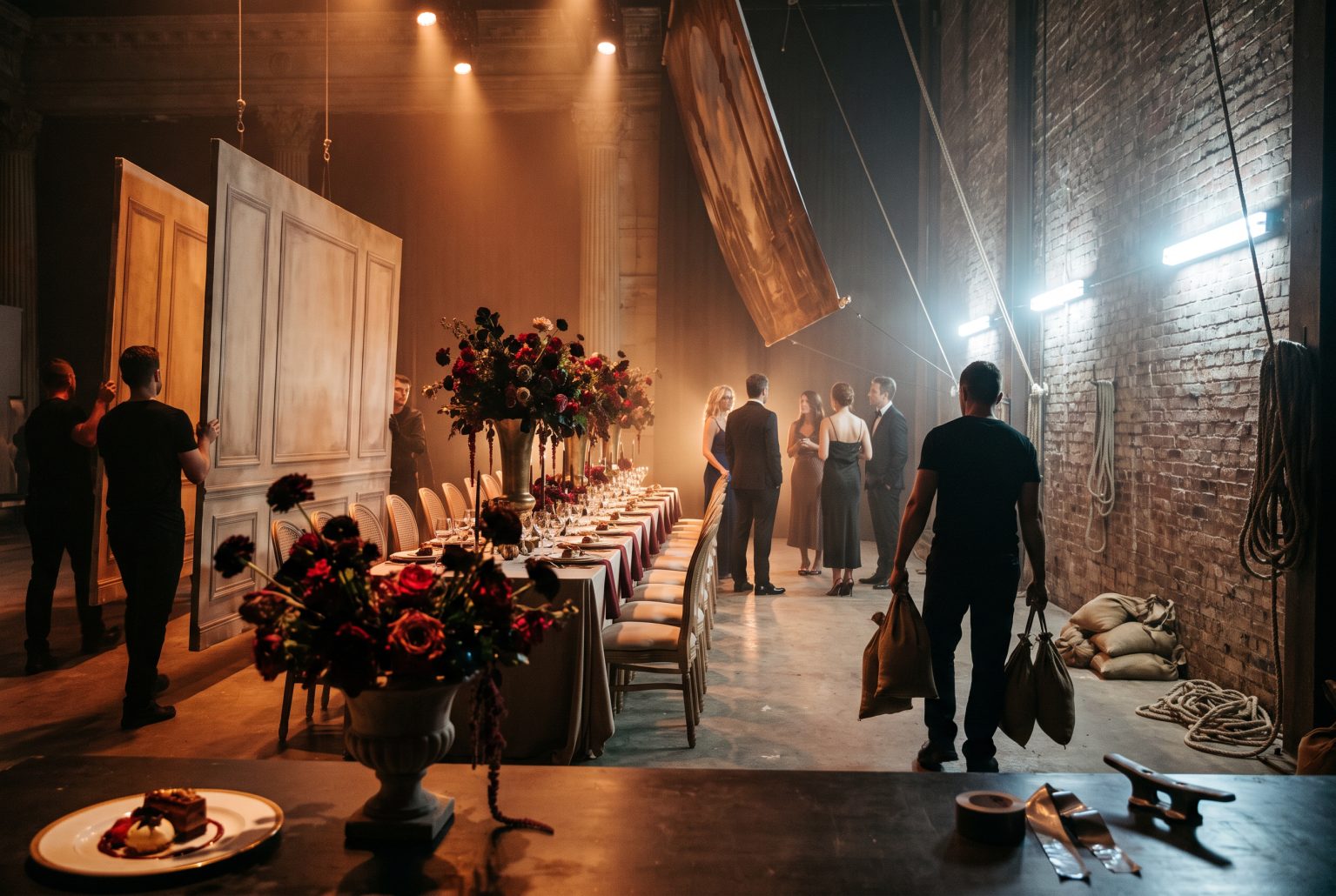
Where the clothes come from
From the get-out, which is the part of a theatre’s working life that nobody buys a ticket for. When a production finishes, a crew comes in and takes the set apart on a clock: props and dressing off first, soft goods brought in and unclipped from the bars, lanterns off the electrics, flown pieces landed and unrigged, flats unscrewed from the deck and run off through the dock doors into a lorry that is booked and has a driver whose hours are legally counted. It is skilled, heavy, fast and completely unsentimental, and it happens in the dark in every theatre in the country.
The crew wear blacks: matte black, long sleeves, closed toe, nothing that catches on a flat and nothing that makes a noise, because calls have to be heard across a stage. It is the most legible uniform in any building and it is designed entirely to disappear. That is the source, and it gives this Look Book two things nothing else in the collection has: a genuine argument about matte finish, and a hard technical constraint, which is that every guest will be seen in two completely different lighting states in one evening.
What we take: the discipline. Matte over shine, utility over decoration, sleeves, pockets, real shoes, nothing swinging. The crew’s wardrobe is the only one in the building that was designed against a specification, and a room full of people who have dressed against a specification looks extraordinary.
What we refuse, twice over. First, the theatre-as-genre costume: top hat, cape, velvet frock coat, half mask, feather. It gestures at the theatre rather than at this building on this night, and it makes the actual crew look like extras in it.
Second, and less obvious: guests do not dress as crew. Head-to-toe matte black on a guest, in a room where eight people are working in head-to-toe matte black, produces two bad outcomes. Guests get asked to move things, and the crew — who are doing a real job, at house rates, at midnight — become indistinguishable from people who are playing at it. Blacks are a working garment worn by working people. Borrowing them is not a compliment.
The line
Built for standing, because everybody will be. The tables go somewhere around midnight and the last part of the evening is eaten upright on a bare stage. So the whole silhouette has to work in three-quarter view at conversational distance, on the move, with a glass in one hand and something in the other, and no table to lean on and nowhere to put anything down.
Volume is welcome and it goes at the top or through the middle — a full sleeve, a gathered shoulder, a cut that stands away from the body. Not at the hem, because the deck will be taped, screwed and swept and a trailing hem picks up staples, gaffer residue and scenic paint in about four minutes. Ankle length or above. If you want floor length, line it and accept that the last three centimetres are a consumable.
The shoulder matters more than usual because of where the light is coming from. In the dressed state, the light is warm and frontal and low, and it flatters. In the bare state, work lights are high, cold and directly overhead, and everything with a horizontal plane — a shoulder, a cheekbone, a brow, the top of a bust line — catches light while everything under it goes into shadow. Clothes with structure at the shoulder survive that change. Clothes that rely on a soft edge and a warm glow do not.
Nothing that has to be held. No clutch, no wrap that needs one hand, no shawl that slips. By half past midnight there is no chair to hang a jacket on and no table to put a bag on; there is a bare deck, a ghost light and a crew coiling cable. Whatever you have brought is attached to you or it is in the cloakroom.
For a wardrobe you already own: a well-cut jacket over a plain dress, with flat shoes and a cross-body bag. That is the entire line and it is not a lesser version of it.
The cloth
The governing fact is the lighting change. The dressed room is lit warm, low and frontal, around 2700 to 3000 kelvin. The bare stage is lit by work lights: hard, flat, blue-white 4000K, hung high, unshaped. Almost no fabric behaves the same under both.
Sequins and heavy shine are the headline casualty. Under warm gel at a low angle, a sequin gown is genuinely magnificent — it was invented for exactly that light. Under overhead work lights it goes hard, cheap and slightly plastic, because the specular highlight is now white rather than amber and it is coming from directly above. Whatever you wear will be seen in that second state for the last hour and in every photograph anybody takes after midnight. If you want shine, take it small: a satin lapel, a metallic thread through a matte ground, one bright accessory.
Velvet is the theatre’s own material and it is a genuine trade-off. Under gel it is the most beautiful thing in the building. Under work light it goes flat and slightly dusty and reads its true colour, which for cheap velvet is not a good colour. Good silk or cotton velvet survives; polyester velvet does not, and the difference is visible at three metres in the second state.
What holds through both: matte wool crepe, worsted, heavy cotton drill, cotton duck and canvas — which is what flats are covered in, so it belongs here twice over — moleskin, leather, dense knit, and any silk with a broken or textured surface rather than a flat one. Structured cotton and wool are the reliable ground for this evening.
What crumples in a car and stays crumpled: unlined linen, silk crepe de chine, viscose. There is a specific problem here beyond the usual one, which is that a stage is dusty. Scenic dust, sawdust from the flats and the residue of years of the same floor being screwed and repainted are all in the air the moment the strike starts, and matte black shows every particle of it. Wear black and you will be grey at the knee by one o’clock. That is another argument against the crew look and it is the practical one.
The thing that looks expensive and is not: heavy cotton canvas or drill in Scenic Canvas or Plywood, cut sharp. Against real flattage, in either lighting state, it reads as deliberate and slightly architectural, and it holds its shape all night, which velvet at four times the price will not.
Colour, on a person
The room is seventeen per cent Flat Black and the crew are wearing all of it. So the single most useful thing this palette does for a guest is tell them what not to wear.
Do not wear Flat Black (#14151A) head to toe, for the reasons above. Do not wear Gaffer Silver (#9AA0A4): it is the colour of the tape on the deck, the ladder, the truss and the grid, and a guest in mid-grey against a bare stage is the most invisible person in the building in both lighting states.
Wear Curtain Red (#7A1420). It is the statement colour and it is the only one that gains in the second state — a deep blue-red under warm gel reads rich, and under cold work light it goes darker and more serious rather than dying. Wear Scenic Canvas (#C6B79A) and Plywood (#C09A62), which are the two colours of unpainted set and are the most forgiving things here on the widest range of skin, warm in both states and never clinical. Wear Rosco Night Blue (#1D3557) for the severe version. Put Ghost Light (#FFE9B0) near the face — a silk lining, an amber earring, a scarf edge — because it is the only warm point left when the work lights come on and it will do more for a jaw at one in the morning than any amount of product.
On black, honestly: an all-black outfit with one strong non-black element — a red shoe, a canvas coat, an amber scarf — is completely correct and is the answer for anybody who owns one good black dress or one good black suit. What is being refused is unrelieved black from collar to sole, which is a uniform in this room and belongs to somebody else.
The looks
House Red
Curtain Red, floor to neck, in a matte cloth — wool crepe, heavy cotton, a compact jersey. Long sleeves, a defined shoulder, hem at the ankle. The single most photographable look at this evening in both lighting states, and the only one that genuinely improves when the work lights come up, because it is the last saturated colour left in a room that has gone grey and timber. Flat or block-heeled shoe with a real sole. One heavy gold or brass piece at the ear or wrist. Detail: nothing else. This look is ruined by a second idea.
The Canvas Coat
A long coat or a boxy jacket in Scenic Canvas cotton duck, over black or Rosco Night Blue, with a heavy trouser and boots. It is the colour of the back of every flat in the building, which means that under work lights the wearer stops being a guest in a room and starts being part of the material world of the place. Non-gendered by construction and it works standing, walking and leaning. Detail: a leather glove or a folded work glove in the outer pocket — not worn, and not a costume prop, just the correct object.
Ghost Light
The pale look, and the one to give a principal. Warm off-white and pale amber — a heavy satin, a matte crepe, a fine wool — cut long and simple, with no shine anywhere on it. In the dressed room it reads as the warmest thing at the table. On the bare stage under blue-white work light it is the only warm object left in the building apart from the ghost light itself, and it is unmistakable from the back of a house. Detail: brass, not silver, and only one piece of it.
Blue and Brass
The severe version. Rosco Night Blue tailoring, worn as a suit or as separates, with a collarless shirt or a fine knit underneath and a plain leather belt. Blue holds its identity under both lighting states better than any other dark colour, which black does not. Brass hardware, brass at the cuff, a brass ring. Boots or a plain derby with a rubber sole. Detail: nothing at the neck. This look is about the shoulder and the shoe.
The Black Suit, already owned
A black suit or a black dress, which most people reading this own, rescued from crew territory by exactly one thing: something that is not black, in quantity, at the top half. A Curtain Red knit under the jacket. A Scenic Canvas shirt. An amber silk scarf, tied and left. That is the whole adjustment and it takes it from invisible to intentional. Do not attempt to fix it with jewellery alone; small bright metal on black under work light reads as nothing at four metres.
Denim and Plywood, already owned
Indigo — a good dark jean or a denim jacket — with a Plywood or tan knit, a leather belt and boots. It sounds too casual for a dinner and it is not, because the last hour of this evening is spent standing on a working stage among people in workwear, and indigo is the one fabric in general circulation with a genuine claim to that room. Add a well-cut jacket if it is a formal invitation. Detail: a proper watch, which is the correct accessory for an evening run to a schedule.
Accessories, jewellery, shoes, bags
Shoes are a technical question here and the venue will have opinions. A stage deck is painted softwood that gets screwed into and repainted between productions, and it is soft. A stiletto tip concentrates the whole of a body’s weight onto a few square millimetres, which is an enormous pressure in the material sense — far beyond what softwood resists — and it punches dents that the venue will notice and may charge for. Take a block heel, a wedge, a flat or a boot. Ask the venue before you decide: some houses ban stilettos on the deck outright and they are right to.
The floor has other opinions too. There will be taped exclusion zones, cable runs under mats, and screw heads. There may be a rake — many older stages slope down towards the audience, and a rake will find any shoe you cannot stand still in. Rubber or composite soles, always. You will be on your feet for the last ninety minutes.
Jewellery has one rule that is specific to this room and it is not about looks: nothing that makes a noise. During a strike, calls are made and answered across a stage, and a warning like heads, bar three coming in has to be heard by everybody. Stacked bangles, long chains against sequins, a bag with hardware — all of it adds to a sound floor that the crew are working against. Wear fewer, heavier pieces.
Scale: large and few, because the second state kills detail. A fine chain, a small stud and a delicate bracelet all disappear at three metres under overhead work light. Brass, bronze and warm gold hold under both colour temperatures; silver goes grey and vanishes against gaffer tape.
Bags: cross-body or nothing, and small. There is no table after midnight. Big enough for a phone, a lip, a card and a folded plastic bag for the shoes you will regret — not a joke; several people at every one of these evenings change out of their shoes and have nowhere to put them.
Hair, face and hands — the short version
Build the face for the second lighting state, not the first. Work lights are hard and come from directly overhead, which drops shadow into the eye socket and under the cheekbone and washes out everything on a vertical plane. The instinct is to add more coverage and more contouring; the correct move is the opposite. A lighter base, a warmer skin finish, and definition moved slightly lower — more on the lash line, less on the socket — survives the change. Anything built to look good under warm frontal light and nothing else will look like a completely different face at ten past midnight.
Hair is off the face and secure, because the last hour is spent standing and moving in a room where people are carrying things past you. Nails short and warm-toned; hands are in every photograph of an evening where the food is eaten standing and there are no plates. The full method — the two-state problem, what happens to a base under 4000K, the hair that survives a room at twenty-six degrees under work lights, and the honest account of what holds until one in the morning — is on Vanity or Vice, in Two Lighting States, One Face.
The host, and the difference
The host has an unusual problem tonight, which is that they are not in charge. The stage manager or the production manager is, and if that person says the dinner stops, the dinner stops. So the host’s clothes have to do something specific: read as the host to the guests, and read as a civilian to the crew, and never read as somebody who thinks they are running the get-out.
The answer is warm and plain. Scenic Canvas, Plywood or Curtain Red, in a compact cloth, with flat shoes, sleeves that push back and genuine pockets, because the host will be carrying a phone, a running order, a torch and somebody’s glasses. Nothing black. Nothing that could be mistaken for blacks at ten metres in a dark room, which is exactly the distance and the light at which mistakes get made.
Carry a small torch. A darkened stage mid-strike is a difficult place to walk, and lighting a guest’s way to the wings is the most useful thing a host can do all night.
A principal — the person the evening belongs to — wears Ghost Light. In a room whose palette is black, timber, canvas and blue, one person in warm off-white is visible from the back of the auditorium in both lighting states and needs no seat marker and no announcement. When the work lights come on, they are the only warm-coloured thing left standing on the deck. That is the whole mechanism and it costs nothing.
What to tell guests
The invitation line: The room comes apart around us and the last hour is spent standing on a bare stage. Wear something you can stand up in for ninety minutes. Flat shoes or a heel with a base — no stilettos on the deck. Colour rather than black; the crew are in black and they are working. Nothing you would mind getting dusty.
The honest translation, because dress codes fail by being atmospheric. It means: dress as you would for a good dinner, then check three things. Can you stand in these shoes for an hour and a half on timber? Is there anything about this outfit that requires a table, a chair back or a spare hand? And is there one thing on me that is not black? If those three are answered, you are correctly dressed, and it costs nothing to be.
Somebody will arrive in stilettos. This is the one dress-code point with a physical consequence, so handle it before the door: say it on the invitation, say it again in the week-before email, and have a box of flats in a range of sizes at the cloakroom, offered to everybody arriving rather than produced at the point of failure. Nobody is corrected and nobody is asked to change their shoes in front of other people.
Getting it wrong
The costume version is the theatre-as-genre one and it will be attempted by at least two people. Top hat, cape, half mask, a feather, a velvet frock coat, something borrowed from a production of anything. It is fancy dress, and its specific failure here is that it makes the crew — who are doing skilled paid work in front of the guests — look like part of a costume party. Nothing else in this book damages the evening as quickly.
The over-matched version is the whole room in black. It happens naturally, because black is what people wear to a theatre, and it produces a dinner that is visually indistinguishable from the strike happening around it. Half the point of this evening is the contrast between people who are eating and people who are working; if everybody is in the same colour, that contrast is gone and so is the idea.
The accessory that cheapens it every time is a small bright rhinestone anything — a clip, a buckle, a bag chain, a heel. It is designed for warm frontal light and it is the first thing to look wrong under a work light, where it stops sparkling and starts looking like hardware.
Get it right, and the last image of the evening is this: an empty deck, a bare brick wall, one bulb on a stand, and forty people standing on the stage in canvas, blue, amber and red, having a conversation, while somebody coils a cable behind them and nobody minds.
Atmosphere OS · Theme Atelier
Where the feeling stops being a photograph.
Theme Atelier converts a direction into a documented design system with the lighting and material consequences attached. It runs in your browser and stays there until you decide the project is worth saving.
The rulebook is public. Every formula it runs on is written down where you can disagree with it.
Continue through the system
Pretty is still not a plan.
This field note belongs to a larger event-design system. Follow the chapter that explains the next pressure point instead of falling back into an undifferentiated archive.
What you have to decide next
One decision constrains the next. This is the order they actually happen in.
- Venue Will this room hold it? The Generator Was Late. The Washrooms Were Waiting.
- Guest experience How will guests move through it? Family Milestone Reception for One Hundred Fifty: Three Generations Need More Than One Volume Level
- Production How does it get built and run? Museum Reception for One Hundred Forty: The Building Gets a Vote
- Vendors Who owns each handoff? The Dance Floor Wrap Is Not the Whole Dance Floor
More in this chapter


See the complete five-chapter Event Design Intelligence map →