Venue Intelligence
Wedding for Two Hundred and Fifty: The Kitchen Is Now the Guest List
Past about two hundred covers the room stops being the constraint on a wedding and the catering kitchen takes over. Hot-holding capacity is now deciding your menu.
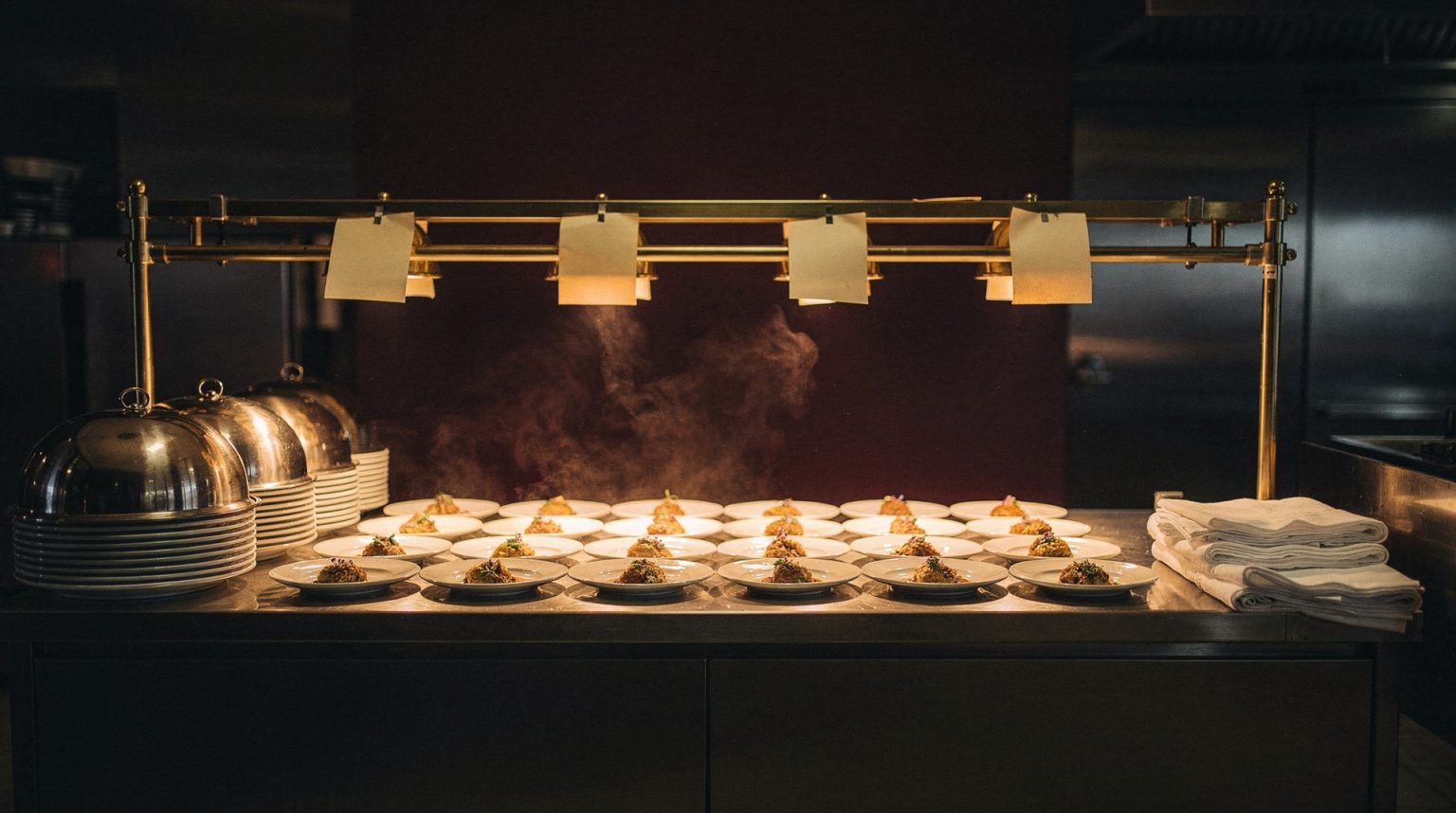
Generated image Made with flux-2-pro via ElevenLabs to show what this article describes. Nothing in it was photographed at an event.
At twenty to eight the kitchen is quiet in the particular way that means everything is committed. Six hot boxes along the wall, all humming. Two hundred and fifty plates stacked in tens on a bench that is a metre too short. A sous chef marking a tray list on masking tape. Somewhere beyond the double doors a best man is discovering that his second anecdote is longer than he remembered, and every person in this room now knows exactly how much that will cost.
This is the part of a large wedding nobody tours. The couple saw the barn, the lawn, the light at six o clock in September. They did not see the eleven square metres behind the service door where two hundred and fifty dinners have to be assembled, held, plated and dispatched inside about forty minutes, and that room is now making decisions about their menu whether or not anyone consults it.
Somewhere around two hundred covers the binding constraint on a wedding stops being the floor and becomes the kitchen. Below that, the question is whether the tables fit. Above it, the question is whether the food can physically leave.
Hot-holding is a capacity, and it is smaller than you think
A standard mobile hot box holds something like forty to sixty plates depending on the plate and the unit. Two hundred and fifty covers therefore needs five or six of them running simultaneously, each drawing roughly 1.5 to 2 kW.
That is eight to twelve kilowatts of continuous load, before the water urns, the coffee, the induction rings and the dishwash. Continuous loads should be planned at eighty per cent of a circuit rating, which means a 16 A circuit at 230 V gives you about 2.9 kW to work with and a 20 A circuit at 120 V gives you about 1,920 W. Six hot boxes is not two circuits. It is a distribution question, and at a dry-hire venue it is a generator question. The extension cord is not the event power plan, and at two hundred and fifty covers the extension cord is not even a joke any more.
Ask the venue what the kitchen ring main is rated at. If nobody knows, the answer is that it has never been tested by six hot boxes, and your wedding is the test.
The pass is a queue with knives
Plating is a serial operation. Two chefs on a composed plate manage something like four to six plates a minute between them once the rhythm is going. At that rate two hundred and fifty covers is forty-five to sixty minutes of plating, and the first plate cannot sit for an hour.
The fix is to widen the pass: more hands, more linear metres of bench, two plating lines instead of one. That requires a kitchen with the floor to hold six people working at once, which most converted stable blocks and country-house sculleries do not have. This is the real reason a caterer will look at a beautiful venue and quietly recommend a menu you did not expect.
| Covers | Servers for synchronised service | Plating at the pass | First plate to last | What changes |
|---|---|---|---|---|
| 80 | 5 to 6 | 15 to 20 min | 12 to 15 min | One line, one wave, no drama |
| 150 | 8 to 10 | 25 to 30 min | 20 to 25 min | Dietary plates need a named runner |
| 250 | 14 to 18 | 40 to 60 min | 30 to 35 min | Two plating lines, or the food holds too long |
| 400 | 22 to 28 | Not on one line | 45 min and up | Staggered service, or stop plating altogether |
These are planning figures from catering practice, not laws. They move with the plate, the room, the distance from kitchen to furthest table and whether the service door opens onto the dance floor. But the shape of the curve is reliable, and the shape is what matters: service time does not scale linearly with covers, because the pass does not get wider just because the guest list did.
The menu is a hot-holding decision now
Anything that suffers in a hot box should not be on the menu at this count. Fish that continues cooking, anything crisp, anything with a sauce that splits, anything that was excellent in the tasting for eight and has never been asked to survive twenty-five minutes at seventy degrees.
What holds: braises, slow-cooked proteins, root vegetables, anything with fat in it, anything with the sauce added at the pass rather than under the lid. The tasting should be conducted on food that has been held, not on food that came off the stove ninety seconds earlier for four people. Ask for that specifically. A good caterer will agree immediately and a nervous one will explain why it is not necessary.
Or stop plating
Family service moves the constraint rather than removing it. Twenty-five tables of ten at three or four platters each is seventy-five to a hundred vessels, all leaving hot inside one wave, which is a trolley problem and an aisle problem rather than a pass problem. It needs wider service routes, somewhere to stage the trolleys, a plan for where empty platters go, and tabletops with room for serving pieces alongside the glassware and the flowers.
Buffet service moves it again: one double-sided line clears roughly a hundred and fifty to two hundred guests an hour, so two hundred and fifty people through one line is a queue with a wedding attached. Two lines, or four access points, or a station format. Service routes are part of the guest experience, and at this size they are most of it.
Twenty-five tables and the floor they need
Two hundred and fifty guests on 1.8 m rounds at eight covers is thirty-one tables. At the ten-cover banqueting squeeze it is twenty-five, which is what will be quoted. The squeeze gives each guest 0.57 m of table edge instead of 0.65 m, and at twenty-five tables it saves roughly eighteen square metres of table footprint plus its circulation.
Around them, allow 1.35 to 1.5 m of clear floor between table edges on any route a server uses, because a pulled-back chair takes about 0.45 m and two of them back to back take 0.9 m before anyone walks between. With fourteen to eighteen servers moving in a synchronised pass, most routes are service routes.
Clear exit width at roughly five millimetres per person puts two hundred and fifty guests at about 1.25 m, subject to whatever the local code says, and the code cares whether that width is clear at eleven at night as well as at eleven in the morning. The things that block it are always the same: the cake table, the photo booth, a stack of chairs from the ceremony flip, and the case the band left in the corridor.
Where the design fights the guest
- The kitchen is a hundred metres from the marquee. Every plate now includes a walk, and the walk is outdoors in October.
- The service door opens onto the dance floor. Fourteen servers will cross it, in both directions, all evening.
- Speeches were scheduled between courses. The kitchen has two hundred and fifty mains committed and no way to pause them politely.
- Dietary requirements were collected and never reached the pass. Twelve special meals at two hundred and fifty covers become a public search unless they are plated with the main and delivered by name.
- Tall centrepieces on twenty-five tables. Multiply anything by twenty-five before approving it, including cost, setup time and the person opposite not being visible.
If the venue has no kitchen at all
Dry-hire and marquee weddings at this size need a field kitchen, and a field kitchen is a building you are renting in parts. As a rough planning figure, allow around one square metre of catering tent per eight to ten covers, plus separate space for wash-up, plus a level surface, plus potable water in and waste water out, plus lighting that works after dark, plus a generator sized with headroom rather than to the sum on the equipment list.
None of that is exotic. It is simply invisible in the venue photographs, which is why it is usually priced last. A tent is a venue you have to build, and the catering half of it is the half that decides whether dinner happens on time.
Measure the pass, not the applause
Ask the caterer, afterwards, for three numbers: the clock time the first main left the pass, the clock time the last one landed, and how many minutes of that gap were caused by the room rather than the kitchen. The third number is the one that improves next time, and it is almost always speeches.
Then ask what they would have changed about the menu given the kitchen they were actually given. They knew in April. The published service and clearance figures are worth reading alongside the quote.
Work two hundred and fifty through the service plan (opens in a new tab)
Also useful here: a catering kitchen is not the same thing as a kitchen, read the loading dock before the ballroom, and serpentine tables and the service aisle. The rest of the ladder is in Occasion Formats, and the building side in Venue Intelligence.
Go out through the back at midnight. There will be a row of hot boxes cooling by the door, twenty-eight crates of plates stacked against the wall, and a bin of untouched garnish. Nobody photographed any of it, and it is the part of the evening that decided whether the food was good.
Sources: hot-box capacities, plating rates, server ratios and buffet-line throughput are catering-operations planning figures that vary by supplier, equipment and menu; confirm yours with the caterer in writing. Continuous-load planning at 80 per cent of circuit rating follows standard electrical practice, and any real load calculation belongs to a qualified electrician. Exit-width planning at roughly 5 mm per person reflects common UK event guidance, with local codes governing.
Venue Intelligence
Most of these rooms have not answered the question yet.
For the large majority of rooms on record, no source of any class addresses the point you are asking about, and Venue Intelligence shows you the blank instead of filling it with something plausible. The silences turn out to be the useful part.
It promises nothing about the day itself, and it puts that sentence where you can see it.
Continue through the system
Pretty is still not a plan.
This field note belongs to a larger event-design system. Follow the chapter that explains the next pressure point instead of falling back into an undifferentiated archive.
What you have to decide next
One decision constrains the next. This is the order they actually happen in.
- Atmosphere What should the room feel like? One Hand, No Plate, After the Tables Go
- Guest experience How will guests move through it? Family Milestone Reception for One Hundred Fifty: Three Generations Need More Than One Volume Level
- Contingency What happens if the weather turns? The Storm Wasn’t the First Failure
- Budget What does this trade off against? The Dance Floor Wrap Is Not the Whole Dance Floor
More in this chapter
See the complete five-chapter Event Design Intelligence map →