Occasions & Formats
Backyard Birthday for Sixty: The Yard Is a Venue Now
At sixty guests, a backyard birthday has crossed into venue territory. Plan bathrooms, power, weather, neighbors, rentals, lighting, food, service routes and parking before the lawn becomes the most expensive thing you forgot to measure.
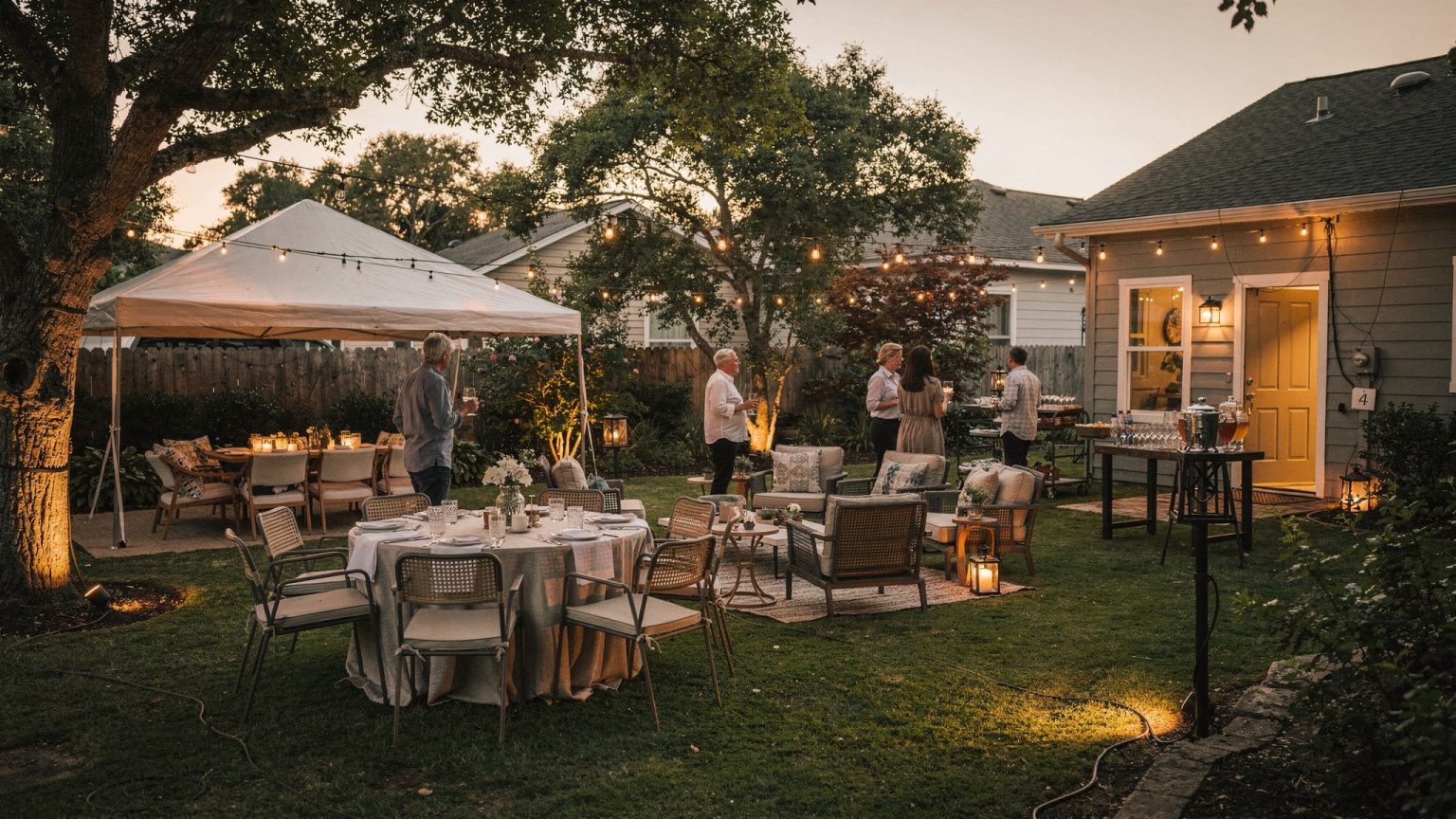
One residential bathroom is about to do a job it has never done. The street is about to hold more cars than it was built for, and one outdoor circuit is about to be asked for more than anybody has ever asked of it.
That is what sixty does to a house, and affection for the garden changes none of it. A backyard can still feel personal in a way a rented room rarely does. It simply does not come with the infrastructure to host sixty people merely because it comes with the address.
The yard is a venue now. Treat it with affection and suspicion. Every question in the venue archive now applies to your own lawn.
Measure usable space, not property size
A large yard can have surprisingly little event space once slopes, garden beds, sprinklers, trees, stairs, septic areas, play equipment and service routes enter the drawing.
Map the actual guest zone, food zone, bar, seating, shade, bathroom route and any music or activity area. Then draw the paths between them. The floor plan still decides the traffic, even when the floor is grass.
Put a dining table or a lounge cluster on the route to the bathroom and it becomes a corridor with chairs in it, all evening, for everybody.
Decide what happens inside the house
Sixty outdoor guests will still use the house unless the event provides alternatives.
Choose which doors are active and which rooms are public. Decide whether the kitchen is event workspace, guest space or both. Protect bedrooms and offices. If the only guest bathroom is deep inside the house, understand that sixty people will create an indoor route whether the party was advertised as outdoors or not.
The threshold needs to survive repeated traffic without becoming a pile of shoes, bags and half-open doors.
Bathrooms are not a delicate topic at sixty
One residential bathroom may function for sixty guests during a short event, but function is not the same as comfort. Duration, age mix, children, alcohol, plumbing capacity and whether guests can easily reach it all matter. Ratios like that live in the rulebook, where they can be argued with in daylight.
If you are renting portable units
If portable restrooms are appropriate, rent units you are willing to make part of the event rather than hiding a construction-site surprise behind the garage. Confirm placement, lighting, handwashing and service access.
If the house bathrooms are doing the work, stock them, ventilate them and assign someone besides the host to notice problems before the entire guest list does.
Power becomes visible the moment it fails
String lights, caterer equipment, coffee, speakers, refrigeration, heaters, fans and decorative lighting can quietly ask more of a residential electrical system than the mood board suggests.
List every electrical load. Ask vendors what they actually require. Keep extension cords rated appropriately, protected from water and routed where guests will not trip over them. If a generator is needed, plan sound, fuel and safe placement rather than parking it beside the conversation zone.
The party can feel informal. The electrical plan should not. Atmosphere OS turns those loads into a vendor pack, which is how they become somebody’s stated responsibility.
The load list is short, but it is a list, and it starts from how many people the yard is actually being asked to hold.
Work out what sixty asks of the yard (opens in a new tab)
What sixty asks of the yard
Weather needs thresholds, not optimism
A sixty-person rain plan cannot be “everyone goes inside” unless the house can truly host sixty people inside.
Decide what conditions activate a tent, cancel an outdoor element, move food service, add heaters or shift the event entirely. Shade matters as much as rain. Wind matters to linens, candles, temporary structures and serving pieces. Heat changes food safety and guest endurance.
Build the weather contingency before the forecast gets personal.
The tent has to solve a problem
A tent is not automatically required. It is also not simply a decorative ceiling.
If the event needs weather protection, define how much of the party must fit under cover and whether sides, flooring, lighting or climate equipment are needed. A small beautiful tent protecting twenty seats does not become a rain plan for sixty people because the photographs were persuasive.
Temporary structures have real installation, anchoring and site requirements. Confirm them with qualified rental providers and local requirements rather than improvising around underground lines or irrigation.
Feed sixty people without turning the back door into a loading dock
Catering at home needs staging space, water, waste, refrigeration or hot holding, and a route from vehicle to service area.
Protect the kitchen if the caterer needs it. If food arrives finished, decide where it lands and how it is replenished. Use service routes so trays, trash and guests are not all using the same narrow gate.
If the host is cooking, simplify aggressively. Sixty people can tell when dinner was ambitious. They can also tell when the host has disappeared for ninety minutes.
Build the bar for peak arrival
A self-service beer, wine and zero-proof station is usually enough for a relaxed birthday in your own yard, and if you would rather someone kept an eye on the pours, staff it. Cocktails will probably need a person regardless. Whichever you choose, ice, water, glassware and waste all need homes.
Keep the bar away from the narrowest path into the yard. Give water a point of access that does not require waiting behind alcohol orders. If guests are driving, make the nonalcoholic offer feel intentional rather than like the emergency shelf.
Neighbors are part of the site plan
Sixty cars, music and outdoor conversation change a residential block.
Tell immediate neighbors what is happening before the first delivery truck arrives. Think about parking, driveways, trash pickup, quiet hours and where rideshare vehicles can stop without blocking access. Local rules around amplified sound, temporary structures, street use, fire and parking vary; confirm what applies.
A friendly warning does not replace compliance. It does reduce the chance that the first event communication a neighbor receives is bass through a bedroom wall.
Use lighting to make the site legible after dark
Decorative string lights can establish mood. They may not illuminate stairs, uneven ground, bathroom routes or the gate.
Layer task lighting into the event: entries, steps, paths, food, bar, restrooms and parking transitions. Keep bright utility light out of guests’ eyes where possible, but do not sacrifice safe movement to protect the romance of the yard.
Seating should match the birthday, not the rental catalog
Sixty guests do not necessarily need sixty dining chairs unless dinner is seated. They do need enough legitimate places to sit.
Use tables, supportive chairs, benches and lounge pieces according to the social format. Keep some seating on firm, level surfaces for guests who cannot comfortably use soft ground or low furniture.
A backyard can feel collected without requiring every chair in the house to migrate outdoors.
Waste and strike begin before the party ends
Residential trash capacity is not event waste capacity.
Plan separate locations for guest trash, catering waste, bottles and recyclables where applicable. Keep them functional without turning the buffet into a sorting station. Decide where rentals stack and how they leave without requiring everything to cross through the house at midnight.
If flowers, candles, signage or other elements are being kept, assign them before breakdown begins.
Let the yard stay recognizable as someone’s yard
The point of hosting at home is not to disguise the property until it looks generically rented.
Use the tree everyone knows. Let the garden matter. Make the porch useful. A backyard becomes a venue through sequence, not through pretending it was never a backyard.
At sixty guests the personal setting is the advantage, and the infrastructure is the price of keeping that advantage pleasant. Power, bathrooms, weather, service, parking and cleanup all want deciding before anybody sees the lawn.
Left undecided, they fail in a fairly predictable order, and it is nearly always the lighting that goes first. The string lights look perfect at eight. At a quarter past nine somebody who has had two drinks misses the step down from the patio, because nobody lit the step.
Sixty is roughly the last size a house can absorb without renting anything. Past that the ground, the power and the one bathroom all start charging rent, and they charge it at predictable numbers.
Field notes and corrections
When a number here turns out to be wrong, you hear about it.
Two things arrive and nothing else. The new field note — bar rates, cover widths, service clearances, the arithmetic worked through on one real evening. And a correction whenever a rule in the published rulebook changes, or a number the tools rely on turns out to have been wrong. There is no weekly slot, because there is nothing weekly to put in it.
One email per field note, plus corrections when a published figure moves. Unsubscribe from any of them.
Continue through the system
Pretty is still not a plan.
This field note belongs to a larger event-design system. Follow the chapter that explains the next pressure point instead of falling back into an undifferentiated archive.
What you have to decide next
One decision constrains the next. This is the order they actually happen in.
More in this chapter



See the complete five-chapter Event Design Intelligence map →