Occasions & Formats
Masquerade Ball: Mystery Without Making Masks Mandatory
Plan a masquerade from an intimate dinner to a full ballroom, scaling arrival, lighting, masks, music, service, accessibility, and reveal moments so the concept works whether there are 24 guests or 400.
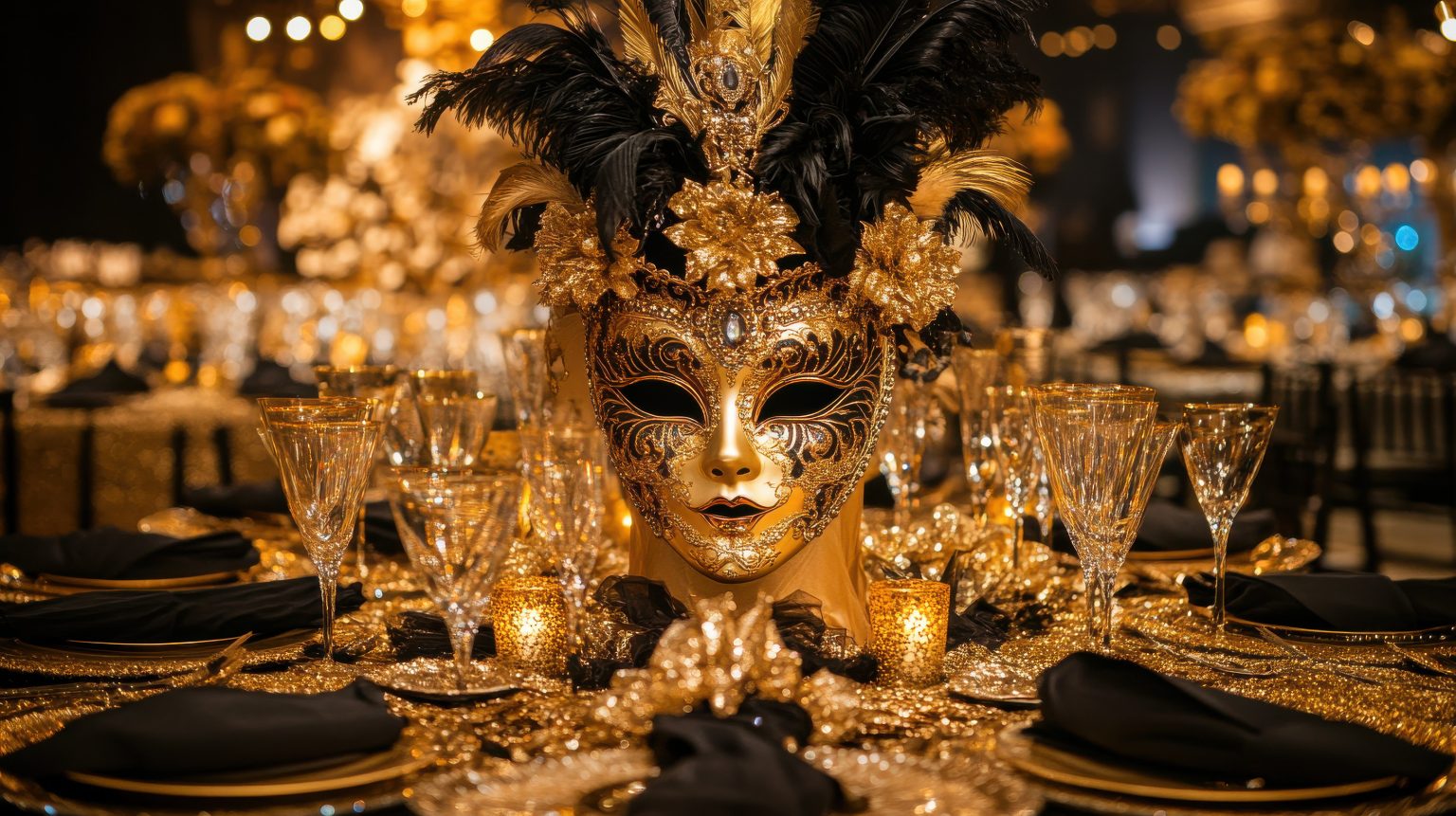
Design Atelier · Theme Planning
A masquerade is not a black tablecloth, a feathered mask and a gold charger having a meeting. The theme works when concealment, recognition and reveal change the way the evening moves. If every guest can remove the mask and nothing else about the event changes, the masks were merchandise.
That is also why masquerade scales so well. At twenty guests, the entire world may live in one table, one threshold and one lighting change. At four hundred, the same premise becomes architecture, circulation, performance and controlled sightlines. The scale changes. The argument should not.
Start with the reveal, not the mask order
Before deciding whether masks are velvet, lacquered, translucent or absent entirely, decide what becomes visible over the course of the event. A concealed room. A change in color. Portraits that appear only after dark. A performer who has been sitting among guests. A dessert salon behind a closed wall. Names attached to anonymous notes. One controlled moment when the whole room changes state.
That reveal is the spine. Everything else should prepare it.
If every guest can remove the mask and nothing else about the event changes, the masks were merchandise.
Without that structure, a masquerade usually becomes a costume prompt wrapped around an ordinary gala. Guests arrive. They eat. Someone gives a speech. There is music. The masks spend the night interfering with glasses.
Make masks an invitation, never an entrance exam
Mandatory masks create several problems at once: fit, glasses, makeup, sensory discomfort, hearing devices, facial recognition, social anxiety and the simple possibility that somebody does not want a decorative object tied to their head for four hours.
A better policy is generous and clear: masks are welcome, excellent ones are available, and nobody is penalized for declining.
If masks are central to the visual identity, build several forms of participation. Wearable masks. Handheld masks. Sculptural masks displayed as art. Projected facial abstractions. Mask-shaped place cards. A portrait installation. The theme should not collapse because one guest needs to see clearly.
As the room grows, hierarchy matters more
At twenty or thirty guests, one threshold and one controlled reveal can carry the entire idea. As the guest list grows, the room needs more hierarchy—not more random decoration.
Large masquerades become weak when every surface receives equal decorative attention. Four hundred centerpieces cannot rescue a room with no visual command structure.
Give the space four jobs:
- Threshold: one unmistakable arrival image that tells guests they have crossed into a different world;
- Primary room: the central dining, social or dance environment where the visual language repeats at scale;
- Quiet counterpoint: a lounge where conversation remains possible and masks can come off without becoming a social announcement;
- Reveal zone: the stage, secondary room, ceiling, curtain line or installation that can visibly change during the night.
If the venue is large, use drape, lighting, ceiling work and portals to control perception. A masquerade is particularly good at thresholds because concealment already belongs to the premise.
Lighting does more work than another cart of props
Low light is not automatically atmosphere. Sometimes it is just a difficult menu.
Protect faces, food, stairs, service routes and accessible circulation. Then build layers: warm arrival light, controlled table light, texture on walls or drape, selective saturated color, and a programmed shift for the reveal. Test the actual masks and materials under the actual light. Metallic surfaces can flare. Dark velvet can disappear. Colored light can turn dinner into a laboratory sample.
An empty-room photograph proves very little. What I want to know is whether the lighting still behaves once four hundred human faces arrive. That test runs through everything filed under atmosphere.
Zones, thresholds, sightlines and the number of faces the lighting has to survive are all functions of a single number, and it is worth putting that number into the plan before the mask order.
Build the masquerade room for four hundred (opens in a new tab)
Design the guest journey as five chapters
A reliable 400-person sequence might look like this:
| Chapter | What guests experience | What production has to solve |
|---|---|---|
| Arrival | Choice, curiosity, portrait or mask moment | Check-in throughput, coat check, mask distribution without a queue |
| Recognition | The room becomes legible | Sightlines, wayfinding, first drink, seating clarity |
| Settling | Dinner, conversation, roaming performance | Comfortable light, service lanes, sound coverage |
| Reveal | One room-wide change | Show calling, lighting cue, drape or scenic transition, stage audio |
| Release | Dancing, dessert, late-night energy | Bar capacity, floor conversion, safe lower-light circulation |
This structure can compress for smaller events. Ten people still need arrival, recognition, change and close. They simply do not need a production truck to achieve it. Atmosphere OS holds those chapters, the florals and the cue that changes the room in one document.
Low light is not automatically atmosphere. Sometimes it is just a difficult menu.
Food and beverage should understand the premise
Do not force a Venetian menu onto the event because the internet associates masks with Venice. Build service around the actual concept. A velvet-dark supper may want glossy fruit, lacquered desserts and reflective glassware. A botanical masquerade might use herbs and green notes. A bright electric version could use sharp color and translucent vessels.
More important: service must work with masks, gloves, dim light and dense social circulation. Avoid elaborate hand-held food that requires three fingers, perfect depth perception and a place to set a cocktail.
Staff the transformation, not the costume
A dinner for thirty may not need a producer, dedicated lighting technician or mask-distribution team at all. Those roles appear when the event has enough guests, programmed cues or operational pressure that one person can no longer own the transition cleanly.
The exact count depends on venue and service style, but the roles should be explicit. One event lead. One producer or show caller if the room changes state. Venue captain. Lighting lead and technicians. Audio support. Entertainment manager. Catering and bar leadership. Welcome team. Coat-check team in cold weather. Two runners. Photo and video. Security as required by the venue, alcohol plan and guest profile.
If masks are being lent or customized, give that job an owner. Do not make registration staff solve tangled ribbons while a check-in line forms behind them.
Budget by consequence, not category prestige
For a polished U.S. event near 400 guests, a broad all-in planning range can easily land between roughly $50,000 and $165,000 before extreme-market premiums or elaborate custom fabrication. There is no universal split, only a priority order.
- Protect venue, food and beverage first because guests have to be hosted.
- Protect lighting and audio because the reveal fails without them.
- Spend scenic money on large consequences: portals, drape, ceiling, stage, bar fronts.
- Use smaller decorative objects only after the room already reads.
- Keep 10–15% contingency because install, labor and venue restrictions have a sense of humor. The published allowances say where that percentage usually goes.
If the budget is modest, shrink the number of scenes, not the clarity of the premise. One beautiful threshold and one room-wide reveal will outperform twenty unrelated mask motifs.
The small-room translation
For twenty guests, I would keep it to one long table, a controlled palette, masks offered but optional, one portrait or note ritual and a single lighting shift. At fifty to a hundred, the arrival starts needing architecture of its own, along with roaming performance and a separate lounge.
Somewhere past a hundred, formal zoning, dedicated show cues and distributed bars stop being optional. From two hundred to four hundred, the event scales through the ceiling, portals, lighting, stage management, staffing and wayfinding. Multiplying tabletop objects is the one move that does not scale at all.
When mystery becomes guest friction
- The dress code becomes coercive. Give guests a path to participate without costume performance.
- The room is too dark to function. Protect faces, food and routes.
- The entire look is black and gold. A recognizable palette is not the same thing as a default palette.
- Feathers become a substitute for concept. They rarely improve a service route.
- The reveal has no operational owner. If nobody is calling the cue, the dramatic moment is a wish.
- Accessibility is handled after scenic install. By then, the most beautiful route may be the unusable one.
The mask is the easiest part of a masquerade and the least interesting. Everything above is the actual event.
Measure whether the theme became an experience
Track check-in time, mask uptake without treating refusal as failure, dwell time by zone, performance sightline problems, bar queues, dance participation, accessibility issues, guest satisfaction and what people say they remember first.
Pay the most attention to that last one. If the answer is simply “the masks on the table,” the theme remained an object. If guests remember the room opening, the portrait ritual, the color changing or the moment everyone realized what the evening had been building toward, the concept did its job.
Use the Atelier before you buy the props
Start with Design Atelier to pressure-test the premise, then use the Guest Journey Pressure Test before finalizing the run of show. If the venue itself is doing a great deal of the visual work, read The Restrictions Page Is the Most Expensive Page to Ignore before the room becomes more ambitious than the contract.
Current reference points: U.S. accessibility planning should follow the applicable ADA Standards and venue requirements; large staged events commonly place significant budget into technical production and labor. Final staffing, capacity, fire/life-safety, licensing and venue requirements must be confirmed locally.
If this is your mood
More crystal & gold

Field notes and corrections
When a number here turns out to be wrong, you hear about it.
Three things arrive and nothing else. The new field note — bar rates, cover widths, service clearances, the arithmetic worked through on one real evening. And a correction whenever a rule in the published rulebook changes, or a number the tools rely on turns out to have been wrong. There is no weekly slot, because there is nothing weekly to put in it.
One email per field note, plus corrections when a published figure moves. Unsubscribe from any of them.
Continue through the system
Pretty is still not a plan.
A party gets planned in roughly this order. Pick the chapter where your next problem lives.
What you have to decide next
One decision constrains the next. This is the order they actually happen in.
More in this chapter

See the complete five-chapter Event Design Intelligence map →