Budget & Trade-Offs
When the Theme Is ‘We Already Own This’
“We already own this” is either a sharp design premise or a roll call of objects that survived several garages. The difference is counting them first.
“We already own this” can be a brilliant design premise or the opening statement of an event assembled from every object nobody wanted to store properly.
Owned materials bring history, specificity, savings, and a lived-in quality rentals cannot manufacture. They also bring uncertain quantities, mismatched scale, hidden damage, transport, cleaning, and the emotional argument that an object deserves inclusion because it has survived several garages.
The theme works when existing pieces are treated as a library you get to edit, rather than a roll call where everyone must be present.
Inventory before imagining
Gather or photograph every candidate object with dimensions, quantity, condition, owner, storage location, and transport requirements.
Useful categories may include:
- tables, chairs, benches, stools, and lounge furniture;
- linens, rugs, curtains, and fabric remnants;
- vessels, bowls, trays, candlesticks, frames, mirrors, and lamps;
- plates, glassware, flatware, serving pieces, and barware;
- books, boxes, baskets, tools, garden objects, art, and collections;
- family objects with genuine meaning;
- structures, screens, shelving, signs, and storage pieces.
Do not design from the sentence “there are plenty of glasses in the basement.” Count them. Inspect them. Determine whether they are drinking glasses or a family archive of chipped mustard jars with excellent self-esteem.
Reject before selecting
Remove items that are:
- broken, unstable, stained, unsafe, or unsuitable for the intended use;
- impossible to transport or install within the available labor and access;
- too precious for guest contact;
- not food-safe, electrical-safe, flame-safe, structurally appropriate, or venue-approved where those concerns apply;
- available in insufficient quantity for the proposed repetition;
- included only because discarding or storing them feels emotionally difficult.
Sentiment can justify one important object. It cannot certify an unstable chair.
Choose the governing relationship
The event needs a visual rule stronger than ownership.
Books, brass, and deep red flowers is a rule. So is mixed floral china held in line by white linen and silver, or dark wood and clear glass against garden green. One family pattern repeated at several scales can do it alone. What these have in common is that you could hand the rule to someone else and they would know what to pull from the basement and what to leave.
Select two or three material, color, shape, or era relationships that explain why the objects belong together. That rule is the difference between a concept and a theme: one decides things, the other only describes them.
Sentiment can justify one important object. It cannot certify an unstable chair.
“Eclectic” is not a governing relationship. It is what objects call themselves before editing.
Use repetition to create authority
Owned pieces look intentional when a relationship repeats.
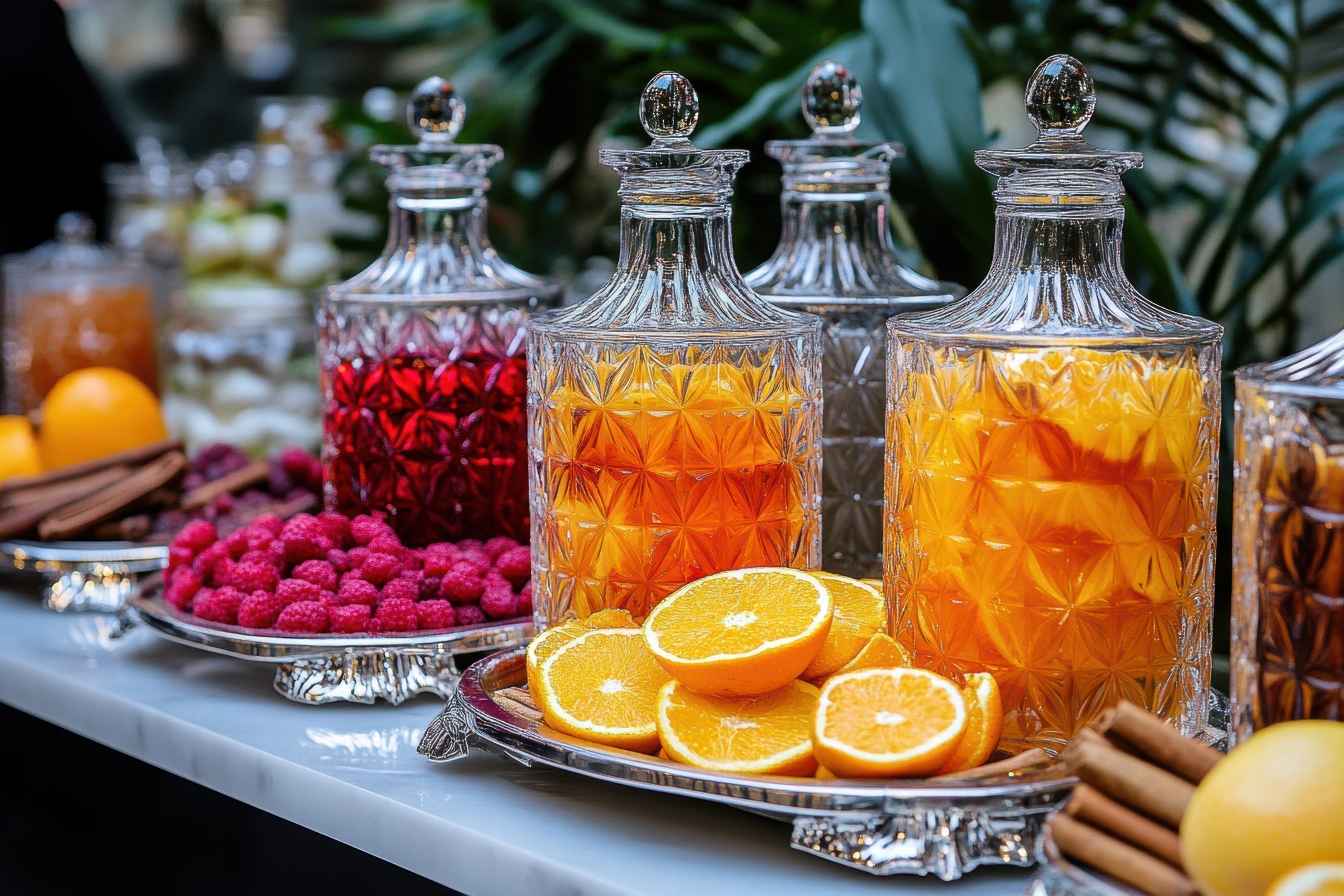
Group similar vessels rather than scattering them individually. Use several books at one bar instead of one book on every table. Repeat brass at three thresholds. Concentrate patterned china on the dessert table and use simpler plates elsewhere.
Repetition turns collection into design. Universal distribution turns it back into storage.
Assign every object a job
A good job is concrete. The bench seats three people. The copper pot holds the ice. The screen divides the bar line from the dance floor. The mirror doubles the candlelight. Grandmother’s cake stand carries a story someone will actually tell. Best of all is the object that fixes a practical problem and looks good doing it.
If the job is merely “adds interest,” ask whether the event already has enough interest and too little surface.
Useful objects usually look more convincing than decorative objects searching for a sentence.
Test food and beverage pieces properly
Do not assume an inherited, decorative, vintage, handmade, or repurposed item is suitable for direct food contact, hot food, acidic food, alcohol, dishwashing, or commercial service.
Use clearly appropriate, food-safe pieces and consult the caterer or qualified professional where material or condition is uncertain. Decorative vessels can hold wrapped items, linens, flowers, or separate food-safe inserts when appropriate.
Keep cracked, crazed, flaking, corroded, unknown, or damaged surfaces away from food and drink.
The family tureen can remain magnificent without being assigned soup.
Make mismatched seating an actual plan
Mixed chairs can feel collected and intimate when they remain stable, comfortable, proportionate, and appropriate to the table height.
Inspect joints, seats, feet, finish, and weight capacity. Test every chair. Remove unstable pieces. Provide equivalent comfort and access; do not assign the least supportive chair to the guest assumed least likely to complain.
Create a repetition rule—similar wood tones, several repeated silhouettes, matching cushions, or a controlled distribution—so the room reads as a composition rather than a clearance aisle.
Use professional rentals to fill functional gaps rather than forcing owned furniture to meet a count it cannot support.
Use textiles to unify cautiously
Linens, rugs, and fabric can connect different objects through color and surface.
Inspect dimensions, stains, fading, odor, flame and venue requirements, laundering, edge condition, and floor behavior. Confirm rugs lie flat and do not obstruct accessible or emergency routes. Keep fabric clear of heat and flame.
A runner can unify several tables. A collection of undersized cloths placed diagonally may simply reveal that the household owns undersized cloths.
Let flowers bridge eras and finishes
Flowers and foliage can connect objects without matching them.
Use one floral palette or material logic across different vessels. A repeated dark bloom, branch form, fruit, or foliage can make mixed glass, ceramic, metal, and baskets feel related.
Choose mechanics appropriate to each vessel and protect valuable interiors. Use separate waterproof inserts where needed. Do not fill an heirloom object directly with water unless its owner and material condition support that use.
Sometimes the best use of the family vessel is holding a smaller hidden vase and retaining plausible deniability about water.
Budget the hidden work
Owned does not mean cost-free.
Include:
- retrieval and return;
- cleaning, polishing, laundering, repair, and testing;
- packing materials and containers;
- vehicles, fuel, storage, and labor;
- setup and strike;
- insurance and venue approval where relevant;
- replacement risk and responsibility for damage;
- inventory and owner handback.
Compare that complete cost with rental, then check it against what the budget is supposed to protect first. Use owned pieces where they add story or value—not because their purchase price occurred in the past.
Mark ownership and destination invisibly
Label containers, undersides, crates, or inventory records without exposing production notes to guests.
Track who owns each item, where it is used, which vehicle takes it home, and who confirms it actually got there. Separate family property from rental and venue inventory during strike.
Do not rely on someone recognizing their candlestick at 1:00 a.m. beneath event lighting.
Fill functional gaps with restraint
Rent or purchase only what the owned collection cannot provide safely, adequately, or coherently.
Spend first on chairs and tables that will hold people, on food and drink pieces that are truly safe for service, and on the unglamorous weather, lighting, power, and access equipment. After that, rent enough compatible basics to cover the real guest count and the crates to move everything. Anything whose absence would make the evening harder to use comes before anything that would only make it prettier.
The purchased gap should support the collection rather than introduce a competing theme.
Do not rely on someone recognizing their candlestick at 1:00 a.m. beneath event lighting.
Use one sentimental object at full strength
Choose the piece with the clearest emotional meaning and give it a real role.
It may hold family photographs, frame a ritual, serve as the cake table, contain flowers, support a toast, or mark the entrance. Protect it and explain the story only if the family wants it shared.
One meaningful object placed clearly can carry more emotion than twenty heirlooms distributed until they become decorative evidence. It is the one-strong-gesture argument, applied to things that came out of a cupboard.
Conduct the removal review
After setup, remove any object that:
- blocks service, sightlines, doors, routes, or seating;
- duplicates another object’s job;
- introduces a new visual language without enough repetition;
- looks fragile, unstable, or anxious in the room;
- requires explanation to justify its presence;
- makes the event feel like a sale rather than a gathering.
Owned objects do not lose their value when they return to storage before guests arrive.
The event should feel inherited, not inventoried
The strongest owned-material occasion feels specific because the objects have lived before.
They carry patina, memory, humor, and an ease that new purchases sometimes imitate badly. The design gives them relationships, jobs, and enough space to be seen.
Guests feel the house, family, garden, or host inside the occasion. They do not feel that every cupboard was emptied to prove thrift.
Atmosphere OS · Budget-to-Atmosphere
Cutting a budget is a design decision, not an accounting one.
Budget-to-Atmosphere shows what leaves the room when the number moves, so the cut gets chosen rather than discovered on the night. Costs are bands and not quotes, and that limit sits at the top of the page.
The rulebook is public. Every formula it runs on is written down where you can disagree with it.
Field notes and corrections
When a number here turns out to be wrong, you hear about it.
Three things arrive and nothing else. The new field note — bar rates, cover widths, service clearances, the arithmetic worked through on one real evening. A line when a World opens, because a night only goes up once it can actually be thrown. And a correction whenever a rule in the published rulebook changes, or a number the tools rely on turns out to have been wrong. There is no weekly slot, because there is nothing weekly to put in it.
One email per field note or opening, plus corrections when a published figure moves. Unsubscribe from any of them.
Continue through the system
Pretty is still not a plan.
A party gets planned in roughly this order. Pick the chapter where your next problem lives.
What you have to decide next
One decision constrains the next. This is the order they actually happen in.
- Venue Will this room hold it? The Serpentine Table Is Eleven Percent Longer Than the Spec Sheet Says
- Guest experience How will guests move through it? The Place Setting Fits. The Person Does Not.
- Production How does it get built and run? The Event Needs a Failure Mode That Still Looks Intentional
- Vendors Who owns each handoff?
More in this chapter


See the complete five-chapter Event Design Intelligence map →
You must be logged in to post a comment.