Guest Experience
The Place Setting Fits. The Person Does Not.
A plate can fit perfectly on the table while the guest has nowhere to put an elbow, a bag, a mobility device or a chair that actually moves.
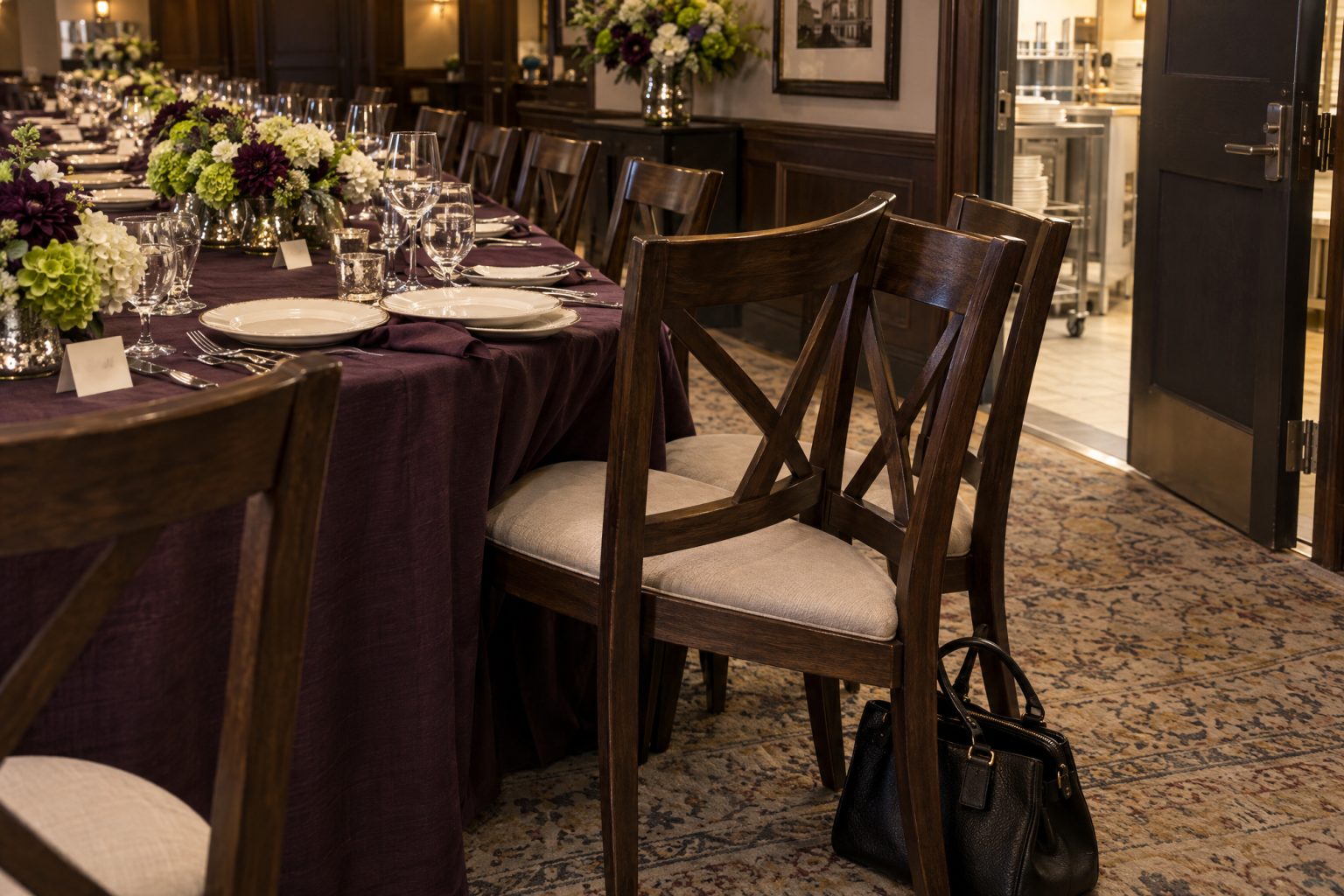
Place settings are measured from above.
People arrive from the side.
That distinction explains an astonishing number of tables that look immaculate in a photograph and feel mildly hostile once eight actual human beings sit down.
The charger fits. The flatware fits. The glasses fit. The centerpiece has been negotiated into a respectable footprint. Therefore, on paper, the table fits.
Then the chairs arrive, somebody brings a handbag the size of a small overnight case, and the eight mathematically perfect place settings discover they have elbows.
The guest needs more than the rectangle around the plate
A person needs room to pull out a chair, sit down, move an elbow, reach a glass, use flatware, stand back up and occasionally turn toward the person beside them without beginning a small diplomatic incident.
They may also have a handbag, a cane, a mobility device, a coat, a child, a camera, medication, or simply shoulders that do not conform to the optimistic little place-setting box on the rental diagram.
None of this is decorative noise. It is the actual dinner.
Table width is only one part of the geometry
People tend to ask whether a table is wide enough for the plates and centerpiece. I want to know what happens on both sides of the table after chairs are occupied and service begins.
A narrow table can be wonderful when the setting is edited for it. It becomes a problem when someone designs a wide formal service on top of it anyway: charger, bread plate, three glasses, menu, favor, candles, shared dishes and a floral arrangement all competing for the same strip of real estate.
The table is not failing. The plan is asking it to be a different table.
If the surface is narrow, reduce what lives on it. If the service requires shared platters, make room for shared platters. If wine service adds glassware later, count the later version rather than congratulating yourself on how clean the table looks before guests arrive.
The chair is part of the place setting
This is the point where “we can squeeze one more in” starts charging interest.
Chair width, arms, upholstery, how far it needs to pull out and what happens behind it all change the usable capacity of the room. Two chair styles with the same number of seats can create completely different circulation.
An extra chair squeezed into the end of a table does not merely make that one guest uncomfortable. It can steal the server’s route, pinch the neighboring place setting and create a bag-and-coat pile exactly where somebody is trying to move.
If the count changes, re-test the geometry. Do not simply add a chair and hope the room develops new square footage out of politeness.
Bags and mobility devices are not backstage objects
A guest should not have to surrender a mobility aid, wedge it into a route or negotiate with a decorative object just to sit at the table. The same practical question applies, at a different level, to handbags and personal items: where do they go without becoming a trip hazard or consuming another person’s space?
The answer depends on the guest, the venue and the actual equipment involved. Accessibility requirements should be verified for the real event, not guessed from an inspiration image.
What the design can do immediately is stop pretending those objects disappear when dinner begins.
Servers need a body too
The guest zone is only half the problem. A table can feel generous from the chair and still leave service staff threading plates through gaps that were drawn wider than they actually are.
Watch the routes behind occupied chairs. Think about plates going in, plates coming out, wine service, clearing, refilling water and what happens when two people need the same aisle in opposite directions.
The room should not require every server to turn sideways because the floor plan was approved before the chairs were pulled out.
Do not solve crowding with prettier crowding
A smaller centerpiece does not fix chair spacing. A delicate glass does not create elbow room. Removing one candle does not repair a service path.
Decor can relieve surface pressure. It cannot manufacture circulation.
This is why I would rather edit the setting than force the guest to adapt to it. One fewer object, one fewer chair at a table, a different table shape, a revised aisle or a better place for shared dishes can do more for the room than an entire additional layer of styling.
The place setting is not the unit. The person is.
I am not interested in defending a tablescape from the people it was supposedly made for. If the plate fits beautifully and the person has to negotiate for elbow room, we measured the wrong thing.
Related reading: Tablescapes That Survive Real Guests and Real Weather · How Many Chairs, Tables, Linens and Glasses Do You Actually Need? · Centerpieces That Do Not Block Conversation
Atmosphere OS · Guest Journey
The bottleneck forms about forty minutes before anyone notices it.
Guest Journey works the evening forwards and marks where pressure builds, so the fix can arrive before the queue does. Every judgment it makes traces back to a rule published at the rulebook.
Free to use, local-first in your browser, and there is no account until you ask for one.
Field notes and corrections
When a number here turns out to be wrong, you hear about it.
Three things arrive and nothing else. The new field note — bar rates, cover widths, service clearances, the arithmetic worked through on one real evening. A line when a new World or Mini Occasion opens, because a night only goes up once it can actually be thrown. And a correction whenever a rule in the published rulebook changes, or a number the tools rely on turns out to have been wrong. There is no weekly slot, because there is nothing weekly to put in it.
One email per field note or opening, plus corrections when a published figure moves. Unsubscribe from any of them.
Continue through the system
Pretty is still not a plan.
A party gets planned in roughly this order. Pick the chapter where your next problem lives.
What you have to decide next
One decision constrains the next. This is the order they actually happen in.
More in this chapter

See the complete five-chapter Event Design Intelligence map →