Atmosphere
Centerpieces That Do Not Block Conversation
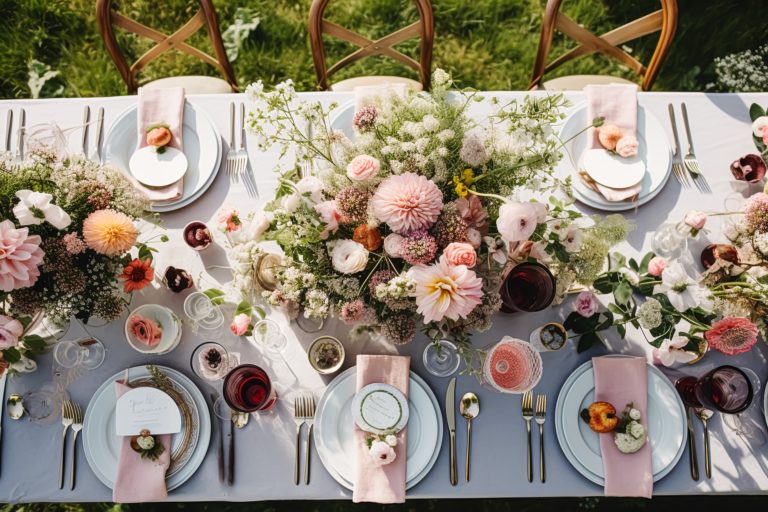
A centerpiece can be beautiful from the doorway and deeply annoying from a chair. Test it sitting down, not standing over the table with a camera.

A centerpiece can be beautiful from the doorway and deeply annoying from a chair. The flowers rise, the candles glow, the table photographs perfectly—and two guests spend dinner leaning sideways to find each other through the stems.
The answer is not a universal maximum height. Tables, chairs, vessels, flowers, guest heights, service styles, and sightlines vary too much for one number to do the work. The better standard is behavioral: seated guests should be able to see, hear, reach, eat, and converse without negotiating with the arrangement.
Test from a chair, not from standing height
Build the centerpiece at the actual table if possible. Add the real chairs and at least a representative place setting. Sit opposite another person and look at the full face—not the forehead through a gap and not the silhouette around a vase.
Rotate the vessel and test several seats. A composition can have one beautifully open angle and three obstructed ones. The guest experience needs to work around the table, not only from the camera position chosen during styling.
Choose low mass or clear-under height
Most conversation-friendly centerpieces follow one of two broad strategies. A low design keeps its visual mass beneath the principal face-to-face sightline. A taller design lifts the visual mass high enough that the space beneath it remains genuinely open.
The better standard is behavioral: seated guests should be able to see, hear, reach, eat, and converse without negotiating with the arrangement.
The difficult middle is a wide arrangement whose densest flowers live directly between faces. Height alone is not the issue. The shape, width, vessel, branch direction, and density decide whether guests can see through or around the piece comfortably.
Use air as part of the floral material
An arrangement does not need to be tiny to support conversation. It needs deliberate openings. Let light and sightlines move through parts of the design. Group flowers rather than distributing every stem evenly. Allow one directional gesture to rise while other areas remain quiet. For the larger spatial-design context, see How Floral Design Became Spatial Event Design, including the different ways Preston Bailey, Mindy Rice and other designers use floral scale.
Negative space also helps an arrangement survive visually once glasses, plates, candles, menus, and hands enter the composition. A centerpiece that begins completely full often becomes crowded after dinner begins.

Respect the table width and service style
A narrow banquet table and a generous round table do not offer the same decorative real estate. Neither do plated, buffet, family-style, or shared-plate service. Ask the caterer what must land on the table during the meal and where servers need to reach.
Family-style service can require substantial clear surface for platters and serving utensils. A low floral runner may technically preserve faces while consuming the exact space dinner needs. In that case, fewer concentrated arrangements or a different service plan may work better.
Watch the vessel as closely as the flowers
A tall arrangement can still block conversation if it sits on a broad opaque vase at eye level. A clear stand may preserve a view but introduce reflections, visual clutter, or stability concerns. A low bowl can work beautifully until its width crowds place settings.
Test the vessel filled and finished. Water, mechanics, branches, and floral mass change its weight and balance. Keep consequential structural or suspended work with appropriately qualified professionals and within venue requirements.
Design scent for proximity
Guests sit closer to dining flowers than they do to most other event installations. Strong fragrance that feels lovely in an entry arrangement can become tiring beside food or during a long meal. Consider the intensity and quantity of scented material in relation to the room and table.
When guest sensitivities or plant-safety questions are consequential, identify materials accurately and follow qualified guidance rather than relying on a generic flower name or assumption.
Candlelight sits exactly where your eyeline does
Candles and small lamps can create a different obstruction from flowers. A line of bright flames or shades directly between faces may be visually distracting even when the physical object is narrow. Glass hurricanes can reflect light and multiply nearby stems.
Test the complete table under the lighting state guests will actually experience. Confirm flame, electrical, clearance, and venue rules before treating candle or lamp placement as purely decorative. For how flowers, textiles, glass, flame, and hard surfaces hold up over a long night, continue with How Event Materials Behave Under Pressure.
Keep the centerpiece out of natural reach zones
Guests reach for glasses, shared food, bread, condiments, phones, bags, and one another. Servers reach across tables or approach from defined sides. A trailing stem that repeatedly brushes sleeves or glassware is not creating movement; it is occupying a working zone.
Run the reach test with the real setting. If ordinary use repeatedly pulls hands through the arrangement, redesign the edge rather than expecting the room to behave more carefully.
Vary height across the room instead of forcing every table to match
Visual rhythm can come from a mixture of lower and taller tables where sightlines, ceiling height, service, and table geometry allow it. A room often feels more dimensional when every centerpiece is not copied at identical scale.
A trailing stem that repeatedly brushes sleeves or glassware is not creating movement; it is occupying a working zone.
Keep the floral language consistent—palette, material, vessel family, gesture—while allowing the form to respond to each table’s job. A narrow table may need a leaner line. A larger round may support a concentrated focal piece. A communal table may work better with repeated low moments and generous gaps. For the larger budget-and-scale decision, use the scaling rules for a floral idea so the concept survives changes in guest count without simply multiplying every arrangement.
Can the person across from you finish a sentence?
- Can seated guests see one another clearly from ordinary posture?
- Can they hear without leaning around the arrangement?
- Can servers reach the table without moving flowers?
- Is there room for the actual meal and glassware?
- Do candles, lamps, reflective vessels, or branches create new visual barriers after dark?
- Can guests use the table normally without brushing fragile or irritating material?
If the answer fails at any seat, change the design while it is still a mockup. Lower it, lift the visual mass, narrow it, open it, divide it, or relocate the strongest gesture.
The flowers should improve the conversation, not become one
A centerpiece earns its place when it gives the table atmosphere, scale, color, texture, and a sense of occasion while still allowing guests to forget about its mechanics. The arrangement can be dramatic. It simply cannot require everyone else to perform around it.
Design from the seated eye line, the occupied table, and the real service plan. Then let the flowers frame the people rather than hide them. If the sightline test is settled and you need to choose the actual floral form, continue with Centerpieces for People Who Intend to See One Another for six table-specific approaches.
Atmosphere OS · Theme Atelier
A palette is not yet a decision.
Atmosphere OS holds the color, the material, the light and the room in one object, so moving any of them shows you what it does to the rest. Costs come back as indicative bands and never as quotes, which is the difference between planning and pretending.
Free to use, local-first in your browser, and there is no account until you ask for one.
Field notes and corrections
When a number here turns out to be wrong, you hear about it.
Three things arrive and nothing else. The new field note — bar rates, cover widths, service clearances, the arithmetic worked through on one real evening. A line when a new World or Mini Occasion opens, because a night only goes up once it can actually be thrown. And a correction whenever a rule in the published rulebook changes, or a number the tools rely on turns out to have been wrong. There is no weekly slot, because there is nothing weekly to put in it.
One email per field note or opening, plus corrections when a published figure moves. Unsubscribe from any of them.
Continue through the system
Pretty is still not a plan.
A party gets planned in roughly this order. Pick the chapter where your next problem lives.
What you have to decide next
One decision constrains the next. This is the order they actually happen in.
More in this chapter


See the complete five-chapter Event Design Intelligence map →
You must be logged in to post a comment.