Design & Florals
Centerpieces for People Who Intend to See One Another
A centerpiece should establish atmosphere, not start a border dispute. If guests lean around flowers to learn names, it mistook visibility for importance.
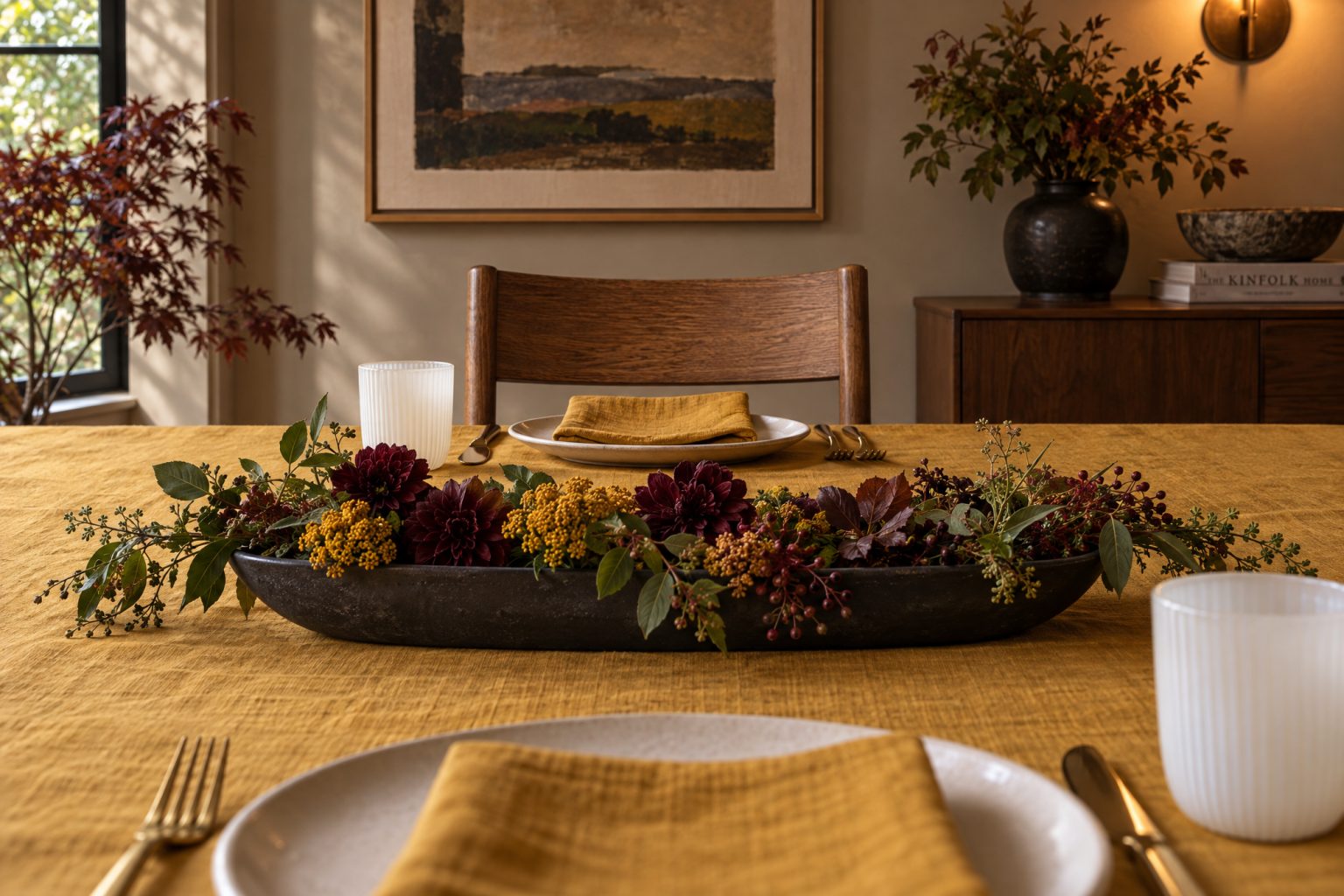
A centerpiece should establish atmosphere, not create a border dispute.
If guests must lean around flowers to learn one another’s names, the arrangement has mistaken visibility for importance.
The answer is not universally “keep it low.” Low flowers can spread across every useful inch. Tall flowers can preserve conversation when their visual mass begins above the seated sightline. The correct centerpiece is the form that supports this table, this service, and the way people are meant to relate across it.
Choose by the table’s social job
Before selecting flowers, decide what guests need to do.
Will they speak across a round table? Pass family-style platters? Watch several toasts? Share one long table with smaller conversational groups? Stand and circulate around a cocktail surface? Eat a tasting menu with substantial glassware and service equipment?
I like to write the table’s job down as one plain sentence:
Eight guests should see one another across the table, share four platters, hear the speakers, and remain seated while the service team clears from one side.
Then choose the centerpiece form that leaves those actions intact.
Option one: low clustered arrangements
Several small or medium vessels create presence through repetition rather than one broad mass.
They earn their keep when the table needs open sightlines and service only lightly touches the center. They also forgive a room seen up close, and pieces can shift when someone needs the space.
Keep each cluster narrow enough that the group does not quietly become one long, low hedge. Vary the density rather than the style, and let a vessel, color, or material repeat so the clusters read as family instead of a yard sale.
Make pieces stable and movable with one hand where appropriate. Guests will adapt the table to their behavior. Good design anticipates that rather than treating movement as vandalism.
Option two: a broken line of bud vases
Bud vases or small containers can create a long visual sequence while preserving serving gaps.
This is my pick for narrow rectangles and long communal tables, especially when the menu keeps landing platters in the middle. It also stretches a modest quantity of flowers further than a single arrangement could, and it welcomes a collected mix of small materials.
Do not place them at equal intervals with municipal precision unless the concept requires that rhythm. Use small groups and pauses. Keep water contained and stems out of plate, glass, and sleeve zones.
Guests will adapt the table to their behavior. Good design anticipates that rather than treating movement as vandalism.
The weakness of this form is object count. Twenty-five tiny vessels create setup, filling, cleaning, packing, and strike labor. Count the private work before calling the idea simple.
Option three: end-weighted flowers
Place the strongest floral gestures at the table ends or just beyond the primary dining surface.
This can free the conversational center while still giving the table a clear visual frame. It works especially well for long tables, buffets, family-style meals, or rooms where guests view the table from the end on arrival.
Check the end seats, service approach, door swing, and guest route. A dramatic end arrangement should not consume the place setting or become the first object every server must circle.
Repeat a smaller material signal through the center so the ends feel connected rather than assigned separate events.
Option four: elevated canopy with a clear lower level
A tall arrangement can preserve conversation when the support is narrow, the lower space remains open, and the floral mass begins above seated sightlines.
It belongs on large rounds, in high-ceilinged rooms that swallow anything short, and at formal dinners where nobody needs to park a platter in the middle. If the design has to read from across the room, this is usually the form that can.
Test the entire canopy from every seat. A narrow stand can hold flowers broad enough to block diagonal views. Finish the underside, protect mechanics, and confirm stability, hydrated weight, table load, lighting, ventilation, guest contact, and service clearance.
Tall does not mean exempt from the room’s actual physics.
Option five: flowers beside the table, not on it
Use a floor arrangement, sideboard piece, overhead gesture, wall treatment, or nearby architectural floral moment to give the dining area atmosphere while leaving the table free.
I reach for this when the menu is abundant and shared, when the table is narrow, or when the place settings are already doing plenty of talking. It is also the honest answer when a centerpiece would fight a view, a performance, or the people trying to talk over it.
Ensure the alternate floral placement does not block routes, seating, exits, or service and is designed for its viewing distance.
“No centerpiece” can be a deliberate choice rather than evidence that the flowers were forgotten.
Option six: one botanical or material runner
A narrow, intermittent line of foliage, fruit, flowers, vessels, candles where permitted, or other material can connect a long table.
Use it when the table has enough width and the service style leaves the center largely undisturbed.
Keep the runner broken at serving, plate, and hand zones. Avoid exposed wire, wet stems, soil, loose pollen, trailing material, or decorative objects that can enter food. Confirm flame and heat clearances.
A runner is not an automatic instruction to fill the entire length. Intervals and empty space often create more authority.
Match the form to the table shape
Round tables
The centerpiece sits inside the social geometry. Dense width affects every guest. Use compact low forms, clearly elevated mass, or a controlled group of small vessels.
Long rectangular tables
Guests form several conversation groups. Use rhythm, end emphasis, broken lines, or alternating moments. Protect the service route and sightlines along the length.
Square tables
Diagonal views and corner settings can be affected by a central mass. Test every chair and keep the arrangement proportionate to the true center.
A runner is not an automatic instruction to fill the entire length. Intervals and empty space often create more authority.
Serpentine and irregular tables
Use the curves and changing views. Repeat materials without placing one object at every geometric turn. Keep inner curves from becoming crowded and maintain service access.
Cocktail and standing tables
Guests need a place for drinks and small plates. Use one narrow, stable object or keep the surface largely clear. Tall unstable flowers at elbow height are an invitation to participate in gravity.
Set it with the whole meal on the table
Place all expected objects on the table:
- full place settings and glassware;
- menus and table identifiers;
- bread, water, wine, condiments, and shared dishes;
- service tools, trivets, bottles, and lids;
- personal objects guests may reasonably have;
- the centerpiece at event scale.
Sit in every type of seat. Pass food. Reach for water. Clear a plate. View the speaker. Pull the chair out.
The table will identify the correct centerpiece form more honestly than an isolated floral sample.
Consider hour four
Flowers open, stems soften, candles shorten, glassware moves, and guests relocate objects.
Choose materials and clearances with enough margin that normal change does not destroy the sightline or service plan. A stem drooping three inches should not turn the arrangement into a privacy screen.
Assign someone to check water, flame, instability, shedding, and guest interference during the event where appropriate.
Use the removal test
Imagine the table without the centerpiece.
If the room loses its only floral identity, the arrangement may need stronger presence. If the table immediately becomes more comfortable and the overall atmosphere remains intact, the centerpiece may be solving a problem the occasion does not have.
Guests should remember the conversation and still notice the flowers. When both happen, the arrangement understood why the table was there in the first place.
Atmosphere OS · Theme Atelier
A palette is not yet a decision.
Atmosphere OS holds the color, the material, the light and the room in one object, so moving any of them shows you what it does to the rest. Costs come back as indicative bands and never as quotes, which is the difference between planning and pretending.
The rulebook is public. Every formula it runs on is written down where you can disagree with it.
Field notes and corrections
When a number here turns out to be wrong, you hear about it.
Three things arrive and nothing else. The new field note — bar rates, cover widths, service clearances, the arithmetic worked through on one real evening. A line when a World opens, because a night only goes up once it can actually be thrown. And a correction whenever a rule in the published rulebook changes, or a number the tools rely on turns out to have been wrong. There is no weekly slot, because there is nothing weekly to put in it.
One email per field note or opening, plus corrections when a published figure moves. Unsubscribe from any of them.
Continue through the system
Pretty is still not a plan.
A party gets planned in roughly this order. Pick the chapter where your next problem lives.
What you have to decide next
One decision constrains the next. This is the order they actually happen in.
More in this chapter


See the complete five-chapter Event Design Intelligence map →