Space & Venue Reality
The Event Friction Audit
Friction rarely announces itself. It's a stroller meeting three steps nobody mentioned, and a speech competing with the ice machine down the hall.
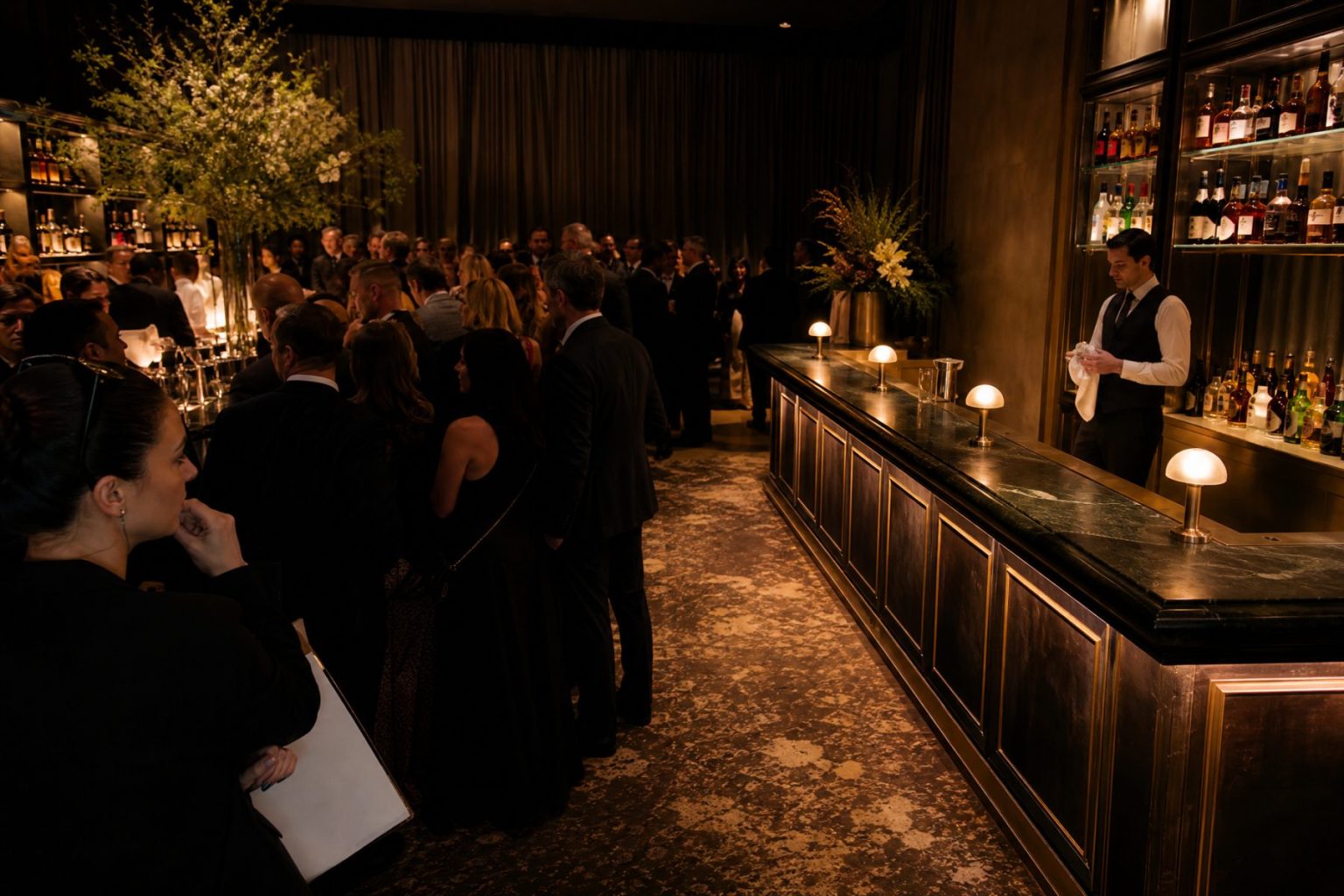
Event friction rarely announces itself as a dramatic failure. It looks like a guest standing in the rain while an umbrella is found, a stroller meeting three steps nobody mentioned, a florist carrying arrangements through cocktail hour, a speech competing with an ice machine, or a child whose only place to decompress is beneath the dinner table.
Each problem can look small in isolation. Together they decide whether the occasion feels thoughtful or laborious. A friction audit is a deliberate walk through the event looking for the places where weather, access, vendors, sound, service, and human needs collide.
Audit a real guest journey, not a list of departments
Choose one plausible guest and walk the occasion in sequence: arrival, entrance, welcome, ceremony or program, drinks, seating, meal, restrooms, social time, departure. At every transition, ask what that person must know, carry, wait for, hear, climb, avoid, or ask someone to solve.
Then repeat the walk for a guest with different needs: someone using a mobility device, an older guest, a parent with a young child, someone arriving alone, or someone who does not know the venue. The point is not to invent every possible circumstance. It is to stop designing around one frictionless imaginary person.
Weather friction begins before the backup room
Look at the exposed minutes: vehicle to entrance, shuttle stop to ceremony, ceremony to reception, restroom routes, smoking or fresh-air areas, and departure. Rain is only one condition. Heat, cold, wind, snow, darkness, wet ground, glare, and rapid temperature drops can all make a short route feel much longer.
- Is there shelter where people actually wait?
- Does the route remain usable when the ground is wet or dark?
- Where do umbrellas, coats, wraps, or wet items go?
- Can guests reach transport without standing in a service or loading zone?
- Does the weather version preserve an accessible route?
For the bigger backup plan, Your Rain Plan Is Not a Tent covers the difference between having shelter and having a second workable event.
Access friction is often hidden by an empty room
A route that looks generous before setup can narrow quickly after signs, florals, cocktail tables, gift displays, photo equipment, queue rails, cords, and chairs arrive. Check the installed plan, not only the architectural plan.
Confirm accessible routes and required accommodations with the venue and appropriate qualified resources. The question I care about is simpler: once the event is fully dressed, can every guest still reach every moment that matters?
Load-in friction becomes guest friction when the routes overlap
Walk the vendor route separately. Where do trucks wait? Which door opens? Is there a freight elevator? Where are cases, carts, flowers, linens, waste, tools, and empty packaging staged? When does that route stop being available to vendors and start belonging to guests?
Check the installed plan, not only the architectural plan.
A narrow overlap can produce several downstream problems at once: late installation, blocked arrival, visible equipment, crowded elevators, rushed staff, and a foyer that feels unfinished. The fix may be scheduling rather than decoration.
Sound friction is not always an audio-equipment problem
Stand where guests will actually listen. What else is happening at that minute? Ice crushing, plate clearing, kitchen doors, traffic, fountains, HVAC, children playing, a second room’s music, or wind may compete with the program even when the microphone works perfectly.
Coordinate quiet moments with service and room operations where practical. Let qualified audio professionals determine system design, coverage, power, and technical requirements. The planning team should make sure the program is not scheduled to fight avoidable noise.
Children expose whether the plan assumes endless adult patience
If children are invited, examine the event at their scale without turning the entire occasion into a children’s party. Consider meal timing, seating, safe movement, restroom access, changing needs, supervision expectations, break spaces, noise, weather, and what happens during a long adult program.
The most useful solutions often help adults too: a quieter corner, clear timing, a place to sit away from speakers, an easy route to the restroom, water within reach, or a shorter wait between major moments.
Find the first force that steals ease
Do not attempt to optimize every small inconvenience equally. Identify the first high-consequence friction point in each journey. If guests cannot find the entrance, the beautiful welcome sign inside the room is late to the problem. If vendors cannot unload on time, the installation plan is already compromised. If the only accessible route is also the service corridor, that conflict deserves attention before another decorative layer.
Use consequence to rank the fixes
Safety and access come first, confirmed with qualified or official sources wherever that is required. Next come the things the evening cannot run without: getting in, sitting down, hearing the toast, being served, staying dry, finding a restroom, and getting home. Then comfort, meaning less waiting, less exposure, less confusion, and less crowding. Atmosphere goes last, and its job is to make the fixed route feel intentional instead of merely compliant.
This order prevents a decorative workaround from concealing a functional problem that remains underneath it.
Run the audit once with the lights low
If the event continues after dark, repeat essential routes in the lighting state guests will experience. Look at steps, thresholds, signs, table numbers, restrooms, outdoor paths, shuttle areas, coat check, and exits. Beautiful darkness should still reveal where a person is going.
Finish with ownership, not observations
Every meaningful friction point needs an owner and a completion test. “Improve arrival” is not finished. “Venue confirms covered accessible drop-off; shuttle lead has the route; exterior signs are installed before guest arrival; umbrella staging is assigned” is a plan that can be verified.
If guests cannot find the entrance, the beautiful welcome sign inside the room is late to the problem.
The audit works when it changes something: a route, a cue, a furniture position, a staffing decision, a weather threshold, a sound moment, or a guest communication. Otherwise it is simply another document describing the evening accurately after the fact.
Ease is designed in the seams
Nobody has ever complimented the smooth walk from the shuttle to the covered entrance. Guests just have an evening that seems to know what it is doing.
So walk the seams before anyone arrives, fix the first thing that would trip each guest up, and then let the flowers and the candlelight take all the credit. They will anyway.
Space Lab
Build the room once. Keep testing it.
Space Lab keeps dimensions, ceiling, obstacles, published capacity and their evidence basis together in one room record, then uses that same room for fit, clearance, flow, turnover, comparison and site-visit questions.
No account required for the core room work. Missing measurements and unanswered questions stay visible.
Field notes and corrections
When a number here turns out to be wrong, you hear about it.
Three things arrive and nothing else. The new field note — bar rates, cover widths, service clearances, the arithmetic worked through on one real evening. A line when a World opens, because a night only goes up once it can actually be thrown. And a correction whenever a rule in the published rulebook changes, or a number the tools rely on turns out to have been wrong. There is no weekly slot, because there is nothing weekly to put in it.
One email per field note or opening, plus corrections when a published figure moves. Unsubscribe from any of them.
Continue through the system
Pretty is still not a plan.
A party gets planned in roughly this order. Pick the chapter where your next problem lives.
What you have to decide next
One decision constrains the next. This is the order they actually happen in.
More in this chapter


See the complete five-chapter Event Design Intelligence map →