Guest Experience
The Newspaper Photo Booth: Editorial Souvenir or Lobby Traffic Jam?
A newspaper-style photo booth feels editorial right up until forty guests are waiting on a printer. Design the queue, print speed, lighting, privacy and paper handling first.
A newspaper-style photo booth has real appeal: a printed front page feels editorial in a way a phone screen never will.
It stops being charming the second forty people are standing next to the restroom waiting for a printer to reconsider its life choices.
Decide honestly whether it is a photo booth or a print station
If guests are walking away with a physical newspaper-style print, printing speed is part of the design. Test the whole process from capture through layout to finished print before approving it. If it is slow, instant digital delivery with a pickup table later beats blocking the booth for twenty minutes at a time. Print speed is a pacing decision as much as a hardware one.
Design the template for actual faces, not a mockup
Leave enough negative space for different heights, group sizes and clothing colors. Never let a decorative headline land over where a face naturally sits. Use high-contrast type, short copy and text that remains readable at the finished print size.
Light it like a portrait, not a newspaper office
Consistent flattering light matters far more than elaborate set dressing. Test glare on glasses, dark clothing, pale clothing and groups standing at different distances from the backdrop.
Give the queue somewhere to exist
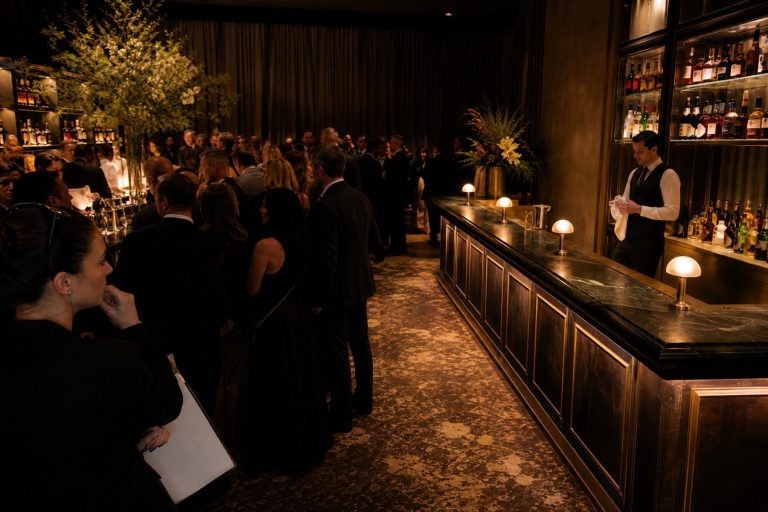
Photo booths create social waiting whether you plan for it or not. Put the line where guests can watch without blocking a door, bar or service route. For a large guest count, shorten the interaction or add another capture point. A booth line is part of the floor plan whether or not it was drawn on one.
Keep the props editorial, since the format already earned that
The newspaper concept is strong on its own. Skip plastic hats and speech bubbles unless irony genuinely belongs to this particular event. A clean frame and one strong headline style age better than a basket of novelty props.
Plan for the paper itself
Fresh prints need a dry, flat landing zone. Use sleeves or a holding rack if ink can smudge. Drinks stay away from the output table.
Respect privacy without being asked
Tell guests clearly if images are stored, shared with the host or organization, or posted publicly. A booth photo is not automatic permission for social media.
Time five groups before you believe it works
Run five consecutive groups during rehearsal. If the station cannot move them through cleanly without staff jumping in, the guests were never the problem; the setup is.
The front-page styling is the optional part. The queue, the privacy decision and a printer that keeps up are not, whether the room is a birthday, a gala or a wedding.
Atmosphere OS · Guest Journey
Somebody is holding a drink, a plate and a bag.
Guest Journey walks arrival, waiting, seating, service and departure, then shows you where the plan asks too much of a person with two hands. None of it is a safety assessment, and it does not pretend to be one.
Free to use, local-first in your browser, and there is no account until you ask for one.
Field notes and corrections
When a number here turns out to be wrong, you hear about it.
Three things arrive and nothing else. The new field note — bar rates, cover widths, service clearances, the arithmetic worked through on one real evening. A line when a World opens, because a night only goes up once it can actually be thrown. And a correction whenever a rule in the published rulebook changes, or a number the tools rely on turns out to have been wrong. There is no weekly slot, because there is nothing weekly to put in it.
One email per field note or opening, plus corrections when a published figure moves. Unsubscribe from any of them.
Continue through the system
Pretty is still not a plan.
A party gets planned in roughly this order. Pick the chapter where your next problem lives.
What you have to decide next
One decision constrains the next. This is the order they actually happen in.
More in this chapter
See the complete five-chapter Event Design Intelligence map →