Space & Venue Reality
Your Rain Plan Is Not a Tent
Rain does not fall only on the part of the event you covered. A tent is equipment. A rain plan is a whole second event.
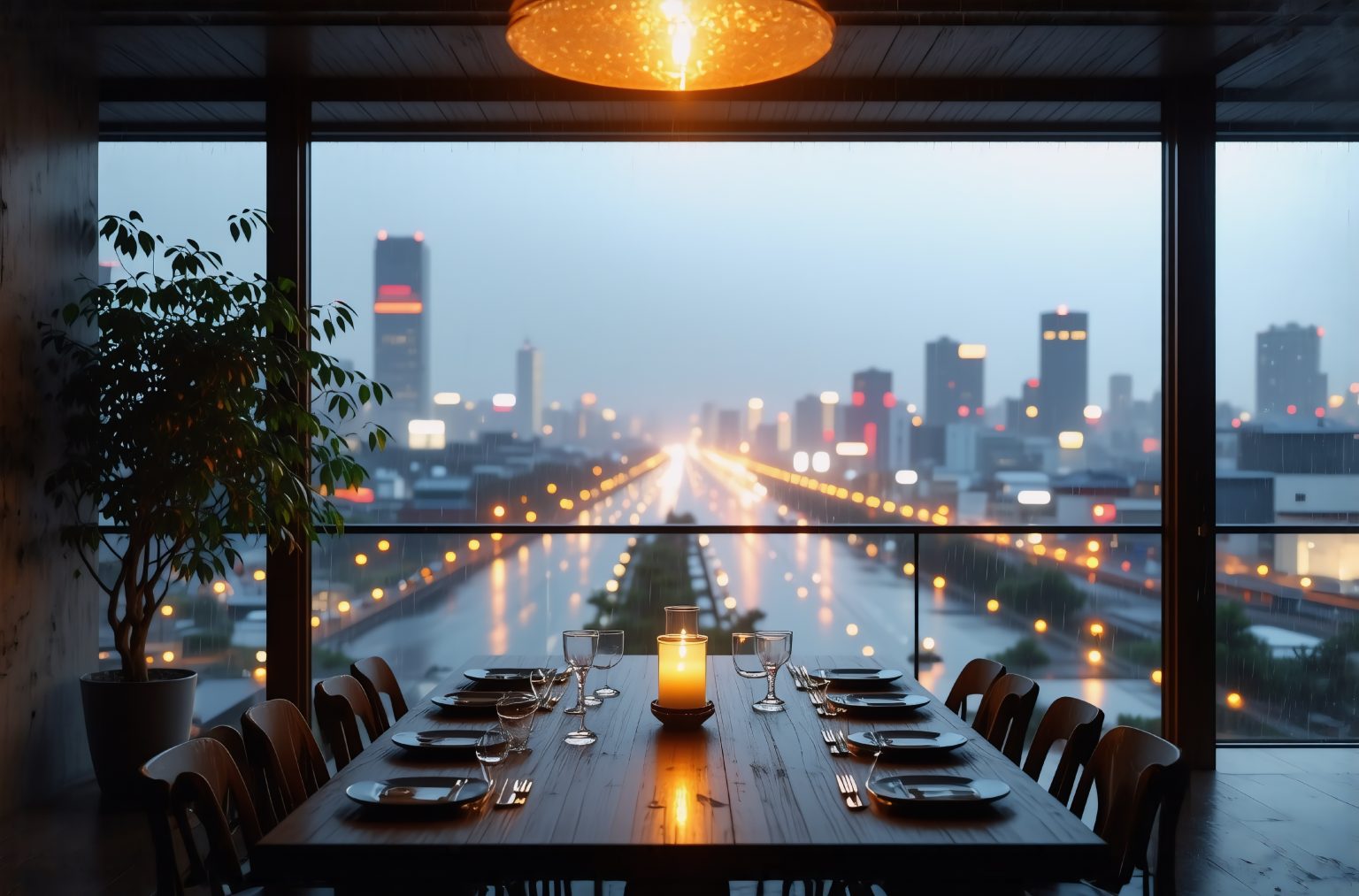
Rain does not fall only on the part of the event you covered.
A tent is weather equipment. A rain plan is a complete alternate event, and the two get confused constantly because one of them can be ordered by Thursday.
Rain changes arrival, surfaces, parking, temperature, sound, power, food service, photography, accessibility, vendor access and departure. Putting a roof over the middle solves exactly one of those.
So the question is not “do we have a tent.” It is: can this event still operate well when everything outside that tent becomes wet, slower, darker, colder, louder and considerably less predictable?
A credible rain plan gives the wet version its own layout, routes, staffing, communication, timing and point of view. It should never feel like the real event was shoved indoors twenty minutes before doors.
Protect the route before the room
Map the drop-off, the parking, the unloading, guest entry, restrooms, food and bar service, every transition, and departure. Then mark everywhere a guest or a vendor has to cross open ground, and work out what that ground does when it is wet, dark, crowded and churned up.
The disproportionate misery is always in the small breaks. Forty feet from the rideshare drop to the covered entrance. The gravel path that stops working for wheels. The coat pile with nowhere to drain. The service door that turns into an ice rink the moment catering starts moving at speed.
Rain exposes every circulation problem that dry weather was politely covering for.
The Guest Journey Is a Floor Plan You Can Feel traces the alternate route as a lived sequence rather than a set of covered locations.
The ground is a design decision
| Condition | Planning response |
|---|---|
| Mud or soft ground | Rated flooring, alternate route, vehicle restrictions |
| Pooling water | Drainage review, raised equipment, rerouted circulation |
| Slick thresholds | Matting, lighting, monitoring, cleanup ownership |
| Wet grass | Accessible hard-surface alternative and footwear guidance |
| Wind-driven rain | Side protection, secure entrances, revised service position |
None of that is cosmetic. Flooring affects accessibility, staff speed, equipment movement, chair stability, electrical safety, cleaning, and what a person is willing to walk across in clothes they cannot replace.
If the plan rests on “people can probably walk over the lawn,” it is not a plan. It is optimism with a seating chart.
Rain exposes every circulation problem that dry weather was politely covering for.
Draw the alternate room properly, from scratch
The indoor or covered version has different scale, sightlines, acoustics, light, ventilation, temperature, furniture fit and capacity. It deserves its own floor plan and its own guest sequence. Pouring the outdoor layout into a smaller space just produces a cramped copy of a plan that no longer applies.
Ask what the alternate room is actually good at. A tighter space often supports a warmer dinner, stronger candlelight, closer conversation, a more concentrated focal moment. It may need fewer decorative moves because the architecture has stepped in to do the work.
You are not recreating the outdoor plan object for object. You are keeping the governing idea and redesigning its expression for the room you actually have.
Then run The Guest Comfort Audit Nobody Puts on the Moodboard over the new sequence — temperature, seating, sound, waiting, access, recovery space.
The unglamorous things need somewhere to go
Confirm power distribution, cable protection, generators, heat or cooling, cooking, refrigeration, bar operation, waste, lighting, communications and emergency systems — and name who is watching for water intrusion and exposed equipment.
Then redraw service. A server carrying glassware cannot use the narrow covered corridor that has just been promoted to main guest entrance. Flowers waiting for placement need somewhere protected that is not the catering staging area.
Wet umbrellas. Soaked coats. Delivery carts. Empty cases. Trash. Every one of them needs a destination, and the plan only becomes believable at the moment they have one.
Decide early enough that you still have options
A late weather call is rarely just a weather call. It arrives as a labor problem, a rental problem, a transportation problem, a staffing problem, a printing problem and a communication problem, all at once, all urgent.
Work backwards from the last useful deadline for each consequence: when flooring can still be installed, when transport can still be rerouted, when a room can still be reset, when staff calls can still change, when guests can still be told something before they leave home.
Nobody is asking you to call the weather earlier than necessary. You just need to know which choices are still reversible at each point, so the plan closes one door at a time instead of staging a single dramatic all-or-nothing moment at dawn.
Somebody has to own the call
Write down the forecast or site condition that changes the plan, the source you are trusting, the time of the decision, and the name of the person who makes it. Include the last practical deadline for flooring, tenting, transport, staffing, printing and guest communication.
Then decide how the decision travels. “The planner will tell people” is far too vague when venue operations, catering, rentals, transportation, entertainment, florals, photography and guests all move differently once the call is made. Name the owner, the order, and the final source of truth.
A good contingency closes one door at a time, instead of staging a single dramatic all-or-nothing moment at dawn.
Write the guest message now, while you are calm
Say what changes for arrival, clothing, transport, location, accessibility and schedule. The message should sound calm because the alternate plan exists — not because the uncertainty has been edited out of it.
Do not make guests reverse-engineer your contingency from “we cannot wait to celebrate, rain or shine.” Tell them the things that affect their body and their logistics. If parking moves, say so. If the ceremony is indoors, say where. If the ground will still be soft, say that too, so people can choose different shoes. If the shuttle time changed, put the new time somewhere it cannot possibly be mistaken for the old one.
Walk the wet version with everything happening at once
Test the route with umbrellas, coats, wet flooring, mobility devices, deliveries, servers and a full arrival wave. Confirm where water, belongings, waste and waiting guests actually go.
Then test the collisions. Guests arriving while the florist finishes an indoor installation. The photographer whose portrait location no longer exists. Catering trying to reach the bar through the coat queue. The accessible route once wet-weather furniture and equipment are in place.
A diagram can look extremely tidy while the lived event is quietly assembling a traffic jam.
Space Lab is for the parts where the contingency depends on current venue facts, restrictions, access conditions, service infrastructure or weather exposure that has to be confirmed directly.
The rain version deserves a point of view
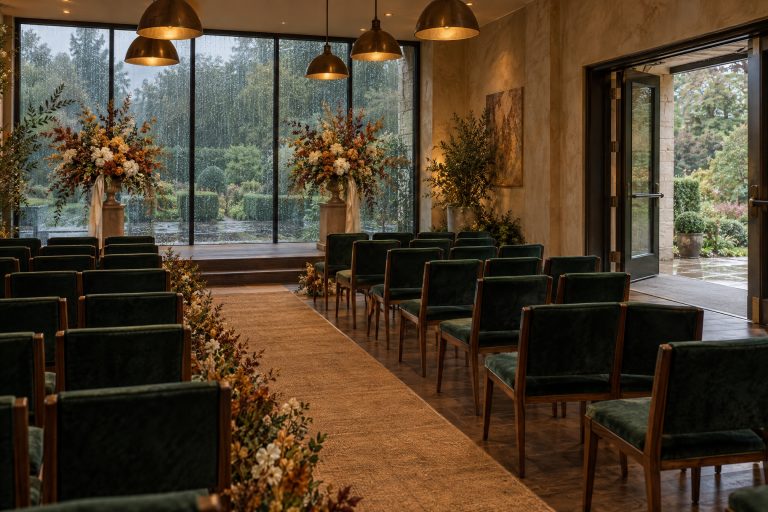
Keep one emotional promise and then use the strengths of the space you are actually in. The outdoor plan was expansive and garden-led; the indoor one can be intimate, candlelit and concentrated. The ceremony loses a view and gains a much better processional threshold. The lounge moves nearer to dinner and becomes useful instead of merely scenic.
Now the design has to earn its money. Forget imitating the preferred plan; the wet version has to protect the people, keep the event’s identity, and operate without quietly handing the inconvenience to guests.
The least a rain plan can be
- A separate guest route, arrival through departure.
- A separate floor plan with honest capacity, service paths and accessibility.
- Ground, drainage, flooring, power, temperature and lighting decisions.
- A named decision owner, a trigger, a deadline and a communication chain.
- Vendor instructions for load-in, staging, changed scope and strike.
- A guest message that says exactly what changes.
- One deliberate atmosphere decision that makes the wet version feel chosen rather than apologized for.
Until those exist, the tent is carrying far more responsibility than a tent can hold.
Space Lab
Build the room once. Keep testing it.
Space Lab keeps dimensions, ceiling, obstacles, published capacity and their evidence basis together in one room record, then uses that same room for fit, clearance, flow, turnover, comparison and site-visit questions.
It shows planning estimates as estimates and keeps legal occupancy, venue approval and other authority decisions outside the calculator.
Field notes and corrections
When a number here turns out to be wrong, you hear about it.
Three things arrive and nothing else. The new field note — bar rates, cover widths, service clearances, the arithmetic worked through on one real evening. A line when a new World or Mini Occasion opens, because a night only goes up once it can actually be thrown. And a correction whenever a rule in the published rulebook changes, or a number the tools rely on turns out to have been wrong. There is no weekly slot, because there is nothing weekly to put in it.
One email per field note or opening, plus corrections when a published figure moves. Unsubscribe from any of them.
Continue through the system
Pretty is still not a plan.
A party gets planned in roughly this order. Pick the chapter where your next problem lives.
What you have to decide next
One decision constrains the next. This is the order they actually happen in.
More in this chapter


See the complete five-chapter Event Design Intelligence map →