Space & Venue Reality
How to Host a Beautiful Event in a Venue with Terrible Lighting
Daylight lies. Walk the room at 7pm with the house lights on and every face turns green. The fix is overruling the house lights, not adding string lights.
Some venues arrive with lighting that works against every photograph, every face, and every mood you planned. It is never subtle about it.
Harsh overheads, cold fluorescents, spots that turn skin a strange shade of green. You walk it at noon and it looks fine. You walk it at 7pm with the house lights on and realize the room has been fighting you the entire time.
These rooms are common, and the fix is never to add more string lights and hope. The house lighting has to be overruled on purpose.
Audit the room after dark, never during the daytime site visit
Daylight lies, every time. Go back at the hour the event will actually run, turn on every house fixture the venue intends to use, and stand where guests will stand. Photograph it on your phone in those conditions, because a camera reveals what your eyes are busy forgiving.
Take real control of the house lights
Most venues will dim or kill a portion of their overheads if you ask early and specifically. Find out which circuits can come down and get it in writing. House rules like that are design decisions in disguise, and they usually arrive with a price attached. If the venue won’t cooperate, plan to mask or redirect the worst fixtures with fabric or a directional light that simply overpowers them.
Build three actual layers, not just one
Ambient light keeps the room from feeling like a cave. Task light goes where people genuinely need to see: tables, paths, restrooms. Accent light makes the deliberate pools that create atmosphere. String lights alone will not do it, and neither will a ring of uplights. A real rescue balances all three so no single source is doing all the work. In a good room I would have settled the light before anything else got chosen. In a bad one I am doing it late, under protest.
Test materials and actual faces under the real light
Bring samples of linens, flowers, and anything metallic, and look at them under the final lighting plan. Some fabrics go muddy. Some metals glare. Skin tones shift in ways nobody wants for their own dinner party. Sit a real person in the worst seat and check how they look across the table. If the faces are wrong, the lighting is still wrong.
Protect the routes no matter how moody the room gets
Paths and stairs need enough light that nobody feels uncertain walking them. Guests forgive a moody dining room without complaint. They don’t forgive a dark step. Keep circulation legible even when the rest of the room is intentionally low. Dim or not, the room still has to let people get past each other.
Accept that a few rooms can’t be fully saved, and lean into that instead
Sometimes the honest move is a different mood entirely, more intimate, more contained, rather than fighting for the bright open look you originally wanted. A coherent darker room beats a half-fixed one that still looks accidental.
Decor will not fix terrible venue lighting. Deal with it at the source, after dark and early enough, and guests will never know the room started out as the enemy.
Space Lab
Build the room once. Keep testing it.
Space Lab keeps dimensions, ceiling, obstacles, published capacity and their evidence basis together in one room record, then uses that same room for fit, clearance, flow, turnover, comparison and site-visit questions.
No account required for the core room work. Missing measurements and unanswered questions stay visible.
If this is your mood
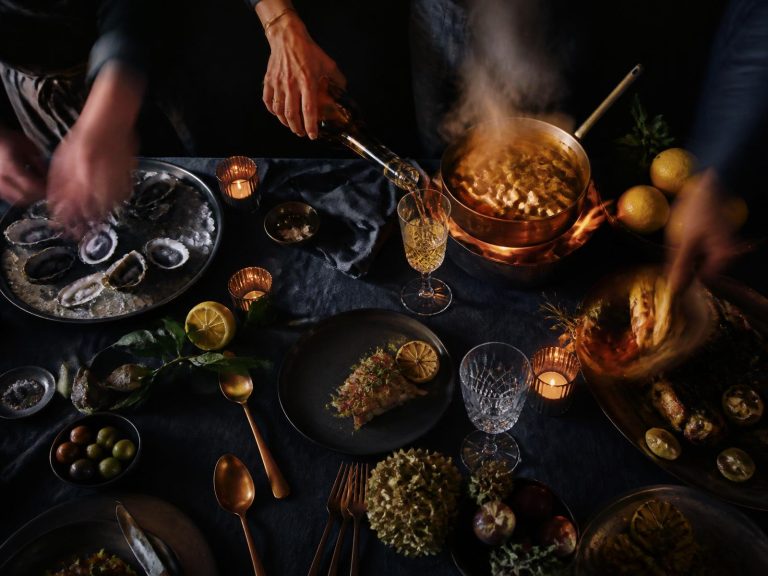
More candlelit


Field notes and corrections
When a number here turns out to be wrong, you hear about it.
Three things arrive and nothing else. The new field note — bar rates, cover widths, service clearances, the arithmetic worked through on one real evening. A line when a World opens, because a night only goes up once it can actually be thrown. And a correction whenever a rule in the published rulebook changes, or a number the tools rely on turns out to have been wrong. There is no weekly slot, because there is nothing weekly to put in it.
One email per field note or opening, plus corrections when a published figure moves. Unsubscribe from any of them.
Continue through the system
Pretty is still not a plan.
A party gets planned in roughly this order. Pick the chapter where your next problem lives.
What you have to decide next
One decision constrains the next. This is the order they actually happen in.
More in this chapter

See the complete five-chapter Event Design Intelligence map →