Space & Venue Reality
The Room Was Rebuilt Before Anybody Came Back
A 240-seat conference room became a celebration floor in 105 minutes. The useful story is not speed for its own sake—it is staging, off-site prep, fixed ownership and a protected two-hour production window.
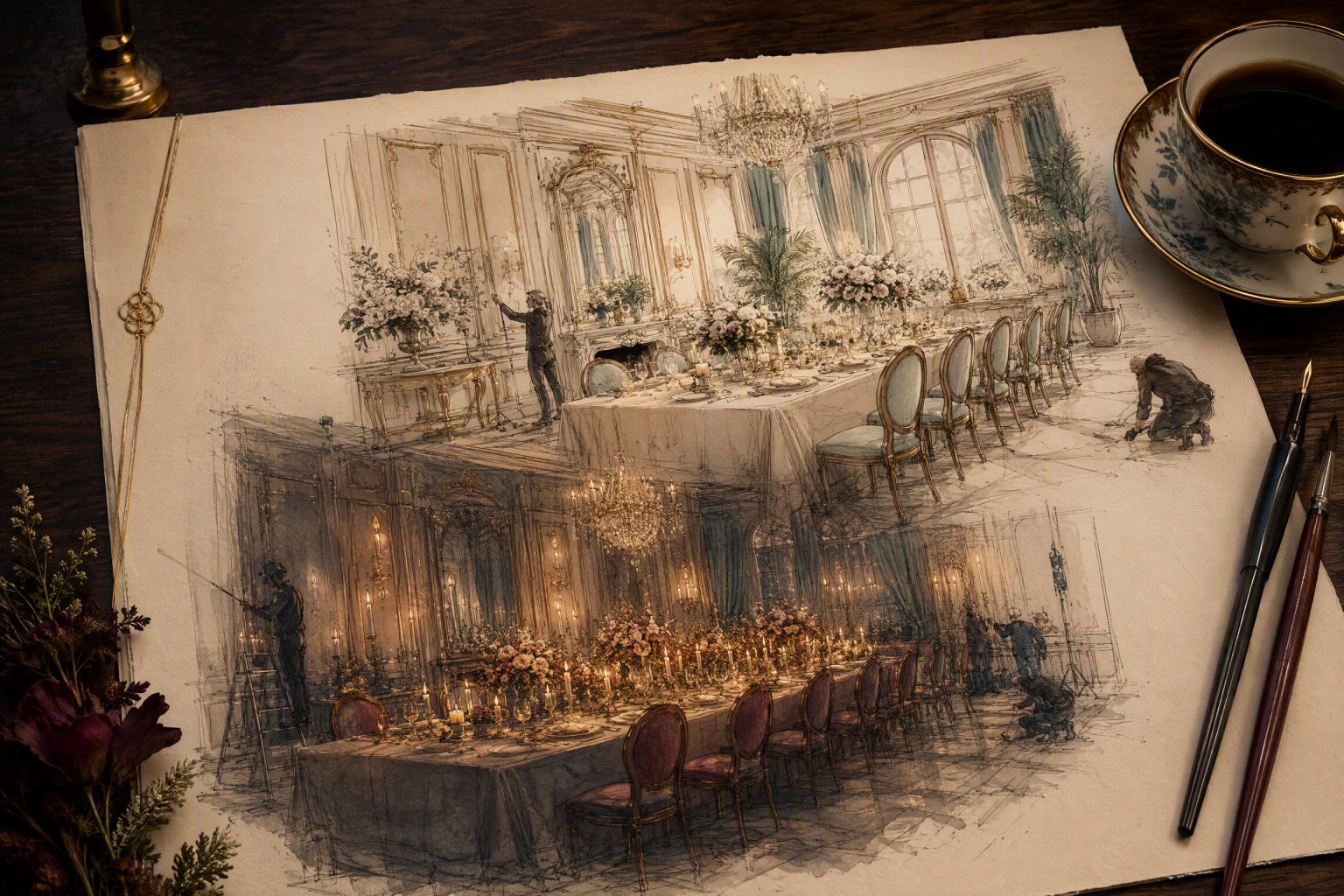
TEARDOWN · TWO EVENTS, ONE ROOM
A 240-seat conference configuration was struck and rebuilt as an evening celebration floor in 105 minutes. Not by discovering a magical crew. By protecting the window, staging people before it opened, moving work off site and giving the room one master sequence.
The most dangerous sentence in a room-turn meeting is, “We have two hours.”
Two hours sounds like time.
It is not time until somebody has decided what may happen inside it, what must happen before it, who owns each move and what physically cannot begin until something else is out of the way.
A useful public example appeared in 2026 in The Idea Hunter’s case study for Ada Support’s Stradaganza event at Toronto’s Globe and Mail Center. The company gathered 240 employees in one room for a daytime conference and wanted the same floor to become an evening celebration with activation booths, bars, lounge seating and a DJ.
The conference ran until 3:00 p.m. Evening guests began returning at 5:30. The production team had a protected two-hour flip window from 3:00 to 5:00, no second room to stage from, and no possibility of extending the window.
The room was set at 4:45.
That is the part worth taking apart.
What the public record confirms
3:00 p.m. Conference ends and guests leave for off-site activities.
2:30 p.m. Rental crew is already on site and staged.
2:45 p.m. Wall-installation crew is already staged.
4:00 p.m. DJ arrives.
4:10 p.m. DJ tech-check complete.
4:45 p.m. Room set.
5:00 p.m. Client walkthrough.
5:30 p.m. Guests return.
The flip did not start at 3:00
The room became physically available at 3:00. The production decision tree began much earlier.
The rental crew arrived at 2:30 and waited. The wall team arrived at 2:45 and waited. The case study is explicit that this was deliberate: crews were staged before the floor cleared so that the event did not spend the first twenty minutes of its only two-hour window finding people, unloading instructions or negotiating where to begin.
That waiting was the whole trick.
Guest release is not vendor call time.
If the room turns at 3:00 and the crew is told to arrive at 3:00, the production clock is already paying for parking, check-in, elevator travel, tool unload, orientation and the first conversation about who is blocking whom.
In this project, those minutes were moved outside the critical window.
The room was not asked to become the second event all at once
The confirmed flip scope included striking the 240-seat theater configuration and replacing it with activation booths, lounge seating, bars and communal tables. A wall-mounted world-map activation was installed. Bars were positioned, wrapped and dressed. The DJ arrived and completed a technical check before the room was declared set.
Those are different kinds of work.
Chair strike is clearing. Wall installation needs access to a specific surface. Furniture placement needs floor area. Bar setup needs inventory, positioning and dressing. DJ setup needs a stage and technical environment that is sufficiently stable to test.
The room only works if those jobs stop pretending they are unrelated.
Crews arrive, check in and stage while guests still occupy the program.
Floor releases. Strike begins immediately instead of beginning with vendor arrival.
Seating out; activations, lounge, bars and wall work enter in controlled sequence.
DJ technical check complete while final room dressing continues.
Room set: 105 minutes after guest release.
105 minutes is the useful number, not “two hours”
From 3:00 to 4:45 is 105 minutes.
The booked production window was 120 minutes.
That leaves a documented 15-minute schedule margin before the 5:00 client walkthrough—not before guests returned, but before the formal internal release point.
Then there was another thirty minutes between the walkthrough and the 5:30 guest return.
This is what a real event turn should look like on paper: not “done by 5:30,” but a series of earlier release conditions that protect the guest-facing deadline.
If the first moment anyone checks the room is when people are walking back in, the schedule has no inspection margin. It has hope.
The room-flip critical-path model makes the same point: the window has to include the longest dependency chain and the final release condition. Here, the public record gives us a real event where the release happened ahead of the contractual window.
The fastest work was the work removed from the room
Eight six-foot green-framed plexi bars were part of the program. The production team did not use the two-hour room turn to apply and remove their vinyl graphics.
The case study says the vinyl was applied off site and removed off site specifically to protect the on-site schedule.
This is one of the least glamorous and most reusable production decisions in the project.
Do not optimize the critical path before asking what can leave it.
Preassembly, labeling, graphic application, packing by destination, sorting hardware, testing: anything completed in a workshop, warehouse or controlled prep space is one less job competing for the same ballroom floor, elevator and clock.
The point is not to shift every task off site. Some work must happen in the room because it depends on the room.
The point is to stop using premium venue minutes for work that does not.
The overnight build explains why the two-hour turn was possible
The same event had a large fabrication package before registration ever opened: a twenty-foot welcome wall standing ten feet high, a twenty-four-foot illuminated stage wall and a built registration area.
The production day began at midnight.
Furniture and rentals loaded in first. The fabrication crew followed at 3:30 a.m. The installation order was explicit: stage wall first, then registration booth, then welcome wall last so the main entrance remained clear for as long as possible.
The client walkthrough happened at 7:00 a.m. The fabrication crew was out by 7:30. Registration opened at 8:30.
That morning sequence matters to the evening turn because it shows the project was not treating setup as one undifferentiated block. It used chapters.
Overnight build. Conference. Flip. Celebration. Load-out.
Each chapter had its own access window and completion checkpoint.
That is how one room survives being asked to have multiple lives in one day.
The seventeenth floor was part of the design
The venue sat on the seventeenth story of a working downtown tower with a shared loading dock and elevator access.
That is not scene-setting trivia.
It means every large scenic component, bar, piece of furniture, tool and case had to pass through a constrained vertical logistics system before it reached the room.
The source says dock and elevator windows were booked in advance and the installation order was set to keep the main entrance clear.
This is exactly why I keep insisting readers should read the loading dock before the ballroom.
The beautiful room is not useful if the event cannot get into it on time.
Split ownership could have killed the schedule
Ada controlled its own program, supplied technology for one evening activation and managed several suppliers directly. The Idea Hunter controlled the environment, activations, entertainment and master run of show.
That is the kind of hybrid ownership structure that produces invisible gaps if everybody only manages their own vendor list.
The case study says all client-owned and agency-owned elements were carried on one master run of show with named owners against every line.
That is not administrative tidiness.
It is dependency control.
If the client’s hardware needs to be in place before the agency can finish a branded surround, both items belong on the same operating schedule even if the invoices live in different inboxes.
Ownership can be split.
The clock cannot.
The flip was solved by sequencing, not “more hands”
The source makes this point directly: the flip was solved by sequencing rather than simply adding people.
That is an important corrective because compressed event schedules often trigger the reflex to throw labor at the window.
Sometimes that works.
Sometimes the room has one doorway, one loading route, one elevator, one wall surface or one task that physically must finish before the next can begin. Ten additional people do not make a single opening wider.
The better questions are:
- Which tasks can genuinely run in parallel?
- Which task controls access to the next task?
- What can be staged before the floor releases?
- What can be completed off site?
- What equipment or route is the bottleneck?
- What is the release condition before the room can be walked?
Only after those are answered does labor become a useful lever.
What is confirmed, calculated and unknown
A teardown is only worth doing if it refuses to invent the sexy missing numbers.
Confirmed
240 employees; Globe and Mail Center in Toronto; one room serving conference and celebration; two-hour protected flip; no second room; rental crew staged at 2:30; wall team staged at 2:45; guest release at 3:00; DJ arrival at 4:00; tech check at 4:10; room set at 4:45; client walkthrough at 5:00; guest return at 5:30; off-site bar vinyl prep; fixed arrival/staging positions; master run of show with named owners.
Calculated
The room reached set condition 105 minutes after guest release. That created 15 minutes of margin before the scheduled 5:00 walkthrough.
Unknown
Exact task-by-task durations. Exact crew count for each vendor. Exact elevator cycle time. Exact dock slot durations. Exact labor cost. Exact scenic weights. Those are not filled in because the source does not publish them.
The rule this teardown earns
A compressed room flip begins before the room releases
Crew arrival, check-in, staging, off-site prep and ownership should be settled outside the protected change window wherever that is physically possible. That goes for any event where one room has to become something else on a fixed guest-facing clock.
Otherwise the first chunk of the window disappears into arrivals, orientation and work that could have happened earlier.
Mark every minute between room release and final walkthrough. Any task that does not need the released room has to explain why it is still inside that window.
The room did not change fast. The production plan changed early.
That is the part worth keeping.
At 3:00, guests left a conference room.
At 4:45, the room was set for a party.
The transformation looks like a 105-minute miracle only if you ignore the rental crew already waiting at 2:30, the wall team already waiting at 2:45, the bar graphics handled off site, the overnight fabrication sequence, the booked dock and elevator windows, and the single run of show holding work that belonged to different owners.
Speed was the visible result.
Preparation did the work.
Source: The Idea Hunter — “Stradaganza: full-day conference and evening celebration”, published May 13, 2026. Project facts above are limited to what the case study reports; I label my own arithmetic separately and do not invent unpublished crew, cost or equipment figures.
Space Lab
Build the room once. Keep testing it.
Space Lab keeps dimensions, ceiling, obstacles, published capacity and their evidence basis together in one room record, then uses that same room for fit, clearance, flow, turnover, comparison and site-visit questions.
Free to use, with one reusable room record shared across the spatial instruments.
The column
Production Teardown
A real event, taken apart to see how it was actually built. Load-in, crew, sequence, dependencies and the hours nobody photographs. What the finished room cost in labor and time, not in dollars.
Field notes and corrections
When a number here turns out to be wrong, you hear about it.
Three things arrive and nothing else. The new field note — bar rates, cover widths, service clearances, the arithmetic worked through on one real evening. And a correction whenever a rule in the published rulebook changes, or a number the tools rely on turns out to have been wrong. There is no weekly slot, because there is nothing weekly to put in it.
One email per field note, plus corrections when a published figure moves. Unsubscribe from any of them.
Continue through the system
Pretty is still not a plan.
A party gets planned in roughly this order. Pick the chapter where your next problem lives.
What you have to decide next
One decision constrains the next. This is the order they actually happen in.
More in this chapter

See the complete five-chapter Event Design Intelligence map →