Atmosphere
Nine Days Out, Somebody Asks About the Lighting
Lighting is almost always the last thing decided, which is backwards. Every material already chosen was a bet on how it behaves under light nobody defined.
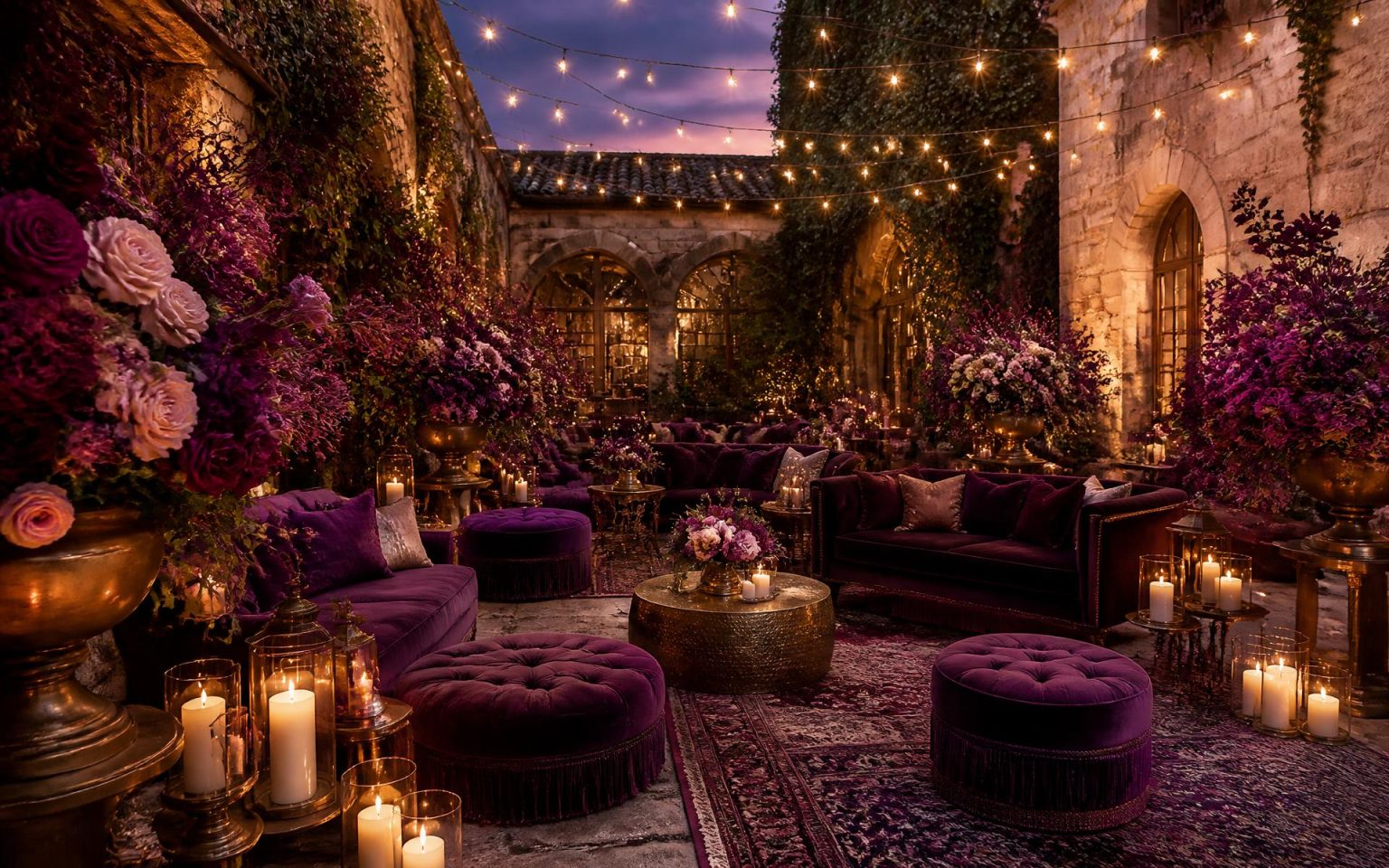
Lighting is almost always the last thing anyone decides.
The linens are chosen. The flowers are approved. The paper has been proofed twice. Somebody has spent real money on a tablecloth in a very specific shade of oxblood.
And then, roughly nine days out, a question surfaces: what are we doing about lighting?
This is backwards. It is also extraordinarily easy to do, which is the only reason I am not going to be smug about it.
Every material decision you have already made is a decision about how something behaves under light. You just made them all without knowing what the light was going to be.
Go look at the room at the hour the party happens
Not at eleven in the morning, when the venue would prefer to show it to you.
Note where the windows face. Where the sun lands and when it leaves. What glares. What sits in permanent shadow. What the glass does after dark, which is the part people forget: a wall of windows that frames a garden at four o’clock becomes a mirror at eight, and now half your guests are watching a reflection of themselves eating.
A dark textile that looks expensive at noon can go flat and muddy by dinner. Pale stone glows under warm sources and turns faintly clinical under broad overheads. The design needs to know which lighting world it is walking into before it commits to anything.
Every material decision you have already made is a decision about how something behaves under light.
There are two kinds of light and they are not interchangeable
One kind is atmosphere. The other kind is so people can find the bathroom.
Guests need enough light to get through the door, manage a step, read a sign, find a table number, see what they are eating, see who they are talking to, and get to their car. That is not the same job as making the room feel like something.
The failure is asking one decorative source to do both. A candle can absolutely contribute movement and intimacy where the venue permits it. A candle cannot be the reason an unlit gravel path is navigable. A pinspot can make an arrangement look like it was worth the money. A pinspot does not help anyone cross a room.
Decide what you want people looking at
Before anyone sends a fixture list, decide what should command attention at each point in the evening. The entrance. The ceremony or the program. The bar. The tables. The stage. The architecture. The flowers. Something else entirely.
Then the plan can build relative emphasis instead of lighting everything to the same brightness, which is the fastest way to make expensive materials look ordinary. A uniformly bright room flattens everything in it.
The opposite mistake is just as available. Push the contrast hard enough and guests cannot read faces, menus, or the floor. State the priorities; let qualified lighting people solve the technical half.
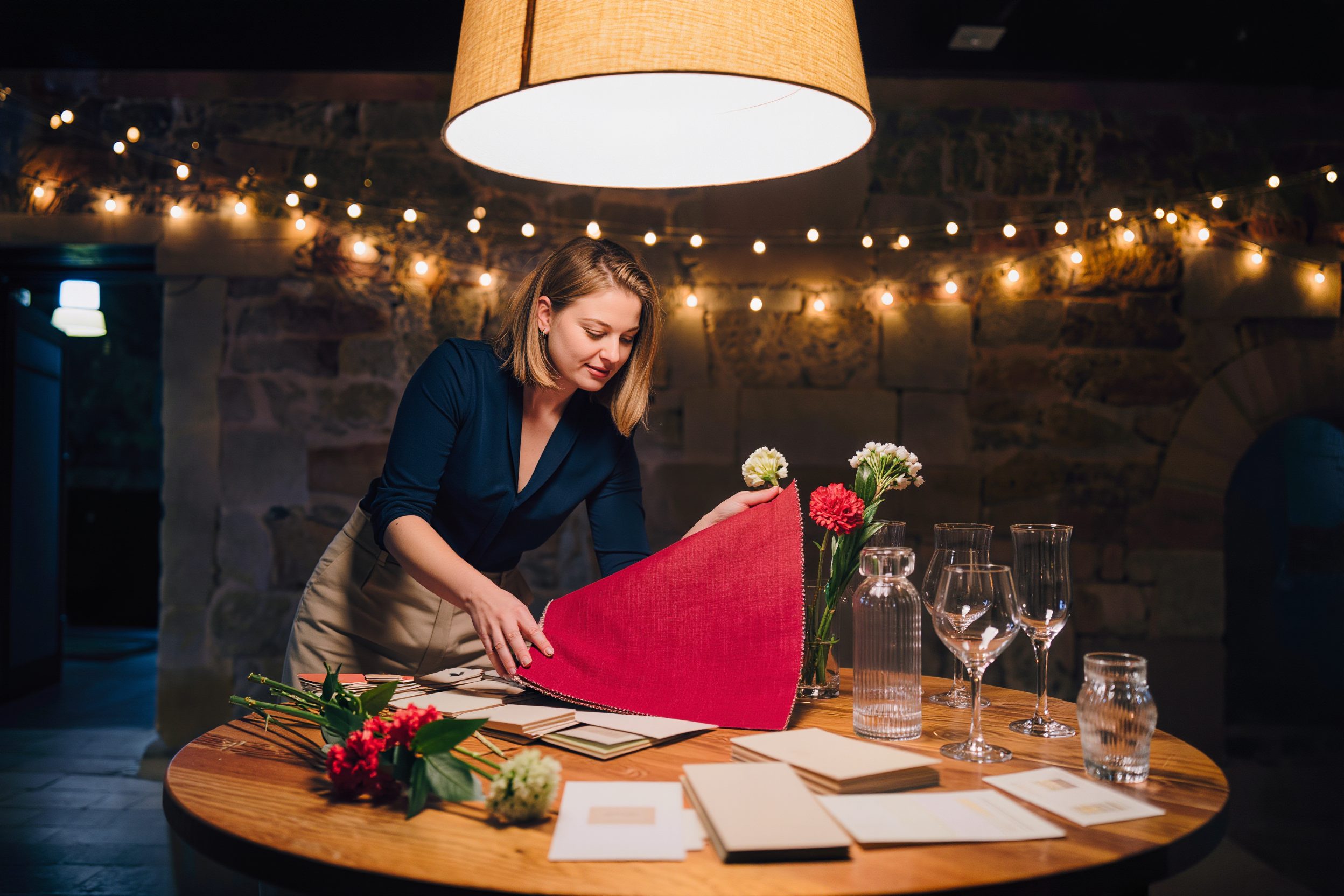
Put the samples together under the actual light
All of them. At once. In the light the event will have.
Linen, flowers, vessel, paper, tabletop, wall tone, glass, metal, and anything reflective or translucent that the concept depends on. Deep colors absorb more than you expect. Metallics either glow or glare and there is very little in between. Clear glass disappears or multiplies into a small crowd of reflections. Wet leaves and water surfaces get visually loud. Light is only one of the conditions doing this; heat, hands and time change materials too.
A palette approved under office lighting is not the palette anyone is going to experience.
Light the faces, not just the objects
Guests spend most of an event looking at each other. It is genuinely the main visual content of the evening.
A room can have spectacular scenic lighting and still feel subtly unpleasant because faces are too dark, lit from a punishing angle, or noticeably better at one end of the room than the other. Ask the production team directly how guest-facing areas are supported during dinner, conversation and speeches.
Photography and video have opinions here too, and they are legitimate. But the live room should not become a set that only feels good through a lens.
A palette approved under office lighting is not the palette anyone is going to experience.
Darkness is a material. Missing light is a mistake.
Used deliberately, darkness creates intimacy, hides architecture nobody needs to look at, deepens saturated color, and makes small pools of light feel significant. Half of what people call “atmosphere” is really just restraint about what gets lit.
It stops being a material the moment it hides a step, a route, a sign, the food, or a person. Let the low-value visual field recede. Keep everything a guest actually needs to see legible, and confirm accessibility and safety requirements with the venue rather than inferring them from a preference for candlelight.
The room should not stay the same all night
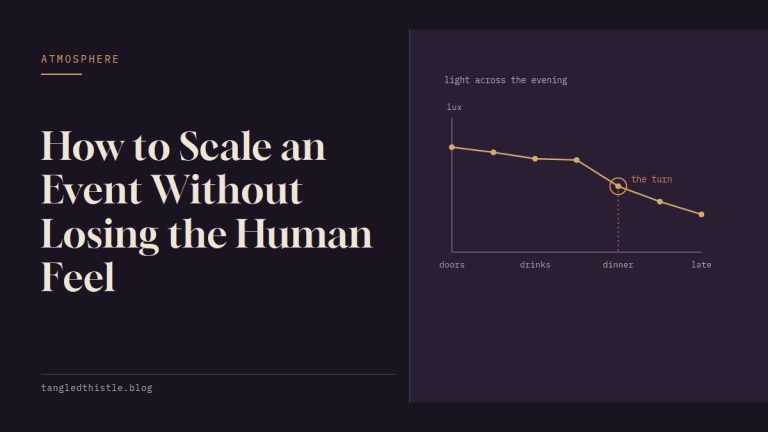
Arrival, ceremony, dinner, speeches, dancing and departure do not want the same light.
A shift in level or warmth can move an evening into its next chapter without anyone picking up a microphone to announce it, which is nearly always better than picking up a microphone to announce it. Coordinate the changes with doors, music, service and guest movement. Write down who owns each cue and what happens when the timing slips, because the timing will slip.
Power is architecture you cannot see
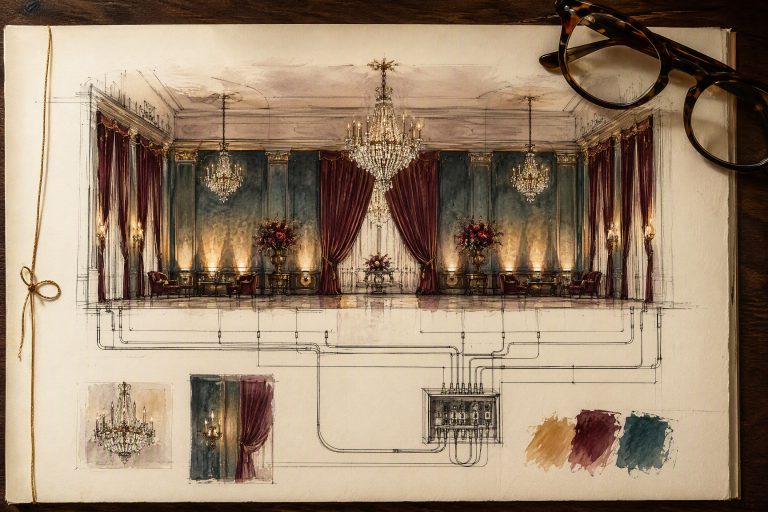
Fixtures, dimming, control, batteries, cable, temporary distribution and generators all carry venue, power, access, fire, weather and safety requirements. Those belong with qualified production and electrical providers, not with a moodboard.
The creative plan still has to make room for them spatially. Where does cable run. Where does the control position sit, and is it somewhere a guest will stand. Which circuits is catering also relying on. Does the weather version use the same equipment, or is it quietly a completely different plan. If it is a different plan, it has to be designed as one.
Do not build the room around candles until somebody confirms the flame rules
If candlelight is carrying the atmosphere, this is the confirmation that has to happen before the concept hardens, not after. Venue rules are design decisions with price tags attached.
Ask what forms of flame are permitted, what holders or enclosures are required, who is allowed to light and maintain them, and what conditions change the answer. Venues have specific requirements and they are not negotiable at seven o’clock on the night.
If flame is out, design the alternative on purpose rather than substituting it in a panic. Small lamps, reflected sources, pinspots, low-voltage fixtures and carefully chosen battery candles can build genuinely layered low light — but only if they were part of the concept from the start. Chosen at the last minute, they look exactly like what they are.
Then go stand in it after dark
Walk the arrival. Walk the path. Walk the threshold, the seating, the tables, the restrooms, the exits, the coat handling, and the route to whatever people are leaving in.
Do it in the lighting state guests will actually have, at the hour they will actually have it. This is the single test that finds the problem, and it is the one most often skipped, because by that point everyone is tired and the room already looks good in photographs.
Lighting is the condition every other decision gets made inside, whether or not anyone has bothered to name it yet.
Decide it first, and the flowers, the linen, the paper and the oxblood tablecloth all get to be chosen for how they behave in the room — instead of hoping.
Atmosphere OS · Theme Atelier
Turn the mood into something a florist can quote.
Theme Atelier builds palette, materials, lighting and spatial mood into one system, then writes it in language a vendor can price. Every number it produces comes from a published rule, and the rulebook names the judgments it deliberately refuses to call rules.
The rulebook is public. Every formula it runs on is written down where you can disagree with it.
If this is your mood
More candlelit


Field notes and corrections
When a number here turns out to be wrong, you hear about it.
Three things arrive and nothing else. The new field note — bar rates, cover widths, service clearances, the arithmetic worked through on one real evening. A line when a new World or Mini Occasion opens, because a night only goes up once it can actually be thrown. And a correction whenever a rule in the published rulebook changes, or a number the tools rely on turns out to have been wrong. There is no weekly slot, because there is nothing weekly to put in it.
One email per field note or opening, plus corrections when a published figure moves. Unsubscribe from any of them.
Continue through the system
Pretty is still not a plan.
A party gets planned in roughly this order. Pick the chapter where your next problem lives.
What you have to decide next
One decision constrains the next. This is the order they actually happen in.
More in this chapter

See the complete five-chapter Event Design Intelligence map →
You must be logged in to post a comment.