Atmosphere
How to Scale an Event Without Losing the Human Feel
Small events forgive because one host quietly repairs the gaps. Grow it and that invisible correction work has to become a plan somebody can read.
Small events are forgiving because one capable host can quietly repair the gaps. A candle is relit. A late transition is softened. A guest who looks uncertain is redirected with a sentence and a hand gesture.
As the event grows, that invisible correction work has to become a visible plan. Nobody wants a wedding that feels like a factory. The point of the plan is to keep the feeling of being looked after alive once the host physically cannot reach every guest.
Let the kitchen own the menu
Food and drink still shape timing, service routes, table space, staffing, and guest comfort, but I have no ambition to turn this place into the menu department. Here, the food questions are practical ones: what the service needs, when guests have to be seated, how much table or station space it takes, and what the venue has to supply.
For actual menu design, food strategy, and culinary execution, continue with Build the Menu Around the Last 30 Minutes at Salty & Clever. Then bring the confirmed service requirements back into the event plan.
Translate flowers into rhythm
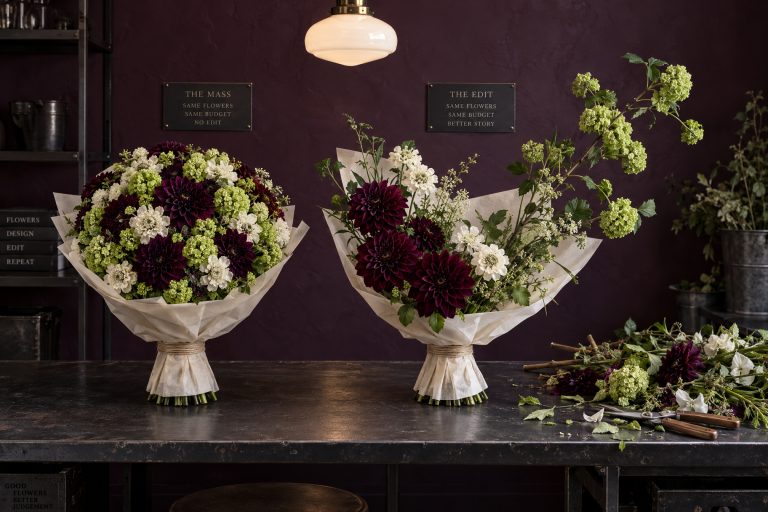
A single arrangement can dominate a dining table beautifully. Repeating that exact arrangement across a large room may flatten the event into a grid. Larger spaces often need variation: low and high moments, concentrated floral areas, quieter tables, architectural gestures, and enough negative space for the room to breathe.
The atmosphere should have rhythm rather than a quota. Decide where flowers must create impact, where they must protect conversation, where they can help direct movement, and where lighting or material can do the work more effectively.
Decide what should still feel personal
Growing an event does not mean every interaction gets processed. Choose the moments where human recognition matters most. That may be a host greeting close family, a staff member helping guests with access needs, a table captain remembering a specific service note, or a coordinator meeting an elderly relative at a difficult threshold.
Then protect those moments from administrative overload. If the person meant to offer a personal welcome is also troubleshooting parking, answering vendor texts, and locating a missing rental case, the “personal touch” has been assigned three other jobs. Human warmth scales when the operational work around it is organized well enough to leave room for actual attention.
Write down what the host would have noticed
At home, the host sees the empty glass and the guest hovering without a seat. At a larger event, that same care depends on who is assigned to which tables, who refills what, where staff stand, and whose job it is. “Someone will handle it” is how nobody handles it.
Define what attentive service means for the event. Can guests find water, restrooms, seating, and exits? Does each major room have an owner? Are accessibility needs and special service requests visible to the correct people without forcing guests to repeat themselves?
Give each zone an owner and a short line to a decision
A larger event often works better when each guest-facing zone has a clear owner: arrival, main room, quieter seating, program area, service support, and departure. Ownership does not mean that person solves every problem. It means they know what normal looks like, what requires intervention, and who has authority when the solution affects another vendor or the event schedule.
Human warmth scales when the operational work around it is organized well enough to leave room for actual attention.
Decide who calls whom before the doors open. A blocked route, a delayed room, a lighting failure, a temperature problem, or a guest accommodation request should not need to travel through five text threads before someone can act. The larger the event becomes, the more valuable a short decision path becomes.
Scale the room through zones, not duplication
A larger event does not need a copy of the same decorative idea at every table, doorway, and lounge. Divide the venue into guest-facing jobs: arrival, orientation, gathering, main program, dining or social space, quieter retreat, service support, and departure.
Give each zone enough design to make its purpose legible. Some areas need atmosphere. Some need wayfinding. Some need almost nothing except excellent light, comfortable furniture, and a clear route.
Use a focal-point budget
Large events can contain more objects and still feel less intentional. Create a focal-point budget instead. Choose the few places where attention should gather: the entrance, a central program moment, the primary room, one transition, or the final goodbye.
Not every area needs equal visual intensity. Quiet zones make dramatic zones more effective. They also reduce installation labor, visual fatigue, and the temptation to spend simply because there is more square footage.
Protect the timing buffer
A dinner party may recover from a fifteen-minute delay because guests are already in conversation. At a larger event, the same delay can affect staff breaks, transportation, vendor access, speeches, entertainment, venue overtime, and every room that depends on the previous one releasing on time.
Build buffers around the moments most likely to slip. Separate guest-facing time from production-ready time. A room that opens at seven should not be scheduled to finish installation at seven. A transition that requires moving hundreds of people also needs more margin than the same transition in a dining room at home.
Plan the reset as carefully as the reveal
Scale creates wear. Candles burn down, water disappears, chairs move, restrooms need attention, flowers react to the room, signs get turned, and small pieces of visual clutter accumulate. Decide what needs to be checked between major phases and who is allowed to reset it without interrupting guests.
Nobody expects the room to look untouched at eleven. They do expect the paths to be clear, the chairs to be usable, the light to be readable, and the bar to still be a bar, and those things slowly wear down as the night goes on unless someone is assigned to them.
Plan the recovery before it is needed
Every big plan needs a smaller emergency version. Where do guests wait if a room is not ready? Who can authorize a simplified floral install? What happens when weather removes an outdoor service point? Which decorative layer can disappear without damaging the event promise?
A room that opens at seven should not be scheduled to finish installation at seven.
Recovery is not pessimism. It is how an event remains gracious when reality refuses to follow the run sheet.
Keep one signature gesture
Scale can tempt a planner to add more ideas simply because the room can hold them. Resist that. Choose one gesture that carries the event’s character across every guest count: a distinctive welcome, a candlelit transition, a particular material, a shared ritual, or a floral form that appears in different ways throughout the event.
A signature gesture creates continuity. It allows the event to grow without becoming generic.
Run the scaling review
- Does the design still have a clear hierarchy when the room is full?
- Can guests understand arrival, seating, transitions, and departure without insider knowledge?
- Does each major zone have an owner, and does that owner know who can make the bigger calls?
- Can service recover from a delay, bad weather, or something that never arrived?
- Which moments should remain personal, and have those people been freed from every unrelated chore?
- What can be simplified without losing the event’s signature gesture?
Proving an event can get big is easy; you just invite more people. The harder trick is getting to four hundred guests with the flowers still shaping the room, the service still feeling like someone noticed you, and the evening still making sense from the front door to the car.
The human feel usually survives right up until one specific piece gives way. Nothing Breaks Gradually sets out where those points sit between two guests and four hundred.
Atmosphere OS · Theme Atelier
Turn the mood into something a florist can quote.
Theme Atelier builds palette, materials, lighting and spatial mood into one system, then writes it in language a vendor can price. Every number it produces comes from a published rule, and the rulebook names the judgments it deliberately refuses to call rules.
Costs come back as indicative bands rather than quotes, and seasonal notes are filters rather than promises.
Field notes and corrections
When a number here turns out to be wrong, you hear about it.
Three things arrive and nothing else. The new field note — bar rates, cover widths, service clearances, the arithmetic worked through on one real evening. A line when a World opens, because a night only goes up once it can actually be thrown. And a correction whenever a rule in the published rulebook changes, or a number the tools rely on turns out to have been wrong. There is no weekly slot, because there is nothing weekly to put in it.
One email per field note or opening, plus corrections when a published figure moves. Unsubscribe from any of them.
Continue through the system
Pretty is still not a plan.
A party gets planned in roughly this order. Pick the chapter where your next problem lives.
What you have to decide next
One decision constrains the next. This is the order they actually happen in.
More in this chapter
See the complete five-chapter Event Design Intelligence map →