Space & Venue Reality
‘There Are Plenty of Outlets’ Describes a Wall
‘There are plenty of outlets’ describes a wall. The AV lead needs the equipment demand, actual power sources, circuit ownership, distribution, locations, cable routes, overlaps and backup before the show can depend on the room.
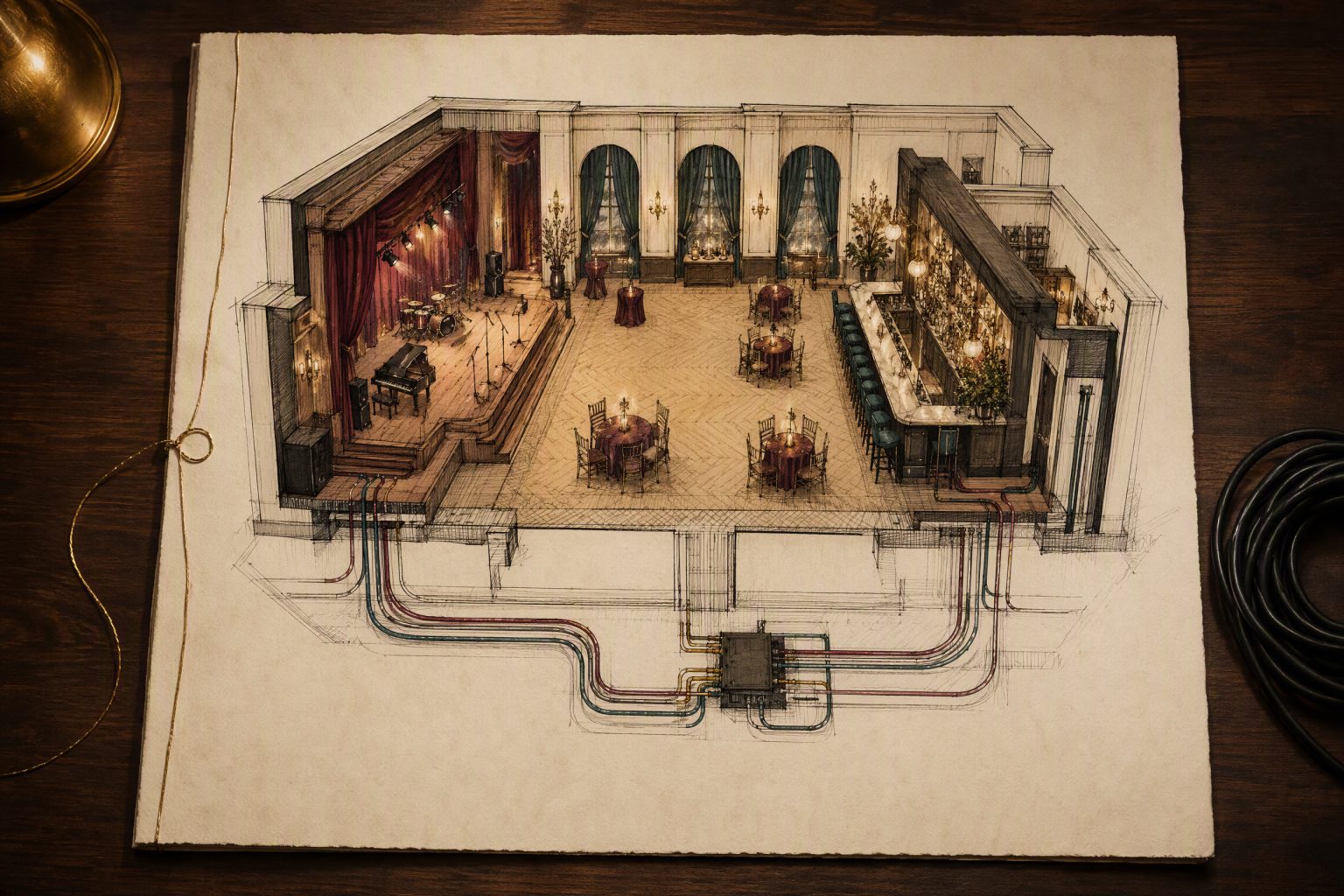
VENDOR POV · AV + PRODUCTION POWER
“There are plenty of outlets” is a venue description, not a production-power answer. The AV lead is trying to understand what is behind those outlets, what the show actually demands, where the equipment lives and who else intends to use the same electrical system at exactly the wrong moment.
I already worked out the planning number in How Much Connected Load Does This Lighting Brief Actually Represent?, which turns a lighting brief into a running tally of quantity, vendor-supplied input, location, scene and unknowns.
This picks up one step later. You hand the production team that list, and they still cannot safely answer the event-power question by counting receptacles along the ballroom wall. An outlet tells you where power might come out. It tells you nothing about what is behind it or who else is drawing on it.
The AV lead wants the equipment before the electricity conversation
Power planning cannot be completed while the show is still described as “DJ, a few lights, screens and microphones.”
The production team needs the actual package, or at least one stable enough to review: audio, lighting, video, playback, LED or projection, recording, streaming if there is any, control and networking gear, and any scenic or branded element that plugs in. Then they need the manufacturer or vendor input requirements and where each device is supposed to operate.
That is what the load calculation is for. It keeps the AV lead from being handed adjectives.
“Immersive” does not have a nameplate.
Current production guidance treats power as a designed service
Encore’s current infrastructure-services guidance describes event power distribution as a service that is designed and managed around venue/event needs, including complex temporary systems and backup generation.
Its current EventNow electrical ordering system also asks exhibitors to identify the location of multiple power drops on a booth diagram rather than treating electrical service as a pile of anonymous wall plugs.
NextLevel Production Services’ current venue AV coordination checklist is even more direct about why this matters operationally: it warns that shared circuits can trip during catering service or peak production load and recommends mapping usable circuits near stage, front-of-house and video positions while determining whether dedicated service, temporary distribution or generator support is required.
Those are practitioners talking, and none of it is electrical code. They do agree on the part that matters here: professional event power planning begins with verified demand and distribution, not outlet abundance.
Two outlets next to each other may tell you almost nothing useful
The wall shows two receptacles, the photograph shows six and the floor plan shows twelve. None of that tells the planner which branch circuits serve them, what else is connected, what capacity is available for the actual production package, whether house rules require venue power services, or whether the proposed equipment can be distributed safely and appropriately.
Those determinations belong to the venue and qualified electrical/production professionals.
Nobody is asking the planner to trace circuitry. The planner’s job is to stop accepting a visible outlet count as proof that the power exists.
The stage and the bar can be electrically adjacent even when they are across the room
Departments collide here. AV thinks in show positions. Catering thinks in coffee, hot holding, refrigeration and service equipment. Lighting thinks in fixture zones. Florals may suddenly acquire illuminated structures, the photo activation arrives with screens and printers, and the dessert station has something that heats.
Each request may be completely reasonable on its own. The building receives them all at once, which is why power has to be coordinated across the whole event.
Someone has to see the overlap before dinner service and the first dance decide to test the same assumption simultaneously.
The AV lead needs location beside load
One kilowatt in a spreadsheet is not a location.
Production equipment is spatial:
- stage;
- front of house;
- video control;
- speaker positions;
- lighting positions;
- projection or LED locations;
- backstage/greenroom;
- recording or streaming position;
- exterior or satellite zones;
- interactive stations.
The electrical solution has to reach the equipment under venue rules without turning guest circulation into a cable-management experiment.
So the power conversation and the floor plan belong in the same meeting.
Actual equipment and vendor-supplied electrical requirements.
Where stage, FOH, video, lighting and satellite equipment live.
What venue/temporary power service is actually available and approved.
The professionally determined route from approved source to operating equipment.
What catering, décor, activations or other systems operate at the same time.
What the show does if a critical system is unavailable.
Cable route is part of the guest journey
The power source may be completely adequate and still be in an inconvenient place.
Now the question becomes routing.
Where can the appropriate production cabling travel under venue rules?
Which doors, aisles, egress paths, accessible routes, service routes and finished surfaces must remain usable?
Does the run cross an exterior path? Does weather change the condition? Does the floor treatment have to be coordinated before the event opens?
Nobody should be selecting conductors or protection methods from an article, least of all from mine. But the planner absolutely should know that moving the stage twenty feet can create a different production path.
A floor-plan revision is allowed to be electrically consequential.
The show state matters
A conference can have a keynote state, breakout state, dinner state, awards state and after-party state.
A wedding can move from ceremony audio to cocktail sound to dinner lighting to band/DJ production.
The AV package does not necessarily operate identically across those states.
That is useful information for the professional team reviewing the system.
It is also dangerous information if somebody uses it casually to subtract loads with “those will probably be off by then.”
If two systems are mutually exclusive by design, document the control and ownership that makes them mutually exclusive.
If the only protection against overlap is that someone intends to remember, treat the overlap as unresolved.
The show runs on instructions, not optimism.
House power rules can change the quote without changing the equipment
Two venues can host the identical AV package and produce different power scopes.
One may provide appropriate service under its standard package.
Another may require an exclusive in-house power-distribution provider, specific labor, dedicated services or ordered drops at exact locations.
Encore’s current venue infrastructure model is a good public example of why you ask the venue first: there, power distribution is a specialized onsite service, and plugging into the building is a different thing entirely.
The production company should learn those rules before its technical package is priced as though electricity is free, generic and already sitting where needed.
This is the same reason The Venue Contract Is Part of the Design.
House exclusivity and infrastructure charges can shape the show, so they cannot wait until after it is designed.
“Dedicated circuit” is not a phrase for the planner to self-certify
Production teams often use language like dedicated circuit because isolation between critical loads can matter.
Current practitioner guidance from NextLevel explicitly calls out shared-circuit failures and recommends verifying how critical AV loads are separated from competing uses.
That does not mean the planner walks around opening panels or assigning branch circuits.
It means the planner asks the venue/qualified production team the correct question:
Has the power service for the actual AV package been verified, and have competing event loads been coordinated?
If the answer is “there are outlets behind the stage,” the question has not been answered yet.
Front of house is not furniture you can move casually
The audio/lighting/video control position often gets treated like a small table that can drift to whatever part of the floor plan remains after dinner seating is solved.
Technically and operationally, it can be a production position with power, signal, sightline and cable-route requirements.
Move it and the routing can move with it.
Hide it behind a scenic wall and the operator may lose a needed sightline.
Put a bar queue through it and you have invented an interactive activation nobody requested.
The AV lead is looking at power as one member of a larger production relationship: equipment, people, signal, sightline, access and room.
Temporary outdoor power adds another layer entirely
Outdoor events do not get to translate indoor assumptions directly onto a lawn.
NextLevel’s current outdoor AV checklist starts its power section by telling planners to verify the source rather than assume a nearby receptacle is sufficient, then treats distribution, source-to-stage distance and backup as part of the production plan.
Weather exposure and temporary-power work introduce project-specific safety and code requirements that belong to qualified professionals.
My contribution is narrower: put the distance and location on the plan early. A source hundreds of feet from the show is not “power nearby.” It is a routing problem the qualified team has to design for.
The backup question should be specific
“Do we have backup power?” can become another vague yes/no field.
Ask what actually has to survive. Speech audio is the usual first answer.
Emergency or required life-safety systems are a separate venue/authority matter and are not yours to redesign.
But for show continuity, the production team can define which event functions are critical and what approved contingency exists if a source, device or signal path fails.
The answer may be redundancy, alternate equipment, a battery-backed small system, a second playback path or another professional solution appropriate to the event.
The important thing is that “backup” has a named job.
The AV lead wants one combined change log
The easiest way to break a plan that has already been reviewed is to change it one department at a time. Somebody adds an illuminated scenic wall, the DJ moves outside, the projector becomes an LED wall, a live band appears, a photo booth lands where the AV control position was, and the stage moves. Each of those can change demand, location, cable routes, staffing or distribution.
So production changes need a shared log.
The AV lead should not discover the new champagne-wall refrigerator because both teams reached the same wall receptacle on event day.
Where I land
Outlet count never approves an AV package. Before technical review, the production team should have the equipment demand, the vendor-supplied electrical requirements, where everything lives, when it runs and what else is powered at the same time. The venue and qualified electrical and production professionals then verify the source, capacity, circuits, distribution, protection, cable routing and any temporary power.
This usually fails quietly. Every department has a plausible plan of its own, and several of them lean on electricity nobody reviewed as one event. If the power conversation can still be summed up as “there are plenty of outlets,” it has not really happened yet.
The AV lead is not trying to make the room less beautiful
They would also like the speakers to disappear, the cable paths to be quiet, the control position to stop reading as a science fair and the lighting to feel as though the room simply decided to glow.
That is easier when the technical side is designed early enough to stop leaking into the guest experience. Count the demand, put it on the floor plan, mark what runs together and tell the production team what changed. Then let the people responsible for electrical safety decide how the power actually gets there.
The outlets can go back to being little rectangles on the wall.
They have been relieved of a job they were never qualified to hold.
Sources for the AV and production-power perspective: Encore — Infrastructure Services / Power Distribution; Encore EventNow — electrical service configuration; and NextLevel Production Services — Venue AV Coordination Checklist. These illustrate current professional coordination practice; they do not replace venue rules, electrical codes or project-specific professional review.
Coordination guidance only. Source verification, capacity, distribution and installation belong to the venue and the licensed electrical and production people.
Space Lab
The floor plan is a drawing. The license is a fact.
Start with the event you are actually planning and test the room against it. Space Lab does not claim that a date is free, a price is current or a license is valid; those remain direct-confirmation questions outside the room model.
No account required for the core room work. Missing measurements and unanswered questions stay visible.
The column
Vendor POV
The same event, described by the person who has to build it. What a rigger, a caterer, a draper or a valet captain is actually looking at when they read your plan — and the question they ask that nobody at the planning table thought to ask.
Field notes and corrections
When a number here turns out to be wrong, you hear about it.
Three things arrive and nothing else. The new field note — bar rates, cover widths, service clearances, the arithmetic worked through on one real evening. And a correction whenever a rule in the published rulebook changes, or a number the tools rely on turns out to have been wrong. There is no weekly slot, because there is nothing weekly to put in it.
One email per field note, plus corrections when a published figure moves. Unsubscribe from any of them.
Continue through the system
Pretty is still not a plan.
A party gets planned in roughly this order. Pick the chapter where your next problem lives.
What you have to decide next
One decision constrains the next. This is the order they actually happen in.
More in this chapter

See the complete five-chapter Event Design Intelligence map →