Budget & Trade-Offs
The Venue Contract Is Part of the Design: What to Read Before You Sign
The ballroom can be beautiful and the contract can still quietly redesign the event. Read the clauses that change cost, access, vendors, timing, sound, weather, and what you are actually allowed to build.
A venue contract is one of the least photogenic documents in event planning, which is unfortunate because it may have more influence over the finished event than the mood board does.
The room can be perfect. The light can be lovely. The staircase can make everyone briefly forget that stairs are also a circulation problem. Then the agreement arrives with an exclusive caterer, a hard stop at 10:00 p.m., a narrow installation window, required security, a furniture-removal fee, a corkage charge, and a paragraph explaining that the rain backup you thought was included is, in fact, another room with another price.
The photograph of the staircase is not the deal. Neither is the quoted rental number.
Start with what the venue price actually buys
Ask what is included before deciding whether the price is reasonable. Tables, chairs, basic linens, staging, house lighting, sound, kitchen access, coat check, security, cleanup, parking, rehearsal time, ceremony space, getting-ready rooms, and a weather backup may be included, optional, required through the venue, or not available at all.
A lower room fee can become the more expensive event if everything needed to make the room usable arrives as a separate line item. A higher fee can be excellent value when the infrastructure is already there and actually suits the plan. I am much more interested in what the money is doing than whether the first number looked polite.
Read the exclusive-vendor language before falling in love with a vendor
Some venues require in-house catering, a preferred rental company, approved production vendors, licensed bartenders, specific security providers, or an exclusive list for certain services. That may be perfectly workable. It may also eliminate the florist, caterer, lighting company, rental collection, or production approach you assumed would be available.
Find out what is truly exclusive, what is merely preferred, whether outside vendors trigger fees, and what approval or insurance requirements apply. Do this before collecting proposals. Designing around a supplier you cannot hire is a very elegant way to waste a week.
The event hours are not the production hours
A six-hour event may need twelve or sixteen hours of access once loading, installation, vendor setup, sound check, photography, breakdown, cleanup, and rental pickup are included. Confirm exactly when each team may enter, where they enter, whether multiple vendors can load simultaneously, and when everything must be out.
A lower room fee can become the more expensive event if everything needed to make the room usable arrives as a separate line item.
Then compare those windows with the design. A ceiling installation that needs a lift is a different proposition when the venue allows eight hours than when it allows ninety minutes between another event and yours. A complicated room turn is different when guests have a real holding space than when everyone is expected to admire a hallway while staff performs a furniture miracle behind closed doors.
I already treat the loading dock as part of the venue. The contract is where that operational reality becomes enforceable.
Curfews change more than the last song
Look for event end time, amplified-sound cutoff, bar close, guest-departure deadline, vendor-strike deadline, neighborhood noise restrictions, and overtime terms. Those are not all the same clock.
If music must end at ten but the room is rented until midnight, the evening needs a deliberate final chapter. If guests must leave at ten and rentals must be gone by eleven, the strike plan suddenly matters quite a lot. If overtime is possible but priced aggressively, decide in advance who has authority to approve it instead of letting a delayed toast make the financial decision.
Find the clauses that turn design into permission
Rigging, draping, candles, adhesives, confetti, fog, haze, generators, open flame, floor coverings, freestanding walls, floral installations, hanging décor, exterior signage, food trucks, live animals, drones, tents, temporary structures, and specialty entertainment may all require approval or be prohibited.
That does not mean the venue is difficult. Buildings have fire systems, surfaces, neighbors, insurance, engineering limits, and other very unromantic realities. The problem is discovering the restriction after the design has been sold to everyone emotionally.
Read these rules beside the design concept, not in a separate administrative universe. A restriction is a design input. Treat it that way early and it can produce a better idea. Treat it as paperwork and it tends to arrive later wearing an invoice.
Food and beverage minimums need translation
A food-and-beverage minimum is not always the final food-and-beverage cost. Ask what counts toward the minimum, what does not, whether service charges and taxes are added afterward, how children or vendors are priced, what bar packages include, how nonalcoholic service is handled, and whether cake cutting, corkage, outside desserts, late-night food, or specialty beverage stations carry separate fees.
None of this is gotcha-hunting. You are simply comparing proposals by the number the event will actually spend rather than the prettiest number in the first email.
A restriction is a design input. Treat it that way early and it can produce a better idea.
In Cvent’s 2026 planner sourcing research, 72% of planners expected event costs to rise and 35% named staying within budget as their biggest concern. That puts contract literacy squarely inside the design job. Source: Cvent 2026 Planner Sourcing Report.
Weather language deserves its own meeting
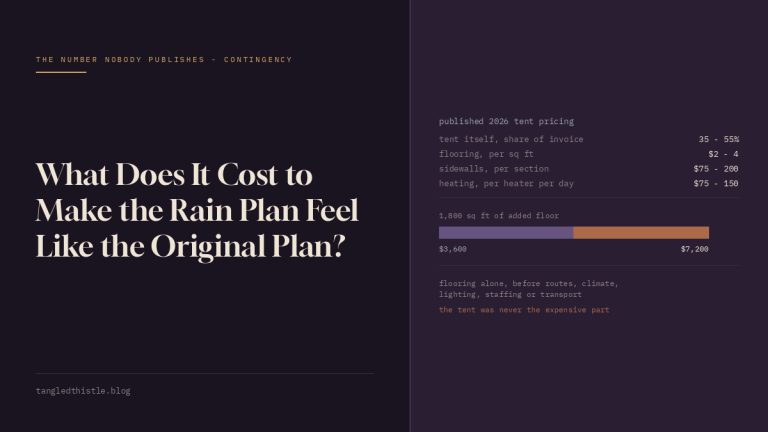
If any portion of the event is outdoors, identify who makes the weather call, by what deadline, what backup space is guaranteed, whether moving indoors changes capacity or layout, what happens to outdoor rentals already ordered, and whether tenting or heaters require separate venue approval.
A rain plan should not be a sentence that says indoor space is available. It should be an event that still works. A weather decision deadline matters only if the contract gives the team enough information to act on it.
Insurance, damage, and cleanup are design-adjacent whether anyone likes it or not
Confirm certificate-of-insurance requirements, vendor coverage requirements, damage deposits, cleaning obligations, trash removal, recycling, candle wax, floral waste, confetti rules, furniture movement, kitchen cleaning, and what condition the venue expects the room to be in when you give it back.
A design with hundreds of candles, heavy scenic construction, large floral mechanics, or complicated rentals creates a different cleanup and damage profile than a dinner with house furniture and bud vases. The budget should know that before the cleanup crew does.
Compare contracts with an event-impact column
When comparing venues, do not create a spreadsheet containing only room fee, capacity, and address. Add the clause that matters and what it changes: cost, vendor choice, design freedom, guest experience, production time, weather resilience, or risk.
When the clauses come down to what the room itself will allow, Space Lab keeps those limits, and the questions still waiting on the venue, in one room record.
That is how a contract becomes useful instead of merely long. The goal is not to find a venue with no rules. That venue probably does not exist, and I would be suspicious if it did. The goal is to know which rules materially change your event and whether the space is still worth choosing once the whole plan is visible.
This is an event-planning framework, not legal advice. A contract that will cost you real money deserves a real reader.
Field notes and corrections
When a number here turns out to be wrong, you hear about it.
Three things arrive and nothing else. The new field note — bar rates, cover widths, service clearances, the arithmetic worked through on one real evening. A line when a World opens, because a night only goes up once it can actually be thrown. And a correction whenever a rule in the published rulebook changes, or a number the tools rely on turns out to have been wrong. There is no weekly slot, because there is nothing weekly to put in it.
One email per field note or opening, plus corrections when a published figure moves. Unsubscribe from any of them.
Continue through the system
Pretty is still not a plan.
A party gets planned in roughly this order. Pick the chapter where your next problem lives.
What you have to decide next
One decision constrains the next. This is the order they actually happen in.
More in this chapter

See the complete five-chapter Event Design Intelligence map →