Budget & Trade-Offs
The Florist Is Protecting the Shape
When a floral budget moves, the florist should not shave the same percentage from every arrangement. Protect the composition: focal hierarchy, scale, silhouette, rhythm, material quality and the mechanics that make the design possible.
VENDOR POV · FLORAL DESIGN
The easiest way to ruin a floral design after the budget changes is to remove the same percentage from everything. What the florist is guarding is the shape of the idea. The shopping list was always negotiable.
I made the planner’s case in Every Table Looks Like the Idea After a Hard Afternoon. This one sits on the florist’s side of the table.
What happens when the proposal comes back and somebody says: we love it, but the floral number needs to come down?
The weak answer is arithmetic.
Twenty percent less budget. Twenty percent fewer stems in every centerpiece. Slightly smaller ceremony flowers. A few bud vases disappear. Every piece survives, technically.
The room looks like the original design has been through a minor illness.
The stronger answer is composition.
Which visual jobs must survive? Which repetitions are doing almost nothing? Which expensive materials are carrying the concept, and which are simply being repeated because the recipe says so?
Answering those well is how a florist earns the design fee.
The florist is buying what the flowers do
A flower name is only half a design instruction. The other half is what the material is doing.
Does it create a dark vertical line? A soft cloud? A heavy round focal? Airy movement? A trailing edge? A very specific color depth? A translucent moment that catches side light? A large face that gives immediate volume?
If a premium stem becomes unavailable or unaffordable, the most useful substitution brief preserves those qualities rather than the exact cultivar.
That is why “replace the peonies with something cheaper” is a worse instruction than “keep the large, soft, pale focal mass and the loose romantic edge.”
The first swaps an ingredient and hopes. The second protects the composition.
Current florist pricing makes labor impossible to ignore
Several current 2026 florist pricing guides make the same point from different markets: the invoice is not only stems.
The May Flower Co.’s 2026 Northern California breakdown explicitly separates design, installation and strike labor, and notes that suspended or large-format installations increase structural, rigging and installation demands. Sue Gallo Designs similarly describes luxury floral pricing as scale, structure, labor and production—not simply blooms.
Zola’s February 2026 floral-cost guidance also recommends concentrating spending in high-impact areas rather than spreading it evenly across every possible floral location.
That is market guidance from specific studios, and local numbers will differ. Where they agree is the part I care about: cutting flowers does not automatically cut the parts of the job that are structure, mechanics, transport, install or strike.
A smaller floral recipe can still need the same truck, the same venue access window and the same midnight return.
So what gets protected first?
I would ask the florist to identify five things before touching quantity:
Which one or two moments tell the room what the floral point of view is?
Low and sprawling, tall and graphic, loose and airy, dense and architectural.
How large must the gesture be to hold its own against the room?
Where repetition carries the language, and where repetition is merely expensive.
Color depth, movement, texture, translucency, line and focal weight.
If those survive, the flower list can move much more than most people think.
Cut the surfaces nobody remembers before the focal point everybody photographs
Florists have been saying versions of this for years because it works.
Current 2026 market guidance from The May Flower Co. recommends concentrating florals where guests actually gather rather than spreading them thinly across every surface. Butera the Florist’s long-running budget guidance makes the same focal-point argument: make a statement, but not everywhere.
Decorating only for the camera would be its own mistake. The point is to stop treating every console table, restroom shelf, bar corner and sign as a floral obligation.
Ask what happens if the welcome table stays quiet.
Ask what happens if half the cocktail arrangements become candle-and-object moments instead.
Ask whether the ceremony focal point can carry enough visual authority that the aisle markers are allowed to disappear.
Ask whether one strong bar arrangement is doing more for the room than six small floral apologies scattered around it.
The floral budget gets stronger when every arrangement has a job.
Do not cut the signature piece until you have cut weak repetition
The instinct to be fair to every table is understandable.
It is also how a room ends up with thirty-five slightly disappointing centerpieces.
If the signature installation is the thing giving the room scale, cut lower-value repetition first.
Some tables can be candle-led. Some can carry simpler botanical material. A long room can use alternating recipes. A view-facing table may need less. A bar under excellent architecture may need no flowers at all.
Spending the same on every table buys sameness, which is easy to mistake for coherence. Rhythm needs pauses as much as it needs repetition, and a quiet table reads as a choice when the rest of the room is confident.
Premium flowers belong where their premium quality can be perceived
If the concept depends on one extraordinary material, do not necessarily ban it from the proposal.
Concentrate it.
Use the premium bloom where guests see it close enough for the difference to matter: bouquet, head table, escort moment, bar focal point, ceremony foreground.
Support the color, movement or silhouette elsewhere with materials that do the same visual work at a different cost.
The room does not receive a prize because the expensive flower was evenly distributed.
It receives atmosphere.
A stem-count reduction can make labor worse
This is the part that catches people off guard.
Suppose a large arrangement is simplified by swapping a few large-volume materials for many smaller stems while trying to preserve the same finished size.
The material bill may move one direction while processing and design time move another.
Or suppose a floral installation is reduced in bloom density but still requires the same framework, lift, rigging review, install crew and strike window.
The flowers got cheaper.
The production did not shrink proportionally.
So the cost conversation has to cover the design and the labor together, not just the wholesale flower bill.
Mechanics are not filler
The guest does not see most floral mechanics.
The florist absolutely does.
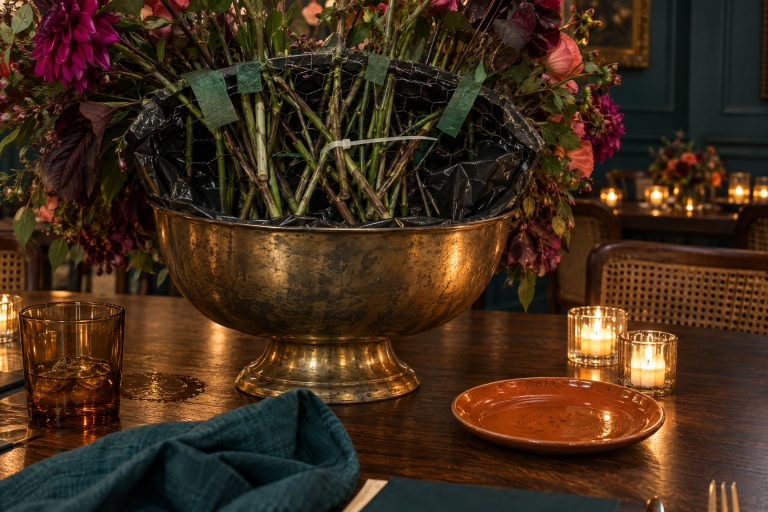
Vessels, frames, armatures, support, hydration, approved attachment, floor protection and other project-specific mechanics are the things allowing the visible material to hold its shape and survive the event.
They also determine labor, transport, waste and strike.
Removing visible blooms does not mean the underlying structure can safely or functionally disappear.
For overhead work, The Flowers Were the Last Layer shows the extreme version: the florist’s visual field depended on a separate engineered production grid.
The same principle exists at smaller scale. The composition rests on an operating object whether the object is beautiful or not.
Repurposing only saves money when the move is actually cheap
“We will just move the ceremony flowers to dinner” is one of the most common ways a floral budget appears to solve itself in a spreadsheet.
Sometimes it works beautifully.
Sometimes the two locations use different mechanics, the timing is impossible, the flowers are wet, the arrangement is too large for the doorway, the ceremony ends twelve minutes before dinner opens, or the receiving surface was never designed to accept the piece.
I went through that in full in The Floral Repurposing Plan Cannot Depend on Magic. From the florist’s side, add one more filter:
Do not count a repurposing saving until the labor, route, timing, reset and mechanics are included.
A theoretical second use is not yet a budget reduction.
A smaller version should be redrawn, not merely subtracted
When the budget changes materially, ask the florist to show you the composition again, drawn for the new number. A revised spreadsheet tells you what left. It does not tell you what the room now looks like.
What is now the signature moment? Which tables are floral-led? Where is the quiet? Does the color story still move through the room? Did the vertical rhythm vanish? Did one premium material become more important because it is now concentrated?
The smaller version should look as though somebody chose it on purpose.
It should not look like the larger version after finance removed twelve line items.
What the florist needs from the planner
Budget scaling is easier when the florist is given real priorities rather than a demand to make every line cheaper.
Say which guest moments matter most. Arrival, ceremony, dinner, dance, bar, photograph, intimacy, room scale.
Give the florist the actual room. Architecture, table count, table shapes, ceiling height, lighting, service objects and sightlines.
Say what cannot change. A color, a particular family flower, the ceremony gesture, the bouquet, one installation.
Say what can. Species, recipe repetition, secondary locations, vessel mix, exact arrangement count.
Give them the production window. Install and strike time can decide which version is financially sensible.
Then let the specialist redesign.
If you dictate every flower and every location before asking for savings, you have already removed most of the useful tools.
Where I land
When the floral scope has to shrink in a real way, redesign the hierarchy before anyone touches stem counts. Protect the signature gesture, the silhouette, the proportion against the room, the color and texture language, and the arrangements guests actually stand near. Cut low-value repetition and optional locations first. And stay honest about the invoice: mechanics, installation, transport, repurposing labor and strike do not shrink in step with the flowers.
The test is whether the smaller version reads as a complete design, with no visible scar where the money came out.
The florist is allowed to change the recipe
That is the design work, and nothing has been lost yet.
The flowers were always going to change. Availability sees to that, and so do the budget, the room and the guest count.
The thing worth protecting is the visual logic underneath all of it.
Keep the focal hierarchy. Keep the scale. Keep the strange branch line that made the arrangement feel like itself. Keep the deep red exactly where the room needs the deep red.
Let the less important stems go with dignity.
Sources for the florist-side cost logic: The May Flower Co. — 2026 Wedding Flower Budget, Northern California; Sue Gallo Designs — floral budget guide; Zola — Wedding Florist Cost, updated February 2026; and Butera the Florist — focal-point budget guidance. These are practitioner/market guidance rather than universal pricing rules; local proposals and project conditions control actual costs.
Mechanics, rigging, water and venue surfaces get confirmed with the florist and the venue, for the actual room.
Atmosphere OS · Budget-to-Atmosphere
Cutting a budget is a design decision, not an accounting one.
Budget-to-Atmosphere shows what leaves the room when the number moves, so the cut gets chosen rather than discovered on the night. Costs are bands and not quotes, and that limit sits at the top of the page.
Free to use, local-first in your browser, and there is no account until you ask for one.
The column
Vendor POV
The same event, described by the person who has to build it. What a rigger, a caterer, a draper or a valet captain is actually looking at when they read your plan — and the question they ask that nobody at the planning table thought to ask.
Field notes and corrections
When a number here turns out to be wrong, you hear about it.
Three things arrive and nothing else. The new field note — bar rates, cover widths, service clearances, the arithmetic worked through on one real evening. And a correction whenever a rule in the published rulebook changes, or a number the tools rely on turns out to have been wrong. There is no weekly slot, because there is nothing weekly to put in it.
One email per field note, plus corrections when a published figure moves. Unsubscribe from any of them.
Continue through the system
Pretty is still not a plan.
A party gets planned in roughly this order. Pick the chapter where your next problem lives.
What you have to decide next
One decision constrains the next. This is the order they actually happen in.
More in this chapter

See the complete five-chapter Event Design Intelligence map →