Space & Venue Reality
Tablescapes That Survive Real Guests and Real Weather
A tablescape has two lives. The pristine one lasts a few minutes; the second starts when people sit down and ask the table to become furniture.
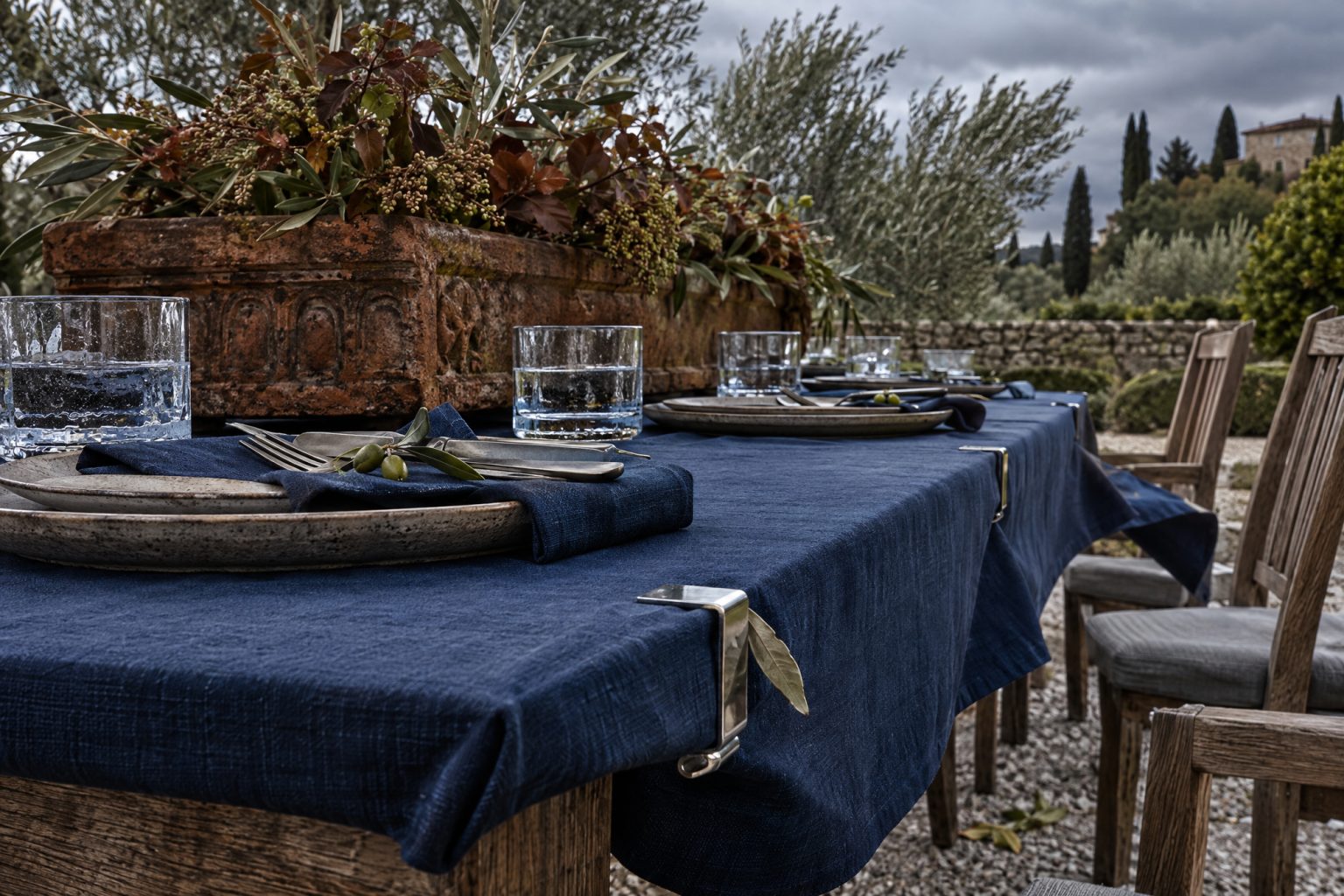
A tablescape has two lives. The first lasts a few pristine minutes before guests arrive: every napkin aligned, every glass untouched, every flower facing the camera. The second begins when people sit down and ask the table to become furniture.
The second life is the one worth designing for. A strong event table can hold atmosphere without punishing conversation, service, movement, weather, accessibility, or the very ordinary fact that people need somewhere to put their hands.
Start with the occupied table
Build or mock up one complete place setting at actual scale. Include the chair, linen, charger or plate, glassware, flatware, napkin, menu, favor if one exists, centerpiece, candle or lighting element, table number, and the service style the caterer expects.
Then sit down. Pull the chair in. Reach for a glass. Turn toward the person beside you. Imagine a server approaching. A table that works only from overhead is a photograph, not a dining plan.
Protect the conversation line
Flowers, branches, candles, vessels, menus, and decorative objects should create visual depth without turning the person opposite into a rumor. Height can work when the visual mass sits clearly above the natural conversation zone. Low arrangements can work when they are truly low enough to see across.
Test the densest section of the arrangement, not the most flattering gap. Guests should not spend dinner leaning sideways around a design that was supposed to make the table feel generous. Height is the decision that either protects the conversation or ends it.
Leave service somewhere to happen
The table needs working surface. Bread, shared dishes, wine, water, clearing, coffee, dessert, or family-style service may require space that an initial styling mockup does not show. Ask the caterer how the meal is actually served and what must land on the table during each course.
If every inch is already occupied before service begins, the decorative plan is borrowing space from dinner. What you get instead is staff shuffling vases around in front of the people you were trying to impress.
A table that works only from overhead is a photograph, not a dining plan.
Wind changes the object hierarchy
Outdoors, the lightest objects become the most demanding. Menus lift. Place cards skate. Napkins unfold. Thin candles struggle. Lightweight vessels shift. Loose petals and decorative scatter travel to another table.
For outdoor plans, test the complete table under realistic site conditions and follow venue and vendor requirements for flame, structures, weights, and weather. Favor objects that can tolerate movement without becoming hazards or constant staff assignments.
- Use stable vessels appropriate to the surface and arrangement.
- Design paper goods with secure placement rather than assuming still air.
- Confirm candle and flame rules before building the mood around them.
- Plan what happens to the table if wind or precipitation changes the event location.
- Keep ballast, weights, mechanics, and safety hardware discreet but professionally specified where needed.
Wind does not respect the tablescape hierarchy. It establishes its own, starting with whatever is lightest.
Heat and sun alter color, comfort, and timing
Direct sun can heat metal, glass, dark linens, and seating surfaces. Flowers and foliage may respond differently to heat and exposure. Chocolate, wax, adhesives, paper, and other decorative materials can also behave differently outside a climate-controlled room.
Coordinate installation timing and material suitability with the relevant vendors, and be honest about how each material behaves once heat, hands, and hours get to it. If the table will sit exposed for hours before guests arrive, the “finished” moment needs to be planned around real conditions rather than the time styling begins.
Design lighting for faces and objects
A moody table still needs to reveal names, food, glassware, edges, and the faces across it. Test the tablescape at the hour dinner will actually happen. Daylight that made everything readable at setup may be gone by the first course.
Use lighting layers rather than asking one decorative candle to do the work of atmosphere, navigation, photography, and visual access. It goes better when light is decided before the table is styled. Where low light is central to the design, make sure printed materials and pathways remain legible enough to use.
Give every guest equivalent usable space
A beautiful table should not depend on squeezing the final chair into a corner. Check elbow room, chair movement, table legs, place-setting width, route clearance, service access, and the space required for mobility devices or other accommodations guests have requested.
Decorative equality matters too. If one end seat loses half its setting to a floral installation or the last place at a long table sits beside exposed mechanics, the composition has prioritized the photograph over the person.
Use repetition to create abundance without crowding
Atmosphere does not require every category of object on every table. Repeating one strong cue—an unusual vessel shape, a berry-toned napkin, a dark taper where permitted, a brass detail, a particular flower, a small pool of reflected light—can make a room feel richly composed without consuming the entire tabletop.
Choose where density belongs. A dramatic central table, escort moment, bar, or entrance can carry visual abundance while dining tables retain more physical margin.
Decide what staff may move
Some objects are temporary by design: a ceremony program, menu, favor, or small decorative layer may disappear as the event progresses. Other pieces should stay put because they are structural, electrical, floral, fragile, or part of a calibrated service layout.
Atmosphere does not require every category of object on every table.
Make those expectations clear to the relevant team. If a centerpiece must be moved before service, the move needs a destination and an owner. If a candle system requires maintenance, the responsible vendor should define that process. “Someone will handle it” is how decorative inventory migrates.
Run the ninety-minute test
Picture the table after ninety minutes of use. Napkins are open. Chairs have shifted. Glasses have multiplied or moved. Some guests have bags beside them. Service has passed several times. The room is darker. Outdoor air may be cooler or windier.
Does the table still look intentional? Can people still see one another? Is there room for the next course? Are decorative elements stable and comfortable? If the answer is yes, the tablescape has survived becoming an event.
The table should become more alive, not less successful
A dining table is supposed to change. Glasses move. Flowers are seen from imperfect angles. Chairs turn toward laughter. Candlelight lowers. The design should become richer through use rather than visibly deteriorate every time a guest behaves like a guest.
Build the beauty around conversation, service, weather, movement, and real human occupation. The result may be slightly less pristine before dinner—and far more convincing once dinner actually begins.
Space Lab
Build the room once. Keep testing it.
Space Lab keeps dimensions, ceiling, obstacles, published capacity and their evidence basis together in one room record, then uses that same room for fit, clearance, flow, turnover, comparison and site-visit questions.
Free to use, with one reusable room record shared across the spatial instruments.
Field notes and corrections
When a number here turns out to be wrong, you hear about it.
Three things arrive and nothing else. The new field note — bar rates, cover widths, service clearances, the arithmetic worked through on one real evening. A line when a World opens, because a night only goes up once it can actually be thrown. And a correction whenever a rule in the published rulebook changes, or a number the tools rely on turns out to have been wrong. There is no weekly slot, because there is nothing weekly to put in it.
One email per field note or opening, plus corrections when a published figure moves. Unsubscribe from any of them.
Continue through the system
Pretty is still not a plan.
A party gets planned in roughly this order. Pick the chapter where your next problem lives.
What you have to decide next
One decision constrains the next. This is the order they actually happen in.
More in this chapter


See the complete five-chapter Event Design Intelligence map →