Atmosphere
The Vase Is Part of the Architecture
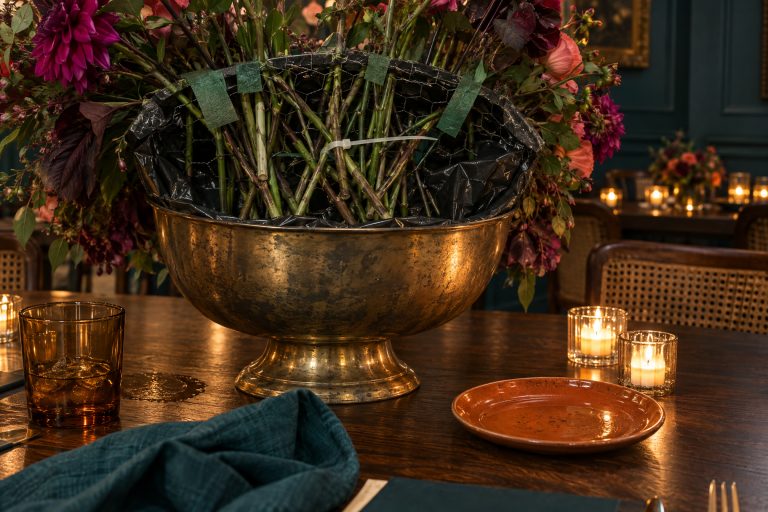
The vessel is not a neutral container for the flowers. Its weight, height, water, transparency and footprint decide how the arrangement behaves in the room and at the table.

Flowers get all the credit.
The vessel sits underneath them carrying water, weight, mechanics, proportion and most of the consequences, and then gets described as neutral.
It is not neutral.
A vase can block a sightline before the first stem goes in. It can make a delicate arrangement feel heavy, make an abundant arrangement feel underfed, expose mechanics you did not mean to feature, stain a linen, tip when the table is bumped, or take up the exact six inches the guest needed for a water glass.
The vase is part of the architecture.
Start with footprint before flower count
Put the empty vessel where it will actually live.
On the dining table, add the place settings, glassware, bread, menus, candles and anything else that has to share the surface. On a bar, leave room for service. On an escort table, imagine people leaning in to find names. On a pedestal, test the base as carefully as the top.
The arrangement will only get larger from there.
A wide bowl may be low enough for conversation and still consume a surprising amount of table. A narrow compote may preserve surface area but need enough weight and mechanics to support the design. A tall cylinder can look visually quiet while creating a hard vertical object exactly where a guest wants to see through.
Measure the occupation, not just the height.
Weight is a design material
Indoors, a light vessel may be perfectly adequate until somebody bumps the table.
Outdoors, weight becomes even more consequential because air movement gives tall or airy arrangements leverage.
Not every arrangement needs a stone urn. The visual lightness of the flowers just has to sit on enough physical stability.
If a vessel is narrow at the base, tall through the center or top-heavy once filled, test it assembled. A design that stands beautifully in the workroom and becomes nervous in the venue has not passed the useful test yet.
Pretty is not structural engineering.
Fortunately, most centerpieces are not bridges. They still have to stay upright.
Water changes the object
An empty vessel and a filled vessel are different things.
Water adds weight, changes handling, reveals marks through clear glass, and creates a maintenance requirement. A shallow arrangement may need attention over a long setup window. A transparent cylinder can turn every stem end, leaf fragment and water line into part of the visual composition.
If clear glass is the concept, treat the inside as visible.
If the vessel will need topping up, make sure someone can do that without dismantling the table or pouring water over the stationery. If it is moving from ceremony to reception, consider whether it can be carried safely while full or whether the transfer plan needs another method.
The flowers are not the only living part of the arrangement. The water is on the timeline too.
The vessel changes the scale of the flower
A modest amount of material can look abundant in the right vessel.
The reverse is also true.
A large-mouth container can swallow flowers, forcing more material simply to establish shape. A narrow opening can create density quickly but limit the spread. A low bowl can make a table feel lush without creating a tall mass. A strong pedestal can give a smaller floral composition more presence because the vessel itself carries visual weight.
This is one reason copying a floral photograph by stem count is unreliable. What you are actually recreating is a relationship among vessel, mechanics, material, light and viewpoint, and the flowers are only one part of it.
Change one and the arithmetic changes.
Transparent is a style, not invisibility
Clear glass is often chosen because it is expected to disappear.
It does not.
It reflects light, shows water, catches candle glow and repeats the shape of the table. It can look wonderfully clean or surprisingly busy depending on what is visible through it.
In a dense tablescape, clear vessels can reduce apparent visual mass. In another setting, a row of glass cylinders can become a strong repeated architectural line.
Use that intentionally.
And if floral mechanics are visible through the vessel, decide whether they are beautiful enough to remain visible or need another solution. There is no prize for pretending the mechanics do not exist when everyone can see them.
One vessel language can make several floral moments belong together
You do not need identical arrangements everywhere.
Repeating a vessel material, finish, color or silhouette can connect the entrance, bar, dining room and smaller guest-facing moments while allowing the flowers to change scale.
That is particularly useful when the event has several spaces. Brass may repeat through a large urn, smaller bud vessels and candle details. Dark ceramic can appear in a major entry arrangement and return quietly on the tables. Clear glass can shift from tall to low while keeping the same visual family.
Repetition creates coherence without cloning.
The tablecloth is underneath all of this
Some vessels sweat. Some drip after filling. Some have rough bases. Some are moved after they are full.
Protect the surface where needed and test the combination before event day.
A tiny waterproof barrier hidden under a vessel is more elegant than discovering a water mark after the arrangement has been photographed from every angle.
Also test stability on the actual tabletop or tray. A vessel that behaves perfectly on a solid workbench may feel different on a lightweight rental table or textured linen.
The surface is part of the structure.
Stage the empty vessel before you buy the flowers
Before final flower quantities are locked, stage the vessel alone in the intended position.
Can guests see? Can service reach? Is there enough surface left? Does the vessel have enough scale without flowers? Will it remain stable once the arrangement expands above it? What does it look like from the side and back, not only the hero angle?
If the empty vessel already creates a problem, flowers are not going to fix it.
They will make the problem prettier.
Choose the vase like it is part of the room.
Because once the event begins, it is.
Related reading: The Flowers Were the Last Layer · Lighting That Still Works After the Room Fills · A Tent Is a Venue You Have to Build
Atmosphere OS · Theme Atelier
Turn the mood into something a florist can quote.
Theme Atelier builds palette, materials, lighting and spatial mood into one system, then writes it in language a vendor can price. Every number it produces comes from a published rule, and the rulebook names the judgments it deliberately refuses to call rules.
Free to use, local-first in your browser, and there is no account until you ask for one.
Field notes and corrections
When a number here turns out to be wrong, you hear about it.
Three things arrive and nothing else. The new field note — bar rates, cover widths, service clearances, the arithmetic worked through on one real evening. A line when a new World or Mini Occasion opens, because a night only goes up once it can actually be thrown. And a correction whenever a rule in the published rulebook changes, or a number the tools rely on turns out to have been wrong. There is no weekly slot, because there is nothing weekly to put in it.
One email per field note or opening, plus corrections when a published figure moves. Unsubscribe from any of them.
Continue through the system
Pretty is still not a plan.
A party gets planned in roughly this order. Pick the chapter where your next problem lives.
What you have to decide next
One decision constrains the next. This is the order they actually happen in.
- Venue Will this room hold it? The Serpentine Table Is Eleven Percent Longer Than the Spec Sheet Says
- Guest experience How will guests move through it? The Place Setting Fits. The Person Does Not.
- Production How does it get built and run? The Event Needs a Failure Mode That Still Looks Intentional
- Vendors Who owns each handoff?
More in this chapter

See the complete five-chapter Event Design Intelligence map →