Budget & Trade-Offs
Where the Event Budget Should Be Boring—and Where It Should Not
A practical way to protect the parts guests actually feel, trim the parts they do not, and keep contingency money from becoming decorative wishful thinking.

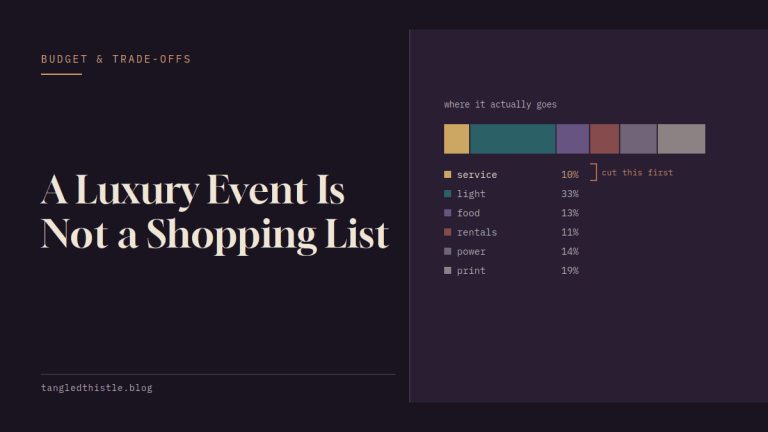
An event budget doesn’t need every category to be equally impressive. It needs to protect the things that can make the day uncomfortable, chaotic, or unmistakably yours.
That means some lines should be genuinely boring. Enough chairs, boring. Enough power, boring. Ice is boring right up until there isn’t enough of it.
The trick is knowing exactly where restraint disappears quietly and where it changes the whole event.
Protect the guest-facing basics first, always
Venue realities, food and beverage minimums, staffing, accessibility, weather protection, these aren’t the dull preface to the design. They’re the floor the design is actually standing on. If cutting one of these creates waiting, crowding, or a service failure, that’s not a harmless trim. It helps to settle which lines are protected before anyone starts cutting.
Choose two or three things to actually carry the atmosphere
Most rooms don’t need money spread evenly across ten decorative categories. They need a few decisions with enough scale to register. Maybe the room lives through candlelight and one aggressive floral gesture. Maybe the architecture is already doing the work and the smartest move is to stop competing with it. I fund the elements that carry the idea properly, and let everything else behave like a supporting layer.
Cut repetition before you start cutting impact
When the number gets uncomfortable, people tend to shave a little off everything, which leaves every category too weak to actually do its job. I try removing repetition first. One excellent printed piece instead of five coordinated paper moments. One strong installation instead of small decor scattered across every surface. Editing is cheaper than dilution, and it looks a lot more intentional too.
Keep a contingency line that’s real money, not leftovers
Contingency isn’t whatever’s left after every fun idea gets approved. I put it in the budget before the fun money disappears. Weather, final guest counts, rush fees: none of that is a moral failure. It’s just how events get more expensive. A real contingency line gives reality somewhere to land without stealing from dinner three days out.
Ask what the cut actually changes for a guest
For every meaningful reduction, I finish the sentence: if this goes, guests will notice ______. Sometimes the answer is nothing, and that’s a great cut. Sometimes the answer is dinner starts later or the room gets cramped, and that’s a different decision entirely.
Don’t confuse cheap with low-priority
Some inexpensive details carry enormous leverage: clear signage, enough water, a well-placed lamp. Some expensive details have almost none if they’re too hidden or too disconnected from the actual event. Price and importance were never the same column. If you would rather see the trade-off line by line, the budget planner in Atmosphere OS runs the same math.
Spend where the event can actually feel it. Be ruthlessly ordinary everywhere it can’t.
Field notes and corrections
When a number here turns out to be wrong, you hear about it.
Three things arrive and nothing else. The new field note — bar rates, cover widths, service clearances, the arithmetic worked through on one real evening. A line when a new World or Mini Occasion opens, because a night only goes up once it can actually be thrown. And a correction whenever a rule in the published rulebook changes, or a number the tools rely on turns out to have been wrong. There is no weekly slot, because there is nothing weekly to put in it.
One email per field note or opening, plus corrections when a published figure moves. Unsubscribe from any of them.
Continue through the system
Pretty is still not a plan.
A party gets planned in roughly this order. Pick the chapter where your next problem lives.
What you have to decide next
One decision constrains the next. This is the order they actually happen in.
- Occasion What are you actually hosting? Exhibit A: Your Host
- Atmosphere What should the room feel like? Marigold Veil Masquerade
- Venue Will this room hold it? The Serpentine Table Is Eleven Percent Longer Than the Spec Sheet Says
- Guest experience How will guests move through it? The Place Setting Fits. The Person Does Not.
More in this chapter

See the complete five-chapter Event Design Intelligence map →