Atmosphere
Your Sofa Reports to the Television
A living room can be perfectly functional on an ordinary night and surprisingly bad at hosting. The fix is not more seating; it is changing what the furniture is facing, how far conversation has to travel, and where drinks can land.
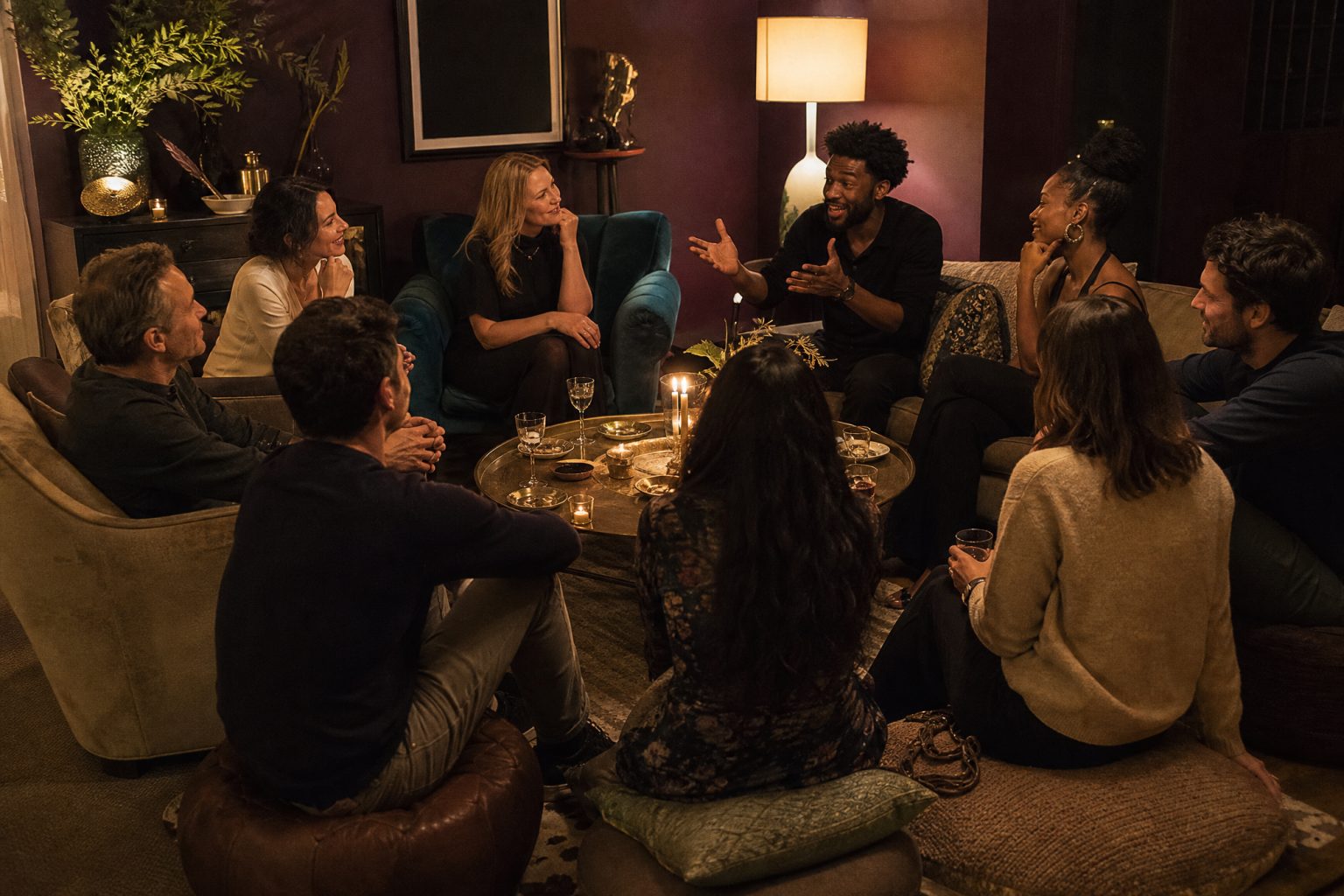
The television is an extremely persuasive piece of furniture.
It sits on one wall and slowly convinces everything else in the room to report to it. Sofa: face forward. Chairs: angle obediently toward the screen. Coffee table: center yourself on the sofa. Side table: try not to matter too much.
This works beautifully when two people are watching a movie.
Then eight people come over and discover that the room has been arranged so everyone can see a screen nobody is using while half the guests have to turn their entire body to see one another.
The living room is not badly designed. It is designed for a different job.
Hosting mode starts by changing the focal point
You do not have to move the television. You do not have to pretend it is not there. You only need to stop letting it be the most important relationship in the room for a few hours.
Look at the seating from above if you can. Who faces whom? Which chair is technically part of the group but actually six feet off to the side staring at the corner of a bookcase? Which person on the sofa has to speak across the entire coffee table to reach the two chairs opposite?
Then move one thing.
Pull a chair inward. Turn another chair away from the screen. Add a stool where it creates a triangle rather than another audience row. Sometimes twelve inches of movement changes the social geometry more than buying two more seats.
None of that is decorating. It changes who can comfortably participate.
A room full of seats can still have nowhere good to sit
Seat count is a terrible measure of conversational capacity.
A long sofa may hold three people but still create one social position because all three face the same direction. A deep armchair in the corner may be comfortable and socially useless if the person in it cannot hear anyone without leaning forward all night. A dining chair pulled in at the last minute may be the best seat in the room if it completes the circle.
Think in small conversations first.
Can four people talk without raising their voices? Can somebody join from the edge without interrupting the whole arrangement? If the room holds ten, can it support two conversations instead of forcing one person to become the moderator of a ten-person panel?
Living rooms become easier when you stop expecting every guest to share one conversation simply because they share one rug. If the problem starts earlier — with a formal room that barely has a job — Room for Drama handles the everyday-use side first.
The coffee table may be too important
There is a point where a coffee table stops supporting conversation and starts acting as a moat.
This tends to happen with very large tables, very deep sofas, or rooms where the furniture has been pushed out to make the center look spacious. The photograph is clean. The people are now communicating across open water.
Before the party, sit in the actual seats with a drink in your hand. Can you put it down without performing a forward lunge? Can the person in the chair beside the sofa do the same? What about the person on the end?
If the answer is no, do not buy a more beautiful coffee table. Add smaller landing surfaces where they are needed.
A stool, small side table, narrow drink table or sturdy surface borrowed from another room can solve more than another decorative object in the middle.
Guests with nowhere to put a glass either hold it all night or place it somewhere you will discover later with a ring around it. Neither is an atmosphere strategy.
Do not create a furniture evacuation
There is an equal and opposite hosting mistake: moving so much furniture that the living room stops feeling like the house.
Nobody wants a reception lounge. Keep the pieces that make the room comfortable. Move only what is blocking the social job you need.
If an ottoman eats the only open path, move it. If a side chair is too far from everyone to function, bring it in. If the room needs one extra seat, borrow one. But do not line the perimeter with dining chairs because the guest count has temporarily frightened you.
People can share seats, stand, migrate, sit on a bench or move between rooms. The room needs enough places to land, not assigned seating for a state dinner.
Light the faces you want people to look at
A television-centered room often has another habit: the best lighting is positioned for screen viewing rather than faces.
When the screen is off, the dark corner that was excellent for a movie can make a guest disappear from the conversation. Turn on lamps that bring the edges back. If an overhead light is harsh, do not automatically use it just because the party has more people. More people do not require interrogation lighting.
Use enough light to see expressions, move safely and find a drink. Then let some depth remain.
Dimming the room does not make atmosphere on its own. Making the important things legible does.
The television can stay. It just needs to stop hosting
There are nights when the screen is the point: a game, a film, an awards show, the family video everybody agreed to watch. In that case, design for it.
But when the evening is supposed to be conversation, leave it off rather than letting silent images keep asking for attention. A moving screen will win peripheral vision even without sound. It is very good at its job.
If the black rectangle bothers you visually, let the room have a stronger focal point somewhere else: flowers, a lit bookshelf, the fireplace if it is safely in use, a beautiful tray at the drinks station, something that makes the social center feel deliberate without pretending the television has ceased to exist.
Test the room with people, not measurements
You can sketch a perfect arrangement and still miss the person who cannot get past the chair once someone sits down.
Set the room. Then walk it with the furniture in hosting position. Enter with a coat. Carry two drinks. Sit in the worst chair. Get up from the sofa while somebody is in the nearest seat. Walk to the bathroom. Reach the drinks table.
If the room works only while all the chairs are empty, it does not work.
The television does not need to lose its wall. The living room simply needs another mode—one where the furniture faces people again.
That is often a ten-minute change, which is irritating only because it means the answer was not another sofa.
Related reading: Open Seating Is Relaxed Until Everybody Needs a Chair · Lighting That Still Works After the Room Fills · The Patio Is Not the Overflow Room
Atmosphere OS · Theme Atelier
A palette is not yet a decision.
Atmosphere OS holds the color, the material, the light and the room in one object, so moving any of them shows you what it does to the rest. Costs come back as indicative bands and never as quotes, which is the difference between planning and pretending.
Costs come back as indicative bands rather than quotes, and seasonal notes are filters rather than promises.
Field notes and corrections
When a number here turns out to be wrong, you hear about it.
Three things arrive and nothing else. The new field note — bar rates, cover widths, service clearances, the arithmetic worked through on one real evening. A line when a new World or Mini Occasion opens, because a night only goes up once it can actually be thrown. And a correction whenever a rule in the published rulebook changes, or a number the tools rely on turns out to have been wrong. There is no weekly slot, because there is nothing weekly to put in it.
One email per field note or opening, plus corrections when a published figure moves. Unsubscribe from any of them.
Continue through the system
Pretty is still not a plan.
A party gets planned in roughly this order. Pick the chapter where your next problem lives.
What you have to decide next
One decision constrains the next. This is the order they actually happen in.
More in this chapter


See the complete five-chapter Event Design Intelligence map →