Design Atelier
Cheap Cloth, Expensive Labour
The food and drink design for Nothing in This Room Is Finished, Occasion Study No. 22 — cabbage, potato, chicken and milk, given the technique usually spent on things that cost money.
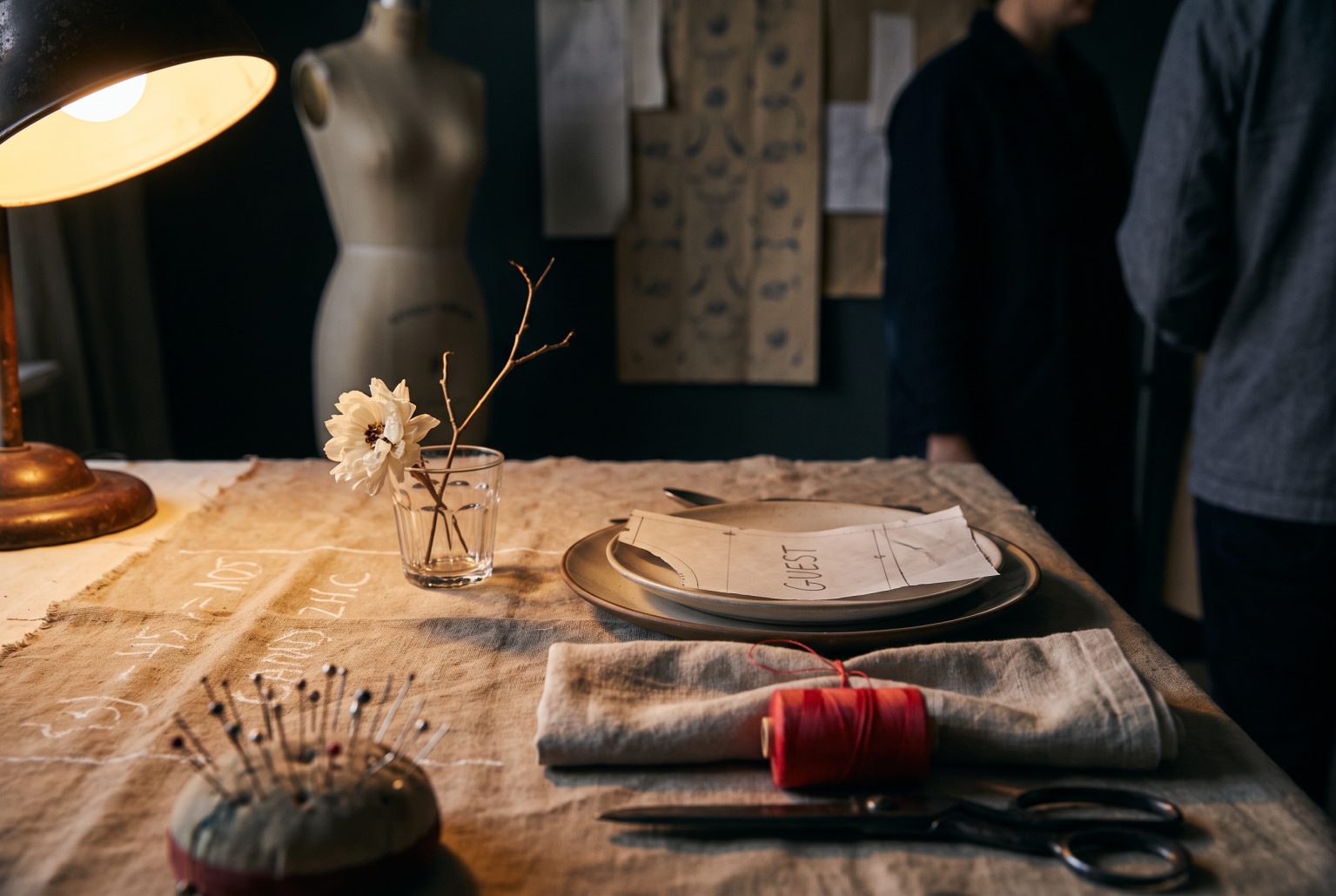
A toile is expensive labour on cheap cloth. That is the whole economy of the thing: the calico costs almost nothing, and the person cutting it is the most skilled and most expensive element in the building. Anybody can make cheap material look cheap. Making it look inevitable takes a cutter.
Run that through a kitchen and you get a menu made of cabbage, potato, chicken, bread, milk and eggs, given the sort of technique usually reserved for things that arrive in a box with a temperature log. Nothing on this table is a statement about money. Everything on it is a statement about work.
What this evening is hungry for
The room is pale, precise and slightly cool. It is not cosy, it does not smell of woodsmoke, and it has a hard task light burning at one end all night. Appetite in a room like that is sharper and later than appetite in a warm one — people are alert, they are looking at things, they talk before they eat. So the arrival food is small, salty and dry, the first proper course does not land until people have been sitting for twenty minutes, and the food gets warmer and heavier as the room gets dimmer.
Colour matters more than usual because the ground is so light. Against Raw Calico and Tracing Paper, a plate of pale food disappears. What reads is brown — the crust, the caramel, the roast — and one dark drawn line, and one red thread. That is the palette on a plate: Pattern Brown at fourteen per cent doing the work, Ink Notation as an actual line of something dark, Thread Red at two per cent and no more.
And the mechanism of the evening is restraint: nothing is allowed to be completed in front of the guests. That does not mean serving people half-cooked food, which would be a stupid literalism and also unpleasant. It means the last move on several plates belongs to the person eating — the oil poured, the crust broken, the tart cut. The kitchen brings the thing to the stage where a decision is still available, and hands the decision over.
The shape of the night
Six-thirty, doors and a glass. Seven, one bite passed standing, and only one. Seven-twenty, seated, bread and butter already on the table. Seven-forty, first course. Eight-fifteen, the main and its two sides, family style down the middle. Nine, the plates come away and nothing replaces them for a while, which is the pause this evening needs and most evenings skip. Nine-thirty, dessert, cut at the table. Ten-fifteen, the maker unpicks something. Eleven, coffee and the after-dinner drink. Midnight, rolls in the hand on the way to the door.
There is no cheese course and no amuse-bouche, and both omissions are deliberate. Cheese would push the meal past the point where anybody notices the unpicking, which is the only event of the evening. An amuse-bouche is a restaurant device that announces the kitchen, and this evening’s announcement belongs to a different table.
The service style is family down the centre from the main course onward. The room is dressed in cloth with pencil on it; a bowl put down in the middle of that cloth and passed hand to hand is the correct behaviour, and it also means the calico ends up marked, which is the point.
The welcome drink and the arrival food
Two clarified punches, poured in advance and standing on a tray in the doorway. That is a throughput decision before it is a flavour decision: a milk-clarified punch is the only cocktail you can put sixty of on a tray, at temperature, with no ice, no shaking and no queue. It also happens to be the exact colour of the thing this room is made of.
The Calico is a gin punch clarified with milk — the technique where hot milk is added to an acidic punch, the curd traps the solids and the whole thing is strained until it is clear and slightly opalescent. It takes two days and about twenty minutes of actual attention, and the result is a drink that looks like nothing and tastes of everything that went into it: gin, lemon, jasmine tea, a strip of orange peel. Served in a coupe at fridge temperature.
The Tack is not that drink with the gin taken out. It is a toasted-barley and pear punch, clarified by the same method, with verjus for the acid and a saline drop at the end to stop it reading as squash. It is drier than the gin version, not sweeter, it is served in the same coupe with the same care, and it is announced by name at the door alongside the other one.
The arrival bite is one thing, passed once. Pin toast: a strip of very thin toasted bread with a smear of chicken-liver and butter, and a single cured anchovy laid diagonally across it, pinned in place with nothing at all. It is one mouthful, it is dry, it is salty, and it does not drip on anybody in a room where fifteen per cent of the surfaces are pale cloth that will not be cleaned again.
The bar
The bar is the cutting table, which is the second-cheapest and best decision in the whole scheme: a two-and-a-half metre bench, top marked out with a real cutting grid, bottles standing on it in a line with a metre rule beside them. It sits at the cool end of the room, under the task light, because that is the only place in this evening where a bartender can actually see what they are doing.
Two batched punches carry the arrival and the first hour. After that the bar makes three things and nothing else.
The signature stays The Calico, made to order after the batch runs out, which it will. Clear, cold, no ice, no garnish beyond a wide strip of orange peel expressed and dropped in. Ice is deliberately almost absent from this evening, which is unusual and is the right call: this is a room of pale, matte, dry surfaces, and a wall of clear cubes in it looks like a different party. The only ice in the building is one bucket behind the bar for chilling and one tray of large cubes for the after-dinner drink.
The zero-proof stays The Tack, on the same terms and in the same glass.
Wine is white and it is textural rather than fruity: something with skin contact or a bit of age, a Jura savagnin, a good chenin, a dry sherry served as wine at the start. Anything oaky and buttery fights the food, which is deliberately lean. One red, light and cold — a gamay or a trousseau — because the chicken and the cabbage want acid, not tannin.
After dinner, one thing: Pattern Brown, a hot drink of milk, dark muscovado, a scrape of nutmeg and a measure of aged rum, served in a small heavy glass over nothing at all. There is a version without the rum, made with the same milk and the same sugar and one drop of bitters, and it is put on the same tray and offered first, not second.
Glassware throughout is plain, thin and unfussy: one coupe, one small tumbler, one wine glass, no stems with cut detail, nothing coloured. Against a room made of notation, decorated glass is noise.
Throughput arithmetic, because it decides the design: one bartender makes roughly one drink a minute once a queue forms. At sixty guests that is a queue at the door unless the first drink is already poured, which is why it is. At a hundred and twenty you need two people behind the cutting table and both punches batched in five-litre containers in a fridge you have confirmed exists.
The table
Bread, on the table from the start. The toile loaf is a plain white sourdough or a slow yeasted loaf, baked in a tin and turned out, scored once across the top with a blade held at a proper angle so the cut opens into a single clean line. One line. Not a wheatsheaf, not a pattern. It sits on the cloth on a board with a slab of cold, salted, cultured butter beside it and a blunt knife, and people tear it rather than slicing it, which marks the cloth immediately and correctly.
First course: cabbage on the bias. A white or hispi cabbage cut into wide diagonal ribbons — on the bias, which in cloth means cut at forty-five degrees to the grain and in a cabbage means cut across the leaf structure so it goes soft and pliable instead of shattering. Salted, left to slacken, dressed warm with brown butter, cider vinegar, toasted hazelnut and a great deal of black pepper, and served at room temperature in a wide shallow bowl. It is a cabbage salad, it costs about four pounds for eight people, and it is the dish that decides whether the guests believe the argument. The twist is the cut, and the cut is the entire couture reference: bias behaves differently from grain, in cloth and in a cabbage, for the same reason.
Main: chicken under the clapper. A clapper is a block of hardwood a tailor drops onto a just-pressed seam and holds there while it cools, which sets the crease flat. Chicken cooked under a weight — spatchcocked, skin down, a foil-wrapped brick or a heavy pan on top of it — does exactly that: the skin is pressed against the heat until it is uniformly flat, dark and crisp, instead of buckling away in the middle. It is a technique from cheap cooking and it produces the best skin available from a bird. Ours goes into a marinade of lemon, garlic, bay and a lot of black pepper the day before, and comes out to be carved down the middle of the table on a board.
Poured over it at the table, by whoever is sitting nearest: the red thread, an oil infused with dried chilli, sweet paprika and a strip of orange peel, warmed and left to sit for a week. It is Thread Red at two per cent, it arrives in a small jug, and it is the one moment where the eater finishes the dish.
Potatoes cut to a millimetre. Potatoes sliced on a mandoline to a genuine one to two millimetres, layered flat in a heavy pan with clarified butter and salt and nothing else, pressed under a weight, and cooked until the underside is a solid brown disc. Pommes Anna, essentially, and there is no way to do it well without the labour. It is the plate’s Pattern Brown, it is made from about a pound of potatoes, and it takes forty minutes of somebody’s hands. That is the menu’s whole thesis on a single dish.
Leeks, plainly. The deliberately plain thing, and every menu needs one. Leeks, trimmed, split, boiled in salted water until they are properly soft, drained hard, and served warm with good olive oil and flaky salt. No dressing, no crumb, no herb oil, no bacon. Six ideas on a table is exhausting; this is the dish that lets the others be interesting, and it is also, quietly, delicious, which is why it survives every round of edits where somebody wants to add hazelnuts to it.
Dessert: burnt milk tart, cut at the table. A tray-baked custard tart in a plain shortcrust, the top taken further than is comfortable under a hot grill until it is properly dark and slightly bitter, cooled to room temperature, and brought to the table whole with a long knife and a metre rule laid across it. Somebody cuts it. Whoever cuts it decides where the lines go, the edges are raw and uneven, and it looks — genuinely, not by contrivance — like something that has been marked out and not yet finished. The custard is milk, cream, eggs, sugar, bay and a lot of vanilla, and the burnt top is the entire flavour argument: bitterness against a very sweet, very plain base.
Late, and after
Coffee at eleven, made properly and served black in small cups with a jug of hot milk on the table. There is no petit four and no chocolate truffle. Both are the things a menu adds when it has stopped thinking.
At midnight, rolls in the hand: soft white rolls, split, filled with the chicken that came off the carcasses at eight, warm, with butter and a spoon of the red thread oil. They are handed over at the door, in paper, to people putting coats on. This is the most reliably remembered course of any long evening and it costs almost nothing, because you already have the chickens.
The next-day continuation is real here and it is the loaf. Whatever bread is left goes home with people, and the last of the burnt milk tart is better cold on Sunday morning than it was on Saturday night, which is worth saying out loud when you hand it over.
Whether it can actually be served
At twenty to sixty, which is where this concept lives, one cook and two people on service will do it, because almost everything is either made in advance or finished in a single pass. The punches are made two days out. The chicken marinates overnight and is pressed in batches. The potatoes are the workload and they are unavoidable. The cabbage is dressed twenty minutes before it goes out. The tart is baked in the morning and does not want a fridge.
The two dishes that fail first if the kitchen is a tent with two induction rings are the potatoes and the chicken, in that order. Pommes Anna needs sustained even bottom heat and a heavy pan, and an induction ring under a thin pan will burn the centre and leave a raw ring. The substitution that keeps the idea: parboil the sliced potatoes, layer and press them in a tray the day before, chill the whole slab, then cut it into squares and colour them in a pan to order. Same labour, same look, moved earlier. For the chicken, if you cannot press it, roast it in trays and finish the skin under a grill; you lose the flatness, which is a real loss, and you keep the dinner.
Holding: the cabbage holds two hours at room temperature and improves for one of them. The potatoes hold thirty minutes and then go soft — they are the item that dictates when the main course actually happens. The chicken holds twenty minutes rested and loosely covered, and is better warm than hot. The leeks are indifferent to everything, which is why they are there. The tart must not be refrigerated before service; it goes rubbery and the burnt top sweats.
Refrigeration is the constraint to check before anything else. This menu needs a fridge for ten litres of punch, and ten litres of punch takes a shelf and a half. If the venue’s fridge is a domestic under-counter unit with the wine already in it, batch the punch into flat containers and plan on an insulated box with ice packs at the cool end of the room.
Dietary versions, designed rather than accommodated. The vegetarian main is the same main: a whole hispi cabbage or a celeriac, halved, pressed under the same weight in the same pan, cooked in the same lemon-garlic-bay marinade until the cut face is as dark as the chicken skin, carved on the same board with the same red thread poured over it. It is not a side promoted; it is the identical technique applied to a vegetable, and it goes down the middle of the table at the same moment. Vegan: as above with olive oil in place of butter throughout, the potatoes done in oil, and the burnt milk tart replaced with a burnt oat-milk custard, which browns slightly faster and needs watching. Gluten-free: the loaf and the rolls are the only wheat in the meal, so the gluten-free table gets a genuinely good gluten-free loaf bought from somebody who makes them properly, and the same butter, and nobody has to ask.
The allergen work is the kitchen’s and the host’s, and it is done at the point of writing the menu rather than at the point of plating: this meal contains nuts in one dish, dairy in four and anchovy in one, and every one of those is separable at the prep stage if it is decided on a Tuesday rather than at seven forty on the night.
The handoff
Every one of these is written up as a real recipe on Salty & Clever — quantities, timings, the sensory cue for each stage, what holds and what does not, what to do at four people and what changes at eighty. The working menu post there carries the whole thing as a prep clock counted backwards from service, along with the shopping order and the honest statement of which two dishes are the workload. Start with the working menu if you are cooking it, and with the individual recipes if you are picking off two things for a Tuesday.
- The Calico — milk-clarified gin punch
- The Tack — the zero-proof clarified punch
- Pattern Brown — hot milk, muscovado and rum, with and without
- Pin toast — chicken liver, butter and one anchovy
- Cabbage on the bias, brown butter and hazelnut
- The toile loaf — a plain tin sourdough, scored once
- Chicken under the clapper, with the red thread oil
- Potatoes cut to a millimetre
- Leeks, plainly
- Burnt milk tart, cut at the table
- Midnight rolls
Atmosphere OS · Theme Atelier
Turn the mood into something a florist can quote.
Theme Atelier builds palette, materials, lighting and spatial mood into one system, then writes it in language a vendor can price. Every number it produces comes from a published rule, and the rulebook names the judgements it deliberately refuses to call rules.
The rulebook is public. Every formula it runs on is written down where you can disagree with it.
Continue through the system
Pretty is still not a plan.
This field note belongs to a larger event-design system. Follow the chapter that explains the next pressure point instead of falling back into an undifferentiated archive.
What you have to decide next
One decision constrains the next. This is the order they actually happen in.
- Venue Will this room hold it? The Generator Was Late. The Washrooms Were Waiting.
- Guest experience How will guests move through it? Family Milestone Reception for One Hundred Fifty: Three Generations Need More Than One Volume Level
- Production How does it get built and run? Museum Reception for One Hundred Forty: The Building Gets a Vote
- Vendors Who owns each handoff? The Dance Floor Wrap Is Not the Whole Dance Floor
More in this chapter


See the complete five-chapter Event Design Intelligence map →