Design Atelier
Lit From the Table Up
The Look Book for One Match, Occasion Study No. 19 — how to dress for a room lit from table height by two hundred candles you are going to light yourself.
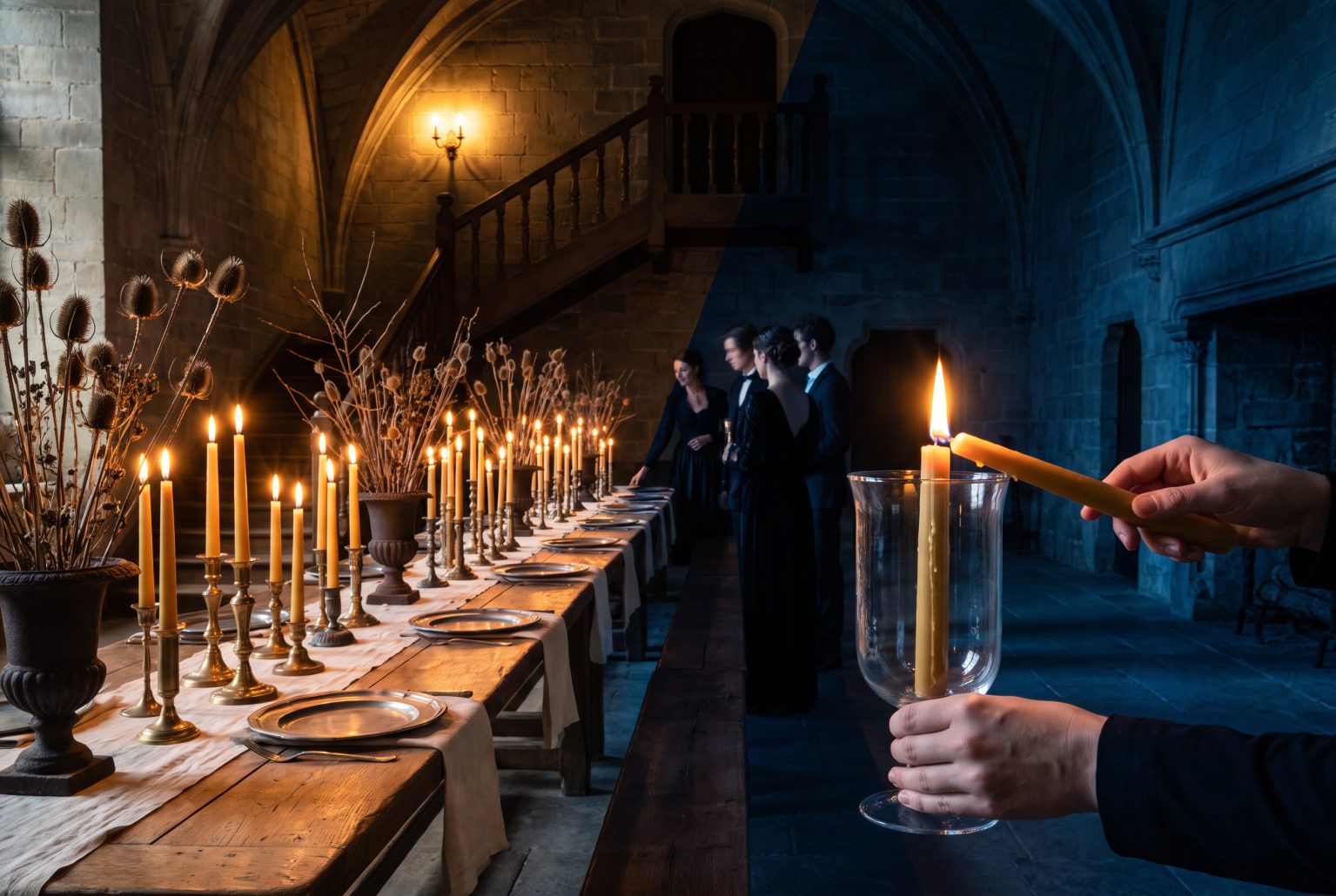
Every styling decision in this document comes from two facts. The first is that the light in this room arrives at the height of a table. The second is that for eleven minutes, everybody in the building is holding their hands out in front of their chest. Nothing else about the evening matters as much to what you wear.
Where the clothes come from
The source is a liturgy, and we are not doing the liturgy. Progressive candle-lighting — one flame carried into a dark building and passed from hand to hand until the whole room is holding light — belongs to living practice. The Paschal vigil does it. Moravian and Quaker candle services do it. Santa Lucia processions do it. The shamash lights the others and is not counted among them. These are other people’s rites, they are current, and they are not a mood board. We are not borrowing their meaning and we are absolutely not dressing anybody as a participant in them.
What we are taking is the mechanical observation all of those practices arrived at independently: a room full of people can light itself, and while it is doing so every person in it is standing or sitting with a flame at chest height and both hands occupied. That is a posture. Clothes have to answer a posture.
The second source is the eye, and it is the more useful one. A human eye in a dark room does not adapt smoothly. The cones settle in the first five to eight minutes and then stall; the rods take over somewhere around the seven-to-ten minute mark — the rod-cone break — and keep gaining sensitivity for another twenty minutes after that. The pass takes about eleven minutes. So the room is getting brighter at the same time as the eye is getting better at seeing, and the two curves multiply. Nobody has ever watched a garment behave under a rising light and a rising sensitivity at once, because it almost never happens.
It has a consequence you can dress for. As the rods take over, peak sensitivity slides from around 555 nanometres toward around 507 — the Purkinje shift — and reds go dark before anything else does. A deep red dress at minute two is a hole in the room. At minute nine it is a deep red dress. That is not a metaphor about the evening. That is what the cloth will actually do while people are looking at it.
What we refuse: the candlelit-castle version. Hoods, cloaks, anything with a bell sleeve and a laced front, anything that reads as monastic. That version is available to anybody who types the word candlelight into a search bar and it is the reason most people think they already know what this evening looks like. We also refuse the second obvious costume, which is subtler and more common at good events — the all-ivory room, where forty adults arrive in cream and the whole thing reads as a choir waiting for a downbeat.
The line
The light source sits between sixty and seventy-five centimetres off the floor and it stays there all night. Nothing below the tabletop is lit. A skirt, a trouser break, a hem, a shoe: unseen for three hours, and only half-seen after that. Spend the money above the waist. If you have a limited budget and you were going to put it into the bottom half of an outfit, you are about to buy something nobody in this room will see.
From sternum to jaw, everything is lit from underneath. That is the reverse of every light a face is normally seen in, and it does specific things. A defined shoulder becomes architectural. A soft dropped shoulder collapses into the chest. A high neck throws a shadow up under the chin and closes the face; an open neck opens it and puts the light on the collarbone, which is the single most flattering thing that happens to anybody at a candlelit dinner. Collars matter more than they have any right to. A collar with structure — a real shirt collar, a stand, a notched revere — catches light along its edge and draws a bright line under the jaw. A limp collar does nothing.
Then the sleeve, which is the most important garment decision of the evening and almost nobody’s first thought. Your forearms are in the lit zone for eleven minutes with a flame in front of them and they stay in it for the rest of dinner. Every photograph anybody takes of this room contains hands. A sleeve that finishes at the wrist bone and stays there is correct. A sleeve with volume in the upper arm is fine and often lovely. A sleeve with volume at the cuff is a fire problem, and I mean that literally rather than as a note on proportion.
The seated silhouette is the only silhouette this evening has. People arrive, they sit, they stay for four hours. Whatever the garment does standing in a mirror is irrelevant; what it does when the wearer is leaning forward with both elbows off the table and a taper in one hand is the whole question. Test it that way. Sit down in it, reach across a table with your right hand, and see whether the neckline moves, the shoulder rides, or the waistband becomes a subject. Anything that needs adjusting is out, because both hands are busy.
Walking is the last piece. Guests move across a floor in near-darkness at least twice. No train. No wrap you have to hold. No hem you have to lift on a step you cannot see.
The cloth
A candle flame burns at roughly 1,800 to 1,900 kelvin and it oscillates — physicists have measured it repeatedly, and it comes out at around ten flickers a second, with flames placed close together drifting into synchrony with each other. Those two numbers govern every fabric choice below.
Start with what a shine does. A specular surface — sequin, paillette, patent leather, high-shine duchesse satin, lamé, a polished metal bracelet — behaves as a small mirror. Under one soft overhead it produces a highlight. Under two hundred point sources flickering ten times a second it produces two hundred highlights, each one going on and off. Across a whole bodice this is a strobe. It is unpleasant to sit opposite and it photographs like a fault in the film. The sequin dress is the single worst garment you can bring into this room, and it is the one most people would choose for a candlelit dinner.
What works is texture with depth: slub, nap, wale, weave. Dupion and raw silk, where the slub catches an irregular light and never lines up into a flash. Velvet, which is the best cloth ever made for this room and has been since the room was invented — the pile absorbs at one angle and returns at another, so a velvet sleeve moving past a candle has a sheen that travels along it rather than blinking. Corduroy, where the wale turns into ribs of light. Brushed wool, moleskin, heavy linen, waffle cotton, cable knit, hopsack. Anything with a surface you could describe with your eyes shut.
Now the heat, which nobody plans for. A taper throws off roughly the warmth of a small filament bulb. Two hundred of them is a radiator the venue cannot switch off, running for four hours, in a room that also contains a hundred and fifty warm bodies. The room at hour three is not the room at hour one, and the room at hour one is genuinely cold because you have almost certainly hired a building with height and stone in it. So dress for two temperatures: something that comes off, or a cloth that copes with both. Heavy wool is wrong by half past nine. Wool crepe, gabardine, mid-weight flannel, heavy cotton and linen are all right at both ends.
The flame constraint is a design fact and gets stated once. There is naked fire at hand height for eleven minutes and on the table for four hours. No trailing sleeve, no fringe, no loose tulle, no chiffon overlay at the cuff. Synthetic fibre near a flame melts rather than chars, which is the worse of the two behaviours, so put natural fibre in the sleeve even if the rest of the garment is not. This is not a rule invented to be strict; it is the only rule in this Look Book that has a consequence you cannot undo.
And a small piece of luck: linen creases in a car and this is the one evening it does not matter, because the light is too soft and too low to raise a crease into a shadow. Wear the linen. It will look better here than it does anywhere in daylight.
Colour, on a person
The concept’s twelve colours are distributed for a room that spends its first ten minutes almost entirely Wick Black and Soot. They do not transfer to a body at the same ratios, and one of them does something on skin that it does not do on a wall.
Wear the room’s warm neutrals. Beeswax, Tallow Cream, Undyed Linen, Wax Drip: on a person, under a 1,850-kelvin source, these do not read as beige. They read as lit. This is unusual permission — normally I would tell you not to dress as the tablecloth — and it holds here only because the tablecloth is invisible until minute six and the walls have gone.
Stop trying to wear white. Modern shirting white is manufactured with optical brighteners, which are fluorescent compounds that need ultraviolet to do their job. A candle emits effectively none. Your bright white shirt does not fail — it simply stops being bright and settles back to the cream it actually is. Buy the cream one and save yourself the argument.
Blue is a wall colour here and not a body colour. Under this illuminant, blues lose their chroma and go grey-brown; Cold Air Blue is in the palette for glass, air and the outside of a window, not for a jacket. A navy suit in this room is a black-brown suit with a slightly dead surface. If you want dark, commit to dark.
Red is the one colour with an arc, for the reason set out above: black at minute two, and itself again by minute nine. That is either the best decision in the room or an eight-minute disappearance, depending on whether you knew it was going to happen. Deep matte red, in a cloth with texture, is superb here. Bright scarlet in satin is the strobe problem wearing a different label.
Two refusals. Do not wear Smoke Grey: it is the exact value of an unlit room, so you will be dressed as the part of the evening we spent eleven minutes getting rid of. And do not wear Ember Core head to foot — it is the hue of the flame itself, and a person dressed entirely in the colour of the light source stops being a guest and becomes a lighting effect.
The looks
The vigil coat
A long, unstructured coat in oatmeal or bone wool crepe, worn indoors over very little — a fine knit and a straight trouser — and kept on. It solves the cold hall at seven and comes off at ten when the candles have done their work. Sleeves pushed back to just below the elbow, which is the correct cuff position for this whole evening. Flat leather-topped shoe with a rubber sole. One heavy ring. The detail that makes it belong here is the turned-back cuff: it is not a style choice, it is what you do with a sleeve when you are about to hold a lit taper.
Cuff and candle — from what you own
This is assembled entirely from a wardrobe most people already have, and it is one of the two or three best-dressed things in the room. A cream or ecru cotton shirt, properly pressed, collar with some stand to it, sleeves rolled to two turns above the wrist. A dark high-waisted trouser in wool or heavy cotton. A belt with a plain brass or bronze buckle. Nothing else. The entire look is the forearm and the collar edge, which is precisely where the light is. It costs nothing and it is not a compromise — say that out loud, because a Look Book where every entry needs a purchase is a shopping list with better lighting.
The slub column
A narrow full-length dress in dupion or raw silk, beeswax or tallow, with a neat set-in sleeve to the wrist and an open, unfussy neck. Dupion’s slub is the ideal surface for this light: irregular enough that the flicker never resolves into a flash, lustrous enough that the whole column reads as warm. No slit, because the leg is in the dark anyway. Bronze or gold at the collarbone, nothing at the ear, one substantial ring. Low block heel. The hem does no work and should therefore be the cheapest part of the garment.
Velvet, and nothing else happening
A jacket in deep brown, bitter chocolate or oxblood cotton velvet, worn over a plain crew-neck in fine merino and a flat-front dark trouser. No pattern anywhere. No shine anywhere. The velvet is doing all of it, and it will do more of it than you expect the moment somebody leans across the table. Add horn or dark tortoiseshell buttons if you are having something made; do not add a pocket square. The temptation here is to put a second idea into the outfit, and the whole point is that there is only one.
A black suit with a lit edge
Ink or true black wool, single-breasted, soft shoulder, worn with a cream shirt that has a deep double cuff and a collar with enough body to hold its own shape. No tie, or a soft knitted one in a dark warm colour. Black in this room is nearly invisible, which is not a criticism — it means the suit becomes the dark and the cream collar and cuffs become three bright lines around a face and two hands. That is a portrait, drawn with two pieces of cotton. Polish the shoes but do not wear a mirror-finish patent, and take the bracelet watch off.
Undyed, head to foot — from what you own
The second look built from an existing wardrobe, and the least gendered thing in the document. Heavy undyed cotton drill or linen: a wide flat-fronted trouser, an overshirt worn open, a plain crew-neck tee underneath, all in the same off-white family without matching exactly. Canvas or leather flat. The cloth is workwear, the colour is the room’s, and under two hundred candles the whole thing glows in a way that a considerably more expensive outfit will not. If the trousers are creased from a drawer, leave them creased.
The red that arrives
For somebody who wants the eleven minutes to happen to them as well as around them. Deep matte red — wool crepe, fine corduroy, a heavy crepe de chine, never satin — cut simply, long sleeve, plain neck. For the first two minutes you are a dark shape. Around minute six you begin to have a colour. By the time the last wick is lit you are the most saturated object in the building. Do not explain this to anybody at the table. Let them work out what changed.
The knitted evening
A heavy gauge knit in cream or camel — a fisherman’s cable, a chunky rib, something with real relief — over a straight dark skirt or trouser. Knit is texture at its most extreme and the low light finds every cable. This is the answer for anybody who is cold, anybody who is uncomfortable in tailoring, and anybody who has been told for years that knitwear is not evening wear. In a stone hall at seven in November, it is the only correct answer, and it will read as considered rather than as a concession.
Accessories, jewellery, shoes, bags
Metal first. Brass, bronze, yellow gold and copper are close to the flame’s own colour and come alive. Silver, white gold and platinum go the colour of pewter and stay there — they need a cool or neutral light to look like anything, and there is no cool light in this building. If your good jewellery is white metal, wear it another night.
Faceted stones are the exception to the no-shine rule, and it is a real exception. A brilliant cut was designed for exactly this: a small, warm, moving point source. Under electric light a diamond is competent; under two hundred flickering candles it scintillates continuously because the source itself is moving. Pearl is the other winner — it diffuses rather than reflects, so it sits on the collarbone as a soft glow. Jet, horn, wood and bone all read beautifully and cost nothing like as much.
Then the rule that follows from the light height, and it is the useful one: put the money on the hands. An earring sits above the light source, in shadow, doing about a third of the work it would do at a lunch. A ring, a bracelet, a cuff and a nail sit exactly in the lit band, at the height of the flame, in front of everyone, for eleven minutes and then for four hours. If you are choosing one piece to wear, choose the one that goes on a hand. If you are choosing a long earring, note also that a drop long enough to reach the lit zone is a drop long enough to reach a candle when you lean in.
Scale against the table: the table is dressed low on purpose, because anything above about fifteen centimetres shadows the face opposite. Jewellery obeys the same logic. A big architectural collar of a necklace throws its own shadow up the throat. Something that sits flat at the collarbone does not.
Shoes have one non-negotiable job here, which is grip. Wax gets onto floors at this event — it is the one form of mess this concept guarantees — and wax on a hard floor is slippery in a way that surprises people. Leather soles are out. Rubber, composition or a good crepe. Height is a separate problem: guests walk across an unlit floor they do not know, at least to the table and at least once to the bathroom. Flat, or a low block heel with a real footprint. A stiletto in the dark on a waxed stone floor is a decision you make once.
Bags: nothing goes on the table, because the table has open flame and molten wax on it. A cross-body that can hang on the back of a chair, or a small bag with a strap long enough to do the same. A clutch is wrong here for once — there is nowhere to put it down that is not either a fire or a floor.
Hair, face and hands — the short version
Skin wants a satin finish, not a wet one. A high-shine highlighter placed on a cheekbone becomes a hard specular hot spot under a point source, and it flickers with the flame. Satin diffuses and holds.
The emphasis moves down. Light coming from below fills the eye socket from underneath and flattens a carefully graded shadow into nothing, so a sculpted smoky eye is largely wasted effort in this room. A defined lash line and a groomed, slightly stronger brow do more, because they are edges rather than gradients and edges survive.
Lip: a stained deep red rather than a flat matte one, for the Purkinje reason — a matte brick lip is a grey shape for the first six minutes, where a stained lip keeps some of the mouth’s own colour underneath it. Hair goes off the face and off the shoulder, and stays out of the flame zone by construction rather than by remembering. Nails are the most-lit surface on a human being tonight: short, filed, clean, one colour, and done.
That is the direction only. The full method — the week of skin prep, what holds for five hours in a room that is climbing toward twenty-six degrees, the hair that survives it, grooming, fragrance and what actually goes in the small bag — is set out in the beauty companion for this theme on Vanity or Vice, at Vanity or Vice: the One Match beauty companion.
The host, and the difference
The host has a different problem from everybody else, because the host is carrying the only fire in the building.
Practically, that means the sleeve is buttoned and stays buttoned — no roll, no push-back, no cuff that can drift forward while both hands are occupied with a long match. Natural fibre from the elbow down without exception. Hair up and off the shoulder, and no aerosol product anywhere near the head, because an aerosol cloud and a naked flame are a combination that only has to go wrong once. Pockets, or a decided answer about not having them: the host needs three spare matches and a dry striking surface on their person, and a cold hall is exactly the place where a matchbox left on a windowsill goes damp. If the garment has no pockets, the answer is a small flat pouch on a belt, worn deliberately, not a bag left somewhere.
Colour: dark. At the strike, the host’s face is the only lit face in the room, lit from below by a match at chest height. Dark cloth means the face reads and nothing else does. Cream on the host at that moment turns them into a lantern and steals the picture from the flame.
The host reads as the host because they are the person holding the match. No other marker is required and none should be added — no apron, no different colour scheme, no badge of office. This is the rare evening where the role announces itself with an object, and the object is already in the design.
The principal — a couple, a guest of honour, whoever the night belongs to — gets the opposite treatment and no sash. Dress the principal, and only the principal, in full-length undyed cream or bone. For the first two minutes they are as dark as everybody else. As the light climbs, they become the brightest object in the room without having done anything, and by the last wick the whole room has quietly found them. It is the only piece of staging in this Look Book, it costs one garment, and nobody will be able to say how it was done.
What to tell guests
Put this on the invitation, in these words or close to them:
The room starts in the dark and we light it ourselves. Please arrive by seven; the lights go out at half past and we will not put them back on. Wear something warm to begin with — it gets hot later. Sleeves that stay where you put them. Nothing you would mind getting wax on.
Now the honest translation, because a dress line that is not translated is a trap. Warm to begin with means the building will be genuinely cold at seven and genuinely warm by ten, and the right answer is a layer that comes off, not a heavier dress. Sleeves that stay where you put them is the only instruction with a safety reason behind it and the only one worth repeating in a second email: no long loose cuff, no fringe, no floating overlay at the wrist. Nothing you would mind getting wax on is not a joke and is not a warning about the venue’s carpet — somebody’s taper will drip, and it will most likely be onto their own sleeve. Dry beeswax lifts off most natural fibres with brown paper and a warm iron, which is worth saying to anybody who asks.
The guest who ignores all of it — the white satin, the enormous sleeve, the four-inch heel — is welcomed exactly as warmly as everybody else and is never corrected at a door, or at a table, or at all. The only intervention anybody ever makes is practical and quiet: a hurricane glass appears in front of the person in the loose sleeve, and their taper is lit inside it. Nobody explains why. That is the entire protocol.
Getting it wrong
The costume version arrives first and it always looks the same: velvet cloaks, laced fronts, a hood on somebody, and a general air of a themed banquet in a converted crypt. It is what happens when you take the source literally instead of taking the physics.
The over-matched version is quieter and more likely. Forty people in cream, on cream linen, holding cream candles. Individually every one of them is dressed correctly. Together they are a choir. The fix is one instruction to five or six people who will not mind: wear the dark thing.
The strobe version is the sequin dress, and it is worth naming precisely because it is the outfit almost everybody would pick for a room lit by candles. Under one soft source, sequins are glamour. Under two hundred flickering point sources, they are two hundred small mirrors going on and off ten times a second, and every photograph of that person comes back looking like a printing error.
The accessory that cheapens it, every time, is the beaded or fringed sleeve. It is also the one thing in this entire document that can actually hurt somebody. That coincidence is not an argument; it just makes the decision easy.
Get all of it right and here is what you have. At minute one, a room of dark shapes. At minute five, a hundred and fifty pairs of hands, each one holding a small flame, each one lit at the cuff. At minute eleven, faces. If your outfit has an opinion about any moment other than those three, it is the wrong outfit.
The room itself, the eleven minutes and the fire conversation are set out in Occasion Study No. 19, One Match. What everybody eats and drinks while the light is still climbing is in the menu and mixology concept for the same evening.
Atmosphere OS · Theme Atelier
Where the feeling stops being a photograph.
Theme Atelier converts a direction into a documented design system with the lighting and material consequences attached. It runs in your browser and stays there until you decide the project is worth saving.
The rulebook is public. Every formula it runs on is written down where you can disagree with it.
Continue through the system
Pretty is still not a plan.
This field note belongs to a larger event-design system. Follow the chapter that explains the next pressure point instead of falling back into an undifferentiated archive.
What you have to decide next
One decision constrains the next. This is the order they actually happen in.
- Venue Will this room hold it? The Generator Was Late. The Washrooms Were Waiting.
- Guest experience How will guests move through it? Family Milestone Reception for One Hundred Fifty: Three Generations Need More Than One Volume Level
- Production How does it get built and run? Museum Reception for One Hundred Forty: The Building Gets a Vote
- Vendors Who owns each handoff? The Dance Floor Wrap Is Not the Whole Dance Floor
More in this chapter


See the complete five-chapter Event Design Intelligence map →