Design Atelier
Wear the Good Thing First
The Cake Arrives First, dressed: what you put on for a party whose entire social event happens in a hallway, standing up, with ganache on your fingers.
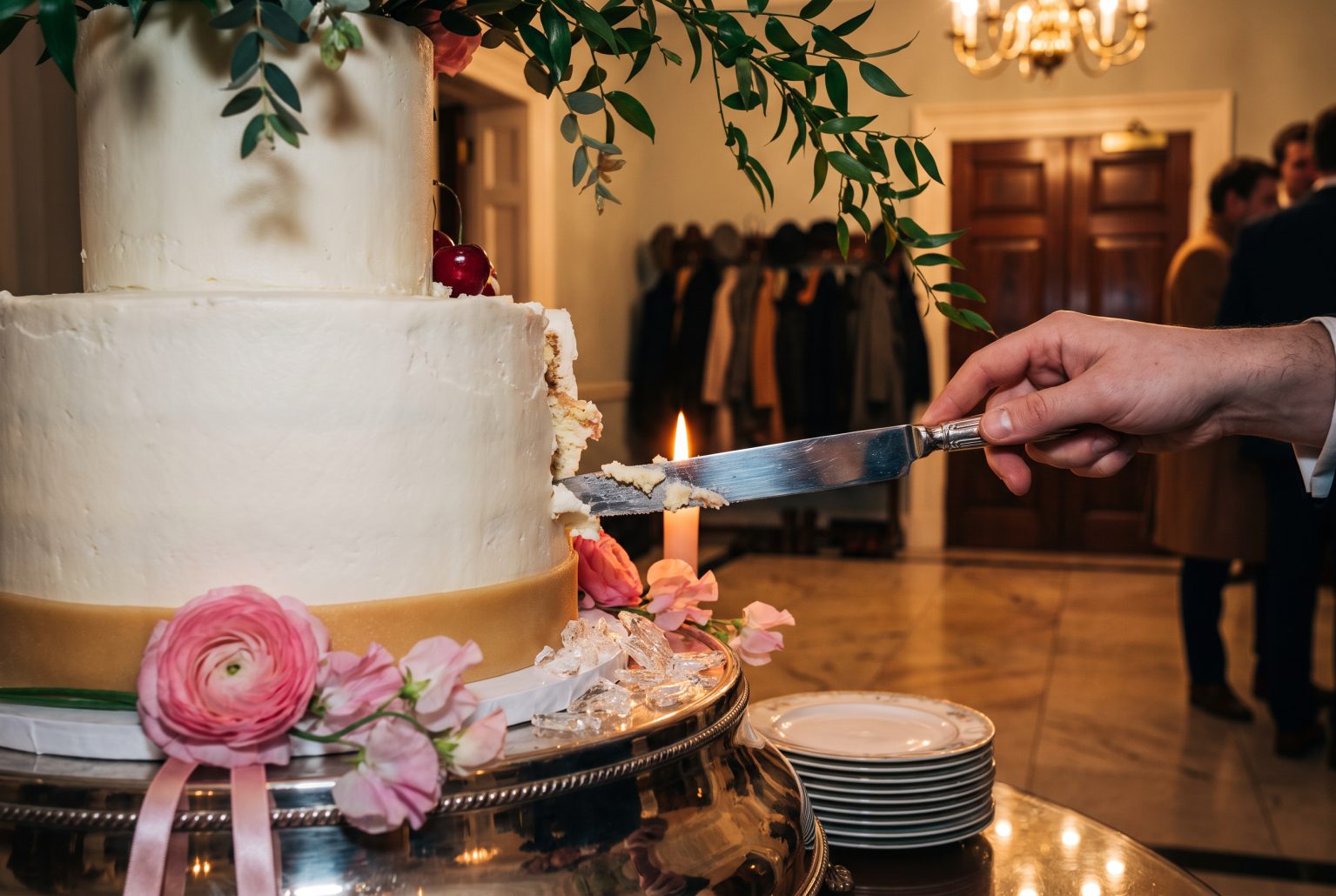
There is a version of this evening’s styling that everybody reaches for within about four seconds of hearing the premise, and it is pastel. Tulle. A cherry print. Something that looks like the thing being served. Refuse all of it. The source of this theme is not cake as an image; it is cake as a schedule, moved. One line goes to the top of a running order, and the consequence is that four hundred people are standing in a hallway at ten past seven eating something rich with their fingers, still in the coats they have not finished taking off, laughing at a joke nobody has explained to them.
That is the thing the clothes have to carry. Not sweetness. Disarmament.
Where the clothes come from
The inversion is a joke about rationing. We save things. We save the good bottle, the good plate, the room at the front of the house, and above all we save the cake for the end, where it arrives at half past ten to a room that has stopped being hungry. This theme takes one of those saved things and spends it immediately, on purpose, before anyone has earned it.
Dressing has exactly the same disease. There is a garment in almost every wardrobe being kept for a better evening than this one. A jacket too good for a Tuesday. A dress bought for a wedding that got postponed. Shoes still in the box because the right night has not turned up. This Look Book’s entire argument is that you wear that thing here, at seven, to a party where the first thing that happens is somebody hands you dessert. Wear the good thing first. It is the same gesture as the cake, performed on a body, and it is the only piece of costume this theme will tolerate.
What we take from the source, then, is generosity with a straight face. Something obviously good, worn without ceremony, at an hour that does not deserve it. Not irony. Irony is the sign on the table explaining the joke, and we do not buy that either.
What we refuse is the confectionery register in every one of its dialects: the cupcake skirt, the icing-coloured satin, the eighteenth-century pastiche, the novelty cherry brooch, the tiny cake-shaped bag. All of them convert a genuine surprise into an announcement, and an announcement is the one failure mode this concept has. The room is already doing something strange. If the room is strange and the clothes are strange, nothing is strange, because there is no straight line for the joke to sit against.
The second thing the source hands us is far more practical, and it governs the next three chapters. Everybody in this room is going to eat something buttery, standing up, using their hands, within ten minutes of arriving, and then wear the consequences for four more hours. Every garment here is being asked a question that garments are almost never asked at seven o’clock: what happens when a hand that has just held ganache touches you?
The line
Design the outfit for standing height in a hallway, not for a seated table. The first ten minutes are the whole social event of this evening and they happen with everyone upright, at close range, in a space that was not built for a party — a hall, a lobby, a landing, the bit of a room in front of the door. Nobody is seeing your hem. Everybody is seeing your forearms, your shoulders, your neck, and whatever is happening between your elbow and your wrist.
So volume goes up top and the sleeve is the design problem. A sleeve that can be pushed to the elbow with one movement and will stay there is worth more tonight than any other feature of any other garment: a soft cuff, a wide one, a three-quarter one, a gather on elastic. No fitted long sleeve in a cloth that will not hold a fold, because you will spend four hours dragging it back down.
Below the waist, take out anything that needs managing. A hem that requires a hand is a hem you cannot have, because both of your hands are committed: one to a plate for the first four minutes, one to a glass for the next four hours. Wrap dresses that need re-tying, long trains, a coat carried over an arm, a shawl that slips — all of them fail at the door. Volume in a skirt is fine if it is self-supporting. Volume that needs holding is not.
One more line note, and it is the odd one. This room gets warmer as the night goes on, not cooler, because it fills, and because the kitchen’s biggest push lands at the end rather than the middle. Dress for a room at twenty-four degrees at eleven, not for the hall at nineteen at seven. Whatever you would have added at the end, add it at the start and take it off, rather than the other way round.
The cloth
The governing fact is butter. Ganache at hand temperature is oil and cocoa solids, and oil on a fibre is not a stain in the ordinary sense — it is a change in how that fibre reflects light. It does not lift with water and it does not lift at a party. So the material question here is not “does it mark” but “does the mark read.”
Silk crepe, silk satin, and fine wool crepe all read badly: they take a fingerprint of oil and hold it as a dull patch that you can see from across a hall. Untreated pale linen is worse, because it also drinks. Anything with a smooth, lustrous, flat face — duchesse, sateen, polished cotton, coated leather — is a display surface for a thumbprint.
What works is texture, matte finish, and depth of colour. Boiled wool. Jacquard. Cloqué. Velvet, which is the surprise entry: cut pile hides a great deal, it photographs richly under warm domestic light, and it is genuinely forgiving at the cuff. Heavy crepe with a granular face. Corduroy in a fine wale, which is deeply unfashionable roughly six years out of seven and is exactly right in a hallway with people eating. Dense cotton twill. Anything with a slub, a nap or a pattern, because all three are camouflage.
Colour, on a person
The room’s twelve colours do not transfer to bodies at anything like their room ratios, and two of the top four are actively hostile to a guest.
Icing White (#F7F4EF) is sixteen per cent of this room and it is the one colour a guest should not wear. Not because it is bridal — because it is the cake. The object everybody is photographing in the first ten minutes is a pale, matte, cream-white mass at chest height, and a guest in the same value stands next to it and becomes background. Buttercream (#F2DFB6) has the same problem one step warmer, with the added misfortune that it is the exact colour of what will be on your hands. Porcelain Rim (#E4E6E3), Sugar Glass (#D9E4E6) and Cake Stand Silver (#C4C7C6) are utility colours: they belong to plates, glass and the stand, and on a body they read as uniform.
The colours that belong on people are the ones the room uses least. Bitter Chocolate (#3B2419) and Cold Coffee (#54423A) together are eleven per cent of the room and should be a great deal more than eleven per cent of the guests — they are deep, warm, unblack browns that sit well against nearly every skin under tungsten light, and they are the only two values in this palette on which ganache is invisible. Cherry on Top (#B3243A) is the theme’s one loud colour and it is a superb thing to wear here: a true blue-red, not orange, worn whole rather than as a detail. Pistachio Crumb (#A8BC85) is the sleeper, a grey-green that is strange enough to look considered and quiet enough not to compete.
On skin: the light is warm, low and domestic, weighted toward Candle Flame (#FFC46B). Warm light flatters warm colours and drains cool ones, so a cold-toned grey, a lilac or a pale icy blue will look grey and tired in this hallway even though it looked fine at home under daylight. If you are wearing something cool, make it dark enough that the light cannot wash it.

The looks
Six, of which two ask you to buy nothing at all.
The Dark Sleeve
A long, narrow dress in dark chocolate wool crepe or heavy viscose, high at the neck, with a soft full sleeve gathered at a wide cuff you can push to the elbow and leave there. Flat or low heel — you are on hard floor, standing, for the best part of an hour. A coat you hand over at the door and do not think about again. No necklace; the neckline is the neckline. One heavy cuff bracelet on the arm that is not holding the plate.
The detail that makes it this theme and not another: the cuff is unlined and cut wide enough to fold back on itself twice. It is designed to be worn pushed up. That is a garment that has been told what is about to happen to it.
The Wrong-Hour Sequin
The evening dress you have been saving, worn at seven. Sequin or paillette, dark ground, short or long, sleeveless or with a sleeve that stops above the elbow. Over it, and this is the whole idea, something entirely ordinary: a grey wool overcoat, a navy raincoat, a men’s cardigan. The mismatch between the garment and the hour is the joke, and the joke lands better if the outer layer refuses to play along.
Bare arms solve the sleeve problem by not having one. Bare arms also mean a bracelet is the only jewellery you need and a ring is the only one anybody will photograph.
Trousers and a Very Good Shirt
Assembled from things most people already own, and the strongest look here. Wide dark trousers with a real waistband. A shirt in the best cloth you have, worn with the cuffs turned back twice before you arrive — not rolled, turned, so it reads as a decision rather than an accident. Leather shoes, polished. No jacket, or a jacket that comes off in the first five minutes and stays off.
The detail: turn the cuffs at home. Somebody who turns their cuffs at the door looks like they are getting ready to do the washing up. Somebody who arrives with them turned looks like they knew.
The Overshirt as the Whole Outfit
Non-gendered, and the most practical thing in this document. A heavy overshirt or chore jacket in dense cotton twill or boiled wool, in bitter chocolate or a deep green, worn buttoned as the top half of the outfit rather than over another one. Straight trousers in the same weight. Flat lace-up boots. It has four pockets, all of them usable, which at an event with no surfaces is worth more than any bag.
The detail: the pockets are the point, and the top two should be empty, because you are going to want somewhere to put a napkin.
Black Tie, Untied
Masculine dressing, taken seriously. A dinner jacket, shawl or peak, worn with the tie in your pocket rather than round your neck, and a fine dark shirt instead of a stiff white one. The white dress shirt is the single worst garment in this room: it is a flat pale surface at exactly the height a hand travels, and it will be marked before you have said hello to anyone. A shirt in dark grey, deep green or chocolate solves it and looks better in this light anyway.
The detail: the jacket sleeve should show a genuine quarter-inch of shirt cuff, and that cuff should be one you can push. Double cuffs with links are a beautiful thing and a liability tonight; they will not go up and they will not come back down one-handed.
The Knit and the Long Skirt
The other look you already own. A fine dark knit — merino, cashmere, anything with a close hand — over a long skirt in a heavier cloth, with boots. It is the outfit people wear to nothing in particular, and it works here for three reasons: the knit takes a mark and hides it in the texture, the sleeve pushes up and stays, and the whole thing is warm at seven in a hall and survives a room at twenty-four degrees at eleven if the knit is fine rather than chunky.
The detail: a single strong earring or a single strong ring, and nothing else. This look fails when it is accessorised into an occasion. It should look like you were already dressed.
The detail: keep it one colour and one material all the way down. Red in two shades reads as a mistake; red in one reads as an instruction.
Accessories, jewellery, shoes and bags
Bags first, because this evening punishes them. There is nowhere to put anything down for the first fifteen minutes, so a bag either hangs on the body or does not exist: a cross-body strap, a wristlet, or a coat with pockets deep enough to be the bag.
Sleeves have already ruled the jewellery. Bracelets and cuffs go on the arm you are not eating with, and everything on the wrist should be smooth-edged, because it is going past a cake at close range. Rings are the most photographed jewellery at this event by a wide margin, because every photograph in the first ten minutes contains hands at chest height holding a plate. If you own one good ring, this is its evening.
Metal: warm rather than white. This room is lit at candle temperature and gold, brass and antiqued bronze all come alive in it, while polished silver and chrome go grey and slightly clinical. Marzipan Gold is in the palette for a reason.
Shoes cope with hard floor and standing, not with terrain. A block heel, a low heel or a flat, in something that does not need looking after, because plates get dropped in the first ten minutes of this evening more often than at any other point of any other party. Suede in a pale colour is optimism. A stiff new leather sole on a waxed floor is genuinely dangerous when you are carrying something with two hands.
Hair, face and hands, briefly
Hair goes off the face and stays there without being touched, because both hands are occupied from the moment you clear the door. Anything you would need to tuck, sweep or re-pin will be tucked, swept and re-pinned with a thumb that has ganache on it. Front sections secured, back left as loose as you like.
Skin should be satin rather than wet. A dewy finish under warm domestic light at close range, with people standing eight inches from your face saying hello, reads as shine rather than glow, and this is the closest-range hour of any party format we run.
The face’s real complication is that it will be photographed before it has been eaten in, not after, and the lip is the whole problem: whatever is on your mouth at seven o’clock will be substantially gone by ten past. Nails are the other thing, and they matter more here than at any other event in the collection, because every hand in the room is up at chest height holding a plate for four minutes while somebody takes pictures. Short, filed, one colour, done the day before.
All of that — the timings, the finishes, what actually survives being eaten off at minute three, and the honest account of what to reapply and when — is written out properly in the beauty companion on Vanity or Vice.
The host, and the difference
The host has a different job and therefore a different outfit. They are moving continuously for the first ten minutes, they are within arm’s reach of a cut cake and a knife, they will carry at least one thing that is hot before midnight, and they are in the background of roughly every photograph taken between seven and half past.
So: dark, matte, one colour, sleeves that are already short or already pushed, and pockets. Pockets are not negotiable and they are the whole reason a host should consider a suit, a jumpsuit with real pockets, or an overshirt over a dress rather than a dress alone. If the garment genuinely has none, the answer is a decided one — a small cross-body bag worn all night, chosen to look intentional, not a clutch abandoned on a windowsill in minute three.
The host reads as the host by being the most legible person in the room from behind, which is how guests will mostly see them. That means a strong silhouette and a single consistent colour, not a badge, a corsage or a different dress code. One person at this event should be recognisable at forty feet in a crowded hall with their back turned. Achieve that with cut and colour and you will never need to explain who is in charge.
What to tell guests
The invitation line reads: Dress as though this were the good party. It starts at seven and it starts with the best part.
The honest translation, which goes in smaller type underneath or in the reply email: wear the thing you have been saving. Dark colours photograph better than pale ones tonight and pale ones are going to meet a cake. Sleeves you can push up. Shoes you can stand in for an hour. Nobody is in black tie unless they want to be, and anybody who wants to be, should.
For the guest who ignores all of it and turns up in a pale suit: hand them a napkin with the plate, put them somewhere with a surface, and say nothing whatsoever. Nobody is corrected at a door, ever, at any of our events. The staff line for a guest who asks whether they are dressed correctly is “you look right, come in” and then a plate, immediately, which ends the conversation better than reassurance does.
Getting it wrong
The costume version is anything that looks like cake. The moment a guest could be mistaken for the dessert, the surprise has an accomplice and stops being a surprise.
The one accessory that always cheapens this is the novelty: the cake-shaped bag, the cherry earrings, the slogan anything. It is the wearable version of the card on the table explaining the joke, and the study already told you not to buy that.
And the quiet failure, which is more common than all of the above: dressing for the dinner rather than the doorway. Somebody who has planned an outfit for a seated table at nine o’clock arrives to find the entire social event of the evening already happening in a hallway, and spends it holding a clutch, in a stiff coat, unable to take anything from the tray.
Wear the good thing. Wear it at seven. Push your sleeves up.
Atmosphere OS · Theme Atelier
Turn the mood into something a florist can quote.
Theme Atelier builds palette, materials, lighting and spatial mood into one system, then writes it in language a vendor can price. Every number it produces comes from a published rule, and the rulebook names the judgements it deliberately refuses to call rules.
The rulebook is public. Every formula it runs on is written down where you can disagree with it.
Continue through the system
Pretty is still not a plan.
This field note belongs to a larger event-design system. Follow the chapter that explains the next pressure point instead of falling back into an undifferentiated archive.
What you have to decide next
One decision constrains the next. This is the order they actually happen in.
- Venue Will this room hold it? The Generator Was Late. The Washrooms Were Waiting.
- Guest experience How will guests move through it? Family Milestone Reception for One Hundred Fifty: Three Generations Need More Than One Volume Level
- Production How does it get built and run? Museum Reception for One Hundred Forty: The Building Gets a Vote
- Vendors Who owns each handoff? The Dance Floor Wrap Is Not the Whole Dance Floor
More in this chapter


See the complete five-chapter Event Design Intelligence map →