Design Atelier
Everything After Sugar
The Cake Arrives First, eaten: a menu written for a room whose palate has already had dessert, where nothing served after ten past seven is allowed to be sweet.
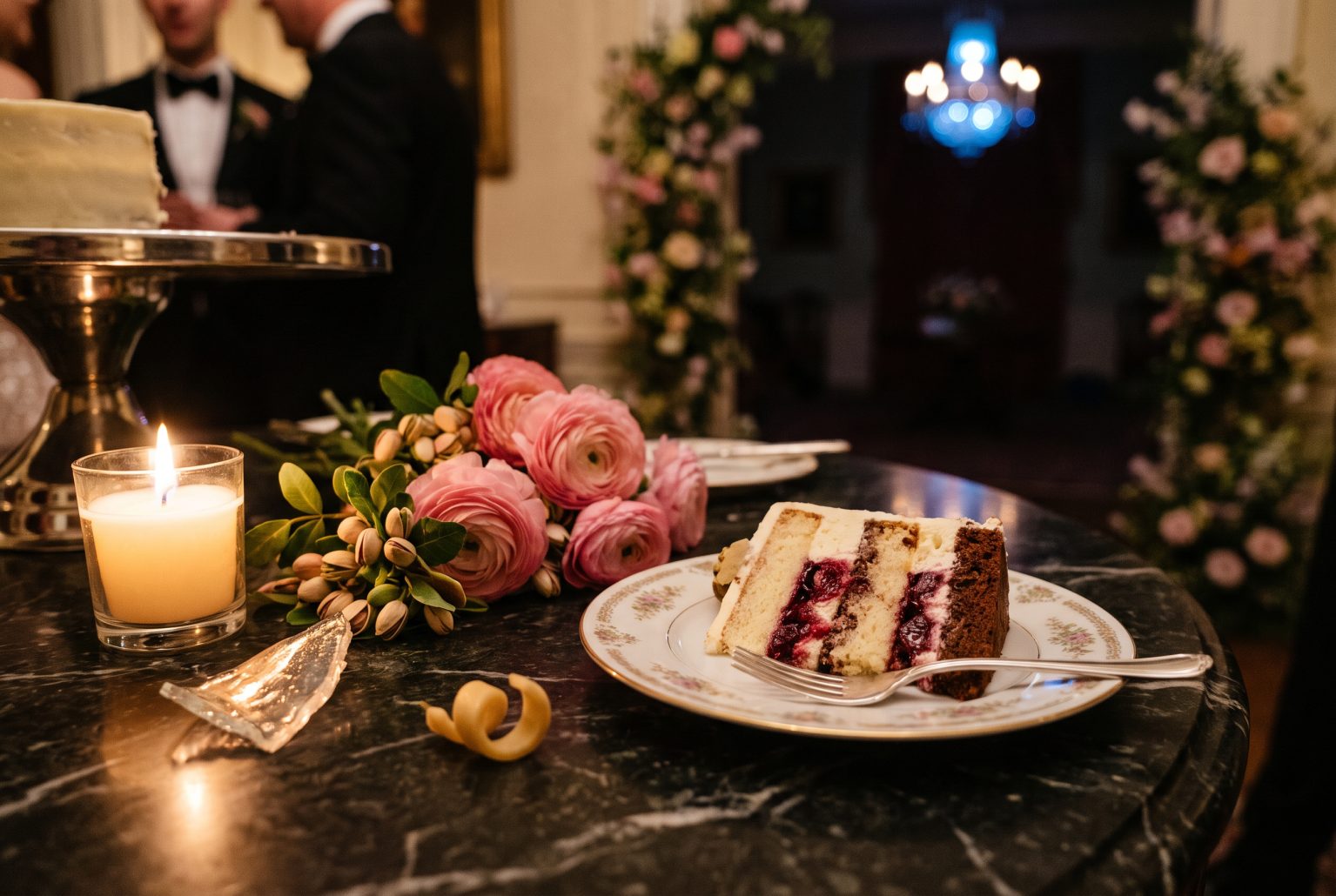
This is the hardest menu in the collection and it is hard for one reason. Dessert opens. Every single decision after ten past seven is being taken for a room whose palate has already had sugar, and that changes what food tastes like — not metaphorically, measurably.
What this evening is hungry for
Two things happen to a person who eats something rich and sweet at the start of a party, and they pull in opposite directions.
The first is helpful. Appetite is not one appetite. The decline in pleasure that comes from eating a food applies mostly to that food and to things like it, which is why a table that has eaten a whole savoury meal still wants dessert, and why a room that has eaten cake at seven is genuinely, properly hungry for a braise at half past ten. Sugar first does not close the evening’s appetite. It closes one channel of it and leaves the others open, and the open ones are salt, fat, acid and bitterness.
The second is the problem, and almost nobody plans for it. Sweetness is a comparative sense. A palate that has just had buttercream is a palate calibrated upward, and for the next hour or so anything mildly sweet lands as flat, dull and faintly stale. That is a very long list of the things ordinary catering does to make food taste generous: the honey glaze on the carrots, the balsamic reduction, the caramelised onion, the sweet potato, the butternut soup, the fruit component next to the meat, the off-dry white, the sticky red, the beetroot purée, the fig with the cheese. Every one of those is a dish that tastes rounded and warm at a normal dinner and tastes of nothing at this one.
So the rule that governs this entire menu is not “no dessert.” It is nothing after minute ten may be sweet at all — not even quietly, not even as a background note. The moment a savoury course tries to be a little bit sweet, it is competing with a cake it cannot beat, and it is doing so with a palate that has moved the goalposts.
What is left is the good part. Take sugar out of the savoury vocabulary entirely and what you have to build with is salt, acid, bitterness, fat, smoke and temperature — which is a stronger vocabulary than the one most menus use, and it produces a meal that climbs. The evening’s shape is written into the tongue: sweet, then sharp, then bitter, then deep, then salt. Nothing here winds down, because winding down is what sugar does and sugar has already been spent.
The shape of the night
Doors at seven. Cake in a hand by ten past, with a drink, standing. The first savoury thing arrives at twelve minutes past — passed, cold, extremely salty, three bites — and it is the most important single item on this menu, because it is the hinge. Seated at twenty to eight. First course out at eight, a bitter, charred, acidic plate that does the second half of the reset. Sides land at a quarter to nine and stay on the table. The main comes out at half past ten, whole, at the exact hour a cake would normally arrive, and it is the biggest thing anybody has seen all night. Something bitter and cold to drink at half eleven. A bowl of broth at one.
Three courses this evening does not have, and each omission is deliberate.
There is no dessert course. Obviously. But say it out loud to the kitchen, because a kitchen that has not been told will produce one anyway at eleven, out of muscle memory, and a second dessert is the single fastest way to convert an inversion into a gimmick.
There is no bread basket at the start. Hands are full, everybody has just eaten, and bread arriving at a table twenty minutes after cake is the definition of surplus. Bread comes out with the main, late, when it is wanted.
There is no amuse-bouche. The cake was the amuse. It weighed four hundred grams and it was served in a hallway.
The welcome drink and the arrival food
The drink goes into the hand at the same moment as the plate, or within thirty seconds of it, and it has exactly one job: cut the cake. Not complement it. Cut it.
That means cold, dry, bitter, and either sparkling or long enough to scrub. It must have no sugar in it worth mentioning, which rules out almost every welcome drink anybody has ever poured — no sparkling wine with a dosage you can taste, no spritz, no cordial, no punch, nothing pink.
The arrival food is not at arrival. It lands at minute twelve, once plates have been cleared and hands are free, and it is anchovy, cold butter and dark rye: a small dark square, cold, salty enough to be slightly startling, eaten in two bites off a tray. It is the first savoury thing anybody tastes and its whole function is to reset the mouth. Guests will describe it later as the moment the evening turned. It costs almost nothing and takes four minutes to assemble.
The bar
The signature: Cold Coffee, No Sugar. Cold-brew coffee concentrate, a bitter red aperitivo, soda, a squeeze and a twist of lemon, a pinch of salt, over one large clear cube in a tall glass. It is dark, faintly bitter, aromatic, and it tastes correct next to buttercream in a way that almost nothing else does. Coffee is the classical partner to cake and it is nearly always served three hours too late; here it arrives with it, cold, at seven o’clock, and does the job it was always meant to do. Two of the palette’s twelve colours — Cold Coffee (#54423A) and Bitter Chocolate (#3B2419) — are in the glass.
The zero-proof drink, designed as its own drink: Roasted Barley and Sour Cherry. Cold roasted-barley infusion, sour cherry vinegar, soda, salt, lemon. It is not the signature with the alcohol taken out; it is built from a different roast and a different acid, it is darker and more tannic, and it is not one degree sweeter. Same tall glass, same cube, same twist, same tray, announced by name in the same breath. Nobody at this event should have to ask for it, and nobody should be handed a smaller glass.
Batch, because you have no choice. A bartender makes roughly one drink a minute once a queue forms. This evening needs every guest holding a glass within ninety seconds of the door, which at forty guests is a bar with a two-minute queue and at a hundred and fifty is not a bar at all. So the highball is batched and bottled the day before, dilution included as measured water, chilled to fridge temperature, and poured onto ice by anybody who can pour. Trays go out pre-poured. The bar opens properly at eight, after the room has sat down, and from that point it can behave like a bar.
Wine. High-acid whites and savoury reds, and read every back label for residual sugar, because this is the one evening where an off-dry Riesling or a soft modern red is actively wrong — both will taste dilute and stale against a sugared palate. Chablis, Muscadet, dry Furmint, a nervy Chenin. For red: Loire Cabernet Franc, Beaujolais from a good site, Etna, anything with acid and grip. Nothing jammy, nothing high in alcohol and low in acid, nothing oaked into vanilla, and — under no circumstances at any point in this night — a dessert wine.
After dinner. A bitter chocolate nightcap: cacao husk and nibs infused into an amaro, served cold in a small glass, unsweetened. This is where the sweet register is allowed back into the room and it comes back as bitterness rather than sugar, which is the only way it can come back without repeating the opening.
Ice, glass and the stand. One large clear cube per drink; small ice dilutes a batched highball to nothing in eleven minutes in a warming room. Tall, thin-walled, plain glass — this is a menu of dark liquids and they should be visible. Garnish is a lemon twist expressed over the surface and dropped in, cut at the last minute, because the aroma is doing real work and a twist cut at four o’clock has none left by seven. Site the bar away from the door, not next to it: the first ten minutes belong to trays, and a bar near the entrance turns an arrival into a queue.
The table
First course: charred radicchio, whipped anchovy cream, burnt lemon. Radicchio halves taken hard on a grill or a dry pan until the cut face is genuinely black at the edges, dressed while hot, over a cold salted anchovy cream, with a burnt lemon half on the plate to be squeezed by the guest. The twist is that it is aggressive on purpose. Bitterness is the fastest route back from sugar, and char plus anchovy plus acid is a course that tastes twice as strong as it would at any other dinner because the palate arriving at it has been recalibrated. On the plate it is Cherry on Top (#B3243A) collapsing into Bitter Chocolate (#3B2419) against Icing White (#F7F4EF), which is the whole palette in one dish and completely accidental.
The main, at half past ten: shoulder braised in coffee and vinegar. A whole shoulder — lamb, pork or mutton — cooked at low heat for nine hours in strong black coffee, red wine vinegar, bay and a great deal of black pepper, with no sugar, no honey, no sweet aromatic and no caramelised onion anywhere in the pot. It goes to the table whole on the board it was cooked on, at the exact hour the cake would traditionally have arrived, and it is carved in front of people. That timing is the entire argument of this theme made edible: the biggest object of the night lands at half past ten, and it is savoury.
The coffee is not a novelty. It is doing the job sugar usually does in a braise — providing the dark, roasted, faintly bitter depth that makes a long-cooked shoulder taste finished — without adding a gram of sweetness to a room that cannot use it.
The deliberately plain thing: potatoes, boiled, salted, buttered. Nothing on them. No herb, no garlic, no crisped edge, no confit. A menu with seven ideas on it is exhausting, and by half past ten this table has had five. The potatoes are there to be the thing you eat without thinking, and they are the dish most likely to be finished.
The vegetable: white beans braised in vinegar and bitter greens. Beans cooked soft with a hard hit of vinegar at the end, stirred through wilted escarole or dandelion, olive oil, no stock made sweet by carrot. Sharp, green-brown, and the one dish on this table that reads as Pistachio Crumb (#A8BC85). It is also, scaled up and served in its own dish, the vegan main event, and it is named on the menu card as a dish rather than as an alternative.
Bread comes out here and not before: a dark, sour rye or a good sourdough, cut thick, with cold salted butter. Late bread at a table that has been drinking for three hours is one of the most welcome things in hospitality and it is nearly always served at the wrong end.
Late, and after
At about one in the morning, when a normal evening would be offering bacon rolls, this one serves a small cup of very clear, very hot, very salty broth. Nothing in it. No noodle, no garnish beyond a scrap of green. It is served in whatever small cups the house owns, handed round rather than plated, and it is the most reliably remembered thing at any evening we have designed.
It is also the correct ending for this specific night, and not a stylistic flourish. A room that opened on butter and sugar and spent five hours climbing through salt, acid and bitterness should finish on the plainest, saltiest, hottest liquid available. It sobers people up, it warms them for the walk out, and it closes a loop that started with something rich in a hallway.
Coffee, properly made, goes out alongside it. Not with the nightcap at half eleven — later, with the broth, for the people who are driving and the people who are staying.
The next-day continuation is the leftover shoulder, which is better cold on rye the following afternoon than it was hot, and the cake, which there will be none of, because it was eaten at seven by everybody.
Whether it can actually be served
Guest counts. The menu holds unchanged to about sixty. Between sixty and a hundred and fifty, the main goes from whole-shoulder-carved-at-the-table to two or three shoulders carved at a pass and plated, which loses the theatre and keeps the food. Above that, plate the main and pass everything else family-style, and accept that the half-past-ten moment becomes a service push rather than a spectacle.
The two dishes that fail first if the kitchen is a tent with two induction rings. The braise fails first, not because it is hard but because it needs nine hours and then needs holding hot for two more; two rings cannot do that and also cook anything else. Cook it the day before, cool it fast, and reheat it in its own liquid — it is better on day two anyway, and this is the rare case where the substitution improves the dish. The second is the cake, which needs cool storage from delivery until service and cannot have it in a marquee in July. The answer there is a cake designed for the temperature: ganache rather than buttercream, no fondant, and a firm crumb.
Holding, honestly. Standard food-safety practice keeps cold food at or below 4°C and hot food at or above 60°C, with the range between them treated as time-limited — commonly stated as two hours out of refrigeration, or one hour above 32°C. Check the numbers against your own food authority rather than against us; the design instruction is simply that this menu is built so that only two items ever sit out. Everything else is either just-cooked or just-taken-out.
The cake and the four hours. A tiered cake standing in a room is a structure, and it behaves like one. Buttercream softens as the room warms; American buttercream is the least stable of the three families and Italian meringue the most; ganache made firm holds its shape at ordinary room temperature; fondant is the most heat-tolerant surface and the least pleasant to eat. The cake this evening wants is ganache under a firm crumb with no fondant at all, cut into portions that hold together in a hand. All of that is specified properly in the recipe.
Dietary versions, named. The vegetarian and vegan main is the bean and bitter greens dish, cooked in its own pot, brought to the table in its own vessel, at the same time, announced by name. The gluten-free version of the cake is the flourless bitter chocolate and olive oil cake, which is also dairy-free, is a genuinely good cake rather than a substitute, and is plated identically and distributed by the same servers at the same moment. The occasion study is explicit about why this matters and it is worth restating: in an evening whose entire premise is that everybody eats together in the first ten minutes, a guest standing empty-handed in that window is not inconvenienced, they are excluded, visibly, in front of the room.
Prep burden. Two days out: braise, batch the highball, bake the cakes. Day before: ganache and cover, cut the rye, pickle nothing because there is nothing to pickle. Morning of: anchovy butter, radicchio prepped not cooked, beans on. The evening itself has one genuinely hard fifteen minutes, and it is the first fifteen.
The handoff
Every dish and every drink named above is written out as a real recipe on Salty & Clever, with quantities, method, make-ahead windows, holding times, scaling and substitutions — including the two that carry the workload, which are the standing cake and the nine-hour shoulder. The working menu, with the prep clock counted backwards from seven o’clock and the shopping order, is on that site as well.
- The standing cake — brown butter, almond and apricot, ganache, cut for the hand
- The flourless bitter chocolate and olive oil cake — gluten-free, dairy-free, plated identically
- Cold Coffee, No Sugar — the signature
- Roasted Barley and Sour Cherry — the zero-proof drink
- The batched highball, bottled, with dilution accounted for
- Anchovy, cold butter and dark rye — the twelve-minute bite
- Charred radicchio, whipped anchovy cream, burnt lemon
- Shoulder braised in coffee and vinegar
- Potatoes, boiled, salted, buttered
- White beans braised in vinegar with bitter greens
- The bitter chocolate nightcap
- Clear broth, one in the morning
Atmosphere OS · Theme Atelier
Turn the mood into something a florist can quote.
Theme Atelier builds palette, materials, lighting and spatial mood into one system, then writes it in language a vendor can price. Every number it produces comes from a published rule, and the rulebook names the judgements it deliberately refuses to call rules.
Free to use, local-first in your browser, and there is no account until you ask for one.
Continue through the system
Pretty is still not a plan.
This field note belongs to a larger event-design system. Follow the chapter that explains the next pressure point instead of falling back into an undifferentiated archive.
What you have to decide next
One decision constrains the next. This is the order they actually happen in.
- Venue Will this room hold it? The Generator Was Late. The Washrooms Were Waiting.
- Guest experience How will guests move through it? Family Milestone Reception for One Hundred Fifty: Three Generations Need More Than One Volume Level
- Production How does it get built and run? Museum Reception for One Hundred Forty: The Building Gets a Vote
- Vendors Who owns each handoff? The Dance Floor Wrap Is Not the Whole Dance Floor
More in this chapter


See the complete five-chapter Event Design Intelligence map →