Design Atelier
The Oven Decides the Order
The Ovens Are Still Warm, Occasion Study No. 24: a menu with no chef's opinion in it, written entirely by a falling temperature, from a blistered flatbread at two hundred and fifty degrees to a tray of meringues left in the dark at seventy.
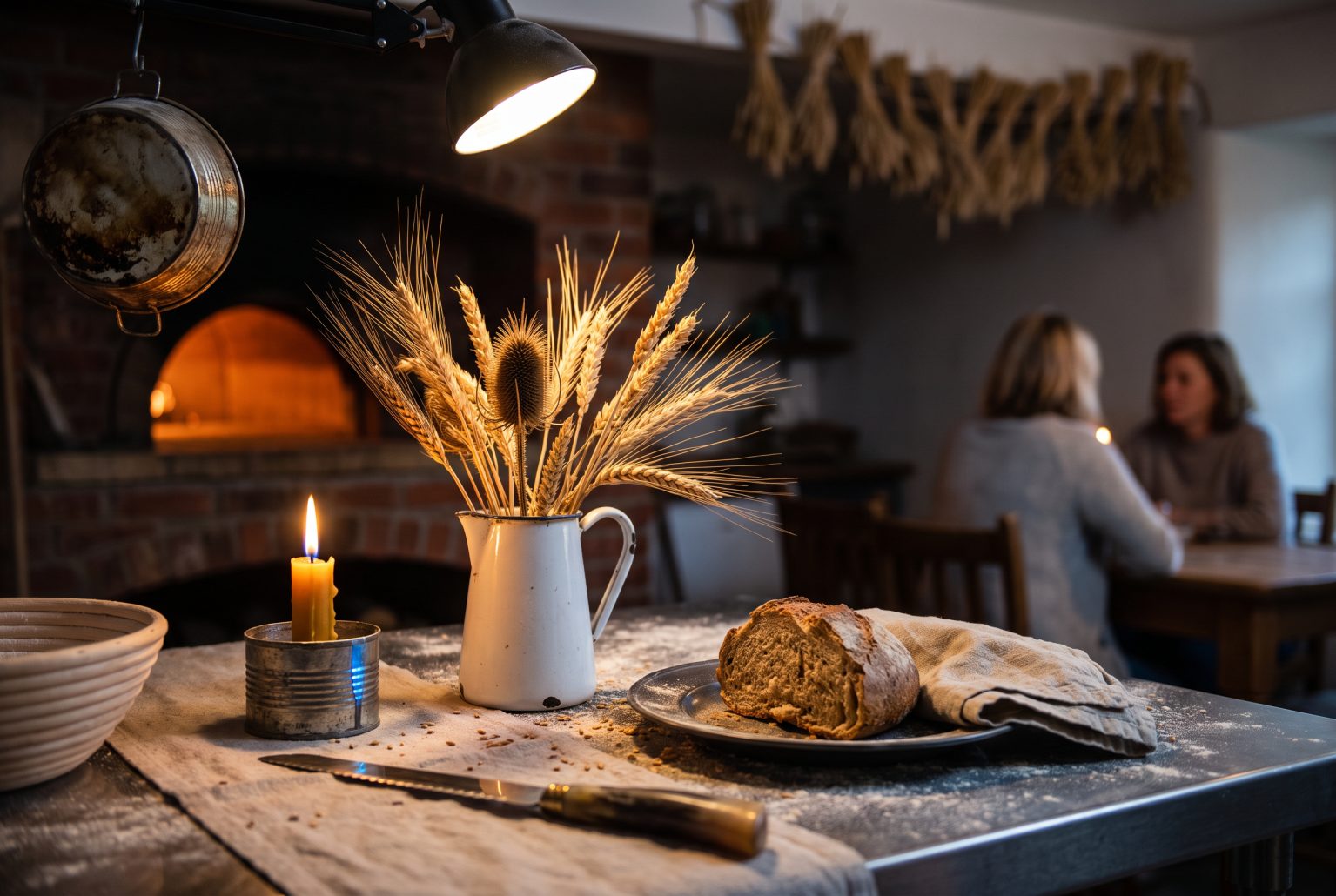
Most menus are written by appetite. This one is written by physics, and it is a better menu for it.
What this evening is hungry for
The mechanism of this evening is a quantity of stored heat that is going away. A deck oven’s hearth is thirty to fifty millimetres of firebrick or cordierite that has been held at temperature since before dawn, and once the burners go off at four in the afternoon that stone begins giving its charge back to the room at a rate you can chart. With the doors shut it is a slow, dignified decline. Every time somebody opens a door it takes a step down and then recovers part of it from the mass underneath. Nobody can tell you what your oven does; you find out by putting a probe in it at four and reading it every hour, and that reading is the menu.
What that implies about food is unusual and it is the whole design. The kitchen sequence and the guest sequence run in opposite directions. Everything slow — the shoulder, the beans, the quinces — goes in before anybody arrives, at five or six, when the deck is still at a hundred and eighty and falling, and it uses the descent as its cooking curve. Everything fast happens at the mouth of the oven at ten o’clock, in front of people, at whatever the hottest deck still holds. So guests experience a menu that begins violent and ends gentle, while the kitchen experienced one that has been getting quieter since teatime and finished its real work before the first coat came off.
The second implication is about hands. The first hour is standing at a bench at nine hundred millimetres with a chalk line on the floor and shoulder-to-shoulder guests behind it. Nobody is cutting anything. Every dish in that hour has to be a single object that goes into a hand, gets torn, and needs no plate — and it has to arrive continuously, because the pleasure of the first hour is that something is always coming out and nothing is ever waiting.
The third is that the room is doing the aromatic work. A bakery at ten at night smells of hot flour, caramelised crust and warm brick, and it is better than anything a kitchen can produce deliberately. This menu therefore contains no smoking gun, no aroma cloche, no herb thrown on a fire for effect. It would be like adding a soundtrack to thunder.
And the last, which is a refusal: nothing on this menu may need a precise internal temperature at a precise minute. A cooling oven cannot be timed. Every dish here has to be either fast enough to watch or forgiving enough to forget, and the moment somebody proposes a dish that has to come out at exactly eleven-fifteen, the concept has been quietly abandoned.
The shape of the night
Three formats, in order, and the format changes because the temperature changes rather than because a plan said so.
Ten o’clock, standing, by hand. Guests come through the yard door, take a drink from a bench, and go straight to the hot end. Flatbread and blackened peppers, in and out of the deck in under two minutes each, torn from paper laid on steel. No plates, no cutlery, no seating. This runs forty to fifty minutes and it is the loudest part of the evening.
A quarter to eleven, the loaf. The one piece of theatre, and the only thing here that resembles a course change. A loaf that was shaped while people were eating flatbread goes into the deck at around two hundred and twenty, and it comes out about an hour later while everybody is sitting down. Stools appear at the benches during this hour. Volume in the room drops by roughly a third on its own.
Eleven onwards, seated, family. The slow things that have been in since six come out and go down the middle of the bench in their trays: shoulder, beans, onions, and the one cold plate. Everything is served from where it cooked. Nothing is plated in a kitchen because there is no kitchen, only benches, and this is a virtue rather than a compromise.
Half past midnight, whatever is left at a hundred and ten. Bread pudding, quinces, last night’s meringues. Coffee if the bakery has a machine, and it usually does.
Two courses this evening does not have, and it is worth saying why. There is no canapé service, because a canapé is a thing made in advance in a cold kitchen and carried into a room, and every single item here is made in front of you or comes out of the oven it cooked in. And there is no cheese course. Cheese needs to be at room temperature and this room does not have one — it has a temperature that is falling all evening — and a cheese board in a room that smells of bread is a course nobody remembers eating.
The welcome drink and the arrival food
The drink is in a hand before the coat is off, and it is handed over in a yard, in the dark, by somebody with a torch. That is the first thing this evening says about itself and it is worth getting right.
Both signature drinks are batched and poured before anybody arrives — the alcoholic one and the zero-proof one, side by side, in identical glasses, on a tray on the bench inside the yard door. Not because batching is easier, though it is, but because nothing at all is gained by making somebody stand in a cold yard while a drink is stirred to order, and because a bakery has no bar and there is no version of this room where a queue at a bottle looks good.
The arrival food is the flatbread, and it is not passed. Guests go to it. The peel handler works the mouth of the hottest deck continuously for the whole first hour: dough goes on, ninety seconds, out onto paper, torn, gone. The correct number of flatbreads for the first hour is not a number of pieces per head, it is a rate — one leaving the oven roughly every ninety seconds, forever, so that at no point in that hour is the bench empty. Guests will eat considerably more than you plan for, because standing food eaten by hand with a drink in the other hand disappears at a rate seated food never does.
The twist on the flatbread is a scrape of butter cooked with toasted flour — flour browned dry in the falling oven until it smells of hazelnuts, then whisked into butter and a little of the dough’s own water. It costs nothing, it is made from the two things the room is already full of, and it tastes like the smell of the building.
The bar
There is no bar. There is a bench with things on it, which is the correct answer, and the sooner that is accepted the better the evening goes.
The Peel
Rye whisky, a toasted-barley infusion, burnt honey and a hard strip of orange, stirred and served long over one large piece of ice. The name is the baker’s peel and it is also the orange, which is the sort of joke this room can carry once.
The argument for it is not that it is bready. Drinks that try to taste of bread are almost always bad, because the flavour compounds people love in a bakery are aromatic and volatile and they do not survive being put in a cold liquid. The argument is that rye, toasted grain and burnt sugar are the three flavours already in the room at ten o’clock, and a drink that carries them does not compete with the air, it agrees with it. Burnt honey — honey taken past caramel until it is genuinely bitter — is the thing that stops it being sweet, which is what most whisky-and-honey drinks fail at.
The Cooling Deck
The zero-proof drink, and it is a different drink rather than the same one with a hole in it. Toasted barley steeped like tea and chilled, baked quince and its syrup, verjus for the acid, a pinch of salt, long over one large rock with the same orange strip.
It is designed against the standard failure of zero-proof drinks, which is that without ethanol you lose both the bitterness and the weight, so the maker adds sugar to compensate and produces a cordial. Here the bitterness comes from the toast on the barley and the tannin in the quince skin, the weight from the barley steep itself, and the length from the salt. It is drier than the cocktail, not sweeter. Same glass, same ice, same garnish, and it is announced as a drink by name rather than as an option — nobody at this bench is asked whether they are drinking.
Ice, glass and throughput
A bakery has no ice machine and it has no freezer worth the name, because its freezers are full of dough. Ice is therefore a delivery and a logistics problem, not an assumption. Order large-format cubes, allow two kilograms per person for an evening, and keep it in an insulated box in the yard, which in autumn and winter is the coldest place on the site and is free. One large cube per drink, cut from a block or bought as fifty-millimetre cubes; the reason is dilution rate rather than looks, because these drinks sit in warm hands in a warm room and small ice turns a stirred drink into water in eleven minutes.
Glassware is hired and it is one shape: a straight-sided heavy tumbler, no stem, for everything, including the wine. Stems fall over on a bench people are leaning on with their forearms, and a bakery bench has a lip and a slight camber to the drain. One shape also means one wash-up, and the bakery’s wash-up is the only sink you have.
Throughput decides everything. One person making drinks to order produces about one a minute once a queue exists, which means forty guests arriving across fifteen minutes need forty drinks in fifteen minutes, and that is mathematically impossible for one bartender and unpleasant for two. So both signatures are batched and poured in advance for the arrival, and after that the bench holds bottles: wine, beer, and the makings of a second round of the batch. Somebody tops up. Nobody performs.
Wine, beer and afterwards
Wine should be red, unoaked, slightly cool and cheap enough to open a lot of. Gamay, a young Grenache, a Frappato, a country Cabernet Franc. The room is warm, so serve everything three or four degrees cooler than you think and let the room do the rest — a red at room temperature in a bakery at twenty-eight degrees is soup. Whites, if any, want texture rather than aromatics: something with skin contact or lees weight, because a crisp aromatic white next to burnt crust reads as thin.
Beer is the honest match for this food and there should be a lot of it, cold, in a crate. A dark lager, a dunkel, a mild — malty rather than hoppy, because hop bitterness and burnt crust fight and malt and burnt crust do not.
After dinner: one bottle of something amaro-shaped and one of something grape-based, on the bench, with the tumblers, and no service at all. People pour their own at one in the morning or they do not.
The table
Blistered flatbread with burnt-flour butter — two hundred and fifty degrees and above
The bakery’s own dough, over-fermented from the day’s production and therefore more sour and more extensible than a dough made for the purpose, rolled thin and thrown onto the hottest deck. Ninety seconds. It comes out blistered and black in patches and it is torn immediately. Butter cooked with toasted flour, coarse salt, nothing else.
It belongs here and nowhere else because the ingredient is the day’s surplus and the cooking method requires a deck that has been at temperature for eighteen hours. On the plate — there is no plate — it is the palette exactly: Flour Dust ivory, Crust brown, black scorch, and a yellow butter sheen. It demands one person doing nothing else for an hour.
Whole peppers gone black, with a crumb of the day’s heels — two hundred and forty
Whole sweet peppers straight onto the hearth stone, no oil, no tray, until the skins are properly black and the insides have collapsed into their own liquid. Out, salted, torn open by hand, dressed warm with sherry vinegar and more of the brown butter. The twist is what goes over the top: the ends and heels of the day’s unsold loaves, dried in the falling oven and crushed coarse, so the bakery’s waste stream is the garnish.
Sweet, sour, salt, bitter char and a crunch, eaten with fingers, at the same bench as the flatbread. It is also the first vegan thing in the evening and it arrives without being labelled as one.
The ten o’clock loaf — two hundred and twenty, falling
This is the moment the whole evening is built around and it is worth protecting above every other item here. A semolina and olive oil loaf, shaped in front of people during the first hour, into the deck at around two hundred and twenty, out at midnight-ish onto the bench, torn while it is too hot to hold.
Semolina because it bakes fast and forgiving in a falling deck and browns hard, and olive oil because it keeps the crumb soft in a loaf that will be torn rather than sliced. Every guest will remember this and nothing else, which is fine. It demands a baker who is being paid to still be there, and that is the single line item in the whole budget that cannot be substituted.
Lamb shoulder in a rye crust — in at one hundred and ninety, out at one hundred and thirty
The main, and the twist is old rather than clever. The shoulder is sealed in a thick paste of rye flour, water and salt — a huff paste, a working crust that is not eaten and never was, used in English kitchens for centuries precisely because it lets a joint cook in a falling oven with no attention and no basting. It goes in at six, when nobody has arrived, and it comes out at eleven and is cracked open on the bench with the back of a knife in front of everybody.
It belongs to this theme and no other because the crust is made from the room’s own material and the technique exists solely to solve the problem of an oven that cannot be adjusted, which is exactly the problem this evening has chosen. Visually it is a grey-brown boulder that opens onto Crust brown and steam. It demands nothing of the kitchen after six o’clock, which is the whole point.
Beans under a bread lid — in at one hundred and sixty, out at one hundred and ten
White beans, garlic, bay, a great deal of olive oil, in a deep tray from five o’clock. Halfway through, a whole heel of yesterday’s bread is pushed down into them and left, where it dissolves into the liquid and thickens it and forms a browned lid on top. It is a real technique from every bean-cooking tradition that also had a bread oven, and it is here because it is the only sensible thing to do with bread and beans in the same building.
This is the vegan main event by name — not a version of something else, the same tray everybody is eating from — and it is the dish most likely to be the thing people go back to.
Onions collapsed on the hearth — one hundred and sixty and down
Whole onions in their skins, placed directly on the hearth stone where the bread was that morning, left for four hours until the skins are papery and black at the base and the insides have gone to sweet liquid. Squeezed out of their jackets onto the bench, salted, dressed with vinegar and the brown butter.
No tray, no oil, no attention. The twist is the absence of technique: this is what a hearth does to an onion if you leave it alone, and almost nobody does.
The cold plate — no oven at all
Bitter leaves, torn, with red wine vinegar, olive oil and salt. Chicory, radicchio, escarole, whatever is good. Nothing else in it. No cheese, no nuts, no fruit, no dressing with a name.
This is the deliberately plain dish and it is not a filler. In a room at twenty-eight degrees where everything else has been in an oven for four hours, the only genuinely refreshing thing on the bench is a cold bitter leaf with vinegar on it, and it will be finished before the lamb. Its job is relief, and a menu with an idea in every dish is a menu nobody finishes.
Bread pudding, bay and brown sugar — one hundred and twenty
The day’s unsold loaves, torn, soaked in milk infused with bay and a lot of it, brown sugar, plenty of salt, into a low deck at half past ten and out at half past midnight. Custard set, top gone dark and slightly chewy where it caught.
Bay rather than vanilla or cinnamon, because bay is savoury and slightly medicinal and it stops a bread pudding tasting like a nursery. It is here because it is what a bakery does with what did not sell, which is a fact about the trade rather than a conceit.
Quinces in honey — one hundred and ten, and forgiving
Whole or halved quinces, honey, water, a strip of orange, covered, in with the lamb at six and out whenever. They go from hard and yellow to deep ruby entirely on their own, and there is no minute at which they are ready or ruined, which is why they are on this menu and a soufflé is not.
Last night’s meringues — seventy degrees, and yesterday
The most theme-specific thing in the whole document. Meringues cannot be baked in tonight’s oven, because at midnight tonight’s oven is still too hot and by the time it is right everybody has gone. So the meringues on this bench were baked in last night’s dying oven, left in the dark at seventy degrees until morning. And as the last guests leave, a tray of them goes into tonight’s, for a night that is not theirs.
Say that out loud once, at the moment they are put in, and then stop talking about it.
Late, and after
Late food at this evening is not a separate course, because the oven has been producing food all night and the sweets are already the late food. What the late hour wants instead is one savoury thing for the people who are still there at one, and it is obvious: another flatbread, from the deck that is now at a hundred and forty rather than two hundred and fifty, so it comes out soft and pale rather than blistered — a completely different bread from the same dough, which is the clearest possible demonstration of what the evening has been about. Butter. Salt. That is all.
Coffee, if the bakery has a machine, and most production bakeries do, because bakers start at three. Serve it black in the tumblers. Nobody is setting up a coffee station in a room this good.
The next-day continuation exists here and it is not optional, because the study’s closing image depends on it. Guests go home with a bag: the meringues that are cool, a heel of the ten o’clock loaf, and nothing else. No favour, no jar with a ribbon. The bag is a plain bakery paper bag with the day’s date written on it in pencil, and the reason it works is that it is the same bag that six hundred customers took away that morning.
Whether it can actually be served
This is one of the easier menus in the collection to execute and one of the harder ones to site, which is an unusual position and worth being clear about.
Easy, because seven of the eleven items go into an oven before guests arrive and are not touched again. There is no plating, no pass, no service window, no holding cabinet, no à la carte. The active labour after ten o’clock is one person at the oven mouth and one person carrying trays. At forty guests you need three working people plus a baker, and at eighty you need six plus a baker and a second peel — and eighty is the ceiling the study sets, not a target.
Hard, because it needs a real production bakery with a deck oven that has been at temperature all day, and there is no substitute for that. A convection oven has almost no thermal mass and is at ambient forty minutes after you switch it off. A decorative oven in a converted venue has never been hot. If your room does not have a genuine hearth in it, this menu does not work and you should build a different evening rather than fake this one.
Holding is the thing to actually plan. Everything slow is in a covered tray in a falling oven, which is the best holding cabinet ever built and will keep the shoulder and the beans perfectly for hours. The two things that will not hold: the flatbread, which is over within two minutes of leaving the deck and must never be made in advance, and the cold plate, which has to be dressed at the bench as it goes down and will be limp in fifteen minutes if it is dressed early. Dress it in two batches.
If the kitchen is a tent with two induction rings — which is to say, if somebody has booked this concept into a room without an oven — the first two dishes to fail are the ten o’clock loaf and the lamb in rye crust, and they fail completely rather than partially. The substitutions that keep the idea: replace the loaf with flatbreads cooked to order on a heavy cast-iron plate over a ring, which keeps the made-in-front-of-you moment and loses the theatre; and replace the shoulder with the same shoulder braised in a covered pot, which keeps the food and loses the crust. Be honest that you have kept the dinner and lost the concept.
Dietary design, by name. The vegan main event is the beans under a bread lid, and it is not a substitution — it is a tray everyone eats from, alongside the peppers, the onions and the cold plate, which are all already vegan. The vegetarian version is the same with butter and a hard cheese grated over. The version of the main-event theatre for a table with no meat at it is a whole celeriac in the same rye crust, cracked open the same way at the same moment, which is the same event rather than a quieter one.
Gluten is where this concept has to be straight with itself. This is a room with airborne flour in it, and a menu built on bread. A guest with coeliac disease cannot be made safe in an operating bakery by a menu decision, and pretending otherwise with one substituted dish is worse than useless. That conversation belongs to the host and the bakery together, weeks out, and the honest options are a different room or a genuinely informed guest making their own call. The same applies to the nuts and shellfish the study already rules out: wooden peels and linen couches cannot be decontaminated, so the allergen position is set before the menu is written, not after.
The handoff
Everything above is the direction. The working version — quantities, the prep clock counted backwards from a six o’clock oven-off, what holds and what collapses, and the honest note about which two dishes are the entire workload — is on our sister site Salty & Clever, as the menu that behaves, with a full recipe for every item below. Read the menu post first if you are cooking this; read the individual recipes if you are cooking one thing.
- The Peel — rye, toasted barley, burnt honey, orange
- The Cooling Deck — the zero-proof drink, and its own drink
- Blistered flatbread with burnt-flour butter
- Whole peppers gone black, with a crumb of the day’s heels
- The ten o’clock loaf
- Lamb shoulder in a rye crust
- Beans under a bread lid — and the celeriac in rye crust
- Onions collapsed on the hearth
- The cold plate
- Bread pudding, bay and brown sugar
- Quinces in honey
- Last night’s meringues
The clothes for this room, including what flour does to a hem, are in the Look Book. The evening itself is Occasion Study No. 24.
Atmosphere OS · Theme Atelier
Where the feeling stops being a photograph.
Theme Atelier converts a direction into a documented design system with the lighting and material consequences attached. It runs in your browser and stays there until you decide the project is worth saving.
Free to use, local-first in your browser, and there is no account until you ask for one.
Continue through the system
Pretty is still not a plan.
This field note belongs to a larger event-design system. Follow the chapter that explains the next pressure point instead of falling back into an undifferentiated archive.
What you have to decide next
One decision constrains the next. This is the order they actually happen in.
- Venue Will this room hold it? The Generator Was Late. The Washrooms Were Waiting.
- Guest experience How will guests move through it? Family Milestone Reception for One Hundred Fifty: Three Generations Need More Than One Volume Level
- Production How does it get built and run? Museum Reception for One Hundred Forty: The Building Gets a Vote
- Vendors Who owns each handoff? The Dance Floor Wrap Is Not the Whole Dance Floor
More in this chapter


See the complete five-chapter Event Design Intelligence map →