Occasions & Formats
Anniversary Party for Fifty: Memory Needs Editing at This Scale
At fifty guests, an anniversary party needs enough history to feel specific and enough editing to stay social. Layer photographs, stories, food and one shared moment without making the couple host a retrospective of themselves.
The slideshow is genuinely moving. Somebody worked hard on it, the music is well chosen, and at twenty-four people seated around one table it would land beautifully.
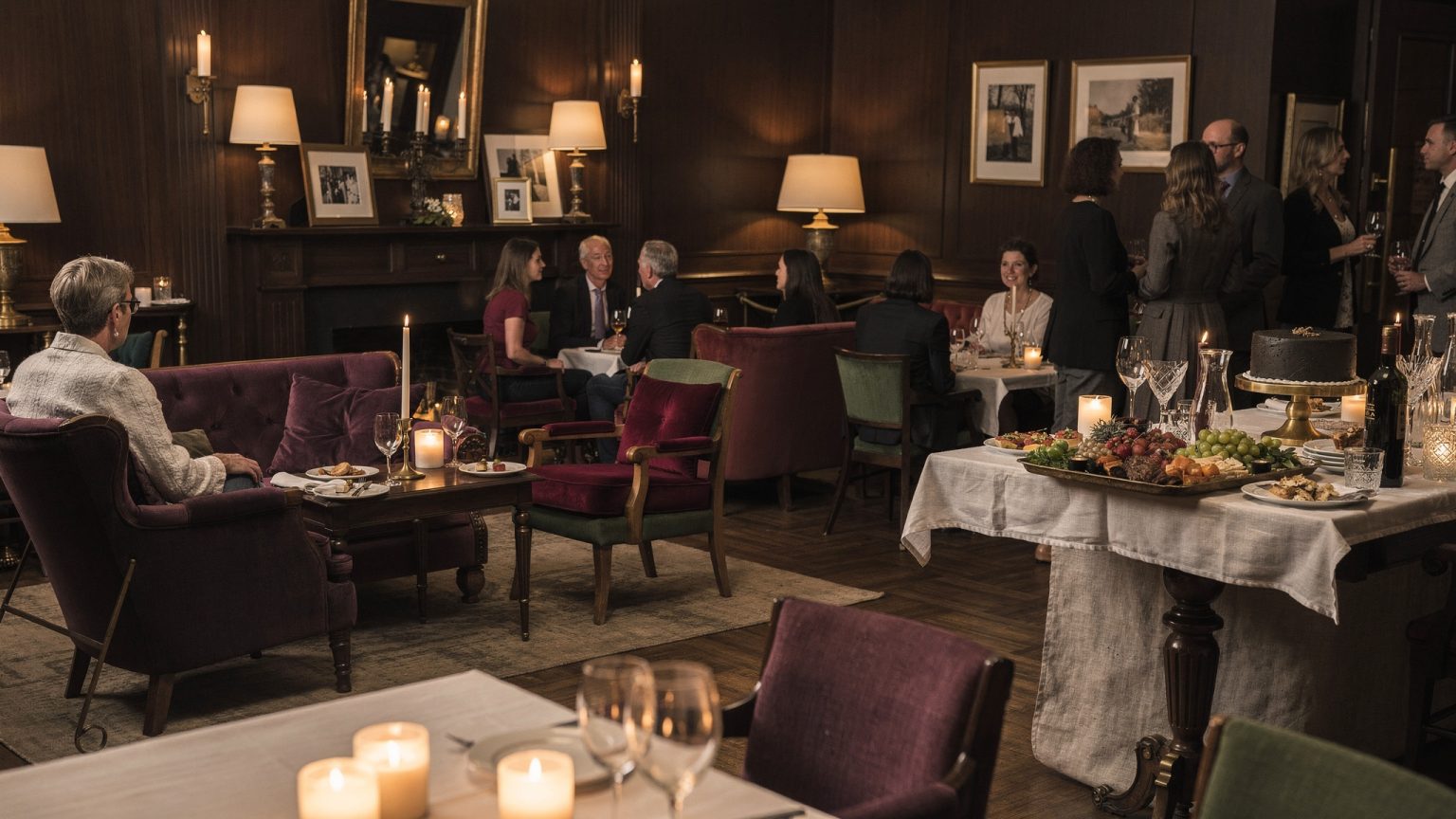
At fifty it becomes a room of standing adults holding drinks and waiting. There are too many relationships present for the couple to narrate the evening personally, and too many years available for any one display to carry them, which is why memory at this size has to become environmental rather than presentational. That is atmosphere doing narrative work.
The good news is that fifty people generate enough social energy for history to live in layers instead of in one compulsory screening. The room only has to belong, unmistakably, to this couple.
Choose the chapter before opening the archive
An anniversary party changes depending on what is being marked. Ten years may feel different from fifty. A couple who has moved through five cities has different material than one whose social world has grown around one neighborhood. A family-heavy guest list has a different rhythm from a room split between friends, colleagues and several generations.
Pick a lens: the places, the table, the music, the people who kept showing up, the things that changed, the things that somehow did not. That lens gives the archive an editor.
Personalization should reveal the people. Printing their names across fifty objects proves only that the printer was working.
Do not put fifty people in front of one giant history wall
One display can be useful. One display carrying every photograph from every year becomes a congestion point with emotional captions.
Spread memory across the room in different densities. A handful of photographs can live near arrival. A few objects or short stories can appear near seating. A playlist can carry whole decades without requiring anyone to read. Food or drink can reference a place or ritual. The cake or dessert can echo a real preference rather than reenact the original wedding unless reenactment is genuinely the joke.
Let guests discover history while the party keeps functioning. Spreading it out is a floor-plan decision, which is why Atmosphere OS holds memory, seating and the running order in one plan.
Use social zones to mix chapters of the couple’s life
Fifty guests will naturally cluster around the people they know. That is fine until the room becomes four unrelated reunions sharing catering.
Build zones that encourage movement without forcing networking. Put drinks where more than one guest group will pass. Use seating clusters large enough to welcome new people into a conversation. Avoid assigning the oldest friends to one table, family to another and newer friends to a third unless the event genuinely needs that separation.
The floor plan should make movement easy enough that curiosity can do some of the introductions.
Let the couple arrive as guests, not as staff
If the couple is greeting every person at the door, checking the bar and answering questions about parking, the party has confused centrality with labor.
Give arrival to someone else. Give the couple enough time to enter the room together and actually see it. If there is a family photograph, schedule it before the social energy becomes impossible to gather, but do not make the couple spend the first hour completing a portrait spreadsheet.
They came to celebrate a shared life, and posting them at opposite ends of a receiving line is a strange way to do it.
Food should feel generous across several generations
An anniversary guest list often spans ages, dietary needs and different ideas about what counts as enough dinner.
If the format is cocktail-style, serve substantial food and make real seating available. If it is a buffet, avoid one access point and one fragile centerpiece in the exact place the line needs to turn. If it is seated, protect conversation and service routes rather than squeezing in one more table because the venue can technically fit it.
Hospitality is not nostalgic work. It happens in the present tense, and it is judged on whether the food is current, edible and within reach of somebody who does not want to cross the room twice for it.
Access points, seat count and service routes all follow from fifty, which is worth settling before the venue starts telling you what fits.
Work fifty through the service plan (opens in a new tab)
Contain the speeches before affection becomes endurance
Anniversary parties attract stories. That is part of their appeal.
Choose a speaker sequence before the microphone appears. Ask for short stories, not summaries of the marriage. A child, sibling, old friend and perhaps the couple themselves can create different angles without producing a chronological documentary.
Use sound that works. Fifty people chatting cannot be called to attention by someone tapping a glass and hoping acoustics respect sentiment.
If the formal remarks matter, give them a real start and end. A timeline should leave room for people, including the person who gets unexpectedly emotional and needs thirty seconds before continuing.
Keep some memories private on purpose
Intimacy is not the same as disclosure.
A party does not need every hard chapter, private joke or family story simply because it is true. Edit with affection. If a photograph or anecdote requires three minutes of context to explain why it is not embarrassing, it probably belongs in the family archive rather than on the bar.
The event should make the couple feel known, not exposed.
Use music as a timeline without making it chronological
Music can connect eras and social groups more gracefully than a visual decade display.
Build the soundtrack from songs that genuinely belong to the couple, plus music that keeps the room alive. A playlist in which every track carries historical significance will be reverent and slightly airless by ten o’clock. A party needs rhythm in the present as well.
If dancing is likely, give it enough room to emerge later. If it is not, do not leave a giant empty dance floor in the center as evidence that the party has failed to become another kind of party.
Give the shared moment one physical shape
At fifty, the event benefits from one point when the room understands itself as a whole.
That can be a toast, a photograph, cake, a song, a short renewal or ritual, or simply the couple saying something brief before dinner. It should fit the people. A renewal of vows is meaningful when desired and painfully theatrical when inserted because anniversaries are apparently required to have programming.
Ritual cues work because they change the room’s attention. Use one where attention is actually worth changing.
Make departure part of the memory rather than the cleanup
Older guests may leave earlier. Families with children may leave after dessert. Close friends may stay much later.
Do not save the only meaningful thank-you for the end. Keep coats easy to retrieve and transport clear. If there are photographs or a small takeaway, make pickup simple enough that it does not create a final line beside the exit.
The party should taper toward the people who want to remain rather than collapse the moment the formal program ends.
Measure success by what people talk about with each other
The strongest anniversary party does not leave guests saying that the photo display was comprehensive.
It leaves them telling each other stories: remembering a place, meeting someone from another chapter, noticing a detail that could only belong to this couple, hearing one story they had never heard, watching the couple actually spend time together.
At fifty guests, memory needs architecture, service and editing. What it can never have is completeness. Forty years does not fit inside one evening, and that is a limit of the form rather than a failure of the planning. The relationship already lasted. The party is not being asked to prove it minute by minute.
Fifty is a forgiving size for memory work. At a hundred and fifty the same editing problem becomes a timing problem, which is a harder evening and a different set of thresholds.
Field notes and corrections
When a number here turns out to be wrong, you hear about it.
Three things arrive and nothing else. The new field note — bar rates, cover widths, service clearances, the arithmetic worked through on one real evening. A line when a World opens, because a night only goes up once it can actually be thrown. And a correction whenever a rule in the published rulebook changes, or a number the tools rely on turns out to have been wrong. There is no weekly slot, because there is nothing weekly to put in it.
One email per field note or opening, plus corrections when a published figure moves. Unsubscribe from any of them.
Continue through the system
Pretty is still not a plan.
A party gets planned in roughly this order. Pick the chapter where your next problem lives.
What you have to decide next
One decision constrains the next. This is the order they actually happen in.
More in this chapter

See the complete five-chapter Event Design Intelligence map →