Occasions & Formats
The Garage Is the Biggest Room You Own. Stop Apologizing for It.
A garage party works when the room is treated as a real temporary venue: clear the hazards, control the threshold, build warmth with light and furniture, and stop trying to disguise what the room is.
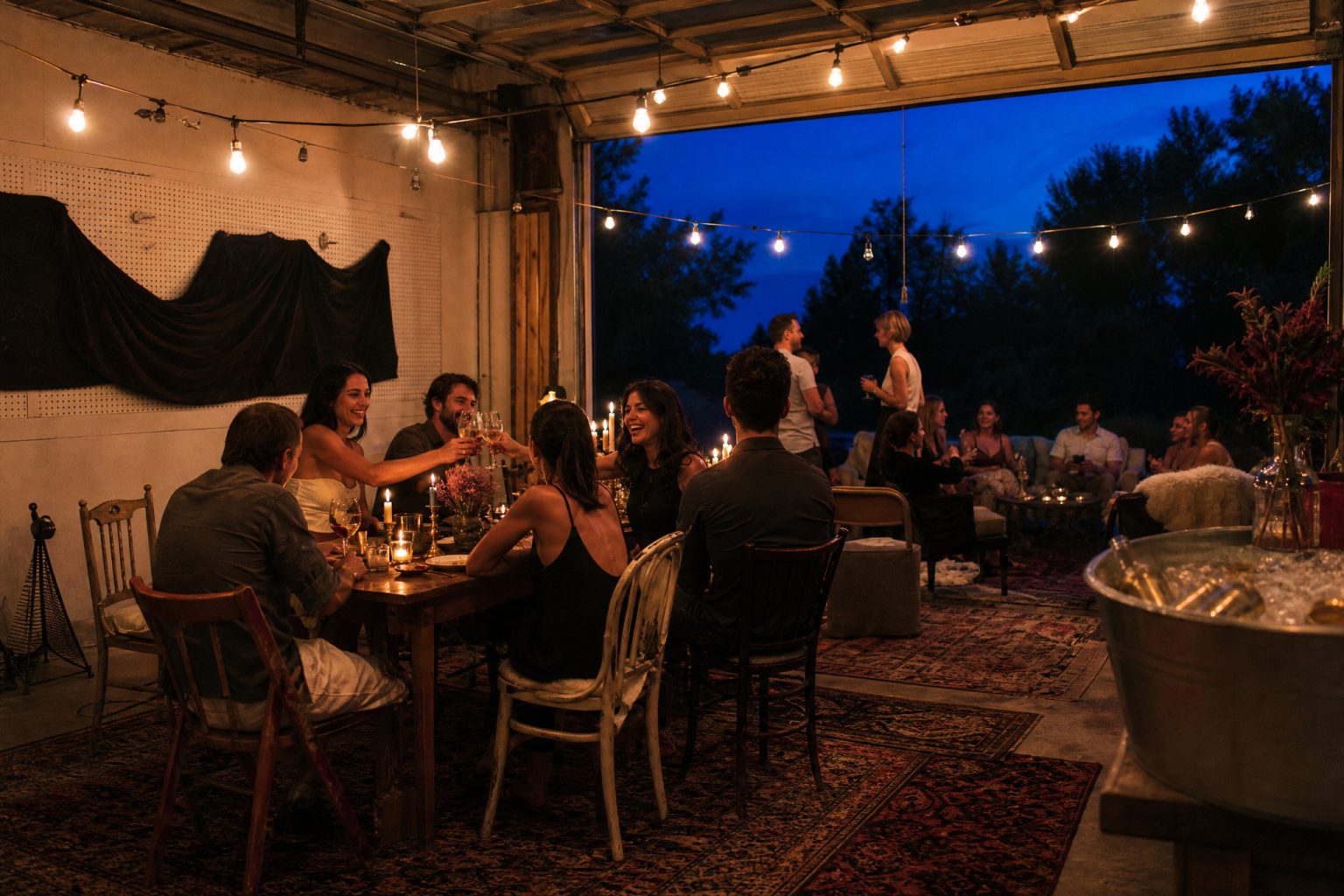
The garage has a branding problem.
It is usually one of the largest open rooms attached to the house, it has a door wide enough to move furniture through, it can tolerate a little noise, and half the time we talk about using it for a party as though the guests have been sentenced there.
That apology is what makes a garage event bad. The folding chairs arrive. Somebody hangs fabric over the shelving with the nervous energy of a witness-protection program. A portable speaker appears on a workbench. The host keeps saying, ‘Sorry, we’re in the garage.’
No. If the garage is the right room, make it the room on purpose.
First, remove the things that make it a garage in the dangerous sense
This is not the fun paragraph, which is exactly why it goes first.
A garage may contain fuel, solvents, tools, sharp equipment, lawn chemicals, batteries, cords, vehicles and heating equipment that were never invited to a party. Put hazardous materials away securely. Move vehicles out. Clear the floor completely enough that nobody is stepping over extension cords or navigating around a snowblower with a drink in hand.
And do not improvise with combustion for warmth. The U.S. Consumer Product Safety Commission warns against operating generators, charcoal grills and other gasoline or fuel-burning equipment in garages because carbon monoxide can build to lethal levels even when doors or windows are open. If the temperature cannot be made comfortable with equipment that is actually designed and installed for the space, the garage is not the venue that night.
A space heater is not a ventilation plan. Neither is ‘we’ll crack the door.’
The door has three settings and somebody has to pick one
Decide what that enormous opening is doing during the event.
Fully open can turn the garage into a covered extension of the driveway or yard. That is excellent when weather and temperature cooperate. Half-open tends to create an awkward visual line and a very efficient draft. Closed gives you a more contained room, but then lighting, ventilation, sound and comfort need to work without borrowing from outside.
The answer can change during the evening. An open arrival can make the space feel generous and obvious. Later, if conditions allow and the room is safe to close, bringing the door down can create a surprising second act.
But someone needs to own that transition. Do not stack a bar, floral arrangement and six coats in front of the door track and then discover at 8:30 that your architectural flourish has been administratively canceled.
Leave some garage visible
A temporary event gets strange when it tries too hard to deny the room it is in.
You do not need to drape every wall. In fact, please do not. Fabric hung badly around a garage can create its own safety and access problems while also making the room look like a school dance that lost funding midway through setup.
Use what helps: a clean concrete floor, exposed structure, one organized workbench, the broad door opening, a row of utility lights switched off in favor of better event lighting. Then add enough softness and intention that the room has changed modes.
A large rug can define a conversation zone if it lies flat and does not create a trip edge. Real chairs beat an army of matching folding chairs if comfort matters. One strong table can carry food or drinks. Plants in substantial containers can soften the edge without pretending there is suddenly a conservatory beside the lawn mower cabinet.
The garage should look transformed, not embarrassed.
Light the people, not the storage shelves
Most garage lighting is excellent for finding a missing screw and less excellent for making anyone want to linger.
Turn off what makes the room feel clinical if you have safe alternatives. Bring light down toward human height with fixtures intended for the environment and placed where cords will not become a circulation problem. Wash one wall. Light the table. Let the far edge recede a little.
Do not make the whole room uniformly bright just because you can. A large open rectangle needs hierarchy or it reads exactly as what it was at four o’clock: empty floor area.
If the garage opens to the yard, let the light tell guests whether outside is another active room or simply the dark place beyond the party. Ambiguity is how three people end up standing by the recycling bins because they thought that was where cocktails continued.
The floor is doing more work than the decor
Concrete is durable, but it is hard, cold underfoot in some conditions and acoustically lively. You do not have to cover it all. You do have to understand what several hours on it will feel like.
Give guests places to sit that are actually comfortable. Break one large room into smaller social distances rather than pushing every chair to the perimeter. If people will stand, scatter useful landing surfaces for drinks instead of assuming everyone enjoys carrying a glass for two hours.
And test the sound after the furniture is in. A bare garage can throw conversation back at itself. More bodies help. So do soft materials in sensible places. Volume is not the repair for a room that already feels loud.
Keep the service path brutally simple
The garage’s great advantage is space. Do not spend it all on guests and leave the host squeezing through a side door with a tray.
Choose one edge for service. Food arrives there. Empties leave there. Trash and recycling live there without becoming a scenic feature. Extra ice, water, napkins and whatever else will be needed after the first hour belong on that side too.
And that’s how the garage outperforms the living room. It can have a backstage and a front-of-house at the same time.
Use the luxury.
Do not overfill the biggest room
There is a peculiar urge to see open square footage and immediately rent more furniture.
Resist it.
A garage becomes interesting when there is room around the idea. One long table. A lounge and a drinks station. A workshop party with a central making surface. A neighborhood supper with the door open to the street side and a clear indoor anchor. Pick the version and let empty space help it.
The garage is not automatically casual, industrial, rustic or cheap. It is simply a large, practical shell with some constraints you need to take seriously. That can become a very good party.
Just do the safety work first, then have the nerve to leave a little concrete showing.
Safety source: U.S. Consumer Product Safety Commission, Carbon Monoxide Fact Sheet.
Related reading: The Venue Coordinator Is Not the Event Planner · A Tent Is a Venue You Have to Build · Lighting That Still Works After the Room Fills
Atmosphere OS · Moodboard-to-Plan
A board full of beautiful rooms is not a plan for yours.
Moodboard-to-Plan works out which quality is doing the emotional labor in the reference and what that quality costs to run in a real room on an ordinary night. The rulebook names the parts it deliberately leaves to taste.
Costs come back as indicative bands rather than quotes, and seasonal notes are filters rather than promises.
Field notes and corrections
When a number here turns out to be wrong, you hear about it.
Three things arrive and nothing else. The new field note — bar rates, cover widths, service clearances, the arithmetic worked through on one real evening. A line when a new World or Mini Occasion opens, because a night only goes up once it can actually be thrown. And a correction whenever a rule in the published rulebook changes, or a number the tools rely on turns out to have been wrong. There is no weekly slot, because there is nothing weekly to put in it.
One email per field note or opening, plus corrections when a published figure moves. Unsubscribe from any of them.
Continue through the system
Pretty is still not a plan.
A party gets planned in roughly this order. Pick the chapter where your next problem lives.
What you have to decide next
One decision constrains the next. This is the order they actually happen in.
More in this chapter

See the complete five-chapter Event Design Intelligence map →