Budget & Trade-Offs
What Does It Cost to Hang the Flowers Instead of Putting Them on the Table?
Hanging flowers do not cost more because gravity is glamorous. They add mechanics, access, rigging coordination, skilled installation, lift time, venue approvals and strike. Compare the room-level gesture with the table-level alternative before pricing stems.
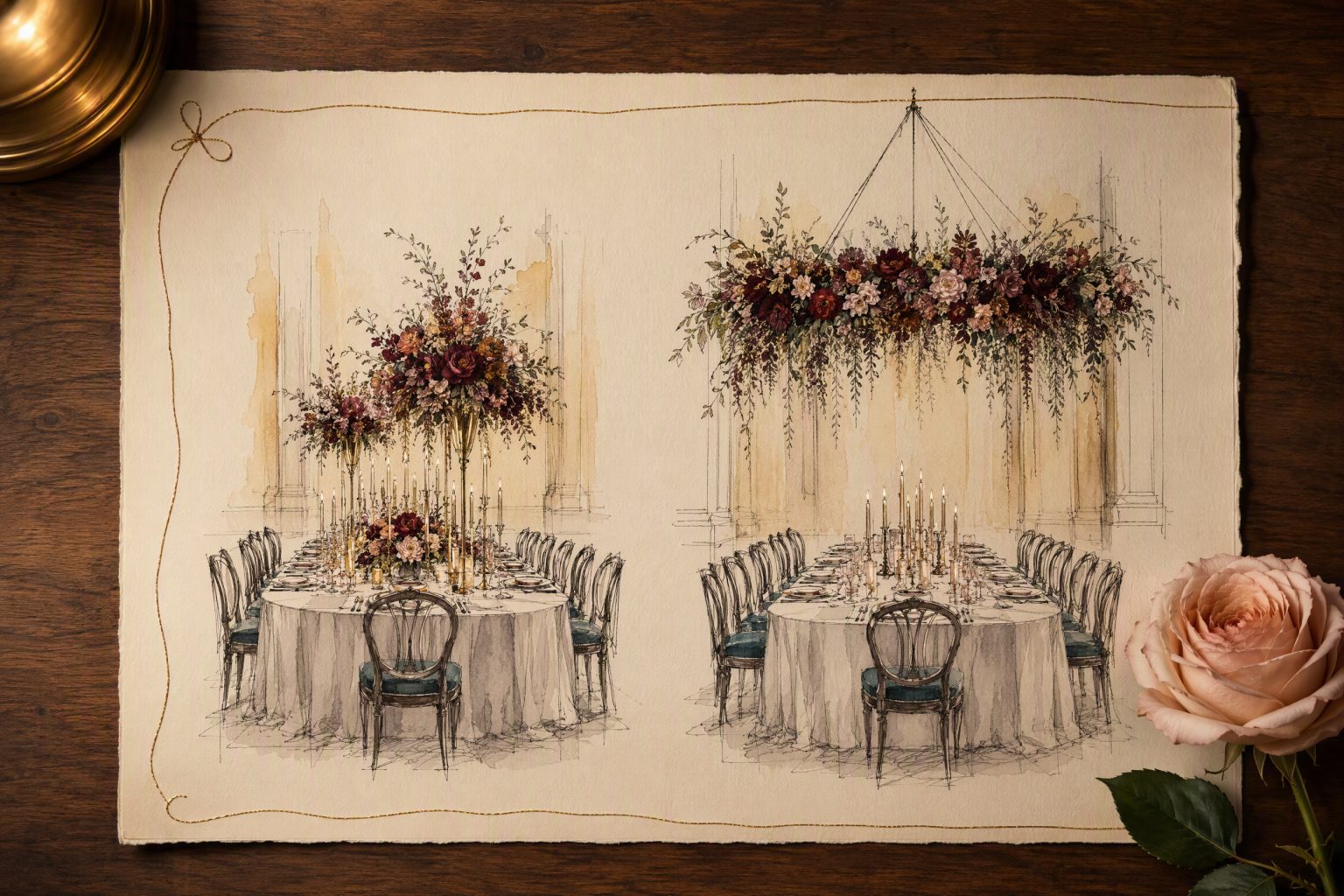
Putting flowers on a table is a floral decision.
Putting flowers over the table is a floral decision that has acquired a production department.
That does not make hanging flowers a bad idea. Quite the opposite. A strong overhead installation can do more to a room than twenty-five small centerpieces politely repeating themselves at waist height.
But the budget comparison has to be honest.
You are not choosing between ‘flowers here’ and ‘flowers there.’
You are choosing between two different productions.
The short answer
Hanging florals get expensive when the design moves from floral material into attachment, access, mechanics, skilled labor and compressed installation time.
What follows prices floral design plus the extra production that suspension creates. It is not a universal wedding-flower budget, because every installation depends on venue, scale, material, access and how the quote is built. The public florist pricing was reviewed in September 2026, and the worked comparison uses one current Northeast U.S. guide.
Watch the approved attachment and the installation window. If either one changes, the labor and equipment plan can move faster than the stem count ever will.
The first cost difference is not flowers
A low centerpiece needs a vessel, mechanics, material, design labor, transport and placement.
A hanging installation may need all of that plus structural or rigging coordination, an approved attachment method, overhead access, lifts or ladders appropriate to the work, fall-protection procedures where required, more crew, longer setup, floor protection, exclusion zones during installation and a strike plan that works after the event ends.
The exact requirements belong to the venue and appropriately qualified floral, rigging, production and safety professionals.
The editorial point is simpler:
Once the flowers leave the table, price the method of keeping them there.
This is why Mechanics Before Romance exists. The floral gesture and the mechanical problem arrive together.
A current published price guide makes the difference visible
CV Flowers’ current pricing guide for Rhode Island, Massachusetts and Connecticut lists low table centerpieces starting at $150, tall table centerpieces at $350, and hanging installations at $75 per square foot and up. The studio also states that its full-service events begin at a $7,000 floral investment and that season, quantities, design complexity and day-of logistics affect the final price.
That one page is useful because it prices the two design directions using the same business, same regional context and same published guide.
It still is not your quote.
It is enough to show why the comparison needs square footage and installation conditions rather than a sentence about hanging flowers being ‘more expensive.’
A worked comparison: twelve tables or one overhead gesture
Take a fictional reception with twelve dining tables.
Using CV Flowers’ published starting figures purely as a September 2026 Northeast planning example:
12 low centerpieces × $150 starting price = $1,800 starting table-floral line.
Now suppose the alternative design proposes an eighty-square-foot hanging floral installation.
80 square feet × $75 starting price = $6,000 starting hanging-installation line.
That is a $4,200 difference before deciding whether the overhead design still needs any table flowers at all, and before any project-specific items that are not included in the published line-item price are known.
12 low centerpieces × $150+
$1,800+ starting floral line
80 sq ft × $75+
$6,000+ starting floral line
$6,000 − $1,800
$4,200+
This is not a quote or a universal ratio. It is a worked example using one florist’s published current starting prices so the design trade-off can be seen.
The number is useful for one reason: it puts a real scale on the sentence ‘let’s hang the flowers.’
But it does not answer whether the overhead version is worth it.
That is a design question.
An overhead installation may replace more than centerpieces
The bad comparison is twelve centerpieces versus one hanging installation while leaving the rest of the room identical.
The better question is what the overhead gesture allows you to remove.
If the installation creates the entire visual architecture of dinner, perhaps the tables can become candle-led with smaller floral accents. Perhaps the bar needs less floral work because the ceiling gesture already carries the room. Perhaps the ceremony installation can move into a secondary role rather than competing with dinner.
That is the whole argument of Every Table Looks Like the Idea After a Hard Afternoon.
The design should protect the strongest gesture rather than keep every floral touchpoint and simply add one more expensive thing above everyone’s head.
A ceiling installation is not a surcharge on the old floral plan.
It should be allowed to rewrite the floral plan.
The square-foot price is only one layer
Another current 2026 florist source illustrates why published ranges spread so widely. Plant Girl Floral’s 2026 ceiling-installation guide puts basic hanging greenery installations around $2,000–$4,000 and elaborate floral chandeliers or broad ceiling coverage around $8,000–$20,000+, specifically citing engineering, labor, safe rigging, scale, mechanics and setup/teardown time as major price drivers.
Those ranges are not directly comparable with the CV Flowers square-foot guide. Different studios, different markets, different scopes.
That difference is the lesson.
‘Hanging installation’ is not a standardized product.
A six-foot greenery cloud suspended from an existing approved point is not the same job as a dense floral canopy spanning the dance floor with custom support and overnight strike.
Price the attachment condition before the flower recipe
The first expensive question is often not ‘which flowers?’
It is ‘what can this legally and safely attach to?’
Some venues have established rigging points and approved procedures. Some require house riggers or approved vendors. Some prohibit attachment to ceilings or historic surfaces. Some can support certain loads only in defined locations. Some need a freestanding support system instead.
Do not infer structural capacity from architecture or previous photographs.
Get the venue’s rules and the qualified professional review required for the actual installation.
Venue Restrictions Nobody Reads Until the Flowers Arrive is not being dramatic when it puts attachment early. The attachment condition can change the entire design.
Access equipment is part of the floral budget even when it contains no flowers
If the work is overhead, somebody has to reach it.
That may mean ladders for small low-risk work, or lifts/scaffolding/other access equipment selected and used by qualified professionals under the venue and work requirements.
Then ask whether the equipment can physically enter the room.
Door dimensions. Elevator dimensions. Floor load and surface protection. Operating hours. Guest areas. Other vendors trying to work underneath.
A lift that cannot get through the service door is not access equipment. It is a very expensive object in the loading dock.
The installation window can cost more than a richer flower
Suppose a crew can normally install an overhead design in an eight-hour daytime window.
Now the venue gives access at 3:00 p.m. and requires the room finished at 7:00.
The floral concept did not change.
The labor model might.
More crew, parallel work, preassembly, additional equipment, a different mechanic or a smaller scope may be required. The quote has to absorb the compressed window somehow.
Plant Girl Floral’s current guide explicitly lists setup and teardown timing among the major cost drivers for ceiling work. That is the part a flower-count comparison misses.
Sometimes the cheapest floral substitution is four more hours in the room.
Strike deserves its own quote line
An installation does not stop costing money when the photographer gets the final shot.
It has to come down.
If the venue requires strike immediately after the event, the same access equipment, qualified crew, loading path and safety constraints may return at midnight when everyone would rather be somewhere else.
The Floral Strike Plan Belongs in the Design for exactly this reason.
Ask:
- When can strike begin?
- When must the room be clear?
- Can access equipment remain on site?
- Which vendors need the same dock or elevator?
- Where do removed mechanics and wet floral material go?
- Who owns disposal, recycling or returnable mechanics?
The most romantic ceiling in the world eventually becomes a load-out problem.
Plan for the second version too.
Fresh flowers are not always the expensive part
For an overhead gesture, a florist may use greenery, branches, dried or preserved material, fabric, structural forms or other materials where appropriate to achieve volume without covering every square inch in premium blooms.
That can reduce floral-material spend.
It does not automatically reduce installation cost.
A lighter-looking design can still require the same access, attachment approvals, crew and strike window.
This is why ‘we will use more greenery to save money’ needs one more sentence:
Which part of the quote does that actually reduce?
If material is 30% of the problem and installation is 70%, shopping for a cheaper flower is not where the budget lives.
Hanging flowers buy a different kind of reach
Table flowers affect the guests nearest the table.
Overhead work can affect the entire room at once.
It changes perceived ceiling height. It creates a focal center. It can make a generic tent feel specific. It can turn a dance floor into a destination without filling the floor with objects. It photographs from multiple directions because the gesture is architectural rather than local.
That room-level reach is why the comparison cannot be reduced to ‘$6,000 overhead versus $1,800 centerpieces, therefore centerpieces win.’
If the $6,000 gesture does the work of centerpieces, bar florals, ceiling décor and part of the lighting concept, the budget comparison changes.
If it is simply added on top of all of those things, it is an expensive extra.
Pricing ambition is not the same as being against it.
It just insists the ambition have a job.
The strongest budget move may be partial overhead
Full ceiling coverage is not the only version.
One installation over the dance floor. A floral line above one long table. A suspended piece over the bar. A cluster over the entrance. A small number of architectural moments can produce the vertical gesture without asking the entire room to participate.
That lets the design put money into the place where overhead scale actually changes the atmosphere.
It also gives the venue and installation team a smaller mechanical problem to solve.
Sometimes the sophisticated version of a huge idea is a smaller area with a clearer job.
Use a delta budget, not a separate fantasy budget
When deciding whether to move flowers overhead, make two complete floral versions.
Version A · Table-led
- centerpieces;
- bar/entry florals;
- ceremony florals;
- candles and supporting décor;
- delivery/setup/strike.
Version B · Overhead-led
- hanging installation;
- reduced or redesigned table florals;
- whatever supporting pieces remain necessary;
- attachment/rigging/access/equipment lines quoted for the real venue;
- delivery/setup/strike.
Then compare the total difference.
That delta is the price of moving the visual center of gravity upward.
It is much more useful than asking a florist what ‘hanging flowers cost’ in the abstract.
Before you move the flowers up
Compare the complete overhead-led floral version with the complete table-led version, not with a national average that knows nothing about your venue. Published florist guides can tell you the starting scale; the decision needs a project-specific quote from the florist and the venue or production team.
Then change the approved attachment, the access equipment or the install and strike window before you touch the flower variety. If the number moves more, the mechanics own the budget, not the blooms.
The flowers can float. The cost cannot.
Hanging flowers are expensive in exactly the way many worthwhile event ideas are expensive: the visible thing asks several invisible systems to cooperate.
That is not a reason to keep everything on the table.
It is a reason to decide whether the room-level effect is important enough to earn the attachment, access, labor and strike it requires.
If it is, protect it. Reduce weaker floral repetition. Give the installation enough room and enough budget to actually be the idea.
If it is not, put the flowers where people can see them, smell them, talk across them and enjoy the fact that gravity is doing the rigging for free.
Anything going overhead needs venue approval and a real review by the riggers and structural people responsible for it. Do not infer attachment capacity, rigging method or allowable load from this article, and certainly not from a photograph of somebody else’s event.
Space Lab
Build the room once. Keep testing it.
Space Lab keeps dimensions, ceiling, obstacles, published capacity and their evidence basis together in one room record, then uses that same room for fit, clearance, flow, turnover, comparison and site-visit questions.
It shows planning estimates as estimates and keeps legal occupancy, venue approval and other authority decisions outside the calculator.
The column
What It Costs
The money question answered structurally: what you are actually buying, what drives the number up, and what can be cut without losing the idea. Cost models, not price lists.
Field notes and corrections
When a number here turns out to be wrong, you hear about it.
Three things arrive and nothing else. The new field note — bar rates, cover widths, service clearances, the arithmetic worked through on one real evening. And a correction whenever a rule in the published rulebook changes, or a number the tools rely on turns out to have been wrong. There is no weekly slot, because there is nothing weekly to put in it.
One email per field note, plus corrections when a published figure moves. Unsubscribe from any of them.
Continue through the system
Pretty is still not a plan.
A party gets planned in roughly this order. Pick the chapter where your next problem lives.
What you have to decide next
One decision constrains the next. This is the order they actually happen in.
More in this chapter


See the complete five-chapter Event Design Intelligence map →