Atmosphere
How to Build Deliberate Floral Chaos Without Making a Mess
Loose, asymmetrical flowers look effortless. The ones that survive the night had a silhouette decided before a single stem went into the vessel.
Loose, asymmetrical flowers look effortless. They are not.
The arrangements that actually hold together when real people move around the table have invisible structure underneath. The ones that fall apart mid-event are the ones that started with “let’s just make it wild” and stopped there.
Deliberate floral chaos is a design problem, not a spontaneous gesture. It requires a clear silhouette, controlled repetition, real mechanics, protected air, and color discipline. Without those, the result is usually congestion or collapse rather than the free, alive feeling that was intended.
If you want the object-by-object build after the design logic is clear, continue with A Recipe for Deliberate Floral Chaos.
Start with a silhouette, not a stem count
Before a single stem goes in, decide the overall shape the arrangement will read from ten feet away. One strong diagonal. A low cloud with a few vertical punches. A clustered mass that leans in a consistent direction. Whatever it is, it has to be legible as a shape first.
If you cannot describe the silhouette in one sentence, the arrangement will look accidental instead of intentional. The eye needs a clear large-scale read before it enjoys the smaller details.
Deliberate floral chaos is a design problem, not a spontaneous gesture.
Sketch it roughly if needed. The silhouette is the architecture. Everything else is cladding. It is the same logic as building a room around one strong gesture.
Repeat, but never evenly
Real wildness still has patterns. Choose two or three elements — a particular leaf, a color, a texture, a flower type — and let them appear more than once, but place them at uneven intervals and heights. The eye reads repetition as order even when the placement is irregular.
This is the difference between “designed loose” and “someone dumped the bucket.” Even distribution reads as formal. Clustered, uneven repetition reads as natural while still feeling composed.
Avoid the temptation to use every interesting stem exactly once. That produces visual noise rather than rhythm.
Give the mechanics real strength
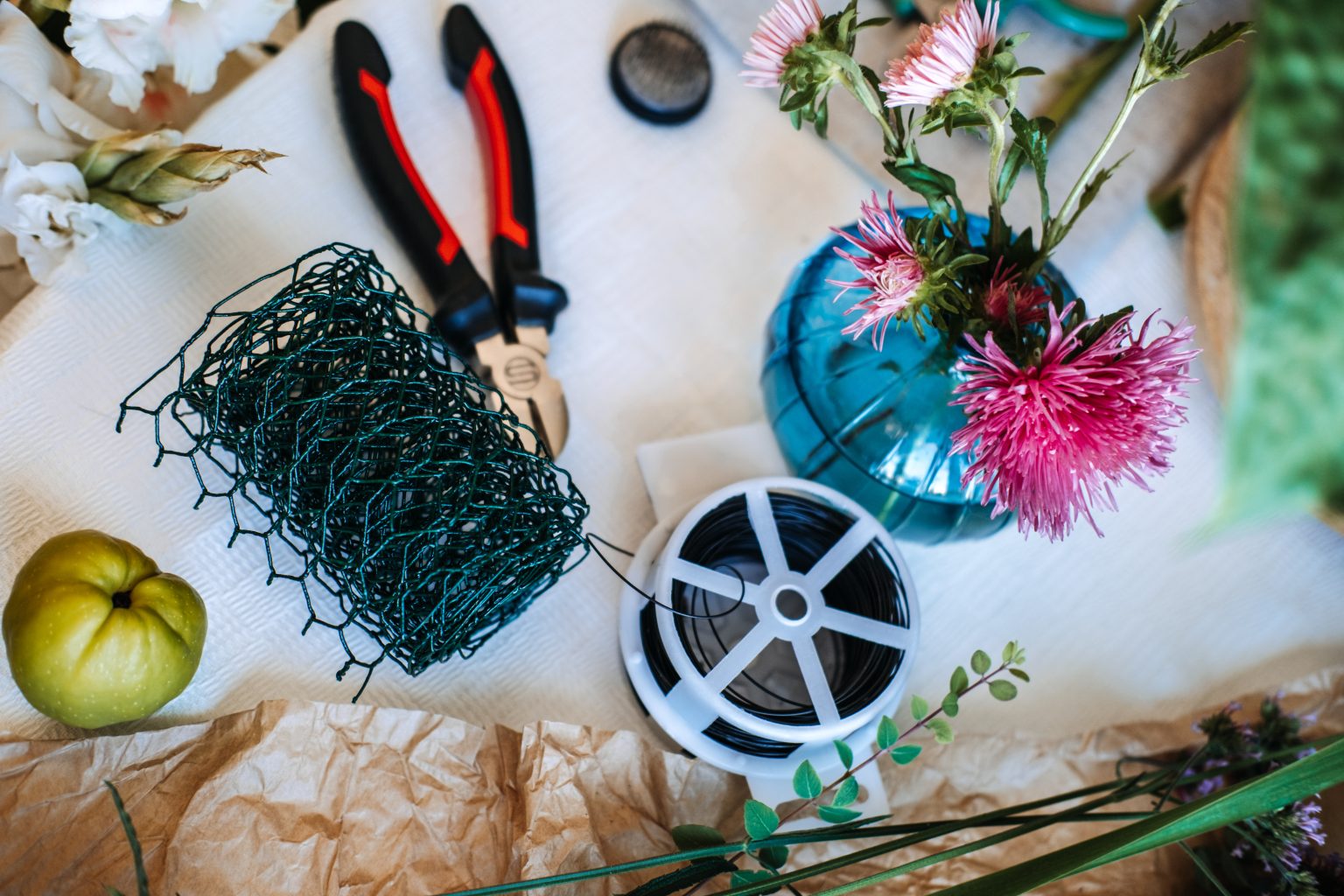
Chicken wire, a taped grid, a heavy pin frog, or a well-built armature are not the enemy of the aesthetic. They are the only reason the aesthetic survives the first guest who bumps the table or the first server who reaches across.
Build the structure so it can hold more weight and movement than you think you need. Then hide it completely. The flowers should look like they are floating or growing. The mechanics should be invisible and slightly over-engineered.
Test the structure before the final stems go in. If it flexes or shifts under light pressure, reinforce it. A beautiful arrangement that collapses when someone leans in is not beautiful for long.
Leave air on purpose
The most common failure in “wild” arrangements is packing every inch. Real growth has negative space. Decide where the arrangement will breathe and protect those gaps. A few deliberate empty zones make the dense parts feel richer and keep the overall shape readable.
If every stem is touching another stem, it is not chaos. It is congestion. Congestion reads as unfinished or overworked rather than free.
Protect the air the same way you protect the silhouette. Once it is gone, the arrangement loses both clarity and life.
Color discipline still applies
You can use ten kinds of flower and still keep a clear color story. Limit the palette so the eye does not have to work. One dominant family, one or two accents, and plenty of green or neutral to hold it together. Uncontrolled color is the fastest way to make deliberate chaos look like a mistake.
If every stem is touching another stem, it is not chaos. It is congestion.
Value and temperature matter as much as hue. A mix of lights and darks, or warm and cool notes within a restrained family, creates depth without noise. Random color usually flattens the arrangement instead of enlivening it.
Test the movement
Once it is built, give the vessel a firm shake. Walk past it hard. Have someone sit down and stand up next to it. If anything shifts more than a fraction, reinforce or remove. The test is not gentle. The real world will not be gentle. Heat, water, and hours of handling all change how the material behaves after you leave.
Also check the arrangement from seated height and from the main approach angles. What looks balanced from above or from the side may block faces or look top-heavy from the positions that actually matter. Height is the difference between a centerpiece and a wall.
Scale and proportion to the table
Even a well-built wild arrangement fails if it is simply too large for the surface or the room. Leave real clearance for plates, glasses, and arms. If the arrangement forces service or conversation to negotiate around it, the scale is wrong regardless of how good the internal structure is.
In tight settings, favor lower mass or high-and-narrow forms that occupy less horizontal space. In generous settings, the silhouette can expand, but the same rules of air, repetition, and mechanics still apply.
What deliberate chaos is not
It is not the absence of control. It is control applied so carefully that it disappears. The viewer should feel the wildness. You should know exactly where every stem is anchored and why the overall shape holds.
It is also not a license to skip the mechanics or the editing. The most convincing “effortless” arrangements are usually the ones that received the most invisible work.
Then step back and let it look like it just happened. When it works, the arrangement feels alive rather than arranged, and it is still standing at the end of the night.
Atmosphere OS · Theme Atelier
Where the feeling stops being a photograph.
Theme Atelier converts a direction into a documented design system with the lighting and material consequences attached. It runs in your browser and stays there until you decide the project is worth saving.
Free to use, local-first in your browser, and there is no account until you ask for one.
Field notes and corrections
When a number here turns out to be wrong, you hear about it.
Three things arrive and nothing else. The new field note — bar rates, cover widths, service clearances, the arithmetic worked through on one real evening. And a correction whenever a rule in the published rulebook changes, or a number the tools rely on turns out to have been wrong. There is no weekly slot, because there is nothing weekly to put in it.
One email per field note, plus corrections when a published figure moves. Unsubscribe from any of them.
Continue through the system
Pretty is still not a plan.
A party gets planned in roughly this order. Pick the chapter where your next problem lives.
What you have to decide next
One decision constrains the next. This is the order they actually happen in.
- Venue Will this room hold it? The Serpentine Table Is Eleven Percent Longer Than the Spec Sheet Says
- Guest experience How will guests move through it? The Place Setting Fits. The Person Does Not.
- Production How does it get built and run? The Event Needs a Failure Mode That Still Looks Intentional
- Vendors Who owns each handoff?
More in this chapter



See the complete five-chapter Event Design Intelligence map →