Occasions & Formats
The Culinary Tasting Passport: Interactive Food Without Turning the Event Into a Kitchen
Plan an interactive culinary event for 20 to 400 guests using tasting passports, demonstrations, assembly stations, dietary routing, food-safety ownership, staffing, budgets, and service flow.
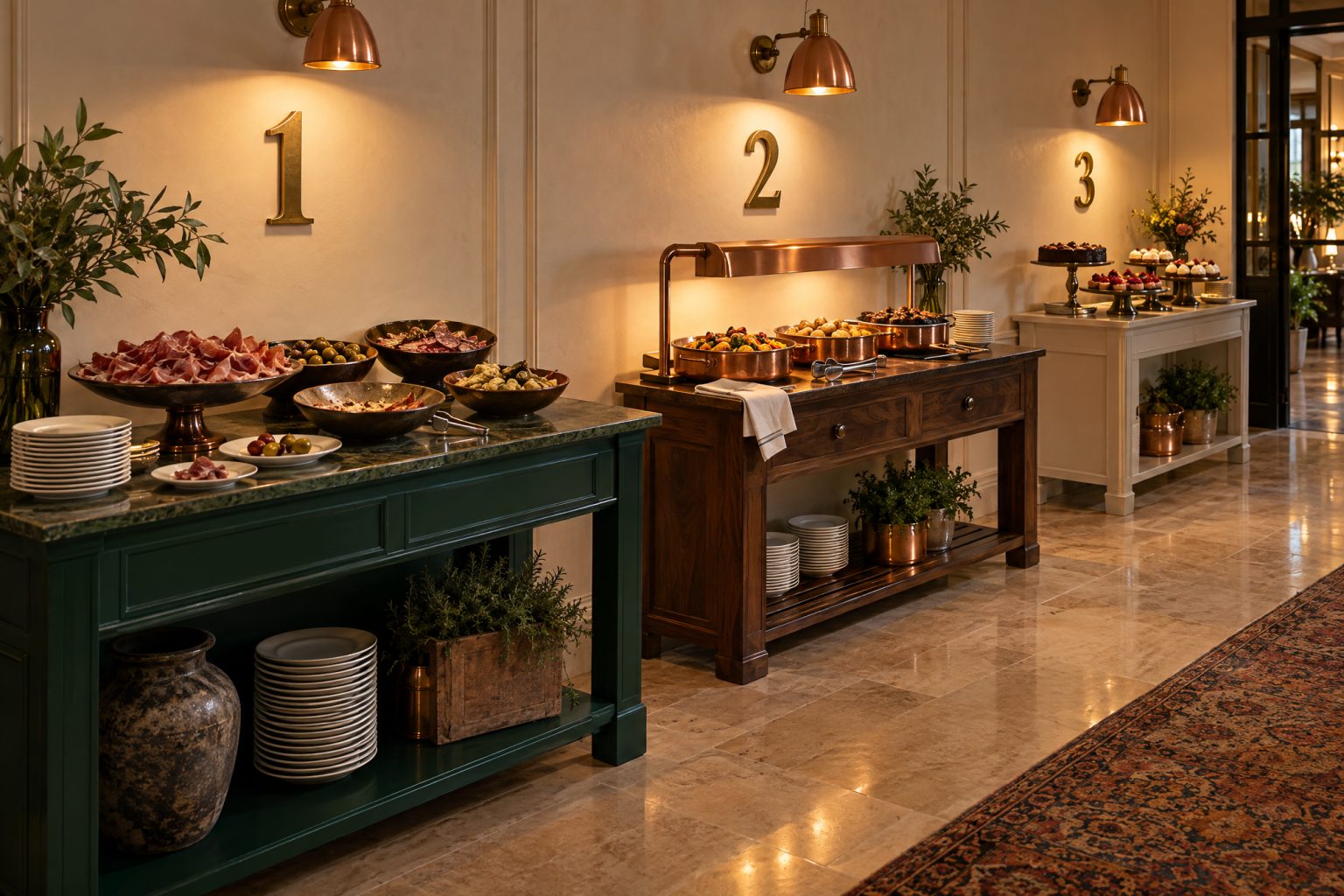
Interactive Events · Taste
At 400 guests, do not scale the cooking class. Scale the culinary experience. It’s the difference between a lively tasting market and a ballroom full of people waiting for access to one demonstration burner.
Food is already participatory. Guests choose, compare, smell, taste, assemble, vote, linger and go back for the thing they liked better than they expected. The design job is to make those actions legible and generous without turning dinner into unpaid prep work.
Eventbrite has reported strong growth in food-led gatherings and specialized cooking experiences. At the same time, current culinary-event providers make the operational ceiling clear: intensive hands-on cooking works beautifully for smaller groups, while larger formats shift toward stations, demonstrations and reception-style participation. Call it the format getting honest about the room.
Give every station one meaningful action
A tasting passport works best when each stop asks the guest to do one thing well: build a garnish, choose a spice blend, compare two preparations, assemble a small bite, identify an aroma, finish a plate, taste a regional variation, pair a nonalcoholic drink, vote on texture or watch one short technique demonstrated close enough to actually see it.
At 400 guests, do not scale the cooking class. Scale the culinary experience.
One meaningful action is enough. Guests do not need to dice, sauté, plate, photograph, scan a code and answer a quiz before they are allowed to eat a two-bite tart.
Scale: hands-on changes before the food does
| Guests | Best hands-on model |
|---|---|
| 20–40 | Full hands-on class is possible |
| 40–80 | Teams or rotating stations |
| 80–200 | Demonstration + assembly + tasting |
| 200–400 | Culinary market / passport with 6–12 stations |
At 200 to 400 guests, the station is the unit. Build several high-throughput experiences with clear identities and enough service capacity that the room feels abundant rather than rationed. The station throughput numbers will tell you how many stations that actually is.
Station count, portions per station and the length of the reset window all come off the headcount, which a caterer will quote against without ever showing you the arithmetic.
Work four hundred through the station map (opens in a new tab)
Guest flow
Food safety needs one named owner
Interactive food is still food service. Someone needs explicit responsibility for sanitation, handwashing, hot and cold holding, allergen information, cross-contact controls, waste, bussing and the boundary between guest activity and professional prep. Put that owner’s name in the contract, alongside the rest of your vendor operations.
At large scale, I would limit guest interaction with open flame, raw proteins, high-risk knife work and anything that requires precise temperature control unless the venue and culinary team have designed a supervised station around it. The fun is not improved by giving 400 people access to chef knives because the word “interactive” appeared in the brief.
Dietary needs should be built into the station map. Clearly identify which stops are appropriate for common restrictions, what substitutions exist and where cross-contact is possible. A guest should not need to interrogate every station lead from scratch.
Remember that guests only have two hands
Do not make every guest carry a plate, glass, passport, phone and utensil at the same time. Humans remain disappointingly limited to two hands.
Provide standing ledges, cocktail tables and seated eating surfaces. Put waste and bussing where people naturally finish. If a passport is important, make it compact enough to tuck away or use a wristband, card or digital record that does not become another object to juggle.
Run of show
| Time | Action |
|---|---|
| 0:00–0:20 | Arrival, passport pickup, dietary orientation |
| 0:20–0:30 | Chef welcome / demonstration |
| 0:30–1:30 | Open stations, first wave |
| 1:30–1:40 | Reset / feature demo |
| 1:40–2:25 | Second station period |
| 2:25–2:35 | Voting / final tasting |
| 2:35–2:45 | Reveal / closing service |
The reset window earns its ten minutes. That is when depleted mise en place, serving pieces, sanitation, trash and service temperature get corrected before the second half of the room notices.
Budget: ingredients are only the beginning
| Production level | Planning allowance | Scope |
|---|---|---|
| Lean | $4,000–$10,000 | Tasting/demo format with limited stations |
| Professional | $15,000–$35,000 | 4–8 interactive stations, culinary crew, service support |
| Large premium market | $40,000–$90,000+ | 250–400 guests, premium ingredients, 8–12 stations, extensive back-of-house and service |
Those are planning allowances rather than published industry averages. Culinary labor, ingredients, kitchen infrastructure and service multiply quickly. One current hands-on culinary provider lists programs around $200 per person plus a kitchen fee for groups far smaller than 400, which is a useful reminder that “interactive food” is not automatically a low-cost alternative to catering.
What to DIY and what to outsource
Simple tasting ballots, garnish choices, seasoning comparisons and low-risk assembly can be host-created if the food itself comes from a qualified kitchen and the service plan is sound. Anything involving hot holding, raw product, significant prep, alcohol service, allergens or large-scale replenishment belongs with professionals who can own those risks.
Do not make every guest carry a plate, glass, passport, phone and utensil at the same time.
Do not outsource the whole concept, though. A chef or caterer can tell you what can be produced safely. The event designer still needs to decide why guests are interacting with it at all. Occasion OS plans the food for the same evening, which is where that question stops being abstract.
How the passport turns into a queue
- Every station is popular at once. Stagger signature moments or duplicate the strongest draw.
- Guests cannot tell what is a sample versus dinner. Portion and expectation need to agree.
- Dietary information is vague. The station map should be useful before the guest is hungry.
- Interactive becomes slow. One meaningful action beats a five-step task.
- There is nowhere to eat. The tasting station is not the dining surface.
- Service and participation use the same narrow aisle. Separate guest curiosity from replenishment traffic.
A passport is a queue with stamps unless the stations disagree about when to be popular.
Measure throughput and waste together
Track station wait times, portions served, food waste, station drop-off, guest votes and the time each station needs to reset. If one experience has a line all night, that may be demand—or it may be poor throughput. If another produces half its food untouched, the answer is not automatically to make it prettier next time.
At 400 people, a good culinary event should feel abundant without being reckless. The room needs enough choice to feel generous and enough control that food remains safe, fresh and worth eating.
Let service carry the premise
Use Interactive Events for participation logic and the Guest Journey Pressure Test for the transition from arrival to tasting to meal to departure. If the culinary experience is the central occasion format rather than one station, take it into Occasions & Formats before building menus.
Sources: Eventbrite food and experience trend reporting; Hands On Gourmet group formats and pricing; Cirillo’s Academy corporate and social event capacity examples.
Field notes and corrections
When a number here turns out to be wrong, you hear about it.
Three things arrive and nothing else. The new field note — bar rates, cover widths, service clearances, the arithmetic worked through on one real evening. A line when a World opens, because a night only goes up once it can actually be thrown. And a correction whenever a rule in the published rulebook changes, or a number the tools rely on turns out to have been wrong. There is no weekly slot, because there is nothing weekly to put in it.
One email per field note or opening, plus corrections when a published figure moves. Unsubscribe from any of them.
Continue through the system
Pretty is still not a plan.
A party gets planned in roughly this order. Pick the chapter where your next problem lives.
What you have to decide next
One decision constrains the next. This is the order they actually happen in.
More in this chapter
See the complete five-chapter Event Design Intelligence map →