Design & Florals
One Enormous Thing
An enormous button suggests an enormous coat, a missing owner, and a world carrying on just out of sight. On scale, mischief, and ordinary things made wonderfully wrong.
I would like a button the size of a serving tray, with a little piece of coat still attached.
The coat itself has apparently gone somewhere.
That is the part I like. We have not simply made a button bigger. We have introduced the possibility of someone whose laundry would require a municipal swimming pool. And they seem to have lost something on the way through.
A sign saying GIANT PARTY would tell me the subject. The abandoned button gives me questions. What happened here? How big was the pocket? Is there another one? What, exactly, does this person consider a reasonably sized cookie?
I would happily design around that last question for quite a while.
Ordinary things have more mischief in them than we give them credit for
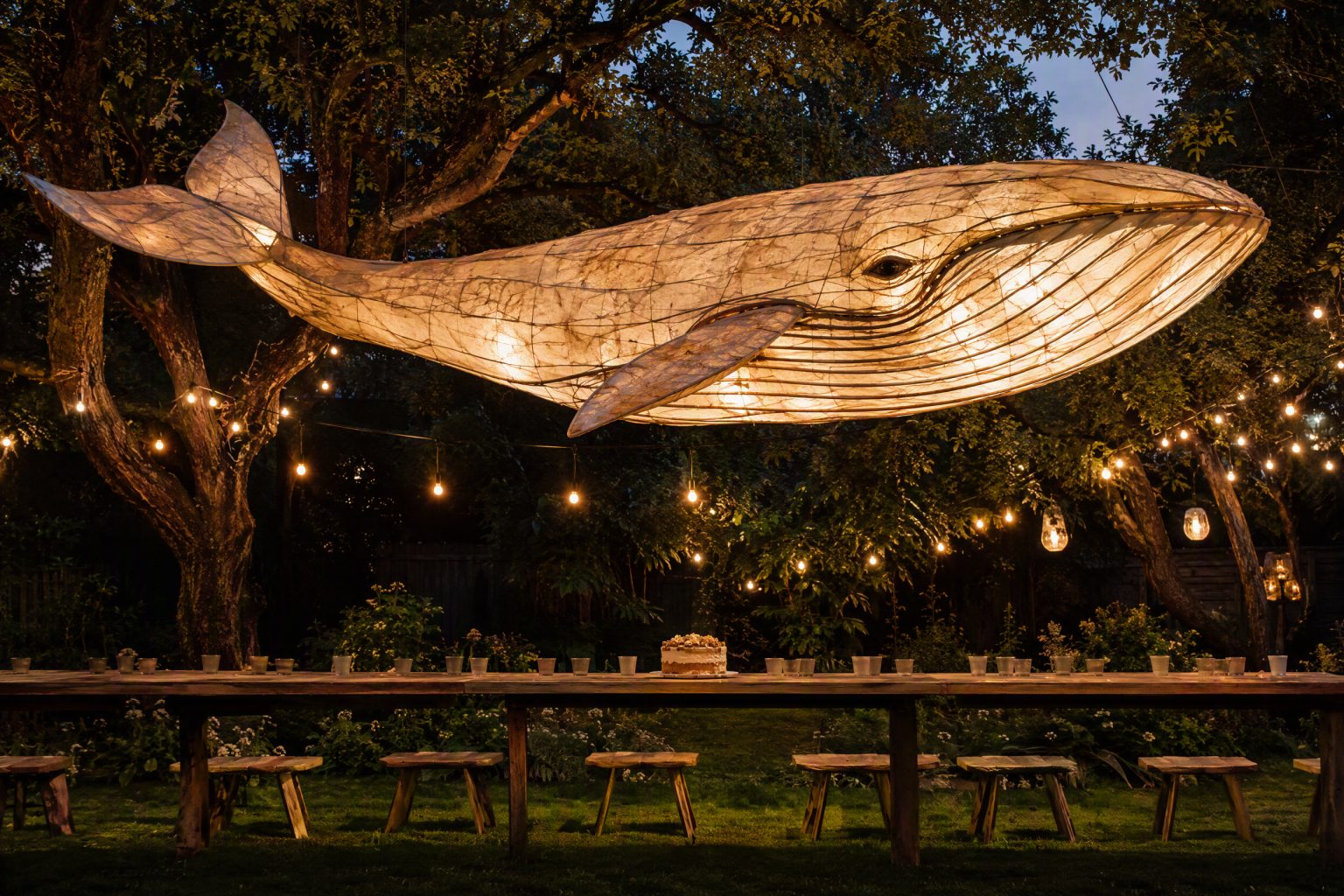
An enormous fantasy creature arrives already extraordinary. An enormous teaspoon has interfered with breakfast.
That is a different joke, and one I find particularly satisfying. The object has kept its manners. It still has the right shape and the little dip at the end. It is just wildly unsuitable for the cup beside it. Nothing else needs to be explained before the mismatch becomes visible.
For a children’s celebration, I would look for an ordinary object that the birthday child actually knows or cares about. An unfamiliar object made enormous may only look unfamiliar. A familiar one, handled well, can make the rest of the room seem to have changed size around it.
A building block. A spool. A postage stamp. A folded paper boat that has become rather optimistic about its passengers. The most promising object is rarely the most expensive or elaborate; it is the one that makes you start imagining what belongs beside it.
The child gets a say here. My brilliant enlarged thimble is not particularly brilliant for someone who has never seen a thimble. We are not testing their knowledge of sewing equipment. We are trying to give them something deliciously wrong.
Leave something the correct size
Imagine an enormous envelope on an otherwise ordinary table. Beside it is a small pencil and a cup someone has actually been drinking from. Now the envelope looks as though it has arrived from elsewhere.
Enlarge the table, pencil, cup, chairs and every other object to match, and you have changed the whole setting. That can be wonderful too, but it is no longer the same trick. The mismatch has disappeared. We need some evidence of the everyday world if the unusual thing is going to argue with it.
That does not mean leaving the room bare. I am not attempting to smuggle minimalism into a birthday party under cover of an enormous envelope. Keep the flowers, the color, the stripes, the strange little supporting details. Just let a few ordinary things remain ordinary enough to make the scale legible.
There is a broader discussion of hierarchy in Why One Strong Gesture Beats Twenty Pretty Details. What interests me here is more particular: the moment when size stops being decoration and starts suggesting that the rules have slipped.
A normal letter beside the enormous one could be correspondence. A little stack of normal letters beneath it could be a problem at the post office. The same prop has acquired an entirely different life.
Let it have a reason to be here
An oversized object can still be dull. Making something large does not excuse it from having an idea.
If the giant spoon exists only so people can stand beside it, that may be all it ever does. Give it a trace of a larger story and it becomes more interesting. Perhaps a huge illustrated recipe is missing its final ingredient. Perhaps the spoon belongs beside a bowl-shaped reading nook, designed for that use, where ordinary-sized storybooks suddenly look like ingredients.
That is the detail I would pursue: what the object makes possible beyond its own photograph.
It could orient the room. It could hold something. It could be the place where messages arrive. It might simply remain gloriously out of reach while smaller, purpose-made pieces invite handling nearby. An object does not have to be climbed to become part of play.
I would resist explaining its entire history. We do not need a laminated biography of the spoon. Leave enough unfinished that a child can decide who used it, what they made, and whether they might come back for seconds.
Cardboard is allowed to be cardboard
There are two versions of this mistake. One is spending heavily on a prop whose size is interesting but whose presence is lifeless. The other is assuming that because something is homemade, nobody needs to care how it looks.
I care. Quite a lot.
A huge paper flower can have wonderful folded edges, strange proportions and a color that no sensible flower has attempted. It does not need to fool anyone into believing it grew there. The pleasure can be that something everyone recognizes as paper has become extravagantly itself.
A cardboard object can show its construction and still feel deliberate. Visible tabs might belong to the idea. A crease can be beautiful. A child adding a crooked piece may improve it in a way another hour of adult correction would not.
What I would avoid is an object caught between two intentions: trying to look convincingly real while hoping nobody notices that the important side is unfinished. Either commit to the illusion or enjoy the material. Both can have charm. Apologizing for both rarely does.
The enormous thing must fit more than the photograph
Here is the less enchanted question: where does it go?
Not in the rendering. In the actual room, with guests and chairs and an adult carrying food. I would establish its footprint, how it arrives, what people are allowed to do with it and how it leaves before becoming emotionally attached to its eyelashes.
Large does not automatically mean expensive, but it does not automatically mean economical either. Transport, secure installation, storage and skilled work can change the whole decision. A borrowed room with a short setup window may be better served by a wall-mounted graphic than a freestanding object requiring an expedition to get through the door.
Anything freestanding, suspended or intended to support people needs an appropriate design and competent safety review. A decorative object is not play equipment simply because it looks climbable. I would rather change the fantasy than spend the party asking children to stay away from its most inviting feature.
Protect the ordinary comforts too. The giant can lose some square footage before the guests lose somewhere to sit. Spectacle is much more enjoyable when nobody is balancing their cake on a knee because a fictional resident has taken all the furniture.
Sometimes the smaller thing is the surprise
One enormous object is a possibility, not a commandment. A tiny version can produce an entirely different delight: a little painting hung beside a normal painting, or a small, securely mounted window showing an imaginary room beyond it.
The point is the relationship. Something familiar has changed just enough to suggest another life carrying on beside ours.
I would follow whichever version makes the birthday child lean closer. The oversized object may be the star. It may also be completely ignored in favor of the small envelope someone left beside it. We should allow the party to contain that possibility without declaring our investment wasted.
And I would keep the scrap of coat attached to the button. Not much of it. Just enough to show that this was once fastened to something.
Someone very large has been through here, and they have gone home improperly dressed.
Read next: The Magic Trick Needs a Before takes the same impossible evidence and adds time: an extraordinary thing becomes more convincing when guests know what the room looked like before it arrived.
Atmosphere OS · Moodboard-to-Plan
Turn the reference images into something buildable.
Moodboard-to-Plan reads the direction and returns layered plans in vendor language, with the material and lighting consequences attached. Every judgment runs against a written rule rather than a fresh guess.
Costs come back as indicative bands rather than quotes, and seasonal notes are filters rather than promises.
If this is your mood
More playful


Field notes and corrections
When a number here turns out to be wrong, you hear about it.
Three things arrive and nothing else. The new field note — bar rates, cover widths, service clearances, the arithmetic worked through on one real evening. And a correction whenever a rule in the published rulebook changes, or a number the tools rely on turns out to have been wrong. There is no weekly slot, because there is nothing weekly to put in it.
One email per field note, plus corrections when a published figure moves. Unsubscribe from any of them.
Continue through the system
Pretty is still not a plan.
A party gets planned in roughly this order. Pick the chapter where your next problem lives.
What you have to decide next
One decision constrains the next. This is the order they actually happen in.
- Venue Will this room hold it? The Serpentine Table Is Eleven Percent Longer Than the Spec Sheet Says
- Guest experience How will guests move through it? The Place Setting Fits. The Person Does Not.
- Production How does it get built and run? The Event Needs a Failure Mode That Still Looks Intentional
- Vendors Who owns each handoff?
More in this chapter

See the complete five-chapter Event Design Intelligence map →