Guest Experience
The Room Turn Needs a Holding Pattern
A room turn is not a furniture operation. It's a guest-relocation problem with a deadline, and both halves have to be designed at the same time.
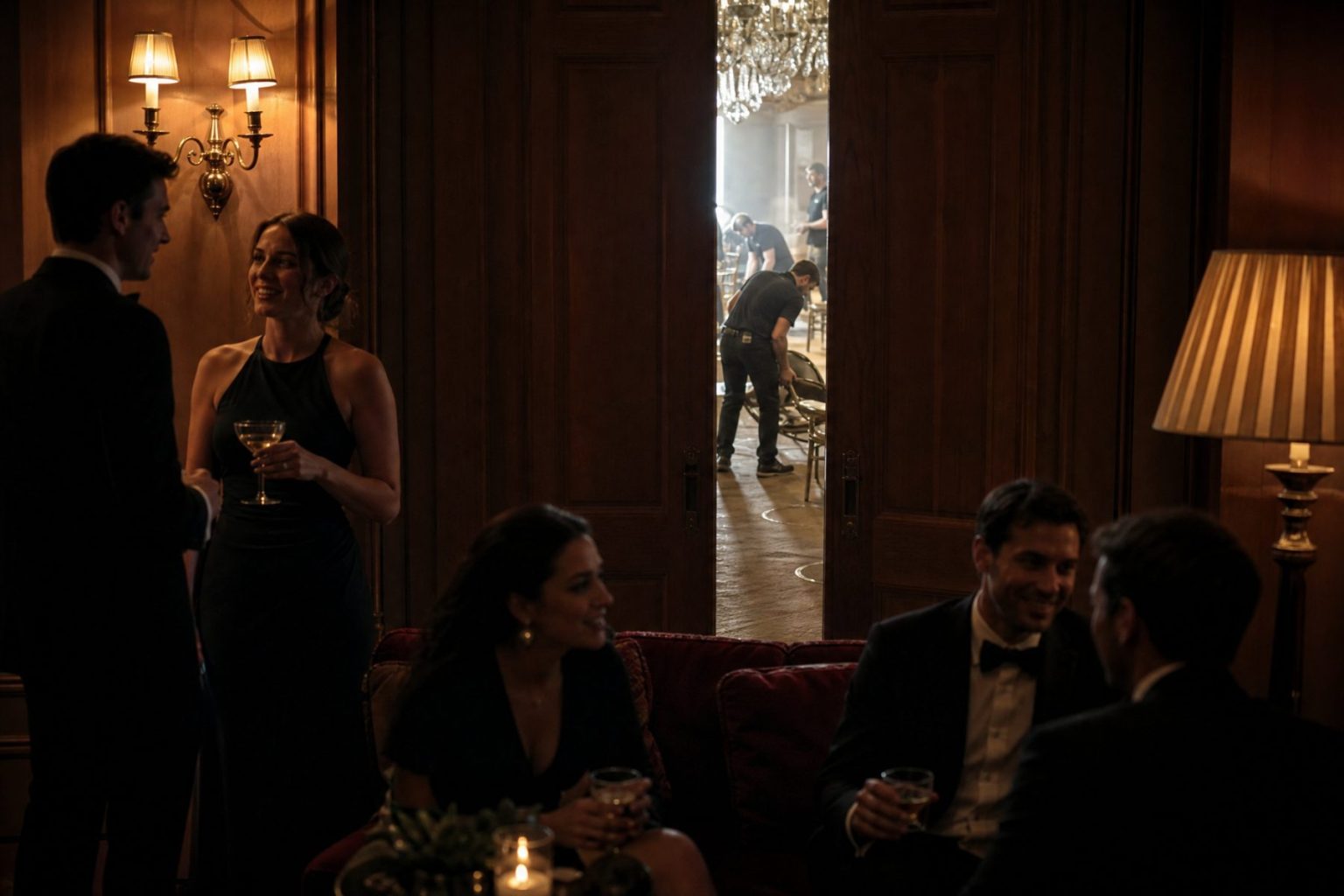
A room turn is not merely a furniture operation. It is a guest-relocation problem with a deadline.
While chairs move, tables appear, sound systems change, floors are cleared, linens land, and lighting shifts, guests need somewhere complete to be. The work crew needs the opposite: an empty, protected route with enough time to make the room look as though none of this occurred.
The turn succeeds only when both experiences are designed together.
Name the room at every stage
Write down what the space is before, during, and after the transition.
A ceremony room may become dinner. Dinner may become dancing. A gallery may become a lounge. A tent may need to close against weather while guests move indoors.
For each stage, record the furniture, floor condition, lighting, sound, service equipment, decor, accessible routes, and guest capacity. Then identify which elements remain, which move, and which must appear during the turn.
“Flip the room” is not a production plan. It is a verb with excellent public relations.
Build the holding environment as a real chapter
The place guests wait should feel intentional enough to support the full estimated turn, not merely the optimistic one.
It needs:
- capacity for the actual guest count, including mobility devices and strollers;
- weather protection and temperature control appropriate to the season;
- seating for guests who need it;
- water, drinks, or food timed to the event rather than offered as distraction;
- restroom access and clear accessible routes;
- boundaries from active work, equipment, and service traffic;
- a clear explanation of what is happening and what comes next.
A view, musician, tasting, lounge, or conversational moment can give the hold its own identity. Do not overprogram it. Guests may be perfectly content with a drink, a chair, and information that does not lie. Heat, cold, noise, and nowhere to sit decide how a hold actually feels.
Time the turn at working speed
Rehearse the sequence with the actual crew size, furniture type, storage location, linens, place settings, decor, cleaning method, sound equipment, and lighting changes.
Include the time required to:
- clear guests and personal items;
- move and store the first setup;
- clean or inspect the floor;
- bring in the next furniture configuration;
- place linens, settings, menus, candles, and decor;
- adjust sound and lighting;
- remove carts, cases, tape, packaging, and visible work evidence;
- perform a final accessibility, safety, and presentation check.
The last table reaching its mark does not make the room ready. Ready means guests can walk in without seeing the turn still breathing heavily. A turn timed at working speed needs buffer built into the timeline around it.
Guests may be perfectly content with a drink, a chair, and information that does not lie.
Sequence the vendors through one route
Furniture, catering, floral, lighting, entertainment, cleaning, and venue teams may all need the same doors, elevators, storage areas, or floor space.
Create an order of operations. Decide who enters first, where empty cases and removed furniture go, which team has decision authority inside the room, and when each route must be clear for the next group.
Keep the guest hold and service routes separate wherever possible. If they must cross, schedule and staff the crossing rather than hoping carts will become socially intuitive.
Protect what guests leave behind
Programs, wraps, bags, mobility accessories, flowers, reserved-seat markers, and personal items may remain after the ceremony or meal.
Decide who collects, labels, protects, and returns them. Do not sweep a sentimental item into a storage cart because the next table layout has strong feelings about efficiency.
Keep essential mobility equipment with its owner unless they explicitly direct otherwise. Maintain clear routes throughout the transition.
Set decision gates before the turn begins
At defined times, the event lead should assess whether the turn is on schedule and choose among prepared responses.
For example:
- On time: proceed with the full planned reveal.
- Ten minutes late: extend the holding chapter with a specific update and adjust service.
- Materially late: open a completed portion, simplify the remaining setup, or activate the alternate program.
- Unsafe or impossible: abandon the turn and use the preplanned fallback configuration.
The exact thresholds depend on the event. What matters is that “five more minutes” is not repeated until the guests have formed their own government.
Do not sweep a sentimental item into a storage cart because the next table layout has strong feelings about efficiency.
Design a partial opening
Decide what can welcome guests first if the entire room is not ready.
The bar and perimeter lounge may open while final dining details are completed behind a controlled boundary. Several tables may be ready while one installation is omitted. Dinner may begin in an alternate sequence. The reveal may become gradual rather than absolute.
A partial opening works only when the visible area looks complete and the remaining work is safely separated. Guests should not enter a room where half the tables are styled and the other half are hosting extension cords.
Give communication one owner
Name the person who receives status from the room, speaks to the holding-area team, coordinates service, and decides when guests move.
That person should provide accurate, specific updates without exposing production panic. “The dining room will open in approximately fifteen minutes; the bar and terrace remain available” is useful. “They are almost done” is an emotional position.
Keep hosts and honored guests out of the operational relay unless their decision is genuinely required.
Use the reveal only when it earns the delay
A closed-door transformation can create anticipation and a strong emotional reveal. It can also consume guest comfort and vendor capacity for a moment that lasts thirty seconds.
Ask whether the same effect could be achieved with partial presetting, modular furniture, drape, lighting, or a transition that guests can witness safely. Not every reset needs to be hidden. Some occasions benefit from seeing the room loosen and change.
The hold and the turn are one design
The guest experience is not suspended while vendors work. The work is not magically easier because guests have been given cocktails elsewhere.
If I could protect only two things, it would be a hold guests can comfortably occupy for the late version of the turn, and decision gates that already say what opens when the ideal clock fails.
The room turn should feel graceful on both sides of the door. One side receives a chapter. The other receives a plan.
Atmosphere OS · Arc Studio
Give the evening a shape it can hold.
Arc Studio builds the energy curve, marks the turn, and produces the run sheet and production brief from it. The timings come out of published rules, and the rulebook is explicit about which parts are judgment rather than arithmetic.
The rulebook is public. Every formula it runs on is written down where you can disagree with it.
Field notes and corrections
When a number here turns out to be wrong, you hear about it.
Three things arrive and nothing else. The new field note — bar rates, cover widths, service clearances, the arithmetic worked through on one real evening. A line when a World opens, because a night only goes up once it can actually be thrown. And a correction whenever a rule in the published rulebook changes, or a number the tools rely on turns out to have been wrong. There is no weekly slot, because there is nothing weekly to put in it.
One email per field note or opening, plus corrections when a published figure moves. Unsubscribe from any of them.
Continue through the system
Pretty is still not a plan.
A party gets planned in roughly this order. Pick the chapter where your next problem lives.
What you have to decide next
One decision constrains the next. This is the order they actually happen in.
More in this chapter
See the complete five-chapter Event Design Intelligence map →