Design Atelier
Three Hundred Metres of Soft Ground, and Then Dinner
The styling world for The Tide Comes In at Nine, Occasion Study No. 18 — an evening where the shoes are settled by the walk, the hem by the water, and the outer layer by a wind that does not stop for anybody's outfit.
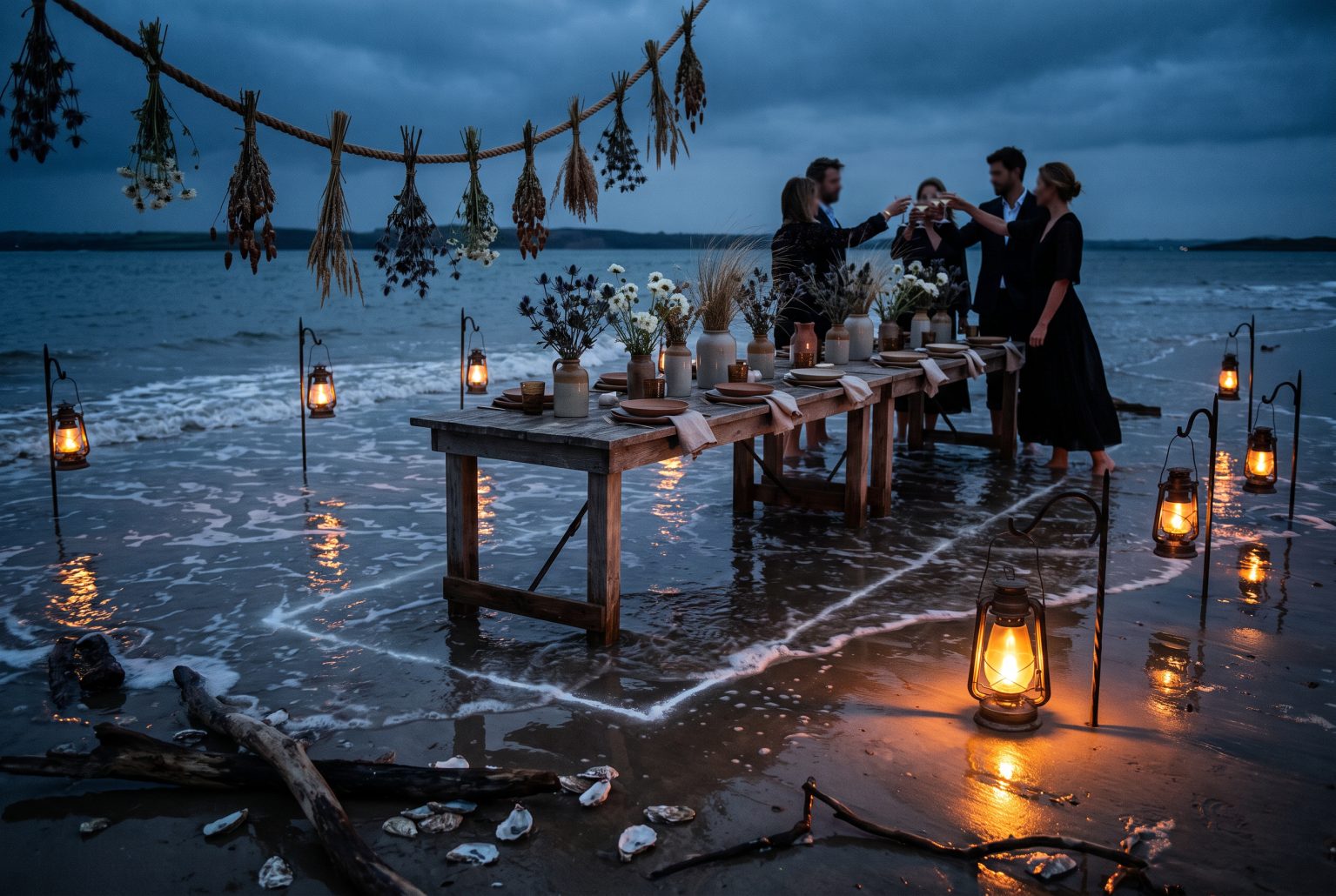
Every other Look Book in this collection begins with a room. This one begins with a walk and a number. The number is a predicted height above chart datum, published months in advance by a hydrographic office, and it decides what time dinner ends. The walk is three hundred metres of sand between the parked cars and the table. Nothing you wear survives contact with this evening unless it has an answer to both.
Where the clothes come from
The source is tidal ground: the strip of the world that is land twice a day and sea twice a day, and the working wardrobe that grew up on it. Not the yacht club. The other coast — the one with bait, mud, cold hands and a gansey knitted at a density that would be absurd anywhere inland. A fisherman’s gansey is knitted in the round in five-ply worsted at a tension that makes it nearly windproof, with the underarm gusset that lets a person raise both arms without the body of the garment climbing. That is a design decision made by people who had to keep working while wet. It is worth taking.
The second thing worth taking is the tidemark itself. On a harbour wall, a hull, a groyne, a mooring post, the water leaves a horizontal band: a change of colour, a line of weed and rust and salt bloom at exactly the height the sea reached. It is the most legible graphic on the entire coast and it is free. Worn on a body it becomes a single horizontal at a decided height — a belt, a sash, a contrast band, a colour break at the waist or the hip — on a silhouette that is otherwise vertical and quiet. One line. That is the whole styling idea, and it is enough.
What we are refusing is the obvious costume, and it is very obvious. Navy and white. Brass buttons. Breton stripes. Rope belts, anchor motifs, a peaked cap worn as a joke by somebody who will keep it on all night. Nautical dressing is the single most available reference in Western clothing and it has nothing to do with a tide. It is a uniform borrowed from a navy, which is a fighting organisation, not a beach. Wearing it here tells everyone you looked at the invitation, saw the word coast, and stopped thinking.
We are also refusing the second costume, which is subtler and more common: the barefoot linen version. White linen, loose hair, no shoes, the whole coastal-wedding grammar. It fails here for physical reasons. Bare feet on a falling tide meet razor shells, broken glass, cold, and a surface that is forty minutes from being under water. The flat shoes handed out at the gate are not a compromise on the styling. They are the styling.
The line
Vertical, weighted, closed at the bottom. That is the shape, and every part of it is a response to something the evening will actually do.
Vertical, because you will be seen from a distance on an empty plane with a horizon behind you. There is no architecture out there to give a body scale. A silhouette with a lot of horizontal interest — peplums, tiered ruffles, a wide sleeve and a wide hem together — dissolves into the sand at forty metres. A column reads.
Weighted, because of the wind. Onshore wind is the reason the lanterns are ballasted with shingle and it is the same reason your hem needs mass. A light hem is not romantic in a real breeze; it is a fight you conduct with one hand for four hours while the other holds a drink. Weight can come from the cloth (wool crepe, a milled flannel, a heavy viscose) or from the construction (a faced hem, a horsehair band, a lining that stops short and hangs true). Both work. Chiffon does not.
Closed at the bottom, because the ground is leaving. Two honest hem lengths exist for this evening: above the ankle bone, where nothing touches anything; or genuinely full-length in a cloth that does not show water, worn by somebody who has decided in advance that the last twenty centimetres will be damp and sandy and does not mind. The length that fails is the fashionable one in between — the hem that skims the floor. It will pick up wet sand, then shell fragment, then weight, and by the fourth course it will hang wrong and slap your ankles.
The shoulder should be real. Not padded into the eighties, but defined enough to survive a coat being pulled over it, because a coat is going on and coming off repeatedly and a soft dropped shoulder simply vanishes underneath one. Volume, if you want volume, belongs in the upper third: a full sleeve, a gathered yoke, a wrap that has body. Up there the wind moves it and it looks like weather. Down at the hem the same wind looks like a mistake.
Then the chair. It stands on sand, and sand is not level for long — one leg finds a soft patch and drops two centimetres while you are sitting on it. A very narrow skirt turns that into a problem you have to solve with your knees. Allow yourself room to move sideways in a seat. And know that the chairs go during dessert, in pairs, quietly, and the last course happens standing. Whatever you are wearing has to work upright, in wind, with a cup in one hand.
The cloth
Wool is the correct answer and it is not close. Salt air is damp air, the temperature falls roughly two degrees between the seventh hour and the tenth, and wool is the only common fibre that holds its shape and its warmth while carrying moisture. Specifically: five-ply worsted in a gansey or a heavy crew; milled lambswool for a coat; wool crepe for anything that has to hang; boiled wool for a jacket that will be sat in and then stood in. Wool also does the one thing this light asks for, which is to have surface. Under lanterns at eye level and below, a matte textured cloth reads as three-dimensional and a flat one reads as a silhouette.
Linen is the trap. It is the fabric everybody associates with a beach, and it is a hot-dry-climate cloth being asked to perform in humidity. In damp coastal air linen does not crisp; it goes soft and slightly limp, it creases in the car on the way and never recovers, and by the third course a linen jacket has the hand of a used napkin. If you want the look, use a linen-wool blend at around a third linen, or a heavy linen canvas in a structured coat where the creasing reads as intention.
Silk needs a warning, because it is the failure people are least prepared for. Water spots silk, sometimes permanently, and the spot appears from spray, from a wet glass, from a hand that was in a mussel pot. Silk chiffon on an exposed foreshore is a flag on a pole. Silk satin has the second problem: under warm low light it blows out into a white shape in every photograph. Heavy silk crepe, matte side out, is the exception and a good one.
Waxed cotton is the outer layer that belongs here without argument. It is heavy, it smells faintly of paraffin and hot fields, it does not photograph as a fashion object, and it is the only coat on that beach that is not pretending. Technical shells keep you drier and read as a different evening entirely — if you own one and nothing else, wear it in a plain dark colour and stop worrying. Velvet is a genuine pleasure at a lantern-lit table and a genuine liability standing up, because it crushes where you sat and holds damp along the pile. Wear it seated with a coat over it and accept the marks.
The thing that costs almost nothing and looks like money: a secondhand heavy wool overcoat, one size generous, in charcoal or navy, sleeves pushed back. Second-hand wool coats are the most underpriced garment in circulation, and on a cold foreshore a good one outranks almost everything worn underneath it.
Colour, on a person
The twelve colours do not transfer to a body at the room’s ratios. Roughly half of them are ground, water and rope, and belong under your feet or on the table rather than on you.
Wear the water. Deep Water Ink (#16232B), Estuary Slate (#4C5B63) and Storm Blue (#375A72) are the wardrobe of this evening and they are all better than black. True black under lantern gold goes flat and reads as an absence — a person-shaped hole in a warm frame. Deep Water Ink does everything black is supposed to do and keeps a colour temperature. Foam White (#F2F1EA) is excellent as a shirt, provided it is matte; a satin white is the brightest object on the beach and every camera will meter for it.
Rope Hemp (#C2A878) and Oyster Shell (#DCD4C6) are the knitwear and outerwear colours, and they warm skin under low light in a way the slates do not. Tidemark Rust (#9A5A3C) is the accent and the concept: one band of it, at a decided height, on an otherwise quiet body. Cockle Pink (#D98E82) works in small quantities close to the face — a scarf, a lining, a lip — and looks cheap in a large quantity, which is true of most tertiary pinks and worth saying once. Marram Green (#8A946B) makes a superb coat and is unkind next to most faces under warm light, where it drags a grey-green into skin. Keep it below the collarbone.
Lantern Gold (#E7B85C) is three per cent of the room for a reason. Wear it as metal, as thread, as a lining that flashes — never as a dress. A gold dress under a gold lantern is a lamp, and it will pull every frame off balance.
The one colour to leave at home is Wet Sand (#B4A48C). It is the floor. A guest in wet-sand tones is camouflage: from twenty metres they are a head and a pair of hands, and in photographs they merge with the ground they are standing on. Salt Bleach (#E9EEEC) has the same problem for a different reason — it is chalk, rope and the marked line, and it belongs to the mechanism rather than to a person.
The looks
The Gansey and the Long Skirt
A heavy five-ply crew-neck in Deep Water Ink, bought a size up so it goes over a shirt when the temperature drops at the fourth course. Under it, an ankle-length wool or wool-crepe skirt in Estuary Slate, straight or very slightly A-line, hem finishing at the ankle bone so it clears the sand. Flat rubber-soled boots with a back and a real sole. One earring’s worth of jewellery — a single solid stud or a small hoop — and nothing at the neck, because the neck is where the collar goes up. The detail that makes it this evening rather than a walk: the sweater is tucked at the front only, so the tidemark falls where the waistband is.
The Tidemark
The concept worn literally, and it is the best look here. A full-length column in Deep Water Ink — wool crepe, matte, long sleeve, no train, nothing at the shoulder. Then one horizontal band of Tidemark Rust at the natural waist: a wide flat leather belt, or a rust silk sash tied once and pressed flat rather than bowed. That is all. No necklace, because the necklace competes with the line. Flat dark boots, a dark heavy coat that does not close over the belt so the band stays visible when the coat is open. It photographs at any distance and it is the only outfit on the beach that means something.
The Working Coat, from your own hall
Assembled entirely from things you already own, and stated as such: the heaviest dark overcoat in your house, worn over a plain dark dress or dark trousers and a plain jumper, sleeves pushed to the forearm, collar up. Add socks you have chosen deliberately and boots that are already scuffed. This look is not a fallback. On ground like this a good old coat outperforms almost everything bought for the occasion, and the person wearing one looks like they have been to this beach before.
Cropped Wide Trouser, Heavy Shirt
Non-gendered and the most comfortable thing here. A wide wool trouser cropped to sit exactly on the ankle bone — cropped rather than long, because the crop is the difference between a clean hem all night and a wet one by the second course. A heavy poplin or brushed cotton shirt in Foam White, buttoned high, sleeves long. A fine wool crew over the shirt rather than a jacket, so the collar can come up. Boots, and socks that will be seen when the shoes come off in the warm room afterwards, because they will. The one detail: no tie, but a plain silk scarf in Storm Blue knotted flat inside the collar, which is warmth pretending to be styling.
The Oilskin Answer
The masculine look that costs least and reads best, and the second one built from a wardrobe that already exists. A waxed cotton jacket in olive or dark brown. Moleskin or dark heavy denim trousers, turned up once at the bottom — the turn-up is a decision, not laziness; it is what people who work that ground actually do, and it keeps the hem out of the wet. A fine-gauge wool crew in Rope Hemp under the jacket, a plain shirt under that if it is cold. Leather boots that have already been ruined once and therefore cannot be ruined again. Nothing on the wrist but a watch that works, which on this evening is not a styling point.
The Evening Dress That Can Get Wet
For the guest who wants the full-length answer and will not be talked out of it. Heavy matte crepe or a substantial viscose in Storm Blue or Deep Water Ink, floor-length, bias avoided, no train, no chiffon overlay, no beading — beading is weight in the wrong place and it snags on a coat. A proper coat over it, chosen at the same time as the dress rather than grabbed at the door, because the coat is in every photograph and the dress is in about a third of them. Flat, and if flat feels wrong, remember that the alternative is a heel finding four inches of soft sand and going in to the ankle.
Ninety Seconds in the Wind
For whoever speaks at the mark. A garment with a collar that stands on its own — a shirt with structure, a coat with a real revere, a knit with a high rolled neck — because the last course happens standing on the shingle line with the wind coming off the water and everything soft will be flattened against you. Dark, so the lantern behind reads as a rim light. Hands free: no notes, no glass, nothing to hold, because ninety seconds is exactly as long as anybody can speak in that cold and you should not spend it managing objects.
Accessories, jewellery, shoes, bags
Shoes are settled by physics rather than taste. A stiletto heel puts a person’s whole weight through roughly a square centimetre; on wet sand it goes in, and on soft dry sand above the line it goes in further. A block heel spreads the load and still sinks. The only shoe that works is flat, closed, with a back and a sole with some tread. Slides and mules are out — sand gets under the foot and stays there for four hours. There are boots in three sizes and a box of wool socks at the gate station, offered to everybody as they arrive, not held back for the person who got it wrong.
Jewellery has a corrosion problem. Salt air pits plated metal, and a night of spray and damp will do visible damage to anything with a thin gold layer over base metal. Wear solid metal, or wear no metal — shell, stone, glass, horn, wood all belong here and several of them are cheap. Scale down: the light comes from below and from the side, which makes any pendant read larger and any earring cast a longer shadow than it would at a lit indoor table. Whatever you were going to wear, go one size smaller. And nothing that swings, because a collar is going up and down all night and a drop earring hooks into a coat collar with real force.
Bags: there is nowhere to put one down. The sand is damp and getting damper, the table is being struck course by course, and anything left on the ground is on the inventory sheet as a missing item. So a bag has to be worn — crossbody, closable, hands free — and it has to hold four things: a phone, a small torch, whatever you need for your face, and a folded cloth. A clutch is a beautiful object you will set down once and lose to the water. Do not bring an umbrella either. In that wind it is a sail with a spike on the end.
Hair, face and hands — the short version
The direction is: nothing that has to be touched. Wind, salt and damp are three separate problems and every one of them punishes a look that needs maintaining, because your hands will be cold and there is no mirror within three hundred metres.
Hair goes up, back, or is cut short enough not to care — and if it goes up it goes up with structure rather than pins, because pins migrate in wind. A low knot at the nape, a plait, or a hood are all correct. Loose hair on an exposed foreshore is a decision to spend the evening pulling it out of your mouth.
Skin wants a satin finish, not a wet one and not a flat matte one. Under lantern light from below, a dewy finish reads as damp, which on a beach is a little too literal; a heavy matte reads as dust. Emphasis sits at the eye rather than the lip, because the lip is going to meet a hot cup, a mussel pot and the wind, and it will not be there at the fourth course. Blush is the one thing worth more of than you think — cold takes colour out of a face and the lanterns do not put it back.
Nails short and finished, because hands are in every photograph of a table and this table has shells on it. The full method — the week before, what holds in salt air, what to do about wind-stripped lips, and the five things that actually fit in the bag — is set out in the beauty companion on Vanity or Vice, Salt Air, Wind and Damp: a Face That Survives All Three.
The host, and the difference
The host has a different job and therefore a different garment. They are walking the soft ground repeatedly, they are carrying things that are hot, and they will be in the edge of every photograph without being warned. Their outfit needs pockets — real ones, deep enough for a phone and a pen and the folded inventory sheet — sleeves that push up and stay up, and a coat that closes with one hand. A long coat that has to be held shut is a coat that will be open all evening.
There is a second role here that outranks the host, and it should be dressed as such. Somebody holds the watch and the authority over the tide, and that person needs to be findable in the dark by a guest who is not sure whether they should be worried. Give them a single garment nobody else has: one coat in Tidemark Rust, or one specific hat, worn all night, plus an actual torch and an actual watch. That is a uniform assembled from one item. It is more useful than a badge and considerably better looking than high-visibility, which is honest and which you should use anyway on the vehicle route where the cars are.
If the night belongs to somebody — a couple, a person having a birthday they will remember — make them visible with the one colour nobody else has. Lantern Gold is three per cent of this world. Give it to them entirely: a gold cuff, a gold-lined coat, a gold thread through a knit. It is quiet, it is visible from the far end of the table, and it does not require a sash, a corsage or an announcement.
What to tell guests
The line on the invitation, written out: Flat shoes and a coat you would wear on a boat. We walk out at seven, we eat as the water comes up, and we are off the sand by half past ten. The tide is not adjustable.
The honest translation, which some guests will need and none should have to ask for. Flat shoes means flat: no block heel, no wedge, no espadrille with a two-inch cork sole. A coat you would wear on a boat means warm and windproof and probably not the good one, because it will get salt on it. Dress as though the evening were happening in October, whatever the forecast says at three in the afternoon, because temperature over water at ten at night is a different number from temperature over a car park at three. Bags on the body. Nothing loose enough to blow away, which includes a scarf worn decoratively and a pocket square.
Somebody will arrive in the wrong shoes. Nobody is corrected, nobody is turned back and nobody is made to explain themselves at the gate. The boots and the wool socks are laid out at the gate station where everyone passes, and they are offered to every single person in the same words, so that taking a pair is the normal thing to do rather than an admission. That is also why they are good boots and not a bin of oddments.
Getting it wrong
The costume version is navy and white with brass on it, and it turns an evening about a physical fact into a themed party about boats. The over-matched version is worse and more likely: everybody dressed inside the twelve colours, so the table looks like a paint chart with people sitting at it. Palettes are for rooms. A guest list dressed to a palette reads as a corporate away-day, and the fix is simply to let people wear their own dark colours and rely on the ground, the linen and the lanterns to do the harmonising, which they will.
Then there is the tablecloth problem. Foam White is twelve per cent of this world and most of it is linen on a table. A room where the guests are also in undyed white is a room where the people and the furniture have the same value, and the photographs will show a long pale smear on a beach.
The accessory that always cheapens it is shell jewellery bought for the occasion — puka, cowrie, a resin starfish, anything from the seaside section. It is a souvenir of a place you are currently standing in. If you want the sea on your body, wear the thing the sea actually made, which is a piece of glass worn smooth over forty years, set plainly, and worn once.
The last thing anybody sees you in is a coat, standing on shingle, holding a cup, with the water four metres away and coming. Choose accordingly. Everything else is decoration on top of that image, and the image is very good on its own.
The full premise, the site requirements and the four-rung ladder are in The Tide Comes In at Nine, Occasion Study No. 18. What everybody eats and drinks while the room shrinks is in Six Courses Against a Published Number.
Atmosphere OS · Theme Atelier
Turn the mood into something a florist can quote.
Theme Atelier builds palette, materials, lighting and spatial mood into one system, then writes it in language a vendor can price. Every number it produces comes from a published rule, and the rulebook names the judgements it deliberately refuses to call rules.
Costs come back as indicative bands rather than quotes, and seasonal notes are filters rather than promises.
Continue through the system
Pretty is still not a plan.
This field note belongs to a larger event-design system. Follow the chapter that explains the next pressure point instead of falling back into an undifferentiated archive.
What you have to decide next
One decision constrains the next. This is the order they actually happen in.
- Venue Will this room hold it? The Generator Was Late. The Washrooms Were Waiting.
- Guest experience How will guests move through it? Family Milestone Reception for One Hundred Fifty: Three Generations Need More Than One Volume Level
- Production How does it get built and run? Museum Reception for One Hundred Forty: The Building Gets a Vote
- Vendors Who owns each handoff? The Dance Floor Wrap Is Not the Whole Dance Floor
More in this chapter


See the complete five-chapter Event Design Intelligence map →