Design Atelier
Six Courses Against a Published Number
The food and drink design for The Tide Comes In at Nine — a dinner where the kitchen has no walls, the bar cannot move, and the last course is eaten standing because the chairs have already gone.
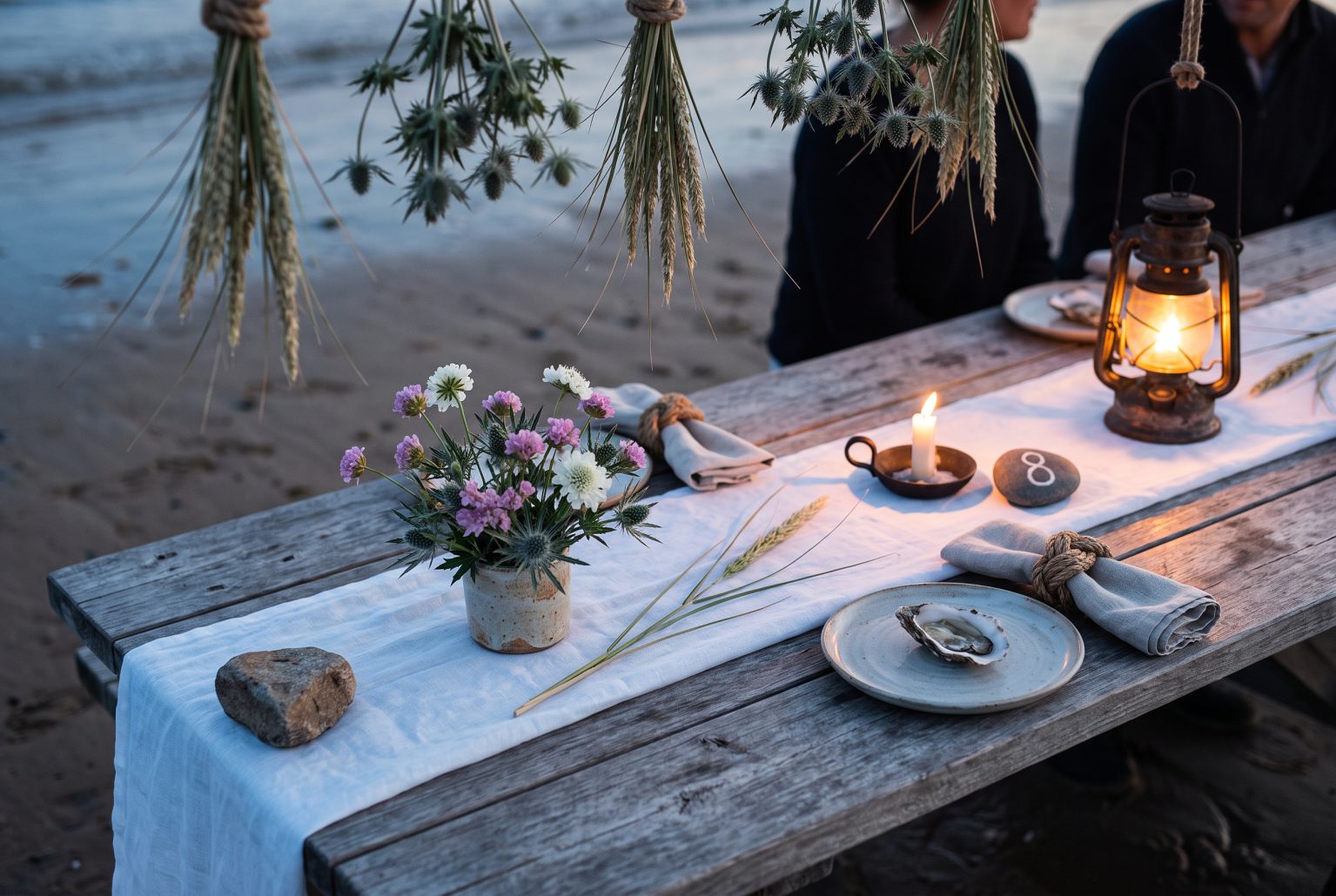
Most menus are written against a room. This one is written against a number published by a hydrographic office eighteen months ago, and the number does not care what time the lamb is ready.
What this evening is hungry for
Start with the body, not the menu. A guest arrives having walked three hundred metres over soft ground into onshore wind, at seven in the evening, in a coat. They are cold at the hands and the ears, slightly out of breath, faintly exhilarated, and they have not eaten since lunch. Four hours later that same person is standing on wet shingle in a falling temperature with nowhere to sit and no interior to retreat into. Everything the kitchen does has to sit between those two facts.
Which produces three design instructions before a single dish is named. Heat first. The first thing in a hand has to be hot, and it has to be in the hand within ninety seconds of arriving at the gate, because a cold guest is a guest who is privately thinking about the car. Front-load the volume. The evening’s appetite peaks at about the ninety-minute mark and then declines, not because the food gets worse but because the body is spending calories staying warm and the ground is visibly wet behind the chairs. A menu that saves its biggest plate for hour four is a menu that watches half of it go back. Nothing that needs cutlery at the end. The last two courses happen standing, because the chairs are removed during dessert. Anything requiring a knife after that point is a design error.
Then there is the temperature problem, which is the real one. Wind strips heat off a plate faster than anything else on this beach. A plated course carried forty metres across open sand from a pass that has not moved up with the room arrives at wind temperature, and wind temperature at nine in the evening on tidal ground is somewhere around fifteen degrees. So this menu is built to be served in vessels rather than on plates: pots, cups, boards, crusts. A pot of mussels holds its liquor at temperature for six or seven minutes; the same mussels on a cold flat plate are lukewarm before the second person is served. A salt crust holds heat for twenty minutes. That is not styling. That is the only way the food arrives hot.
And one more, which is unusual: the menu has to be finite and it has to be counted. Anything left on the sand goes out on the tide and comes back somewhere else as somebody else’s problem. So there are no paper napkins, no picks, no shells discarded onto the ground, no wrappers, and no dish that generates loose small debris. Every vessel is on the inventory sheet and every vessel comes back.
The shape of the night
Six things happen, and each one is pinned to a time that came from the tide table rather than from the kitchen. What follows assumes predicted high water shortly before midnight, which puts the water at the outer lantern line at around nine — the hour the evening is named for.
- 18:40 — the gate station. Boots, wool socks, and a hot cup handed to every person as they arrive. Nothing to eat here; hands are busy.
- 19:00 — the crossing. Three hundred metres, walked. Nothing is served on the walk.
- 19:20 — standing, on the sand. The arrival food, passed from a barrow while people find their places. Hot, one hand, no cutlery.
- 19:40 — first course, seated. Family service, in the pot. The bread is already on the table.
- 20:10 — the plain course, and the first contraction. The outer lanterns move in four metres while people are eating bread.
- 20:40 — the main, carved at the table. Second contraction follows at 21:00, with the pass moving up the beach.
- 21:30 — dessert, in cups, as the chairs go.
- 22:05 — the toast, standing at the mark. The signature drink is poured here, not at a bar.
- 22:45 — above the line. Late food and coffee in the warm room, with the sand still on everybody.
Courses this evening does not have: a canapé sequence, a soup, a cheese course and a palate cleanser. The canapés are gone because everybody is walking. Soup is gone because a bowl of liquid on a table on sand in wind is an accident waiting to be blamed on someone. Cheese is gone because it is the course that adds forty minutes to a night whose end time is fixed by physics, and the last forty minutes are needed for the water. There is no palate cleanser because this menu already has one, running through it: cold air.
The welcome drink and the arrival food
The welcome drink is hot, unsweetened and salted, and it is called The Crossing: dry cider infused with bay, a strip of orange and a small measured amount of salt, held at around 70°C in insulated urns at the gate, poured into enamel or tinned-steel cups. Half the urns carry a measure of cider brandy; half do not. Both are poured from the same station into the same cup by the same person, with the same sentence, and nobody has to declare anything at a gate in front of a queue.
The salt is the twist and it is doing real work. A hot cider that is merely sweet and spiced is a Christmas market drink, and this is not that evening. Around 1.5 grams of salt per litre takes the sugar down, makes the cider taste of apple rather than of syrup, and lands correctly on somebody who has just been out in salt air. It also does the thing that a hot drink at a gate is actually for, which is warming hands — the cup is the point as much as the contents.
The arrival food is served twenty minutes later, standing on the sand, and it is small potatoes baked in a salt crust and split with smoked cod’s roe butter. They come down the beach in a shingle-lined tray, look almost exactly like the wet stones around them, and stay hot for twenty minutes inside their crust because that is what a salt crust does. One hand. No plate. No cutlery. Nothing to drop. The skins go into a lidded tin on the barrow, not onto the sand.
Why not oysters, which is what everybody does on a beach: because a raw shellfish course requires cold holding you do not have out there, generates fifty sharp shells that must be counted back off the ground, and is served to people who at that moment want heat more than they want luxury. Oysters are a mid-afternoon food on a jetty. This is a cold walk at dusk.
The bar
The bar sits at the landward end of the table, on the highest ground inside the lit zone, and it never moves. This is the single most useful decision in the entire production, and it comes from the mechanism: the room contracts toward the bar. Put the bar at the seaward end and you have to strike and rebuild it three times in an evening, each time with a queue forming behind you on ground that is filling. Put it at the landward end and it is also standing exactly where the exit is, which means the last drink and the walk home are the same direction.
The signature is Slack Water: gin, fino sherry, a sea buckthorn cordial, a measured saline, lemon oil, stirred and served over one hand-cut block in a heavy-based tumbler. It is a coastal martini with the edges rounded off — dry, saline, faintly bitter-orange from the buckthorn, and cold enough to hurt. The twist is the dilution, and it is deliberate: the drink is built one notch stronger than it should be and poured over a single large piece of ice, so that over the fifteen minutes somebody nurses it on a cold beach, it comes down to exactly right. The drink weakens as the evening does. Nobody needs that explained to them and nobody should be told.
The zero-proof drink is The Second Line, and it is not Slack Water with the gin taken out. It is built from cold-brewed roasted barley, verjuice, sea buckthorn and the same saline, with a little celery bitterness — savoury, tannic, bracingly sour, and served in the identical tumbler over the identical block of ice, poured by the same person from a bottle sitting on the same board. It is drier than the cocktail rather than sweeter, because the default assumption that a person not drinking alcohol wants something sweet is both wrong and slightly insulting. It is announced by name at the table alongside the other one.
Both are batched, bottled and pre-diluted before they leave the kitchen, and this is not a shortcut. One bartender makes roughly one drink a minute once a queue forms. Forty guests wanting a signature at the same moment is a forty-minute queue on ground that is actively shrinking, in the dark, with people getting cold. Batching turns that into pouring, and pouring runs at about four a minute. At the toast the bottles are carried to the mark in insulated sleeves and poured there, at the line, into cups already in people’s hands — no queue at all, because a queue at the high-water mark at ten past ten is the worst place to put one.
Ice is a design problem and a throughput problem simultaneously. There is no machine, meltwater cannot go into the sand where people are sitting, and a bucket of ice on soft ground goes over. So ice arrives as blocks in insulated boxes, is cut into large pieces once at the start, and is used only for the two signature drinks. Everything else is chilled rather than iced. Wine goes into the sand. Dig a trench half a metre down in the wet sand behind the bar and bury the bottles: at that depth the sand sits near cellar temperature, it holds them upright against wind, and it costs nothing. Serve a Muscadet sur lie or an Assyrtiko with the shellfish, something with real acid and salt; a light chilled red — a Trousseau, a young Cabernet Franc — with the main, because a heavy red outdoors at fifteen degrees closes up and tastes of nothing.
No stems. Everything is a heavy-based tumbler, a stoneware cup or a tinned-steel mug — stems fall over on sand, and a broken stem on a beach at night is a genuinely bad object. Garnish is one thing only: a wide strip of lemon peel expressed over the glass and dropped in, because a garnish that has to be assembled per drink destroys the throughput you just bought by batching. The after-dinner drink lives in the warm room, not on the sand: a single malt with some coastal iodine to it, or a good calvados, poured neat at midnight for the people still standing.
The table
First: mussels in cider, in the pot
One lidded pot per four people, straight onto the table, lid off at the table so the steam is the announcement. Mussels opened in dry cider with shallot, thyme and a knob of butter, finished with a handful of marsh herbs — sea purslane, a little samphire, dill. The twist is the finish: a spoonful of the cider liquor is reduced hard with cream and mustard and stirred back in at the last second, so the broth is thickened enough to cling and to stay hot, rather than being the thin grey liquid at the bottom of a bowl. The shells go into a weighted tin in the middle of the table, which is also ballast.
It belongs to this evening and nowhere else because the empty shells become part of the count. Nothing else on this menu turns its own waste into an object that has to be tallied before the last four people leave the sand. The kitchen’s demand is a single very high-heat burner and about four minutes per pot; it is the dish that most wants a real flame.
Second: bread, butter, radishes — the plain one
A dulse soda bread, salted butter, and cold radishes in a bowl of shingle. That is the entire course and it is deliberately the least interesting thing on the table, because a menu with an idea in every course is exhausting and because this is the course that runs underneath the first contraction, when the lanterns move in and the room gets four metres smaller. People should be doing something ordinary with their hands when they notice.
The bread is soda bread specifically, not sourdough, and the reason is operational rather than nostalgic: you cannot prove a dough on a beach, you cannot prove one in a tent with two induction rings, and a yeasted loaf has to be timed against an oven you probably do not have. Soda bread is mixed and baked in the hour before you leave the house and travels warm in linen. The dulse is toasted and crumbled into the flour and gives it a dark speckle and a savoury, faintly bacon-ish depth. Butter is left out to soften, because cold butter on a cold beach is a small daily cruelty.
Main: salt-marsh lamb, carved at the table
A shoulder cooked long and slow, brought down in a hot box, and carved at the table with a spoon rather than a knife. Served with samphire and brown butter, and boiled new potatoes with nothing on them but salt.
This is the dish that could not exist at any other event in the collection. Salt-marsh lamb is grazed on coastal marsh that floods on the spring tides — the animal ate from ground that goes underwater on the same cycle the guests are currently sitting on, and the herbs it grazed are the herbs in the pot from the first course. Nobody has to be told that at the table, and nobody should be, but it is the reason the plate is coherent. Serve it in September if you can, when the marsh season is properly underway; ask your butcher rather than assuming, because the season varies by marsh and by year.
Against this palette it is the one warm object in the frame: rust-brown meat, a green so dark it reads as slate, and pale potatoes, on undyed linen, under gold light. It is also the dish with the largest kitchen demand by a distance, and the section below is honest about what to do when the kitchen is a tent.
Main, the other one: salt-baked celeriac
A whole celeriac baked in a salt-and-egg-white crust, cracked open at the table with the back of a spoon, and carved into thick slices with a dressing of brown butter, capers, dill and a great deal of lemon. Vegan version uses a browned hazelnut butter and holds up entirely.
It arrives on the same board, with the same knife, at the same moment, with the same sentence said over it. This matters more than the recipe does. A vegetarian main that comes out first, alone, on a smaller plate, is a message about status delivered in food. Two crusts get cracked at that table and neither one is the concession.
Dessert: burnt honey and buttermilk custard, in cups
Small stoneware cups of set custard made with honey cooked to the point where it turns bitter, cut with buttermilk, topped with a salted oat crumble. No plate, no spoon that can be dropped in the dark — a short spoon that lives in the cup — and no cutting, because the chairs are being taken away in pairs while it is being eaten.
Burning the honey is the twist and it is not a flourish. A sweet dessert at this point in a cold evening is unwelcome; honey taken to a dark amber loses most of its sweetness and gains a bitterness close to caramel and slightly closer to smoke, which is the correct register for a course being eaten as the water arrives. It sets in the fridge the day before and travels in a crate, which makes it the only course with no live cooking at all.
Late, and after
Everybody comes off the sand at about half past ten with cold hands, salt on their coats and a specific kind of elation, and walks into a warm room with hard floors. That room needs one hot thing waiting, and it needs it within ten minutes, not forty.
Crab rolls, buttered soft rolls filled with white and brown crab meat dressed with lemon, cayenne and a lot of butter, served warm from a tray at a quarter to eleven. They are made in advance and warmed through; the crab is from the same water; and there is a version with no crab in it made from the same roll, the same butter and roasted celeriac trimmings, so nobody is standing there at midnight eating nothing. Alongside: coffee that is actually good, made properly, in a pot, because coffee at midnight after four hours in the cold is the most gratefully received thing on the entire list and it is almost always an afterthought in a jug.
The after-dinner drink is poured here rather than on the beach: an island malt or a calvados, neat, at room temperature, from one bottle on a table. No cocktail. Nobody at eleven at night in a barn wants something built.
And there is a next morning, because this theme genuinely has one. Whoever is doing the load-out walk at first light — and somebody is, because the inventory sheet has to be reconciled against the beach in daylight — should be sent out with a flask of the salted cider and a bacon roll. The ground they will be walking is the ground the table was on, and it will be flat, wet and completely unmarked. It is the best twenty minutes of the whole production and it should not be done on an empty stomach.
Whether it can actually be served
Assume the worst honest case: no kitchen on site, a tent above the high-water line with two induction rings and a gas burner, everything else brought cooked and held, and every item carried down by hand or tracked barrow across three hundred metres of sand. That is the version this menu is designed for, and at forty guests it works.
The two dishes that fail first are the mussels and the lamb, for opposite reasons. Mussels need violent heat and volume — you cannot open twelve kilos on two induction rings, and a pot that takes eleven minutes instead of four produces rubber. The substitution that keeps the idea is cockles or small clams, which open faster in smaller batches and can be run in staggered pots of two at a time; failing that, cook the shellfish in one large batch on a proper gas ring, hold the liquor separately, and marry them at the last minute, accepting that this is second best and tastes it. The lamb fails because six hours of low cooking cannot happen on a beach at all. Cook it the day before, cool it quickly and properly, refrigerate it, and reheat it whole in a covered tray until it is thoroughly hot all the way through — reheating cooked meat is routine, and the standard to follow is your own national food authority’s guidance on cooling and reheating rather than anything a design column tells you. If even that is impossible, switch the main to a whole side of hot-smoked fish, which arrives cooked, needs no oven, and holds warm in a box for an hour.
Hot holding is the constraint that shapes the whole clock. Insulated boxes and hay boxes will hold a covered tray hot for around an hour if it goes in genuinely hot and the lid is not opened; that hour is your entire margin between the tent and the table, and it is why the pass moves up the beach at the second contraction rather than staying where it was built. If the pass does not move, the fourth course arrives at wind temperature and nothing else you did that evening matters. Refrigeration on site is one insulated crate with ice blocks for the dessert cups and the crab, and it must not be opened between the crossing and service.
Prep burden, counted backwards: three days out, the cordials, the saline and the batched drinks. Two days out, the lamb bought and the crab picked. The day before, the lamb cooked and cooled, the custards set, the potatoes crusted. The morning of, the bread baked, the butter softened, the wine buried. Nothing is cooked from raw on the sand except the mussels and the potatoes going into their salt.
Staff at forty guests: two on food, one on drinks, one on the barrow, and one person who does nothing but the clipboard and the lantern line. That last one is not catering and should not be paid out of the catering budget, but they are the reason the mussel shells come back and the crates leave the beach.
Diets are designed in, not accommodated at the door. The vegetarian and vegan main is the salt-baked celeriac and it is announced as a main, not as an alternative. Gluten-free is the buckwheat-and-dulse soda bread baked in the same tins that morning, on the same board, not a wrapped roll from a shop. Shellfish is the real one: a shellfish allergy at a table where the first course is mussels is a serious matter, so that table gets a second pot — salt-baked beetroot with dill, capers and brown butter — served in the identical lidded pot at the identical moment, so the person avoiding shellfish is not sitting in front of an empty space while everybody else steams. Responsibility for allergen handling sits with whoever is cooking and whoever is hosting, and it is settled in writing before the day rather than shouted across a beach.
The handoff
Everything above is direction. The working version — the quantities, the prep clock counted backwards from the crossing, what holds and what collapses, and the shopping order — lives on Salty & Clever, where each of these has been written out as a recipe somebody can actually cook from, with the make-ahead windows and the honest note about which two dishes are the workload. Start with the working menu for The Tide Comes In at Nine, which sequences the whole night, and go into the individual recipes from there.
- The Crossing — hot salted cider, with and without the brandy
- Slack Water — the signature, batched and bottled
- The Second Line — barley, verjuice and sea buckthorn, no alcohol
- Salt-baked potatoes with smoked cod’s roe butter
- Mussels in cider with marsh herbs
- Dulse soda bread, and the buckwheat version
- Salt-marsh lamb shoulder, cooked the day before
- Salt-baked celeriac, carved at the table
- Burnt honey and buttermilk custard cups
- Midnight crab rolls, for the warm room
The evening these belong to is The Tide Comes In at Nine, Occasion Study No. 18, and what everybody is wearing while they eat it is Three Hundred Metres of Soft Ground, and Then Dinner.
Atmosphere OS · Theme Atelier
Where the feeling stops being a photograph.
Theme Atelier converts a direction into a documented design system with the lighting and material consequences attached. It runs in your browser and stays there until you decide the project is worth saving.
Costs come back as indicative bands rather than quotes, and seasonal notes are filters rather than promises.
Continue through the system
Pretty is still not a plan.
This field note belongs to a larger event-design system. Follow the chapter that explains the next pressure point instead of falling back into an undifferentiated archive.
What you have to decide next
One decision constrains the next. This is the order they actually happen in.
- Venue Will this room hold it? The Generator Was Late. The Washrooms Were Waiting.
- Guest experience How will guests move through it? Family Milestone Reception for One Hundred Fifty: Three Generations Need More Than One Volume Level
- Production How does it get built and run? Museum Reception for One Hundred Forty: The Building Gets a Vote
- Vendors Who owns each handoff? The Dance Floor Wrap Is Not the Whole Dance Floor
More in this chapter


See the complete five-chapter Event Design Intelligence map →