Budget & Trade-Offs
What Does It Cost to Turn a Private Property Into a Wedding Venue?
The house is not the venue. The temporary systems are. Price shelter, flooring, power, sanitation, catering support, access, lighting, waste and labor before calling a private property the cheaper option.
A private property has one enormous advantage over a conventional venue.
It is already yours, or somebody loves you enough to let you borrow it.
That is also how people arrive at the sentence that causes the problem:
‘At least we are saving the venue fee.’
Maybe.
But a venue fee usually buys more than permission to stand on the grass. It buys bathrooms, power, parking, service access, a kitchen or catering support, lighting, weather protection, finished floors, waste removal, staff familiarity, load-in routes and a building that has already had a very long conversation with the fire marshal.
A private property starts with the land and whatever the property already has. Everything else has to be counted.
The short answer
The useful number is the infrastructure subtotal required to make this specific property perform the way the event needs it to.
That means shelter, flooring, climate, sanitation, temporary power, lighting, catering support, access and transport, site protection, waste, setup and strike, wherever the property does not already cover them. Food, drink, florals, photography, entertainment, clothing and stationery stay out of it, because you would buy those anywhere.
The public prices below are U.S. figures reviewed in September 2026, so treat this as a planning model, not a local quote. The number moves most with two things: how much infrastructure the property already has, and how hard the site makes delivery, installation and strike.
Start by subtracting what a real venue would already include
The cleanest way to compare a private property with a conventional venue is not ‘venue fee versus free backyard.’
It is:
private-property infrastructure + event rentals + site logistics
versus
venue fee + whatever the venue does not include.
That sounds obvious. It disappears in budgets constantly.
If the property already has enough restrooms, reliable power, usable indoor backup, hard-surface parking, a catering kitchen and lighting from car to dinner, wonderful. Those categories may be zero or close to it.
If it has a beautiful lawn and a house designed for six people to live in, you are building more.
The lawn is not being difficult. It simply never applied for the job.
The temporary venue stack
For a private-property wedding, I would price the site in layers.
Tent or indoor fallback, sidewalls, anchoring, engineered requirements where applicable.
Flooring, dance floor, leveling, turf or surface protection, drainage response.
Power, lighting, water, climate, fuel and the distribution those systems require.
Restroom capacity, accessible provision, handwashing, water/waste service, placement.
Temporary kitchen/BOH, refrigeration, prep, dish handling, ice, waste and staff support.
Parking, shuttle, valet, load-in, staging, road/driveway constraints and route lighting.
Weather change, backup equipment, cleanup, site restoration, security and strike.
The category is only zero if the property already solves it at the scale and duration of this event.
The tent price is not the temporary venue price
Published 2026 tent pricing makes this visible.
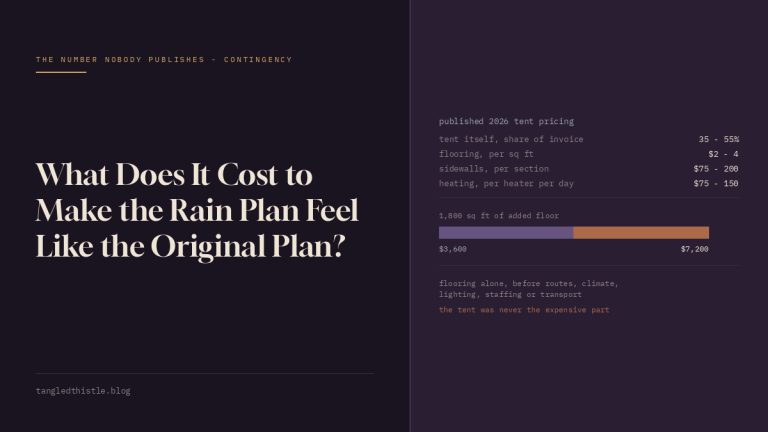
Tent & Party Rentals Directory’s 2026 guide says the tent structure itself may represent only about 35–55% of a typical tent invoice, with the rest coming from items such as sidewalls, flooring, lighting, climate, delivery, setup and permits. Its published planning range for a 100–150 guest full tent package is $3,000–$7,500, while flooring alone is listed around $2–$4 per square foot.
That is not a quote for your property. It is the warning label.
A 40-by-80 tent contains 3,200 square feet. If the design requires full flooring and your actual vendor quotes within that published flooring range, flooring alone becomes a $6,400–$12,800 line before anyone rents a chair.
Then ask whether the site is level. Ask whether the anchoring method the tent company needs is permitted. Ask whether trucks can reach the install point. Ask whether the floor needs to bridge grade changes. Ask whether drainage becomes your problem after rain.
This is why the striped-tent teardown matters. The visible shelter can conceal foundations, structural sequence, HVAC, flooring and site logistics. A tent is not a roof somebody dropped onto a party.
Bathrooms are not a footnote
If the house does not have event-scale restroom capacity, sanitation becomes its own rental system.
Stahla Services’ 2026 published pricing lists base event rates of $2,799 for a two-stall restroom trailer and $3,399 for a four-stall trailer, with larger and ADA configurations priced higher. Their current guide also discloses separate setup, pack-up and mileage charges.
Again: not your quote.
But it tells you why ‘we can rent a bathroom trailer’ is not a $300 miscellaneous line.
The trailer also needs somewhere appropriate to sit. It may need power, water or a water/waste solution. Guests need a lit, stable route to it. Accessible use needs to be solved deliberately. Service and pump access cannot be blocked by the pretty parking plan.
At a conventional venue, the bathrooms tend to be boring because they already exist.
Boring infrastructure is one of the great luxuries.
Power is whatever runs simultaneously, not whatever outlets exist in the house
A private home having electricity tells you almost nothing about whether the event has the power it requires.
Catering, refrigeration, coffee, band or DJ, production, decorative lighting, path lighting, climate equipment, restroom trailers and other systems may all have requirements. Those demands have to be collected and reviewed by the venue/property owner and appropriately qualified electrical or production professionals.
The planning work is making the demand visible. The longer piece on event power covers that layer.
If temporary generation is required, price the equipment, distribution, delivery, fuel, placement, weather protection and professional oversight required for the actual system. Do not put ‘generator: $500’ into the budget because a search result showed a small rental for that price and assume the electrical plan has now been completed.
The catering kitchen may be a tent behind the tent
A residential kitchen can be a wonderful place to make dinner for twelve.
It is not automatically a production kitchen for 150 people.
The caterer may need a temporary prep area, hot holding, cold holding, water, work tables, dish handling, handwashing, waste, service access, lighting and a path from production to guests that does not cross the dance floor.
Ask the caterer what the property changes in their quote.
That sentence is more useful than deciding in advance that ‘they can use the kitchen.’
The caterer is not a raccoon. Access to a house is not the same thing as a workable food-service environment.
Parking is cheap until the property cannot hold it
Count vehicles before designing parking.
Then count the road, driveway, turnaround, emergency access, neighbor impact, ground conditions, after-dark visibility and whether guests can safely reach the event from wherever the vehicles end up.
If the property cannot absorb the vehicle count, the budget may gain valet, off-site parking, shuttles, drivers, signage, lighting, attendants or traffic control appropriate to the event and local requirements.
Remote staging can also add hours to load-in even when the distance is short. The remote-staging calculation treats each transfer as a real production cycle rather than invisible travel.
The beautiful part of the property may be the least useful part operationally
The meadow is excellent at being a meadow.
It may be less excellent at receiving a box truck after rain.
The terrace may have the best view and the worst route from catering. The flat patch that fits the tent may be the exact place vehicles need to turn. The driveway may technically reach the house but not allow a rental truck and a florist van to pass each other.
Walk the site with the vendors whose work has the largest physical footprint.
Every awkward carry, shuttle cycle, extra install hour and additional crew member belongs in the cost conversation.
Distance masquerades as atmosphere until somebody has to carry eighty chairs through it.
Weather protection is not just buying a tent
The rain version still needs arrival, flooring, drainage, lighting, climate, service routes, restrooms, power and a room that can actually hold the people.
Your Rain Plan Is Not a Tent already makes the conceptual argument. The cost version is harsher: every part of Plan B that does not already exist has to be reserved, built, staffed or deliberately abandoned.
A property with a beautiful indoor fallback may save enormous money here.
A property with no meaningful fallback pushes weather protection into the base event, whether the forecast eventually behaves or not.
Do not forget the property after the guests leave
Strike is not the moment the band stops.
Tents come down. Flooring leaves. Rental trucks return. Restroom trailers need collection. Trash and recycling leave. Generator or temporary power equipment is removed. Florals and candles are cleared. The lawn may need restoration. The driveway may need protection or repair. The house has to become a house again.
If the property belongs to family, this is precisely when everybody becomes tempted to donate unpaid labor.
Do not make the bride’s uncle the waste-management plan because he owns gloves.
Price the exit.
A real comparison has two columns
For each property under consideration, build this comparison:
| Private property | Conventional venue |
|---|---|
| Property/site fee, if any | Venue fee |
| Temporary shelter/fallback | Included room + backup? |
| Flooring/site prep | Finished floor included? |
| Restrooms | Included? |
| Power/lighting | Existing service / house rules? |
| Kitchen/BOH | Existing catering support? |
| Parking/transport | Included parking / valet / access? |
| Setup/strike windows | Included hours / overtime? |
| Waste/site restoration | Included cleanup? |
| Labor/logistics premium | House labor / vendor restrictions? |
Only then compare totals.
The private property may absolutely win. Sometimes it wins by money. Sometimes by meaning. Sometimes the site gives the occasion something a ballroom cannot touch.
But let it win honestly.
What changes the number fastest
Utility availability. Real power, water and sanitation remove entire temporary systems.
Weather fallback. A usable existing building can be worth more than acres of pretty grass.
Vehicle access. The difference between ‘truck can unload beside the tent’ and ‘everything transfers from a staging point’ is labor and time.
Ground condition. Level, durable surfaces reduce flooring, protection and recovery complexity.
Setup and strike window. More time lets vendors sequence work normally. Compressed access often buys additional labor or equipment.
Guest count. More people change sanitation, parking, shelter, service, rentals and transport at the same time.
Before you call it the cheaper option
Price everything temporary the property needs in order to behave like a venue, and leave out the ordinary wedding spending you would do anywhere. Make the decision on local itemized quotes; the public 2026 pricing here shows the scale of each category, not your bill.
Then try to break it. Take away one existing utility, shorten the setup window or move truck access off-site, and reprice. If the total jumps, that dependency belongs near the top of the venue decision.
The venue fee is not the enemy
A private-property wedding can be extraordinary because the site is specific. It has history. It belongs to the family. It overlooks the right mountain. It lets the event stretch into a weekend rather than a six-hour rental window.
Those are excellent reasons.
‘Free venue’ is not one of them until the infrastructure proves it.
Price the venue you have to build. Compare it with the venue you could rent. Then decide whether the property is still worth it.
If the answer is yes, excellent.
Now you are paying for something on purpose.
Planning note: permit, occupancy, structural, fire/life-safety, accessibility, sanitation, electrical, alcohol, parking/traffic, noise, environmental and other requirements vary by property and jurisdiction. Confirm them with the property owner, venue/event professionals and appropriate qualified or official authorities.
Space Lab
Unknown is a useful answer.
A room record can hold measured, published, supplied, estimated and unknown facts without pretending they are equivalent. The unknowns become the questions worth carrying to the site visit.
It shows planning estimates as estimates and keeps legal occupancy, venue approval and other authority decisions outside the calculator.
The column
What It Costs
The money question answered structurally: what you are actually buying, what drives the number up, and what can be cut without losing the idea. Cost models, not price lists.
Field notes and corrections
When a number here turns out to be wrong, you hear about it.
Three things arrive and nothing else. The new field note — bar rates, cover widths, service clearances, the arithmetic worked through on one real evening. And a correction whenever a rule in the published rulebook changes, or a number the tools rely on turns out to have been wrong. There is no weekly slot, because there is nothing weekly to put in it.
One email per field note, plus corrections when a published figure moves. Unsubscribe from any of them.
Continue through the system
Pretty is still not a plan.
A party gets planned in roughly this order. Pick the chapter where your next problem lives.
What you have to decide next
One decision constrains the next. This is the order they actually happen in.
More in this chapter


See the complete five-chapter Event Design Intelligence map →