Production & Hosting
The Ceremony Flip Is a Risky Little Machine
Twenty minutes, a hundred guests, and every object in the room needing a new home. The ceremony flip only works when someone has planned all of it.
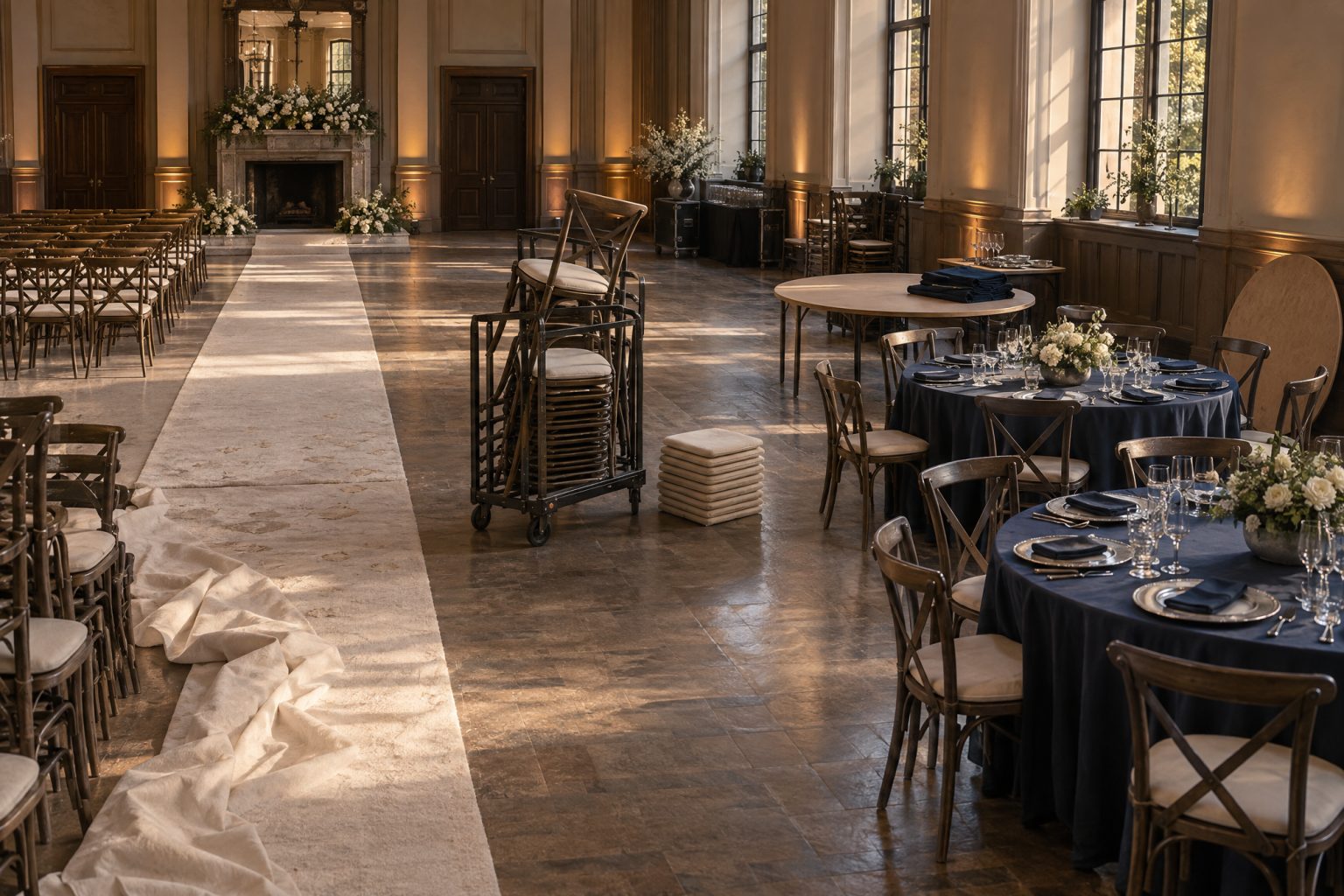
A ceremony flip is basically a temporary production company operating inside a room guests still expect to feel like magic.
Furniture, floral, sound, cleaning, service, and a hundred guests moving somewhere all compete for the same twenty minutes. It works when every object has a destination and every team has a lane, and it falls apart the instant one of those is missing.
Write the move list object by object
Guest chairs, the floral structure, sound equipment and service stations each need a from, a to, an owner, and a dependency. Chairs can’t move until guests are fully released. The floral piece can’t relocate until there’s a safe route for it. Skip the dependency and you get a very expensive collision.
Give everything a temporary home, not just a destination
Before the flip starts, mark exactly where chairs, cases, waste, and carts wait. Hallways, accessible routes, and fire exits are not temporary storage, no matter how tempting they look at that exact moment.
Design where guests actually go while it’s happening
The whole group needs somewhere comfortable, with seating and restrooms, that can absorb timing running long. A cocktail hour is not a holding plan if the room can’t actually carry the full guest count.
Put one person in charge of the whole flip
Furniture, design, technical and catering teams all report readiness to one director. That person controls entry order, sequence, and the final decision to release the room. Not a committee. One person.
Decide the bare-minimum version first
What has to move for capacity and safety, and what’s the one central visual change that actually matters. If time gets tight, secondary decor and nonessential furniture leave the sequence first, not last.
Rehearse it with actual carts and actual people
Time the real service routes, elevator cycles, chair stacks. Add a blocked corridor on purpose. The rehearsal’s whole job is to reveal which task becomes the bottleneck before it becomes one for real.
The flip ends when the routes are clear, the lighting’s set, service is ready, and one person has actually walked the room and signed off. The clock running out is not the same thing as done.
Atmosphere OS · Arc Studio
Every event has a turn. Most plans do not know where theirs is.
Arc Studio places the peak, then arranges load-in, service and the close around it and hands you the run sheet. It is a planning document rather than a venue-compliance one, and it draws that line for you.
The rulebook is public. Every formula it runs on is written down where you can disagree with it.
Field notes and corrections
When a number here turns out to be wrong, you hear about it.
Three things arrive and nothing else. The new field note — bar rates, cover widths, service clearances, the arithmetic worked through on one real evening. And a correction whenever a rule in the published rulebook changes, or a number the tools rely on turns out to have been wrong. There is no weekly slot, because there is nothing weekly to put in it.
One email per field note, plus corrections when a published figure moves. Unsubscribe from any of them.
Continue through the system
Pretty is still not a plan.
A party gets planned in roughly this order. Pick the chapter where your next problem lives.
What you have to decide next
One decision constrains the next. This is the order they actually happen in.
More in this chapter



See the complete five-chapter Event Design Intelligence map →