Space & Venue Reality
Wind Is a Design Constraint
Wind finds the one thing nobody weighed down. It is not a styling nuisance — it touches comfort, sound, flame, service and structures at once.
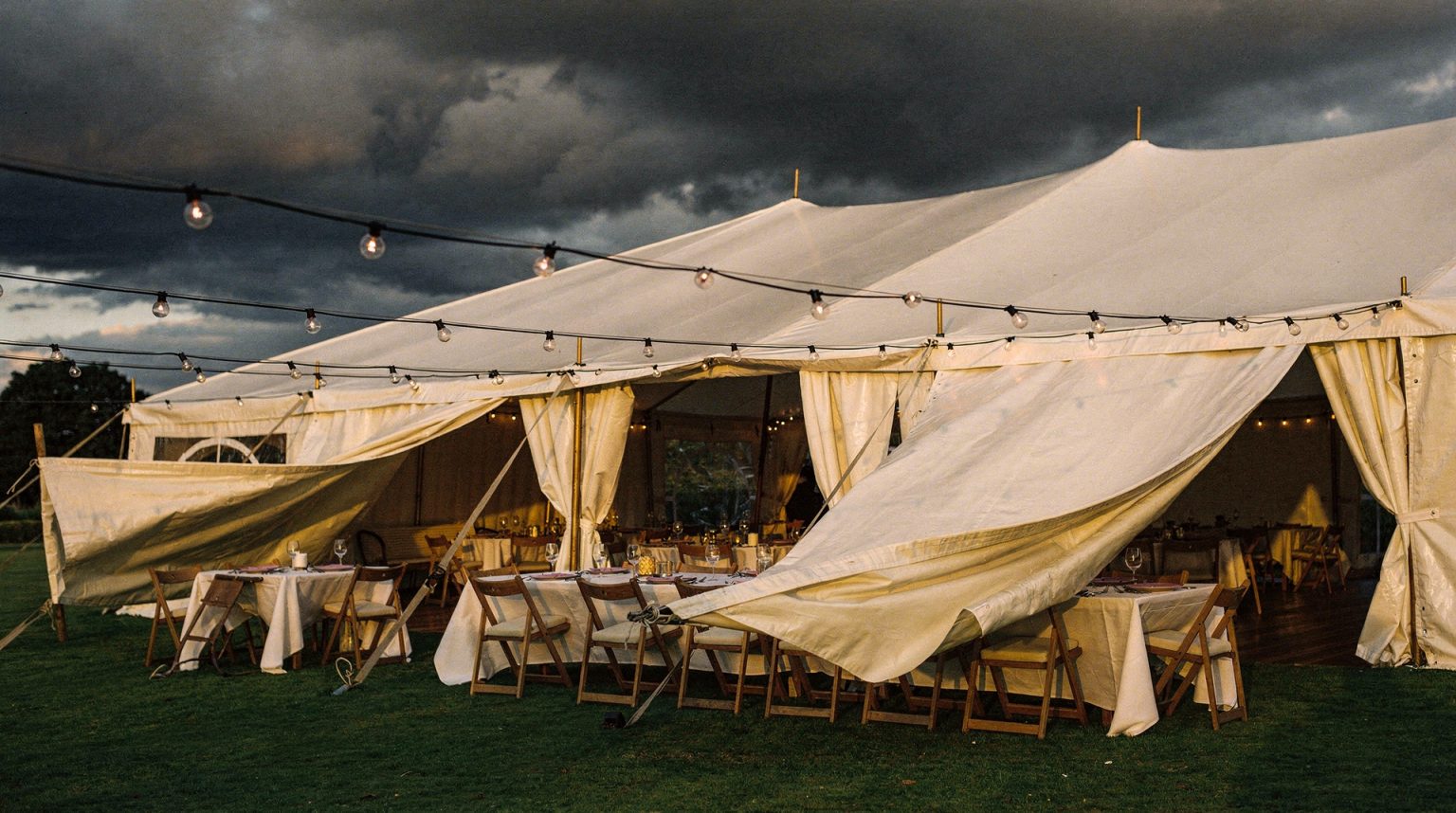
Wind will find the one thing nobody weighed down.
Menus lift. Napkins unfold themselves. The tall flowers begin swaying like they have opinions. Candles struggle. The microphone can hear the air. Everyone holds their hair through the entire ceremony. And a lightweight sign becomes a physics lesson nobody requested.
Outdoors, wind is not a decorative inconvenience. It is a condition that reaches into guest comfort, material behavior, sound, service, temporary structures, and the moment at which the preferred version of the event stops being the right one. For the object-by-object version, menus and napkins included, carry on to The Outdoor Party Versus the Wind.
One site can have four different wind conditions
Buildings, walls, trees, open water, elevation, courtyards and the shape of the surrounding land all conspire. Two areas fifty feet apart can behave completely differently.
Walk the actual guest and vendor areas with the venue team and note the exposed edges, the sheltered pockets, the corners where air picks up speed, and the routes that stop being pleasant the moment the weather turns.
Use current forecast information close to the date, and let the venue and qualified professionals own the consequential wind and structural decisions. A historical average and one calm site visit are not evidence about the day you are actually having.
Start with the lightest thing on the table
Place cards, menus, programs, cocktail napkins, paper signs, loose petals, ribbon, disposable décor, anything small enough to travel.
Build security into the object rather than expecting staff to spend the evening resetting it. A menu can tuck under a napkin. A table number can have a heavier base. Paper can be reduced wherever it is not doing essential work.
And decorative scatter that only holds in still air is simply the wrong material for this site. Nobody executed it badly. It was never going to work here. Choosing outdoor material is a question of how the thing behaves once conditions get involved.
Movement is beautiful right up until it is not
Grasses, foliage, branches and loose floral lines make an outdoor design feel alive in a way no interior arrangement manages. That is a real argument for wind.
The trouble starts when the movement begins affecting stability, guest contact, candles, food service or structural safety.
Give the florist the real site conditions: exposure, install time, how close guests will be, what the venue permits. Mechanics and ballast for consequential pieces belong to qualified floral or structural professionals. Design for graceful movement where you can, and get fragile projections away from anywhere a guest or a server has to pass.
Treat flame as conditional until somebody says otherwise in writing
Wind and open flame is a terrible place to be making assumptions.
Confirm the venue’s current policy, which candle or flame systems are permitted, what enclosures or clearances are required, who maintains them, and the conditions under which flame gets extinguished or never lit at all.
If the atmosphere depends on low moving light, develop the approved non-flame version from the start rather than in a panic. Small lamps, reflected light, pinspots and well-chosen battery systems can hold the mood — as long as they were designed in, not substituted at seven o’clock.
Long linen has ambitions
It lifts. It billows. Lightweight lounge cushions migrate across a terrace with real determination. Draping, umbrellas, screens and temporary fabric installations all carry structural or operational requirements.
A romantic textile treatment that keeps wandering into the service route becomes the single least subtle moving part of the event.
Test loose fabric under realistic conditions, and use venue-approved, professionally specified methods anywhere attachment or structural loads are involved. Often the right edit is shorter linen, heavier cloth, fewer loose layers, or moving the strongest textile idea somewhere sheltered.
Test the sound where the speaking happens
Outdoor sound is already working without reflective boundaries. Add wind and environmental noise and speech gets genuinely hard to manage — especially when the microphone and speaker positions were chosen for the view rather than for the listening area.
Qualified audio professionals determine the system, the microphone protection, the coverage, the power and the operating limits. The planning job is making sure the proposed ceremony, stage or speech position gets tested instead of assumed.
The table can be perfectly fine while the guests are not
Wind changes perceived temperature, makes conversation an effort, disrupts hair and clothing, carries dust, and turns a beautiful exposed spot into somewhere tiring within about twenty minutes.
Provide protected seating or a sheltered gathering area where the venue allows it. Think about what wind does to older guests, to children, to formal clothing, to hearing, and to anyone who needs steadier footing or a calmer route.
The most photogenic overlook does not have to host the longest stationary segment of the evening. It can host the shortest one and be remembered better for it. Wind belongs on the same list as heat, noise and nowhere to sit down.
Everything needs two hands now
Bars, tray service, glassware, paper goods, linens, open food displays and waste handling all behave differently in wind. Coordinate with catering and the venue on how food and drink are protected and served in the real conditions.
Keep service routes as sheltered and as direct as you can manage. A server carrying a full tray should not also be expected to chase menus down the lawn.
The most photogenic overlook does not have to host the longest stationary segment of the evening.
Temporary structures have thresholds, and they are not yours
Tents, canopies, umbrellas, arches, freestanding walls, rigged décor, signage and staging all carry wind-related limits and specific anchoring, ballast, engineering, permit, inspection or operating requirements.
Those calls belong to the venue, qualified installers, engineers where required, and official authorities. Not to a design preference, however strongly felt.
What the design team needs to know is who owns the threshold and what the event does if the structure has to come down, or never goes up.
Count how much of the concept needs calm air
If the honest answer is every menu, every candle, every floral installation, all the drape, the signage and the ceremony position, then the event is carrying far too much weather sensitivity for one afternoon.
Take some of those dependencies out in advance. Heavier or secured paper systems. Protected lighting. Lower centers of gravity in the flowers. Fewer loose fabrics. A backup program position. The visual effect survives; the number of things depending on the wind’s cooperation drops.
Know when outdoors stops being the hospitable option
Set the process for changing, shortening or moving the event before guests are anywhere near the property.
Safety thresholds and temporary-structure limits belong to the venue and to qualified or official authorities. Hospitality can justify an earlier move whenever conditions make conversation, seating, temperature or normal use of the space unreasonably hard.
And the alternate plan should already know where guests go, how sound and service travel, which décor comes along, and which outdoor elements are being cheerfully abandoned. That is a second event, designed on purpose, not a tent held in reserve.
The wind walk
- What paper or lightweight objects can move?
- Which flowers, fabrics or scenic pieces are exposed?
- What happens to flame and low lighting?
- Can the speeches still be heard?
- Where can guests get out of it?
- How does service change?
- Which temporary structures have professional wind limits?
- Who has the authority to change the version of the event?
Wind is the only thing here that will edit your event for you, and it does not consult the plan.
Air that refuses to be decorative
Outdoor atmosphere is compelling precisely because the environment is alive. Wind brings movement, temperature, sound and a sense of place that no indoor room can manufacture at any price.
It simply will not agree to work as a styling assistant.
Choose materials that tolerate movement, protect the guests and the service, let qualified people own the structural and safety limits, and build the second version before the forecast demands one. Then the air stays part of the magic instead of quietly taking over as event manager.
Space Lab
The floor plan is a drawing. The license is a fact.
Start with the event you are actually planning and test the room against it. Space Lab does not claim that a date is free, a price is current or a license is valid; those remain direct-confirmation questions outside the room model.
It shows planning estimates as estimates and keeps legal occupancy, venue approval and other authority decisions outside the calculator.
Field notes and corrections
When a number here turns out to be wrong, you hear about it.
Three things arrive and nothing else. The new field note — bar rates, cover widths, service clearances, the arithmetic worked through on one real evening. A line when a World opens, because a night only goes up once it can actually be thrown. And a correction whenever a rule in the published rulebook changes, or a number the tools rely on turns out to have been wrong. There is no weekly slot, because there is nothing weekly to put in it.
One email per field note or opening, plus corrections when a published figure moves. Unsubscribe from any of them.
Continue through the system
Pretty is still not a plan.
A party gets planned in roughly this order. Pick the chapter where your next problem lives.
What you have to decide next
One decision constrains the next. This is the order they actually happen in.
More in this chapter
See the complete five-chapter Event Design Intelligence map →